
Case Summary: Aruna Shanbaug v. Union of India
In short
Deciding the plea of Aruna Shanbaug — a KEM Hospital nurse left in a permanent vegetative state by a 1973 assault — the Supreme Court (Katju and Gyan Sudha Misra JJ., 7 March 2011) drew a line between active euthanasia (unlawful) and passive euthanasia (withdrawal of life support), and permitted the latter for PVS patients under High Court supervision and a doctors' committee until Parliament legislated. It refused euthanasia for Aruna herself, holding the KEM nurses who cared for her were her real next friends. Common Cause v. Union of India (2018) later recognised the right to die with dignity under Article 21 and legalised living wills; the Supreme Court simplified that procedure in 2023.
In this brief
- Introduction
- Background of the Case
- Aruna Shanbaug's Tragic Story
- The Legal Context
- The Petition
- The Supreme Court's Judgment
- The Verdict on Passive Euthanasia
- Why Aruna's Own Plea Was Refused
- Legal Evolution After Aruna Shanbaug
- From Gian Kaur to Common Cause
- The 2023 Simplification
- Aftermath and a Note on Suicide Law
- Conclusion
Introduction
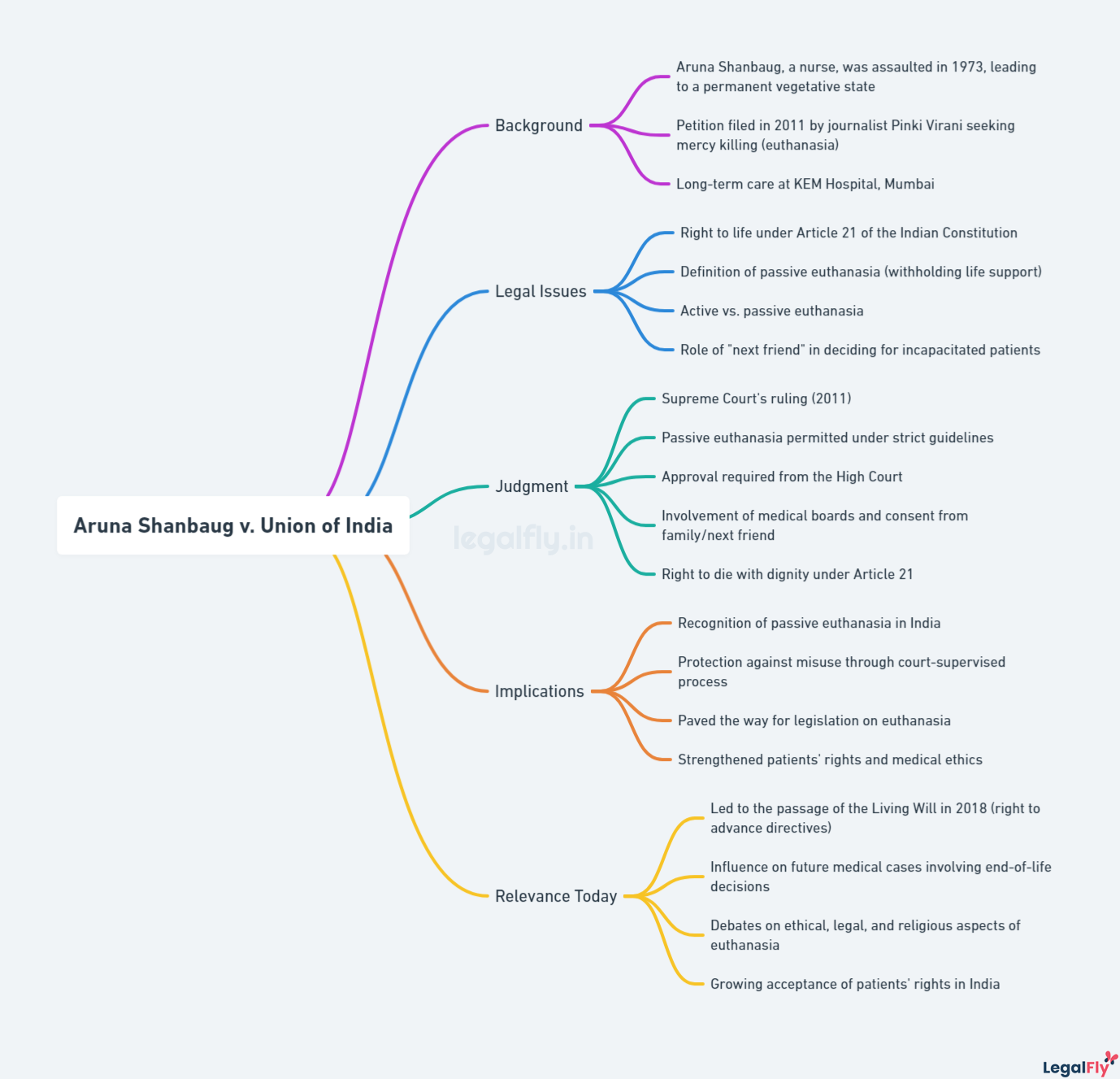
Aruna Ramchandra Shanbaug v. Union of India (2011) is the judgment that first made passive euthanasia lawful in India. Deciding the case of a nurse who had spent decades in a permanent vegetative state after a brutal assault, the Supreme Court drew a careful line between actively ending a life and withdrawing the life support that artificially sustains one — permitting the latter, under strict safeguards, while refusing it in Aruna's own case.
| Element | Detail |
|---|---|
| Case | Aruna Ramchandra Shanbaug v. Union of India & Ors. |
| Citation | (2011) 4 SCC 454; AIR 2011 SC 1290 |
| Court / Bench | Supreme Court of India — Markandey Katju & Gyan Sudha Misra JJ. (opinion by Katju J.) |
| Decided | 7 March 2011 |
| Held | Passive euthanasia permitted for PVS patients with High Court approval; Aruna's own plea refused |
Background of the Case
Aruna Shanbaug's Tragic Story
Aruna Ramchandra Shanbaug was a young nurse at the King Edward Memorial (KEM) Hospital in Parel, Bombay. On 27 November 1973, a ward attendant, Sohanlal Bhartha Walmiki, attacked her — strangling her with a dog chain and sexually assaulting her. The strangulation cut off oxygen to her brain, causing severe and irreversible cortical damage and leaving her in a permanent vegetative state (PVS). (Because the assault was sodomy, the assailant was convicted of assault and robbery and served only seven years; he was never tried for rape.)
For the next four decades Aruna was cared for, devotedly, by the nurses and staff of KEM Hospital. By the time her case reached the Supreme Court in 2011 she had been in this state for roughly 37 years; she finally died of pneumonia in May 2015, having spent some 42 years in the hospital.
The Legal Context
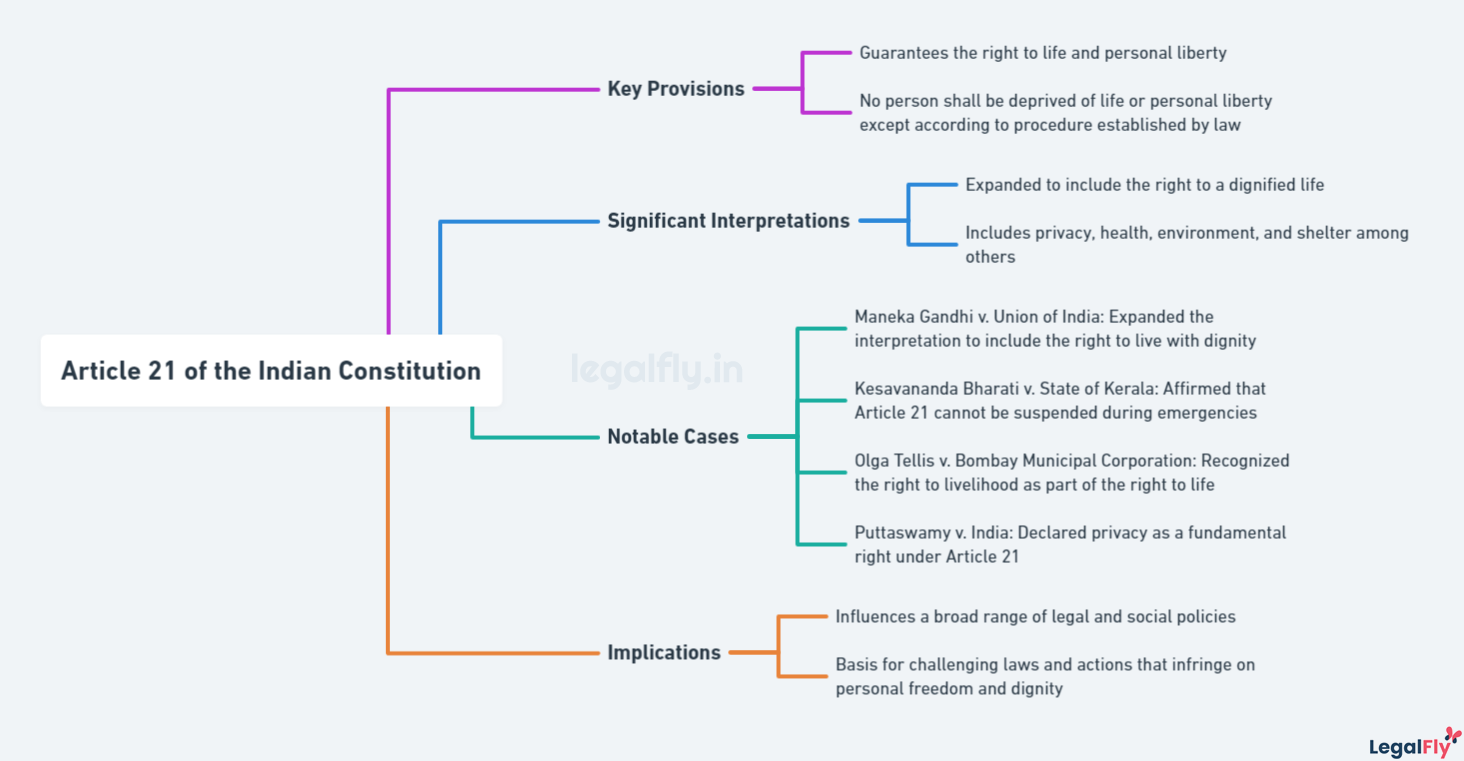
Before this case, the law on the "right to die" was set by two decisions. In P. Rathinam v. Union of India (1994) the Court had struck down Section 309 IPC (attempt to suicide) as unconstitutional; but in Gian Kaur v. State of Punjab (1996) a five-judge bench overruled it, holding that the right to life under Article 21 does not include a right to die. Whether that bar also forbade the withdrawal of life support from a terminally incapacitated patient was the open question Aruna's case raised.
The Petition
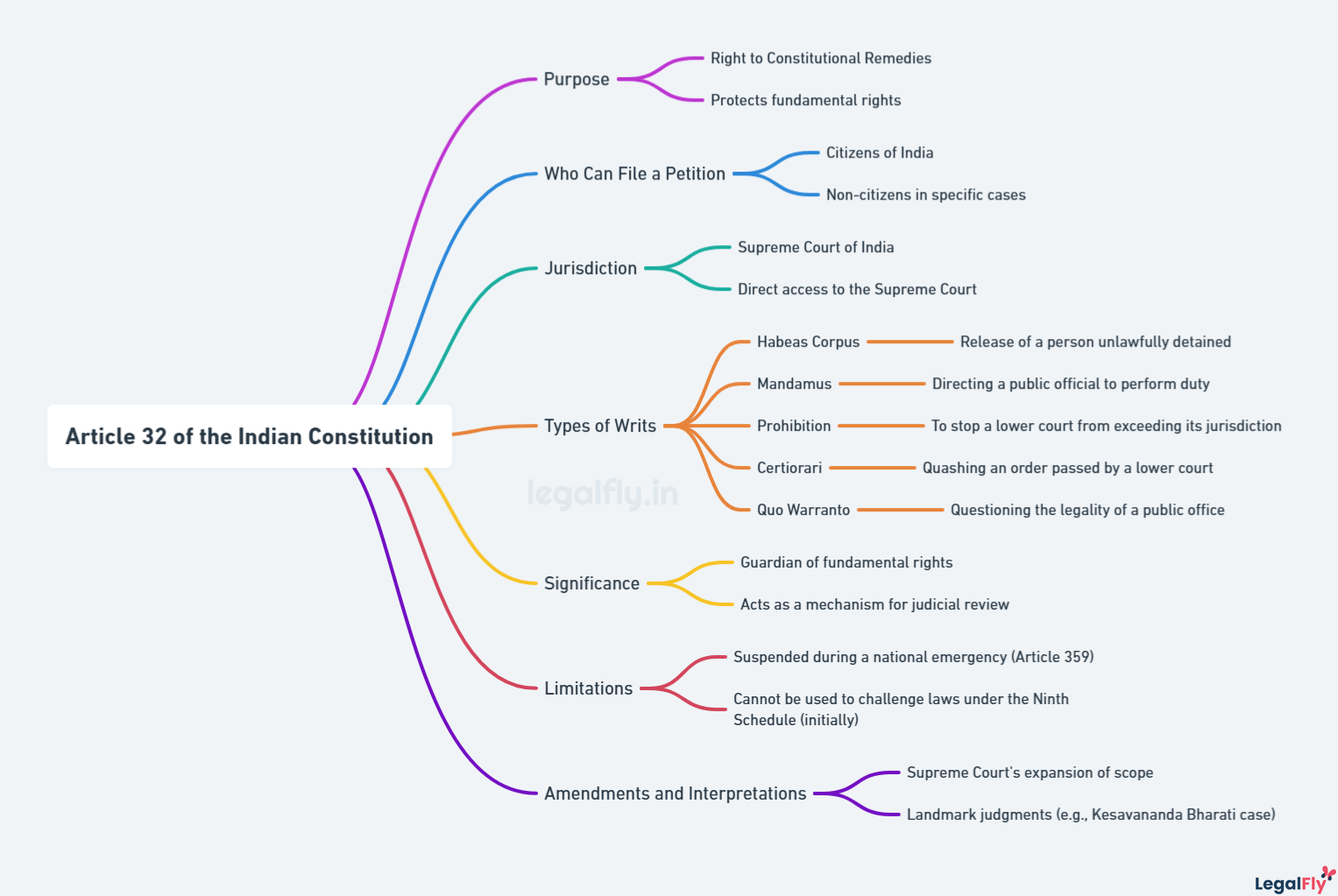
The petition was filed under Article 32 by the journalist Pinki Virani, claiming to act as Aruna's "next friend," asking the Court to allow the withdrawal of life support so that Aruna could die with dignity. The dean and staff of KEM Hospital strongly opposed the plea, insisting that they had cared for Aruna for decades and wished to continue. This conflict — over who could speak for a person unable to speak for herself — became central to the outcome.
The Supreme Court's Judgment
The Verdict on Passive Euthanasia
The bench of Justices Markandey Katju and Gyan Sudha Misra (this was a two-judge bench, not a Chief Justice's bench) distinguished two forms of euthanasia and treated them very differently:
| Form | What it means | Status after Aruna Shanbaug |
|---|---|---|
| Active euthanasia | A positive act (e.g. a lethal injection) to end life | Unlawful — amounts to a crime |
| Passive euthanasia | Withholding or withdrawing life-sustaining treatment | Permitted for PVS/terminal patients, under safeguards |
The Court held that passive euthanasia could be allowed for a patient in a permanent vegetative state, but only with High Court approval under Article 226: the High Court, acting parens patriae, must constitute a committee of three doctors to examine the patient and must hear the close relatives, the State and the carers before deciding in the patient's best interests. These guidelines were to hold the field until Parliament enacted a law.
Why Aruna's Own Plea Was Refused
Crucially, the Court declined to permit euthanasia for Aruna herself. It held that Pinki Virani, however well-intentioned, was not Aruna's true "next friend" — that role belonged to the KEM Hospital nurses who had devotedly cared for her for decades and who wished to continue. Since her real surrogates did not want life support withdrawn (and she was being kept alive by feeding, not a ventilator), withdrawal was not in her best interests. Aruna therefore lived on at KEM until her natural death in 2015.
Legal Evolution After Aruna Shanbaug
From Gian Kaur to Common Cause
Aruna Shanbaug was a turning point, but not the last word. In Common Cause v. Union of India (2018), a five-judge Constitution Bench went further: it held that the right to die with dignity is a fundamental right under Article 21, formally legalised passive euthanasia, and for the first time recognised the "living will" (advance medical directive) — a document by which a person can record, in advance, a refusal of life-prolonging treatment.
| Case | Year | Contribution |
|---|---|---|
| P. Rathinam | 1994 | Struck down §309 IPC (attempt to suicide) |
| Gian Kaur | 1996 | Overruled P. Rathinam — Art 21 does not include a right to die |
| Aruna Shanbaug | 2011 | Permitted passive euthanasia for PVS patients via High Court |
| Common Cause | 2018 | Right to die with dignity = Art 21; recognised the living will |
The 2023 Simplification
The 2018 procedure for living wills proved unworkably cumbersome — it required attestation before a judicial magistrate and layers of approval. In January 2023, the Supreme Court modified those guidelines: a living will can now be attested by a notary or gazetted officer instead of a magistrate, and decisions on withdrawing treatment are taken by a primary and a secondary medical board within fixed timelines. This made the right to die with dignity practically accessible for the first time.
Aftermath and a Note on Suicide Law
Aruna Shanbaug reshaped Indian thinking on end-of-life care, separating the genuinely contested question (passive euthanasia) from the criminal act of actively killing. Its concern for the autonomy and dignity of the dying also runs alongside the modern softening of suicide law: Section 309 IPC (attempt to suicide) has been all but neutralised by Section 115 of the Mental Healthcare Act, 2017 (which presumes severe stress and bars punishment), and the new Bharatiya Nyaya Sanhita, 2023 contains no general offence of attempting suicide.
Conclusion
Aruna Shanbaug v. Union of India gave India its first legal framework for dying with dignity, while showing characteristic caution — permitting passive euthanasia in principle yet refusing it for the very patient whose suffering prompted the case, out of deference to those who actually cared for her. Built upon by Common Cause (2018) and refined in 2023, it remains the foundation of euthanasia law in India and a landmark in the constitutional understanding of Article 21.