
Carlill v Carbolic Smoke Ball Co [1893] 1 QB 256
![Carlill v Carbolic Smoke Ball Co [1893] 1 QB 256](/wp-content/uploads/2024/08/Carlill-v.-Carbolic-Smoke-Ball-Co.webp)
In short
The Carbolic Smoke Ball Co advertised a £100 reward to anyone who used their product and still caught influenza. Mrs. Carlill did — and the Court of Appeal held that the advertisement was a binding unilateral contract and she was entitled to the £100.
In this brief
- Overview
- Key Facts at a Glance
- Background
- Procedural History
- The Company's Arguments — and Why Each Failed
- The Judgment
- Legal Principles Established
- 1. Unilateral Contracts
- 2. Advertisement as Offer
- 3. Acceptance by Performance
- 4. Consideration as Detriment
- Position under Indian Contract Law
- Significance and Legacy
- Conclusion
Overview
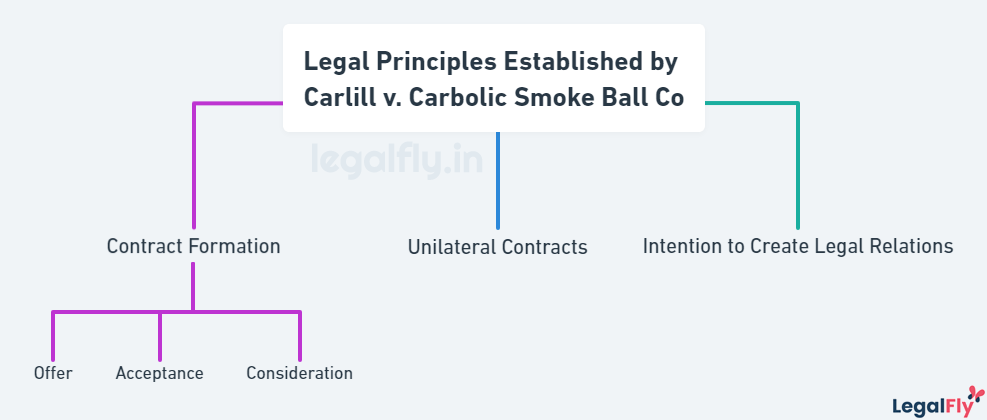
Carlill v Carbolic Smoke Ball Co [1893] 1 QB 256 is one of the most-cited cases in the common law world. Decided by the Court of Appeal of England and Wales (Lindley LJ, Bowen LJ, and A.L. Smith LJ), it established three principles that underpin modern contract law: an advertisement can be a binding offer; a unilateral contract is accepted by performance, without prior notice; and the offeree's detriment in performing the stipulated act constitutes good consideration.
Key Facts at a Glance
| Detail | Particulars |
|---|---|
| Full citation | [1893] 1 QB 256 |
| Court | Court of Appeal (England & Wales) |
| Judges | Lindley LJ, Bowen LJ, A.L. Smith LJ |
| First instance | Queen's Bench Division — Hawkins J (found for plaintiff) |
| Date of CA judgment | 7 December 1892; reported 1893 |
| Plaintiff / Respondent on appeal | Mrs. Jane Louisa Carlill |
| Defendant / Appellant on appeal | Carbolic Smoke Ball Co |
| Amount claimed | £100 (the reward promised in the advertisement) |
| Outcome | Appeal dismissed — plaintiff entitled to £100 |
Background
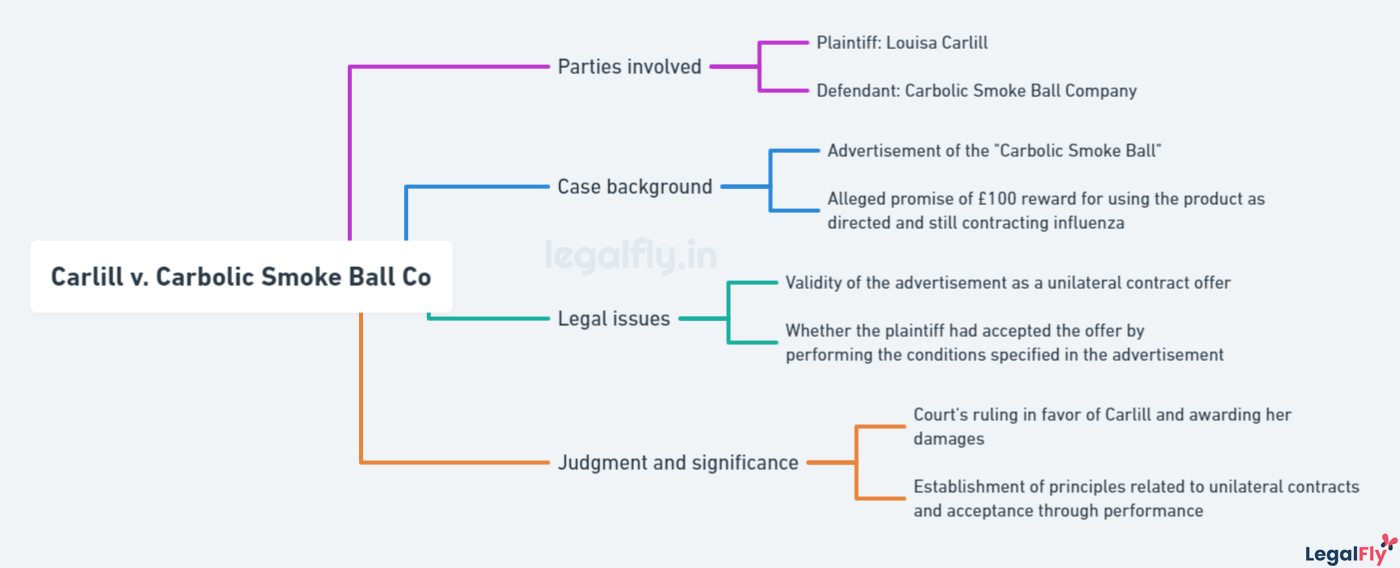
The Carbolic Smoke Ball Company was incorporated in London in 1889 by Frederick Roe. Its flagship product was the "carbolic smoke ball" — a small rubber ball filled with carbolic acid powder. Users squeezed the ball to inhale the vapour through a glass tube inserted into each nostril, with the claimed effect of disinfecting the nasal passages and warding off influenza.
In November 1891, during a widespread influenza epidemic, the company placed advertisements in the Pall Mall Gazette and other London newspapers. The advertisement read (in material part):
"£100 reward will be paid by the Carbolic Smoke Ball Company to any person who contracts the increasing epidemic influenza, colds, or any disease caused by taking cold, after having used the ball three times daily for two weeks according to the printed directions supplied with each ball. £1,000 is deposited with the Alliance Bank, Regent Street, showing our sincerity in the matter."
Mrs. Jane Louisa Carlill — wife of a solicitor, Frederick Carlill — read the advertisement and purchased a smoke ball from a chemist. She used it three times daily from 20 November 1891. On 17 January 1892 — well within the two-week period — she contracted influenza. She wrote to the company claiming the £100 reward. The company refused to pay.
Procedural History
Mrs. Carlill sued in the Queen's Bench Division. Hawkins J found in her favour, holding that the advertisement was a definite offer, that she had accepted it by using the product as directed, and that she had provided good consideration. The company appealed to the Court of Appeal.
The Company's Arguments — and Why Each Failed
| Argument by Carbolic Smoke Ball Co | Court of Appeal's response |
|---|---|
| 1. Mere puff / too vague to be an offer — The advertisement was sales exaggeration with no intention to create legal relations; the terms were too uncertain to be binding. | Rejected. The specific sum of £100 and the deposit of £1,000 in the Alliance Bank demonstrated a genuine, serious intention to be bound. A reasonable person reading the ad would understand it as a definite promise, not mere boasting. (Lindley LJ) |
| 2. An offer cannot be made to the whole world — A valid offer must be addressed to an identified person or persons; an advertisement addressed to "the public" cannot constitute a legal offer. | Rejected. An offer may be made to the world at large. It becomes a contract with each individual who comes forward and performs the specified conditions. (Lindley LJ: "Why should not an offer be made to all the world which is to ripen into a contract with anybody who comes forward and performs the condition?") |
| 3. No notification of acceptance — Even if the ad was an offer, Mrs. Carlill never communicated her acceptance to the company before using the product, so no contract was formed. | Rejected. In a unilateral contract, the offeror implicitly waives the need for prior notification of acceptance; performance of the stipulated act is itself the acceptance. (Bowen LJ) |
| 4. No consideration — Mrs. Carlill gave nothing of value; merely buying a product from a third party (the chemist) or using it could not be consideration moving to the company. | Rejected. The inconvenience of using the smoke ball as directed — and, on the evidence, the potential health risk — was sufficient detriment to the promisee to constitute good consideration. There was also a benefit to the company in increased sales. (A.L. Smith LJ) |
The Judgment
All three judges dismissed the company's appeal in separate concurring judgments.
Lindley LJ held that the advertisement was a definite promise made with serious intent, evidenced by the £1,000 deposited in the Alliance Bank. The language was not mere puffery. An offer to the world at large is perfectly valid in law; it ripens into a contract when anyone performs the stipulated conditions. Mrs. Carlill had performed those conditions.
Bowen LJ delivered perhaps the most influential judgment. He reasoned that the ad was an offer, not an invitation to treat, because it contained specific terms and a definite reward. On notification of acceptance, he held that in a unilateral contract the offeror dispenses with the need for advance notice — performance of the act is acceptance. On consideration, using the ball as directed was a sufficient act of detriment.
A.L. Smith LJ agreed. He emphasised that consideration need not be a direct benefit to the promisor; a detriment to the promisee is equally sufficient. The act of purchasing and using the smoke ball — at some inconvenience and health risk — was good consideration.
Legal Principles Established
1. Unilateral Contracts
A unilateral contract involves a promise made by one party (the offeror) in exchange for an act by the other (the offeree). Unlike a bilateral contract, no counter-promise is needed — only performance of the specified act. Carlill confirmed that such contracts are fully enforceable: the offeror cannot revoke once the offeree has begun performing the act.
2. Advertisement as Offer
Advertisements are ordinarily treated as invitations to treat (Partridge v Crittenden [1968] 1 WLR 1204). Carlill is the established exception: where an advertisement contains a specific promise with certain terms, directed at anyone who performs the stipulated act, it is a valid offer to the world. The court looks for an objective intention to be bound.
3. Acceptance by Performance
In a unilateral contract, acceptance occurs when the offeree fully performs the act requested. There is no obligation to communicate acceptance in advance. The act of performing is the acceptance.
4. Consideration as Detriment
Consideration does not require a direct monetary benefit to the promisor. Detriment to the promisee — here, the inconvenience and risk of inhaling carbolic acid vapour daily — is sufficient. This confirmed the classic rule from Currie v Misa (1875): consideration is either some right, interest, profit or benefit accruing to one party, or some forbearance, detriment, loss or responsibility given by the other.
Position under Indian Contract Law
Carlill is routinely applied in Indian courts and taught as foundational contract law in Indian law schools. The Indian Contract Act 1872 provides the statutory framework that maps onto the principles the case established:
- Section 2(a) — Proposal (Offer): "When one person signifies to another his willingness to do or to abstain from doing anything, with a view to obtaining the assent of that other to such act or abstinence, he is said to make a proposal." The Carbolic Smoke Ball advertisement satisfies this definition — it signified a willingness to pay £100 on a specific condition.
- Section 2(b) — Acceptance: "When the person to whom the proposal is made signifies his assent thereto, the proposal is said to be accepted." Under Indian law, as in Carlill, acceptance of a unilateral proposal occurs through conduct (performance), not necessarily through express communication.
- Section 2(d) — Consideration: "When, at the desire of the promisor, the promisee… does or abstains from doing… any act or abstinence… such act or abstinence or promise is called consideration." Mrs. Carlill's act of using the smoke ball — done at the desire of the promisor — would satisfy this definition squarely.
- Section 8 — Acceptance by performance: "Performance of the conditions of a proposal, or the acceptance of any consideration for a reciprocal promise which may be offered with a proposal, is an acceptance of the proposal." This provision directly codifies the Carlill principle for Indian law.
Indian courts have cited Carlill in disputes involving reward advertisements, loyalty programme terms, and promotional offer disputes. The case is studied under the Indian Contract Act in all major law schools and features in the syllabus of the Bar Council of India's LL.B. curriculum.
Significance and Legacy
Carlill has remained good law for over 130 years. Its significance extends beyond the curious Victorian facts:
- Consumer protection: The case established that companies cannot make promotional promises and then disclaim them as puffery when customers take them up. This principle underpins modern consumer protection legislation in the UK (Consumer Rights Act 2015) and equivalent Indian legislation (Consumer Protection Act 2019).
- Online offers and e-commerce: "Click-to-accept" terms, promotional codes, reward programmes, and cashback offers are all analysed through the Carlill framework — is the advertisement sufficiently definite to constitute an offer? Does clicking/purchasing constitute acceptance by performance?
- Medical and pharmaceutical advertising: The case is a reminder that efficacy claims in advertising, if specific enough, can create contractual liability — a principle that resonates in an era of health-product marketing.
Conclusion
Carlill v Carbolic Smoke Ball Co resolved a simple Victorian contract dispute and, in doing so, built the scaffolding for modern unilateral contract theory. The Court of Appeal unanimously held that a specific, sincere advertisement is a binding offer; that performance of the stipulated act is acceptance; and that detriment to the promisee is good consideration. Mrs. Carlill's £100 was a small sum — but the principles it generated have shaped contract law across the common law world, and continue to apply wherever a company makes a promise to the public.