
Case Summary: Employment Division v. Smith

In short
Two counsellors, members of the Native American Church, were fired and denied unemployment benefits in Oregon for ingesting peyote in a religious ceremony. The Supreme Court held 6-3 (Scalia J.) that the Free Exercise Clause does not exempt religious believers from a neutral, generally applicable law, so Oregon's drug ban applied — sidelining the Sherbert "compelling interest" test (which the Court confined to unemployment cases and "hybrid" rights). O'Connor J. concurred only in the result, and Blackmun, Brennan and Marshall dissented. Congress responded with RFRA (1993), which City of Boerne v. Flores (1997) limited to the federal government; the 1994 amendment to the American Indian Religious Freedom Act legalised sacramental peyote; and Fulton v. Philadelphia (2021) narrowed Smith without overruling it.
In this brief
Introduction
Employment Division, Department of Human Resources of Oregon v. Smith (1990) is one of the most consequential — and contested — religious-liberty decisions in American law. The Supreme Court held that the Free Exercise Clause of the First Amendment does not entitle a person to an exemption from a neutral law of general applicability, even when that law burdens a sincere religious practice. The practice here was the sacramental use of peyote in the Native American Church.
| Element | Detail |
|---|---|
| Case | Employment Division v. Smith |
| Citation | 494 U.S. 872 (1990) |
| Court | Supreme Court of the United States |
| Vote | 6-3; majority opinion by Justice Antonin Scalia |
| Holding | Neutral, generally applicable laws do not violate the Free Exercise Clause even if they burden religion |
Background of the Case
The Petitioners: Smith and Black
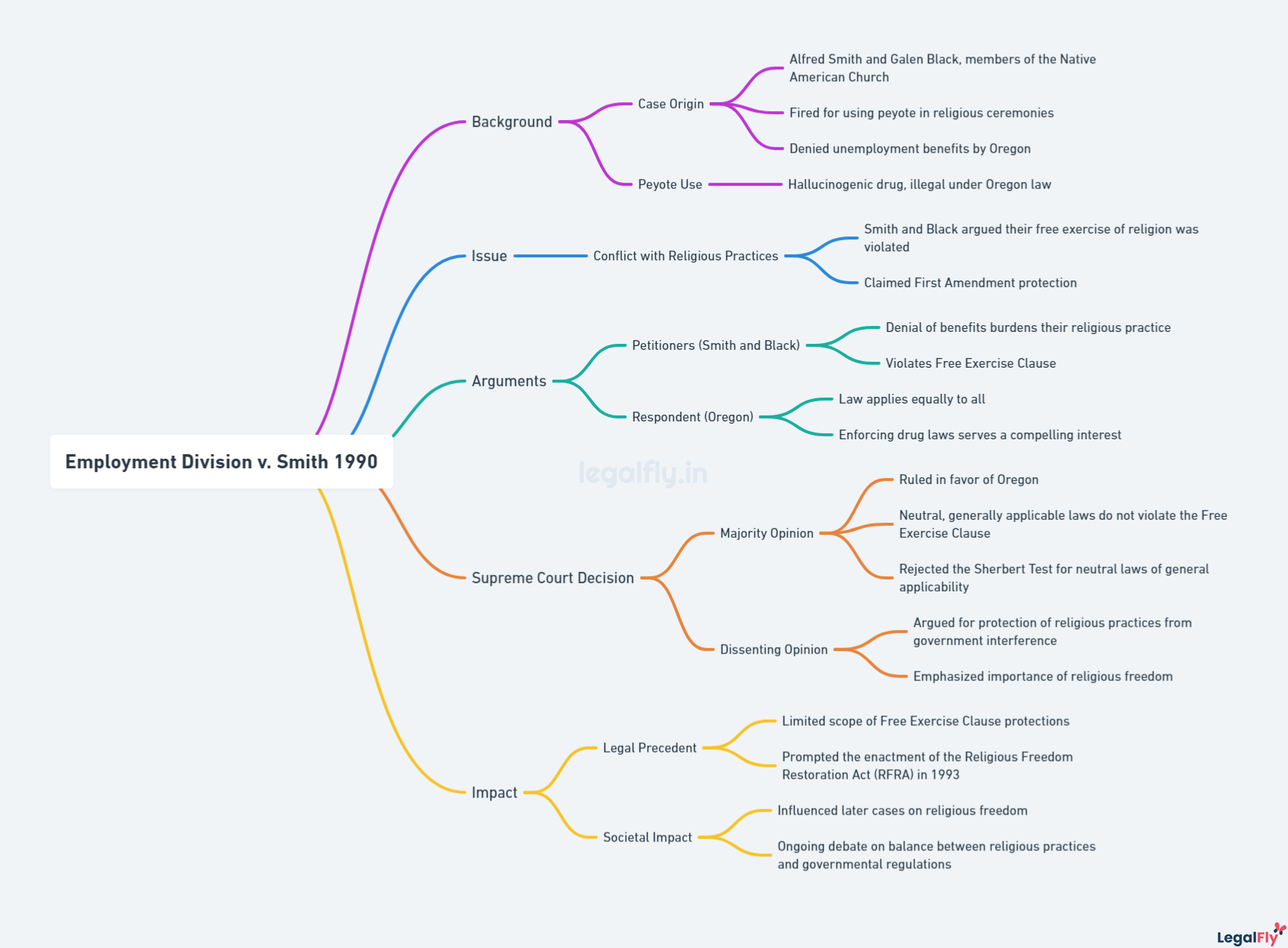
Alfred Smith and Galen Black were counsellors at a private drug-rehabilitation clinic in Oregon and members of the Native American Church. They were dismissed for "misconduct" after ingesting peyote at a Church ceremony, and the State then denied them unemployment benefits. They argued the denial penalised the free exercise of their religion.
Peyote and the Native American Church
Peyote, a cactus containing the hallucinogen mescaline, is a sacrament in the Native American Church, used in carefully structured ceremonies. At the time, Oregon classified peyote as a controlled substance with no religious exemption, so its sacramental use was technically a crime.
Oregon Law and Unemployment Compensation
Because Oregon law criminalised peyote without exception, the State treated the men's dismissal as misconduct connected to work and denied benefits. The Oregon Supreme Court sided with Smith and Black on free-exercise grounds; the U.S. Supreme Court granted review and ultimately reversed.
The Legal Question
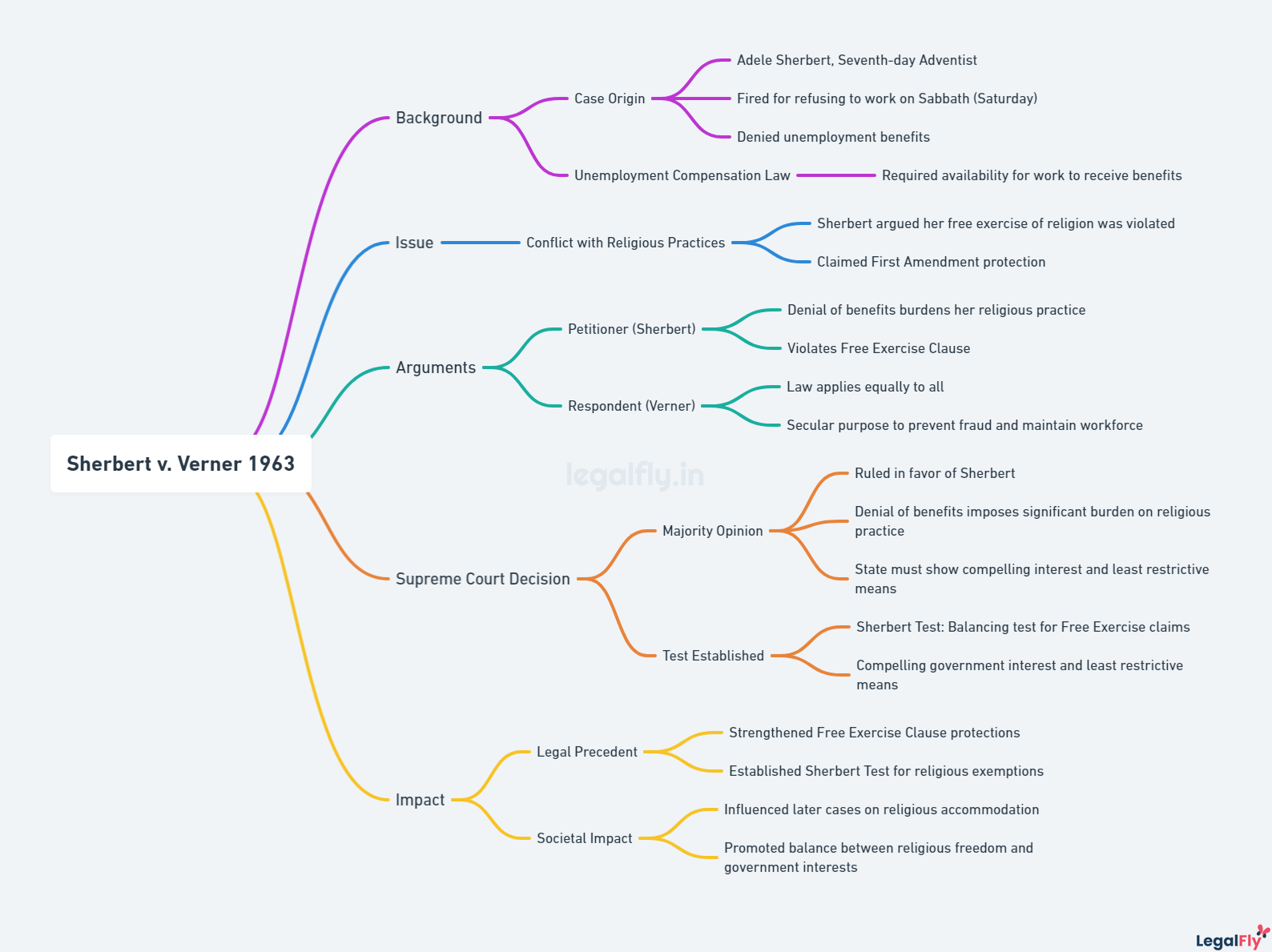
Before Smith, free-exercise claims were generally tested under the Sherbert v. Verner (1963) "compelling interest" standard: a law substantially burdening religion had to serve a compelling state interest by the least restrictive means. The question in Smith was whether that demanding test applied to a neutral, generally applicable criminal law — Oregon's drug ban — that happened to catch a religious practice.
Justice Scalia's Majority Opinion
Writing for a 6-3 majority, Justice Scalia answered no. The Free Exercise Clause, he held, does not relieve an individual of the obligation to comply with a valid, neutral law of general applicability on the ground that the law proscribes conduct his religion prescribes. To hold otherwise — to make every person's religious beliefs "a law unto himself" — would, he wrote, court anarchy in a society of many faiths and many laws.
Scalia distinguished, rather than overruled, the earlier strict-scrutiny cases:
- Sherbert was confined to the unemployment-benefits context, where the State makes individualised assessments of why a person is out of work.
- Cases like Wisconsin v. Yoder were recast as "hybrid" cases — free exercise combined with another right (there, parental rights) — where heightened scrutiny still applies.
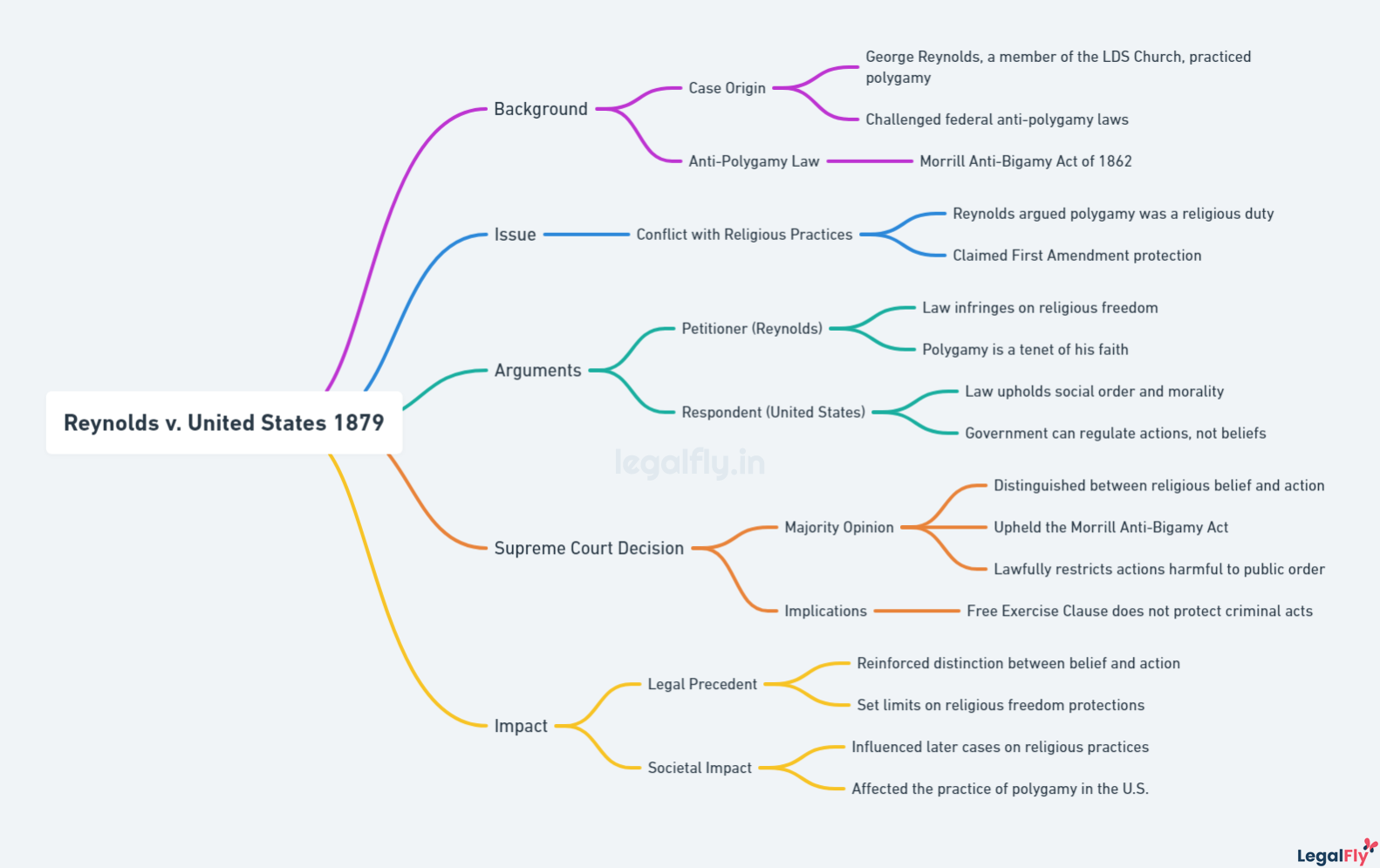
The decision built on the long-standing principle, traceable to Reynolds v. United States (1879), that religious belief does not excuse a person from an otherwise valid law governing conduct.
The Separate Opinions
| Opinion | Justices | Position |
|---|---|---|
| Majority | Scalia (with Rehnquist, White, Stevens, Kennedy) | No strict scrutiny for neutral, generally applicable laws |
| Concurrence in judgment | O'Connor | Agreed Oregon could ban peyote (compelling interest), but would have kept the Sherbert strict-scrutiny test |
| Dissent | Blackmun (with Brennan and Marshall) | Strict scrutiny should apply; Oregon lacked a compelling interest to deny benefits for sacramental use |
Justice O'Connor's separate opinion is important: she reached the same result but sharply criticised the majority for "dramatically depart[ing]" from settled First Amendment law. The dissenters, drawing on Sherbert, would have ruled for Smith and Black outright.
Aftermath: RFRA, Boerne, Peyote and Fulton
Smith provoked one of the rare bipartisan backlashes in modern church-state law, and a chain of responses followed:
| Year | Development | Effect on Smith |
|---|---|---|
| 1993 | Religious Freedom Restoration Act (RFRA) | By statute, restored the compelling-interest test for laws burdening religion |
| 1994 | American Indian Religious Freedom Act amendments | Specifically legalised sacramental peyote use by Native Americans — directly fixing Smith's facts |
| 1997 | City of Boerne v. Flores | Held RFRA exceeds Congress's power as applied to the states; RFRA now binds only the federal government (RLUIPA, 2000, and state RFRAs filled the gap) |
| 2006 | Gonzales v. O Centro | Used federal RFRA to protect a religious group's sacramental use of a controlled substance |
| 2021 | Fulton v. City of Philadelphia | Narrowed Smith — a law with individualised exemptions is not "generally applicable" — but declined to overrule it; Alito (with two others) urged that it be overruled |
Note the chronology: Reynolds (1879) is the precedent Smith relied on, not a later case; the developments that revisited and pushed back against Smith are RFRA, Boerne, O Centro and Fulton.
Conclusion
Employment Division v. Smith remade free-exercise doctrine: a neutral, generally applicable law now survives a religious-liberty challenge without strict scrutiny, leaving accommodation largely to legislatures rather than courts. The decision was so contested that Congress acted twice (RFRA and the peyote amendment), the Court trimmed Congress's reach in Boerne, and the question of whether Smith itself should be overruled remains live after Fulton. It stands as the central modern battleground over how far religious conscience can excuse compliance with the general law.