
Case Summary: Obergefell v. Hodges 2015
In short
On 26 June 2015 the U.S. Supreme Court held 5-4 (Kennedy J.) that the Fourteenth Amendment guarantees same-sex couples the fundamental right to marry and requires states to recognise same-sex marriages performed elsewhere — legalising marriage equality nationwide and overruling Baker v. Nelson. Four justices dissented (Roberts, Scalia, Thomas, Alito). Congress later codified federal recognition in the Respect for Marriage Act (2022) after Justice Thomas's Dobbs concurrence urged revisiting the case. India took the opposite path: in Supriyo v. Union of India (2023) the Supreme Court declined to legalise same-sex marriage, leaving it to Parliament.
In this brief
- Introduction
- Historical Background and Precedent Cases
- From Baker v. Nelson to the Tipping Point
- United States v. Windsor and Its Impact
- State Bans and the Circuit Split
- The Case of Obergefell v. Hodges
- The Plaintiffs and Their Arguments
- The States' Defence
- The Supreme Court's Opinion and the Dissents
- Majority Opinion by Justice Kennedy
- The Dissents
- Implications and Consequences
- Later Developments: Is Obergefell Secure?
- The Indian Contrast: Supriyo v. Union of India (2023)
- Analysis and Conclusion
Introduction
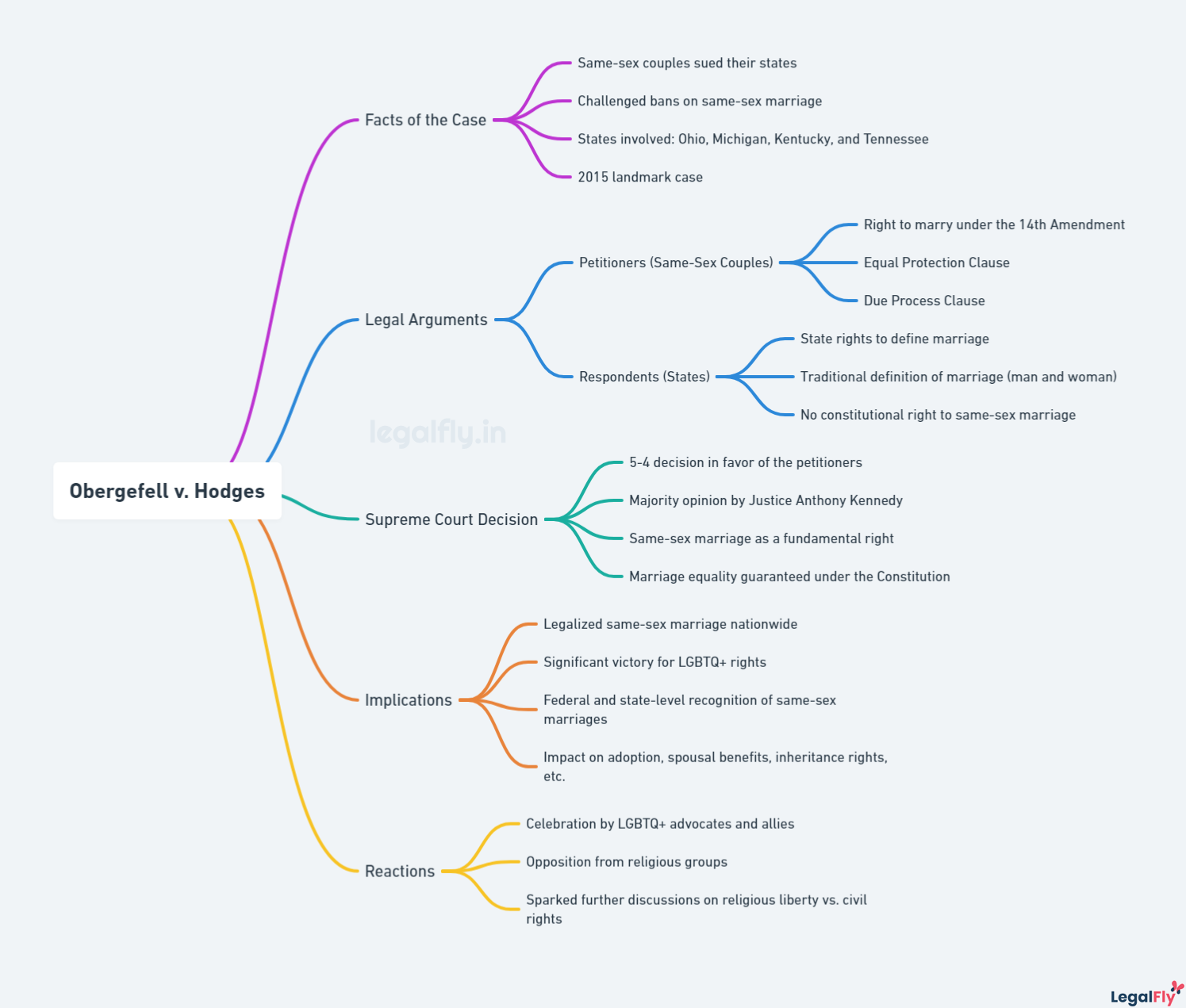
Obergefell v. Hodges (2015) is the decision in which the Supreme Court of the United States legalised same-sex marriage nationwide. In a 5-4 ruling authored by Justice Anthony Kennedy, the Court held that the Fourteenth Amendment requires every state both to license marriages between two people of the same sex and to recognise such marriages lawfully performed in other states.
| Element | Detail |
|---|---|
| Case | Obergefell v. Hodges |
| Citation | 576 U.S. 644 (2015) |
| Court | Supreme Court of the United States |
| Decided | 26 June 2015 |
| Vote | 5-4; majority opinion by Justice Anthony Kennedy |
| Basis | Due Process and Equal Protection Clauses, Fourteenth Amendment |
Historical Background and Precedent Cases
From Baker v. Nelson to the Tipping Point
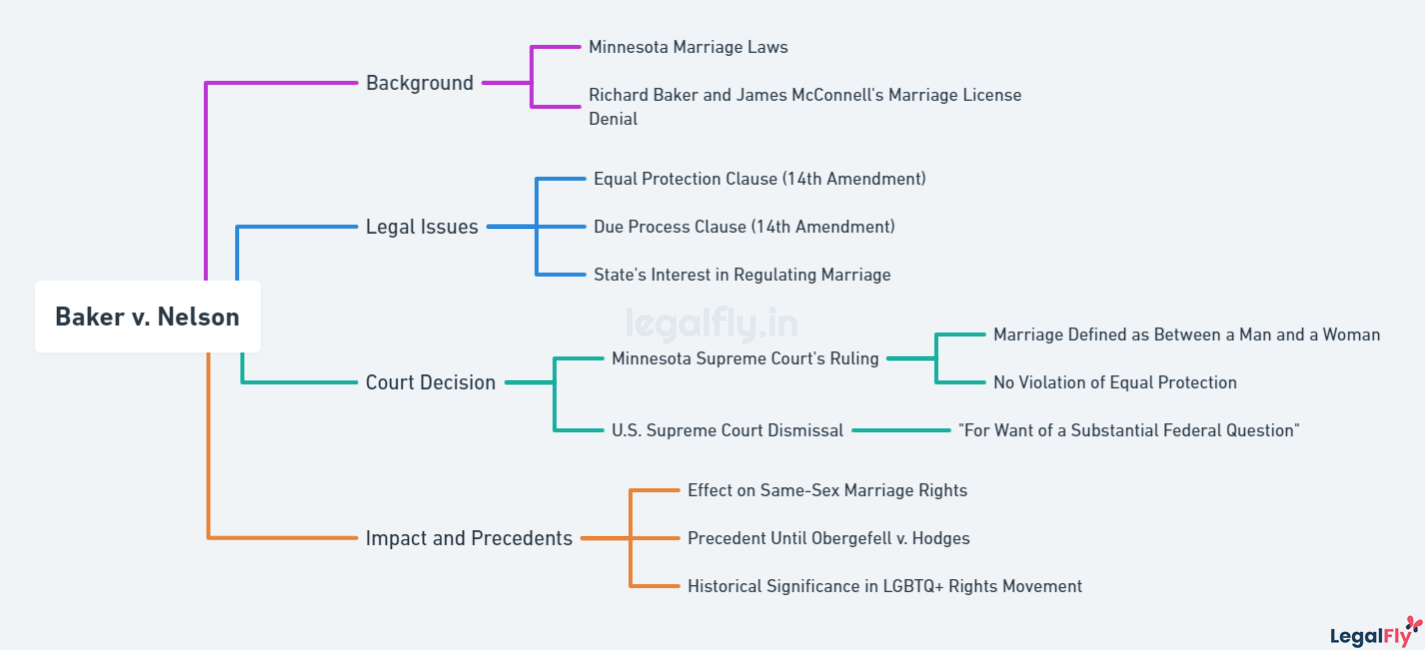
In 1972 the Supreme Court dismissed Baker v. Nelson — a challenge to Minnesota's refusal to license a same-sex marriage — "for want of a substantial federal question," and that one-line disposition stood as precedent for over four decades. Through the 2000s, however, public opinion and the law shifted rapidly, and Obergefell would ultimately overrule Baker outright.
United States v. Windsor and Its Impact
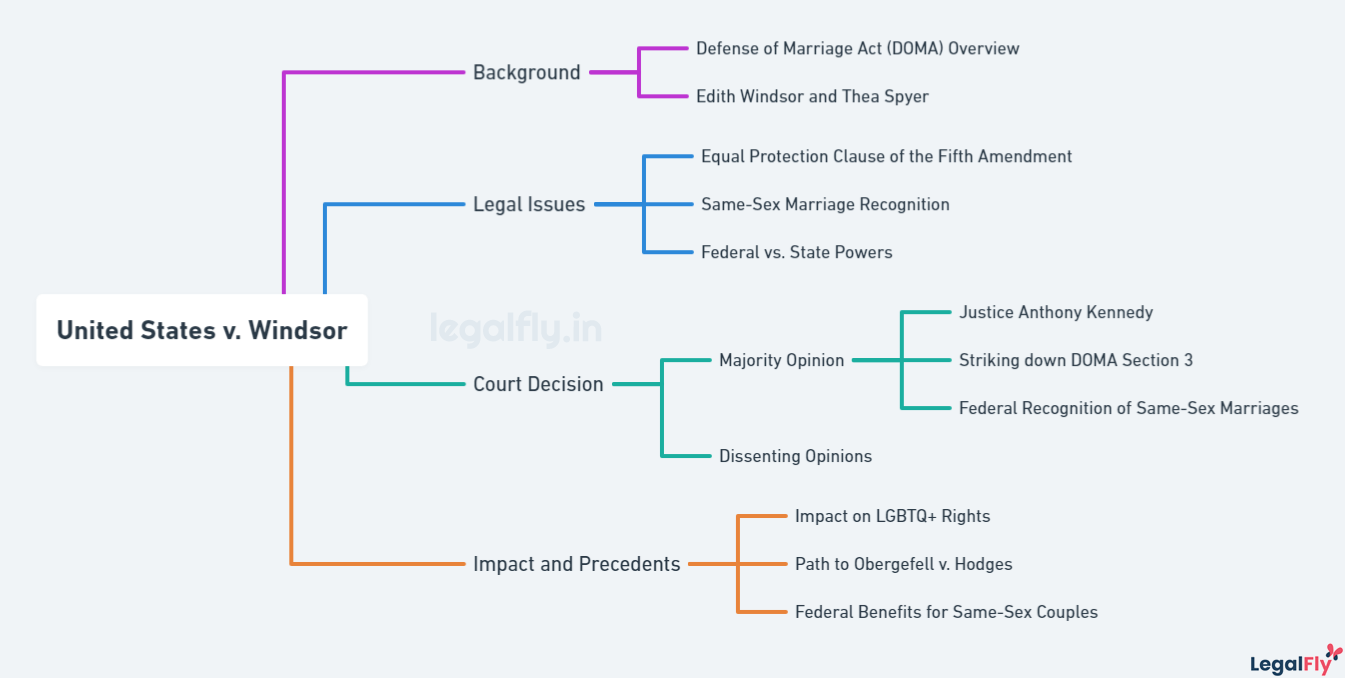
The immediate catalyst was United States v. Windsor (2013), in which the Court struck down Section 3 of the Defense of Marriage Act, requiring the federal government to recognise same-sex marriages performed where they were legal. Windsor set off a cascade of lower-court rulings invalidating state bans.
State Bans and the Circuit Split
By the mid-2000s roughly 40 states had statutory or constitutional bans on same-sex marriage (California's Proposition 8 among the most contested). After Windsor, most federal appeals courts struck such bans down — but in 2014 the Sixth Circuit upheld the bans in Michigan, Ohio, Kentucky and Tennessee. That split among the circuits is what brought the question to the Supreme Court.
The Case of Obergefell v. Hodges
The Plaintiffs and Their Arguments
The lead plaintiff, James Obergefell, had married John Arthur in Maryland; Arthur was dying of ALS, and Obergefell sought to be listed as the surviving spouse on Arthur's Ohio death certificate. His case was consolidated with others from Michigan, Kentucky and Tennessee. The plaintiffs argued that the bans violated two guarantees of the Fourteenth Amendment:
- the Due Process Clause — marriage is a fundamental liberty; and
- the Equal Protection Clause — same-sex couples were treated unequally without justification.
The States' Defence
The states (the named respondent, Richard Hodges, was Ohio's health director) argued that defining marriage was a matter for voters and legislatures, not courts; that the traditional definition was tied to procreation and child-rearing; and that caution counselled against redefining so fundamental an institution by judicial decree.
The Supreme Court's Opinion and the Dissents
Majority Opinion by Justice Kennedy
Justice Kennedy, writing for the majority (joined by Ginsburg, Breyer, Sotomayor and Kagan JJ.), grounded the right to marry in personal autonomy and equal dignity. He identified four principles explaining why marriage is fundamental and why they apply equally to same-sex couples:
- the right to personal choice in marriage is inherent in individual autonomy;
- marriage supports a two-person union unlike any other in its importance to committed individuals;
- it safeguards children and families; and
- it is a keystone of the nation's social order.
Denying same-sex couples this right, the Court held, violated both the Due Process and Equal Protection Clauses.
The Dissents
All four dissenters wrote separately. Chief Justice Roberts (his first-ever dissent read from the bench) argued the Court had overstepped its role and that the matter belonged to the democratic process. Justice Scalia attacked the decision as a threat to self-government. Justice Thomas disputed the majority's conception of "liberty" and "dignity." Justice Alito warned of consequences for religious dissenters. Their common theme was that the definition of marriage should be left to the states and voters.
| Bloc | Justices |
|---|---|
| Majority (5) | Kennedy (author), Ginsburg, Breyer, Sotomayor, Kagan |
| Dissent (4) | Roberts, Scalia, Thomas, Alito (four separate dissents) |
Implications and Consequences
The ruling made same-sex marriage legal in all 50 states. Marriage licences had to be issued to same-sex couples everywhere, and out-of-state same-sex marriages had to be recognised. Same-sex couples gained the full legal incidents of marriage — joint adoption, medical decision-making, inheritance, tax and benefit entitlements — and the decision rippled into adoption, family-leave and anti-discrimination policy across the states.
Later Developments: Is Obergefell Secure?
Two developments have since reshaped the landscape:
- Thomas's Dobbs concurrence (2022): in overruling Roe v. Wade, Justice Thomas wrote separately to urge the Court to reconsider "all of this Court's substantive due process precedents," naming Obergefell, Griswold and Lawrence. No other justice joined that view, and the Dobbs majority insisted its reasoning did not extend to same-sex marriage — but the concurrence raised real concern about Obergefell's durability.
- The Respect for Marriage Act (2022): partly in response, Congress passed and the President signed a statute requiring the federal government, and every state, to recognise same-sex and interracial marriages validly performed — a legislative backstop should Obergefell ever be revisited.
The Indian Contrast: Supriyo v. Union of India (2023)
For Indian readers, Obergefell is a useful counterpoint. While the U.S. recognised a constitutional right to same-sex marriage by judicial decision, the Supreme Court of India took the opposite course. In Supriyo @ Supriya Chakraborty v. Union of India (2023), a five-judge bench unanimously declined to legalise same-sex marriage: it held there is no fundamental right to marry, that the Special Marriage Act could not be read to include same-sex couples, and that the question was for Parliament — not the Court — to decide. India has thus decriminalised gay sex (Navtej Singh Johar, 2018) but has not extended marriage, a sharp divergence from the path Obergefell charted.
Analysis and Conclusion
Obergefell remains one of the most consequential civil-rights decisions in American history, completing the constitutional recognition of same-sex relationships that Lawrence and Windsor had begun. It also crystallised an enduring debate about the proper role of the judiciary in recognising new rights under the Fourteenth Amendment — a debate that, as the post-Dobbs discussion shows, is far from settled in the United States legal system.