
K.S. Puttaswamy v. Union of India (2017)
In short
A 9-judge constitutional bench unanimously held on 24 August 2017 that the right to privacy is a fundamental right under Articles 14, 19 and 21 of the Constitution, overruling M.P. Sharma (1954) and Kharak Singh (1963) on this point.
In this brief
- Introduction
- Background and Context
- Legal Issues
- Nine-Judge Bench
- The Court's Decision
- The Threefold Test for Privacy Restrictions
- Cases Overruled or Distinguished
- Key Doctrinal Contributions of Individual Opinions
- Implications of the Judgment
- Impact on Laws and Policy
- Influence on Subsequent Cases
- Position Under Current Law (BNS / DPDP)
- Conclusion
Introduction
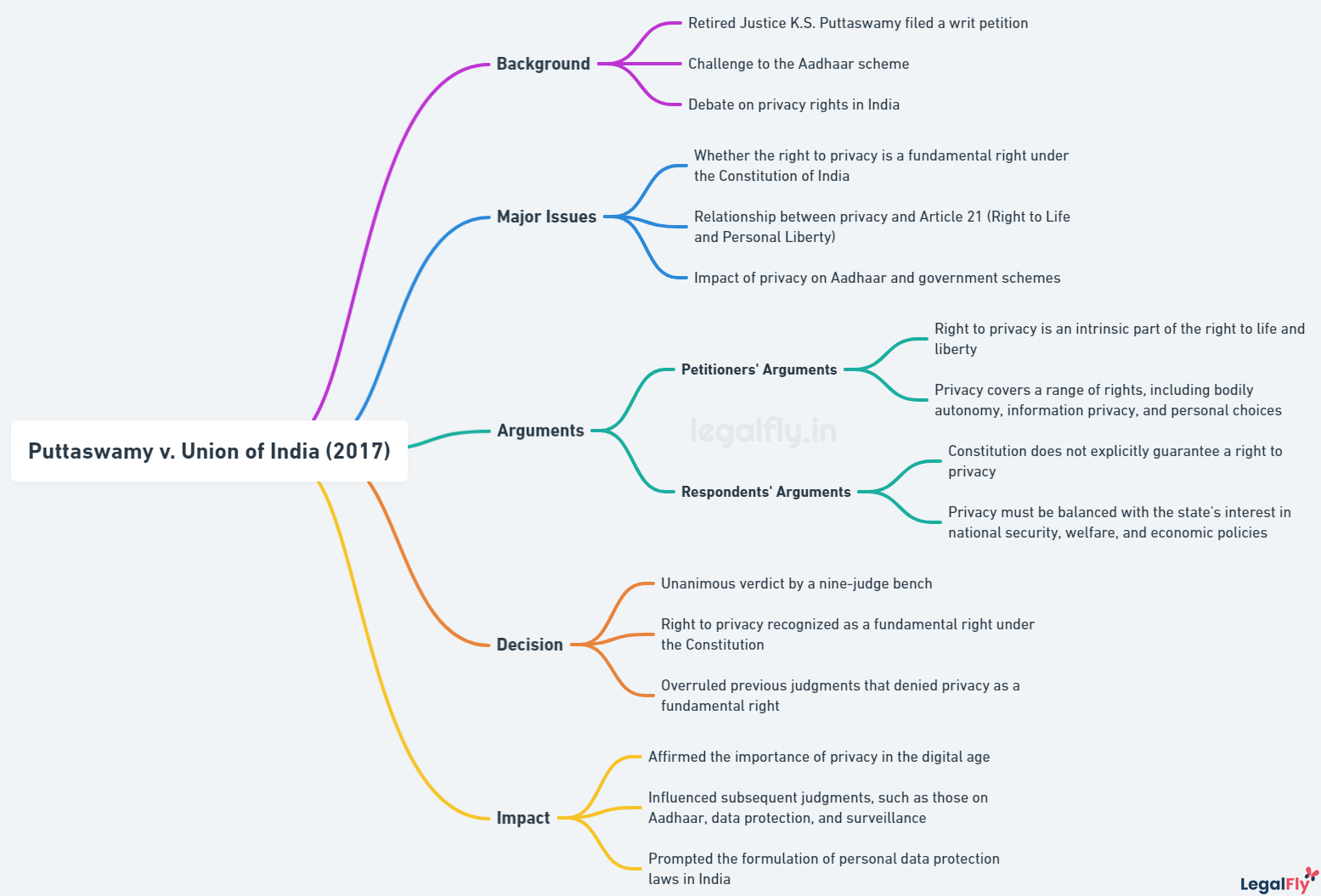
Justice K.S. Puttaswamy (Retd.) & Anr. v. Union of India & Ors. (2017) 10 SCC 1 is widely regarded as one of the most consequential constitutional judgments in India's legal history. On 24 August 2017, a nine-judge constitutional bench of the Supreme Court unanimously held that the right to privacy is a fundamental right protected under Articles 14, 19 and 21 of the Constitution of India.
The proceedings originated from a challenge to the Aadhaar biometric identification scheme introduced in 2009. The immediate constitutional question — whether privacy is a fundamental right — had been left unresolved by two earlier eight-judge and five-judge benches in M.P. Sharma (1954) and Kharak Singh (1963). Those rulings, which had denied or doubted a constitutional right to privacy, were expressly overruled.
Background and Context
Justice K.S. Puttaswamy, a retired judge of the Karnataka High Court, filed a writ petition in 2012 challenging the constitutional validity of the Aadhaar scheme. Aadhaar, administered by the Unique Identification Authority of India (UIDAI), enrolled residents by collecting biometric data — fingerprints and iris scans — linked to a 12-digit identifier. The government progressively made Aadhaar mandatory for welfare benefits, tax filings, mobile SIM verification, and bank accounts.
Civil society petitioners argued that the mass collection of biometric data without adequate legal safeguards violated the right to privacy. The Union of India resisted the claim on a threshold ground: that no fundamental right to privacy exists under the Constitution, relying on M.P. Sharma (1954) and Kharak Singh (1963). That threshold question was referred to a nine-judge bench, which delivered its unanimous verdict on 24 August 2017. The substantive challenge to Aadhaar itself was decided separately in Puttaswamy v. Union of India (Aadhaar) (2018) 1 SCC 809.
India has also ratified the International Covenant on Civil and Political Rights (ICCPR), whose Article 17 prohibits arbitrary or unlawful interference with privacy, family, home or correspondence. The bench drew on this international obligation in placing privacy within the constitutional framework.
Legal Issues
- Whether the right to privacy is a fundamental right under Part III of the Constitution.
- Whether M.P. Sharma v. Satish Chandra (1954) and Kharak Singh v. State of U.P. (1963) correctly stated the law in denying or doubting a constitutional right to privacy.
- What restrictions, if any, the State may impose on the right to privacy, and by what standard those restrictions are to be judged.
Nine-Judge Bench
The bench comprised nine judges who together produced six separate opinions, all reaching the same unanimous conclusion. The opinion groupings were:
| Opinion | Authored by | Joined by |
|---|---|---|
| Lead judgment | Justice D.Y. Chandrachud | CJI J.S. Khehar, Justice R.K. Agrawal, Justice S.A. Nazeer |
| Concurring | Justice J. Chelameswar | — |
| Concurring | Justice S.A. Bobde | — |
| Concurring | Justice R.F. Nariman | — |
| Concurring | Justice A.M. Sapre | — |
| Concurring | Justice S.K. Kaul | — |
All nine judges — CJI J.S. Khehar, Justice J. Chelameswar, Justice S.A. Bobde, Justice R.K. Agrawal, Justice R.F. Nariman, Justice A.M. Sapre, Justice D.Y. Chandrachud, Justice S.K. Kaul, and Justice S.A. Nazeer — agreed that privacy is a fundamental right. The six separate opinions reflect different reasoning pathways to that unanimous conclusion rather than any disagreement on outcome.
The Court's Decision
The bench unanimously held:
- The right to privacy is protected as an intrinsic part of the right to life and personal liberty under Article 21 and as part of the freedoms guaranteed by Part III of the Constitution (including Articles 14 and 19).
- Privacy encompasses bodily integrity, personal autonomy, informational self-determination, the sanctity of the home, intimate choices, and the right to dignity.
- Privacy is not an absolute right; the State may restrict it subject to the threefold test set out below.
- M.P. Sharma v. Satish Chandra (1954) 8 SCC 522 and Kharak Singh v. State of U.P. AIR 1963 SC 1295 were overruled to the extent they held or suggested that the Constitution does not guarantee a right to privacy.
- ADM Jabalpur v. Shivkant Shukla (1976) 2 SCC 521 — the Emergency-era ruling that suspended fundamental rights — was characterised by Justice Kaul as "an aberration in the constitutional jurisprudence of our country" that deserved to be buried "ten fathoms deep with no chance of resurrection."
The Threefold Test for Privacy Restrictions
Justice Chandrachud's lead judgment laid down that any State action that restricts privacy must satisfy three cumulative requirements:
- Legality — the restriction must be sanctioned by law (not merely executive instruction or policy).
- Legitimate aim — the law must pursue a legitimate state objective.
- Proportionality — the means employed must be proportionate to the object sought; the least restrictive measure must be preferred.
Justice Nariman added a fourth element — procedural safeguards against abuse — making it a fourfold test in his formulation. Both formulations have been applied in subsequent judgments.
Cases Overruled or Distinguished
| Earlier Case | What it held on privacy | Puttaswamy's treatment |
|---|---|---|
| M.P. Sharma v. Satish Chandra (1954) 8 SCC 522 (8-judge bench) | No fundamental right to privacy in the Constitution; search and seizure under CrPC valid without any privacy right barrier | Overruled to the extent it denied a fundamental right to privacy |
| Kharak Singh v. State of U.P. AIR 1963 SC 1295 (6-judge bench) | Majority held privacy is not a guaranteed right under Part III; only night-domiciliary visits violated Article 21 | Overruled to the extent it denied a constitutional right to privacy; the minority view of Justice Subba Rao (upholding privacy) was approved |
| Gobind v. State of M.P. AIR 1975 SC 1378 | Recognised a limited right to privacy under Article 21 but left the question open | Approved and expanded |
| ADM Jabalpur v. Shivkant Shukla (1976) 2 SCC 521 | During the Emergency, held that the right to life under Article 21 could be suspended; implicitly denied robust personal liberty | Not formally overruled but characterised as an aberration; effectively repudiated |
Key Doctrinal Contributions of Individual Opinions
Although all six opinions reached the same verdict, each added distinct doctrinal threads:
- Justice Chandrachud (lead, for four judges): Privacy is the constitutional core of human dignity and liberty; it includes informational privacy and the right to control the dissemination of personal data; historical subjugation (e.g., criminalisation of homosexuality) cannot justify the erosion of dignity.
- Justice Chelameswar: Recognised four facets — repose, sanctuary, intimate decision-making, and identity — and held that privacy is a natural right anterior to the Constitution.
- Justice Bobde: Consent is the irreducible minimum for collection of sensitive personal data such as health records; privacy is not absolute but the burden is on the State to justify restriction.
- Justice Nariman: Linked privacy and dignity as twin aspects of Article 21; classified privacy into non-interference with the body, protection of personal information, and autonomy over personal choices; added procedural safeguards as a fourth prong to the proportionality test.
- Justice Sapre: Privacy is essential to liberty and fraternity; it includes freedom of expression and movement and must be read into the constitutional scheme as a whole.
- Justice Kaul: Adopted a comparative and natural-law lens; described ADM Jabalpur as an "aberration" to be buried; emphasised data protection as an urgent legislative imperative.
Implications of the Judgment
Impact on Laws and Policy
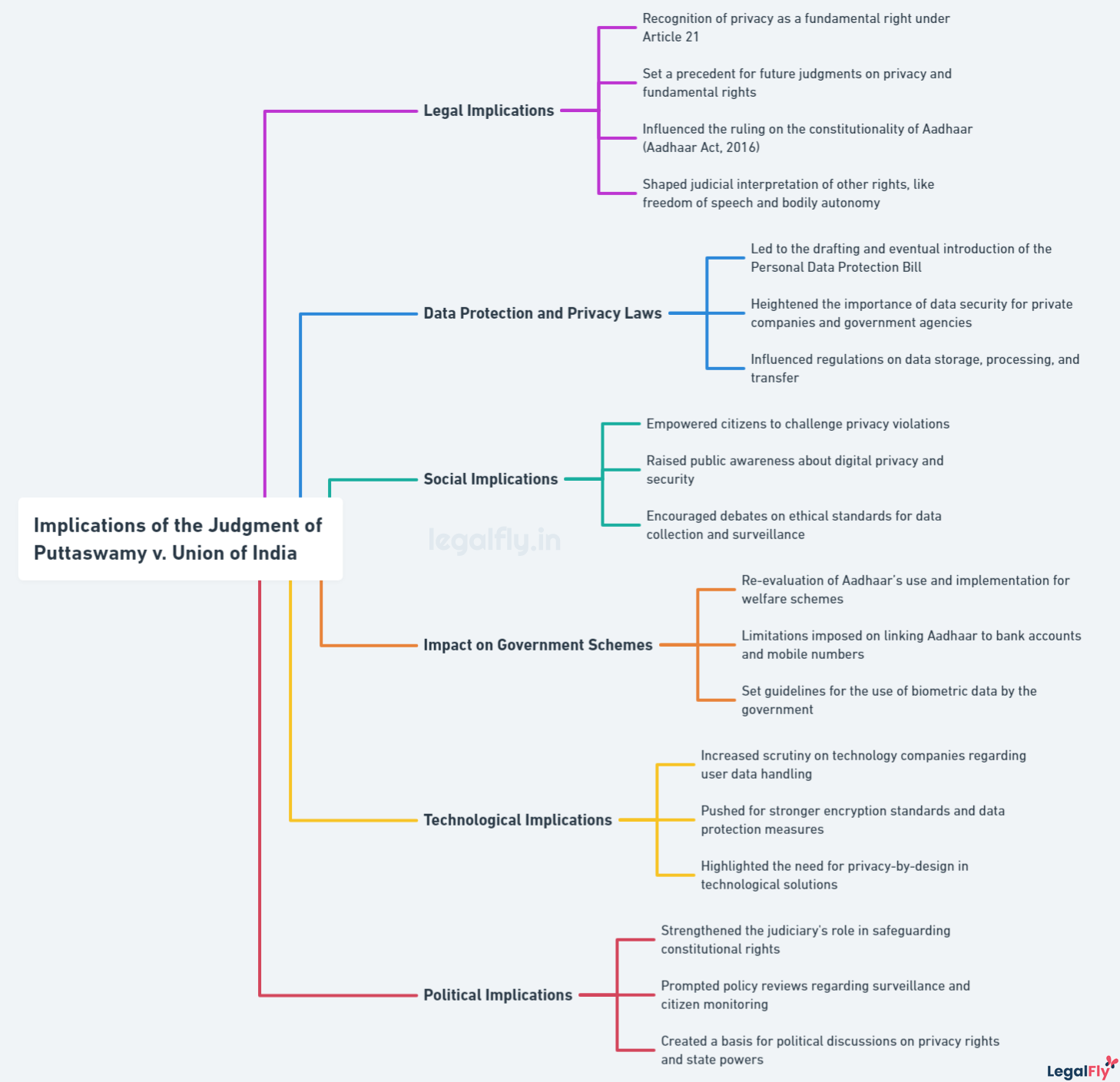
The most direct legislative sequel to Puttaswamy is the Digital Personal Data Protection Act, 2023 (DPDP Act) — India's first comprehensive data-protection statute. Enacted six years after the judgment, the DPDP Act operationalises the informational privacy principles recognised by the bench: purpose limitation, data minimisation, consent requirements, and rights of data principals to access, correct, and erase their data. Any DPDP provision that falls short of the Puttaswamy threefold test remains vulnerable to constitutional challenge.
The Aadhaar scheme itself was upheld (with modifications) by a separate constitution bench in Puttaswamy v. Union of India (Aadhaar) (2018) 1 SCC 809, applying the very proportionality framework established in the privacy judgment. The bench struck down Section 57 of the Aadhaar Act (which allowed private entities to demand Aadhaar) as disproportionate.
Influence on Subsequent Cases
Puttaswamy has been applied across a wide range of constitutional questions:
- Navtej Singh Johar v. Union of India (2018) 10 SCC 1 — A five-judge bench decriminalised consensual same-sex relations by reading down Section 377 IPC (since omitted entirely from the Bharatiya Nyaya Sanhita, 2023, which contains no successor provision), drawing directly on Puttaswamy's recognition of autonomy and dignity as elements of privacy.
- Joseph Shine v. Union of India (2018) 2 SCC 189 — Section 497 IPC (adultery) struck down; the bench cited Puttaswamy on the right to intimate choices free from State interference.
- Shayara Bano v. Union of India (2017) 9 SCC 1 — Decided weeks after Puttaswamy; the majority applied the doctrine of manifest arbitrariness (drawn from Article 14 proportionality reasoning) to strike down triple talaq.
- K.S. Puttaswamy (Aadhaar) (2018) — The proportionality framework from the privacy judgment was applied to each challenged provision of the Aadhaar Act.
Position Under Current Law (BNS / DPDP)
With the enactment of the Bharatiya Nyaya Sanhita, 2023 (BNS) and the Bharatiya Nagarik Suraksha Sanhita, 2023 (BNSS), the criminal-law landscape referenced in post-Puttaswamy cases has been renumbered. The substance of the privacy right, however, is unchanged: Puttaswamy remains the foundational constitutional authority. The DPDP Act, 2023 gives that right statutory expression in the digital domain and is the primary instrument governing personal data processing in India as of 2024-2025. The DPDP Rules, 2025 (in draft as of mid-2025) will further operationalise consent management and data-fiduciary obligations.
Conclusion
K.S. Puttaswamy v. Union of India (2017) 10 SCC 1 settled a question that had shadowed Indian constitutional law for over six decades. By unanimously recognising privacy as a fundamental right — and overruling the eight-judge bench in M.P. Sharma and the six-judge majority in Kharak Singh — the nine-judge bench placed India among the jurisdictions that give privacy its strongest constitutional footing. The threefold test of legality, legitimate aim, and proportionality now serves as the benchmark against which every surveillance law, data-collection programme, and identity mandate must be measured. Its most immediate statutory translation, the DPDP Act, 2023, marks only the first chapter of the legislative work the judgment called for.