
Case Summary: V. Revathi v. Union of India 1988
In short
The Supreme Court in 1988 upheld Section 497 IPC (adultery) and Section 198(2) CrPC, rejecting the petitioner's argument that denying wives the right to prosecute their adulterous husbands was discriminatory under Arts 14, 15 and 21. The provision was finally struck down in Joseph Shine v. Union of India (2018).
In this brief
Key Facts
| Detail | |
|---|---|
| Court | Supreme Court of India (2-judge bench) |
| Citation | AIR 1988 SC 835 |
| Year | 1988 |
| Petitioner | V. Revathi (wife challenging §497 IPC) |
| Respondent | Union of India |
| Provision challenged | §497 IPC (adultery) + §198(2) CrPC (complaint procedure) |
| Constitutional grounds | Articles 14, 15, 21 |
| Holding | §497 IPC and §198(2) CrPC upheld — no discrimination found |
| Later overruled by | Joseph Shine v. Union of India, AIR 2018 SC 4898 (5-judge bench) |
Background: Section 497 IPC
Section 497 of the Indian Penal Code 1860 criminalised adultery in asymmetric terms. It provided that a man who has sexual intercourse with the wife of another man — without that husband's consent — commits adultery punishable with up to five years' imprisonment or fine or both. Two structural features made §497 distinctive:
- Only the man could be prosecuted; the adulterous woman was expressly exempt — and could not even be convicted as an abettor.
- Only the husband of the adulterous woman could file a complaint under §198(2) CrPC; the wife of the adulterous man had no standing to prosecute.
This architecture reflected Victorian-era assumptions that a wife's sexual fidelity was her husband's property interest to protect, while a husband's fidelity attracted no criminal sanction at the instance of his own wife.
Earlier Challenges to Section 497
The Revathi petition was neither the first nor the last challenge to §497:
| Case | Petitioner's complaint | Outcome |
|---|---|---|
| Yusuf Abdul Aziz v. State of Bombay, AIR 1954 SC 321 | Man argued: why should only the male be punished for adultery, not the woman? | §497 upheld; Art 15(3) ("special provision for women") permits this differential treatment |
| Sowmithri Vishnu v. Union of India, AIR 1985 SC 1618 | Wife argued: §497 should let her prosecute the "other woman" (her husband's mistress) | §497 upheld; SC held the law seeks to protect, not criminalise, women in such situations |
| V. Revathi v. Union of India, AIR 1988 SC 835 | Wife argued: §497 should let her prosecute her own adulterous husband | §497 upheld (this case) |
| Joseph Shine v. Union of India, AIR 2018 SC 4898 | Man (NRI) challenged §497 as criminalising consensual sex between adults, violating autonomy | §497 struck down by 5-judge bench; adultery no longer a criminal offence |
The Petition: What Revathi Argued
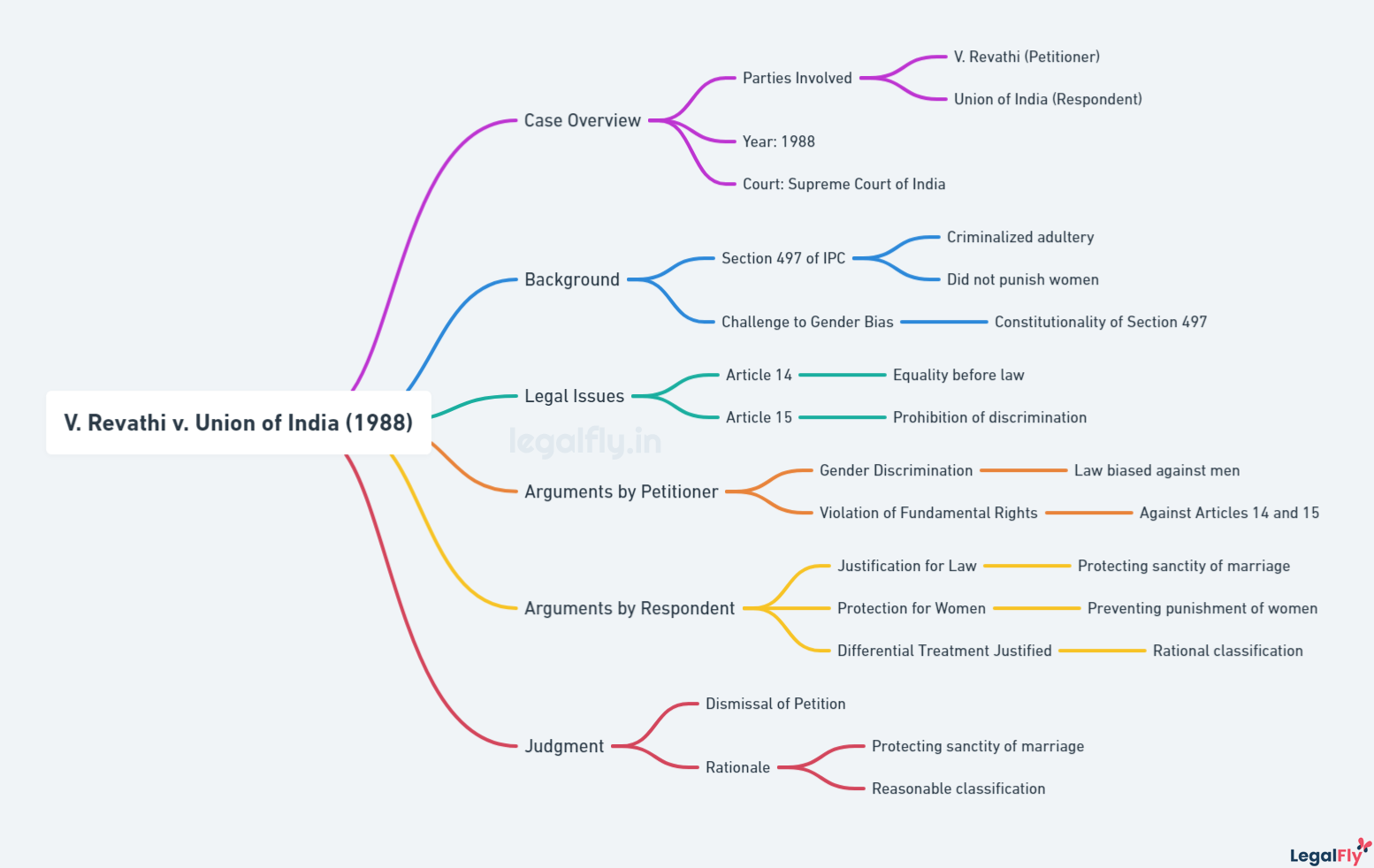
V. Revathi filed a writ petition under Article 32 of the Constitution challenging §497 IPC and §198(2) CrPC on three grounds:
- Article 14 (equality). §497 creates an arbitrary sex-based distinction — the husband of the adulterous woman can prosecute the man, but the wife of the adulterous man has no equivalent right. This asymmetry in who may complain is irrational.
- Article 15 (non-discrimination on grounds of sex). By allowing only the male party (the adulterous man) to be prosecuted — and only on the complaint of a male party (the aggrieved husband) — the provision discriminates on the basis of sex.
- Article 21 (personal liberty). Treating the wife as an incompetent complainant about her own husband's conduct infringes her personal liberty and dignity.
The Court's Reasoning: Upholding Section 497
The Supreme Court rejected all three grounds and upheld §497 IPC and §198(2) CrPC in their entirety — without any reading-down. The court's reasoning centred on three propositions:
- The woman is protected, not discriminated against. Because the adulterous woman cannot be prosecuted — not even as an abettor — the provision is a shield for women, not a sword against them. Her exemption from criminal liability cannot be characterised as discrimination.
- The legislature's classification is reasonable. Parliament chose to treat the aggrieved husband's right to prosecute as the relevant remedy; Parliament could equally have chosen no remedy at all. Providing a remedy to one aggrieved party (the husband of the adulterous woman) while not providing it to another (the wife of the adulterous man) is a permissible legislative choice, not an Art 14 violation.
- The social purpose: preserving the sanctity of marriage. §497 is intended as a special provision that serves the social interest in marital stability. Its design reflects a conscious legislative choice, not an invidious distinction.
Crucially, the court did not hold that the law was beyond constitutional challenge in principle — only that on the facts presented, no violation of Arts 14, 15, or 21 was made out.
The Joseph Shine Overruling (2018)
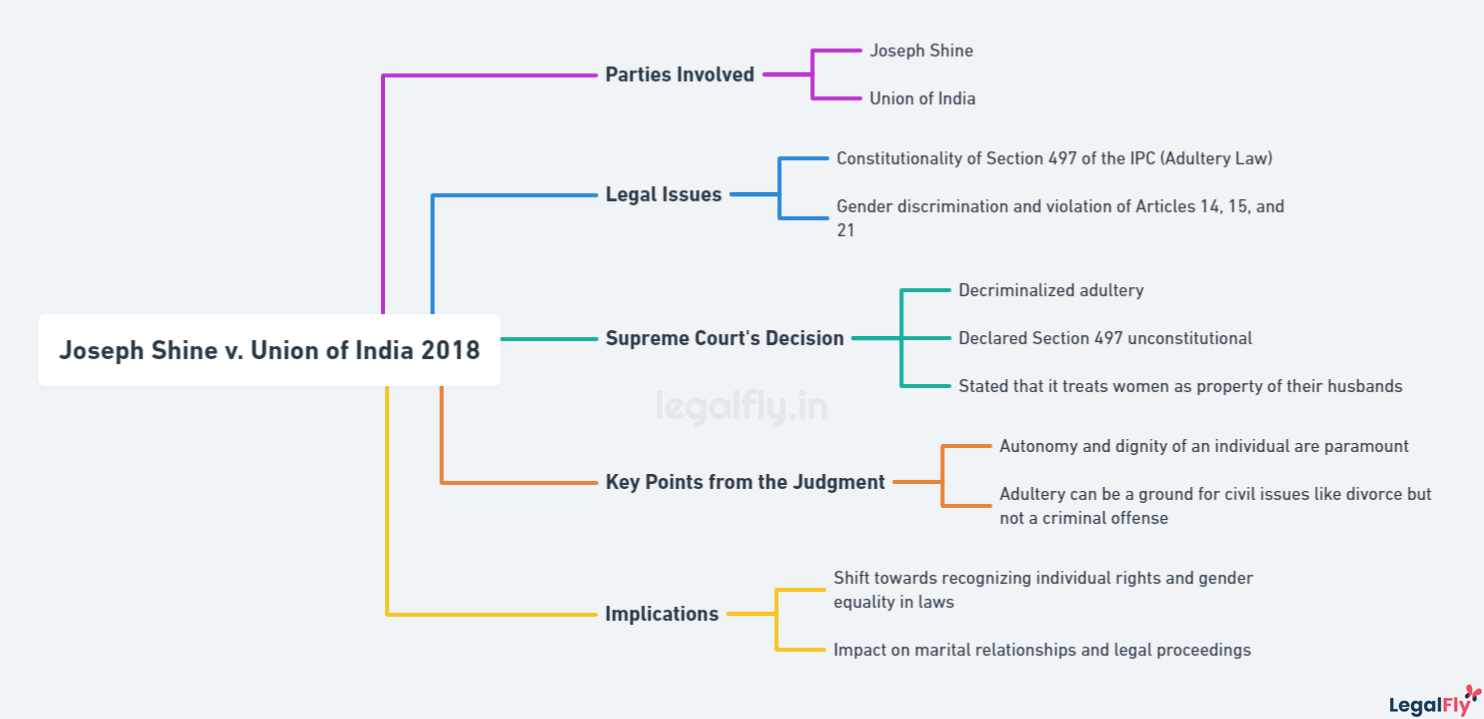
Thirty years after V. Revathi, a five-judge Constitution Bench in Joseph Shine v. Union of India (2018) unanimously struck down §497 IPC and §198(2) CrPC as unconstitutional. The 2018 bench departed from all three earlier precedents (Yusuf Abdul Aziz, Sowmithri Vishnu, and Revathi) and held:
- §497 treats a wife as the husband's chattel, violating her dignity and autonomy under Art 21.
- The provision is manifestly arbitrary under Art 14 (the Shayara Bano "manifest arbitrariness" standard).
- A husband cannot be the "licensor" of his wife's sexuality; the consent/connivance exception in §497 ("without the consent or connivance of that man") embodies a patriarchal proprietary view incompatible with constitutional morality.
- Adultery between consenting adults is a purely private matter; its criminalisation violates the right to privacy (K.S. Puttaswamy, 2017).
Adultery is no longer a criminal offence in India. It may still be relevant as a ground for divorce under civil personal laws.
Significance of V. Revathi
Though ultimately reversed, V. Revathi matters for three reasons:
- It crystallised the asymmetry. The case forced a precise articulation of §497's internal logic — that a wife had no standing to complain about her own husband's adultery — making the provision's patriarchal architecture impossible to ignore.
- It built the doctrinal record. Revathi, Sowmithri Vishnu, and Yusuf Abdul Aziz together created a body of reasoning that the Joseph Shine bench engaged and overruled section by section.
- It illustrates constitutional evolution. The same provision was upheld in 1954, 1985, and 1988, then struck down in 2018. The shift reflects not a change in the text of Arts 14/15/21 but a deepening of what constitutional equality requires in a changing society.