
Mohini Jain v. State of Karnataka (1992): Case Summary
In short
In Mohini Jain v. State of Karnataka (AIR 1992 SC 1858), the Supreme Court held that the right to education flows from the right to life under Article 21, and that charging capitation fees is arbitrary and violates Articles 14 and 21. The sweeping ruling was narrowed a year later in Unni Krishnan (1993), which limited the fundamental right to education to children up to age 14, later codified by Article 21A (86th Amendment, 2002) and the RTE Act, 2009.
In this brief
- Introduction
- Key Takeaways
- Background of the Case
- Petition Filing and Primary Grievances
- Capitation Fee and Its Implications
- Legal Framework and Previous Judgments
- The Rights and Legal Provisions
- Article 21 and the Right to Life
- Article 14 and Right to Equality
- Fundamental Right to Education
- Directive Principles of State Policy
- Judgement and Rationale
- Analysis of the Karnataka Act
- Arguments and Deliberations
- Implications for Private Educational Institutions
- Impact of the Case
- What Came After: The Right to Education Timeline
- On Educational Accessibility and Fees
- Precedent for Future Judgements
- Conclusion
Introduction
Miss Mohini Jain v. State of Karnataka (1992) is one of the foundational Indian judgments on the right to education. A two-judge bench of the Supreme Court held that the right to education flows directly from the right to life and human dignity under Article 21 of the Constitution, and that charging a "capitation fee" for admission to a professional course is arbitrary, unfair and unconstitutional.
The case arose after the Karnataka government issued a notification permitting private medical colleges to charge sharply higher fees from students outside the government quota. The Court read the right to education into Article 21 in light of the Directive Principles of State Policy (Articles 38, 39, 41 and 45) and struck down the practice of capitation fees as a violation of both Article 14 (equality) and Article 21.
Importantly, Mohini Jain's sweeping statement that education is a fundamental right "at all levels" did not survive intact. Within a year it was substantially narrowed by the Constitution Bench in Unni Krishnan, J.P. v. State of Andhra Pradesh (1993), and the constitutional position was later settled by Article 21A and the Right to Education Act, 2009. Any accurate reading of Mohini Jain has to be placed within that arc.
| Case name | Miss Mohini Jain v. State of Karnataka & Ors. |
|---|---|
| Court | Supreme Court of India |
| Bench | Kuldip Singh J. and R. M. Sahai J. |
| Date of judgment | 30 July 1992 |
| Citation | (1992) 3 SCC 666; AIR 1992 SC 1858 |
Key Takeaways
- The Court held that the right to education is a fundamental right flowing from the right to life under Article 21, read with the guarantee of human dignity and the Directive Principles.
- Charging a capitation fee for admission was held to be arbitrary and a violation of Articles 14 and 21.
- The ruling's broad sweep (education a fundamental right at every level) was modified one year later in Unni Krishnan (1993).
Background of the Case
This section covers how the petition arose, what a capitation fee is, and the legal backdrop the Court was working against.
Petition Filing and Primary Grievances
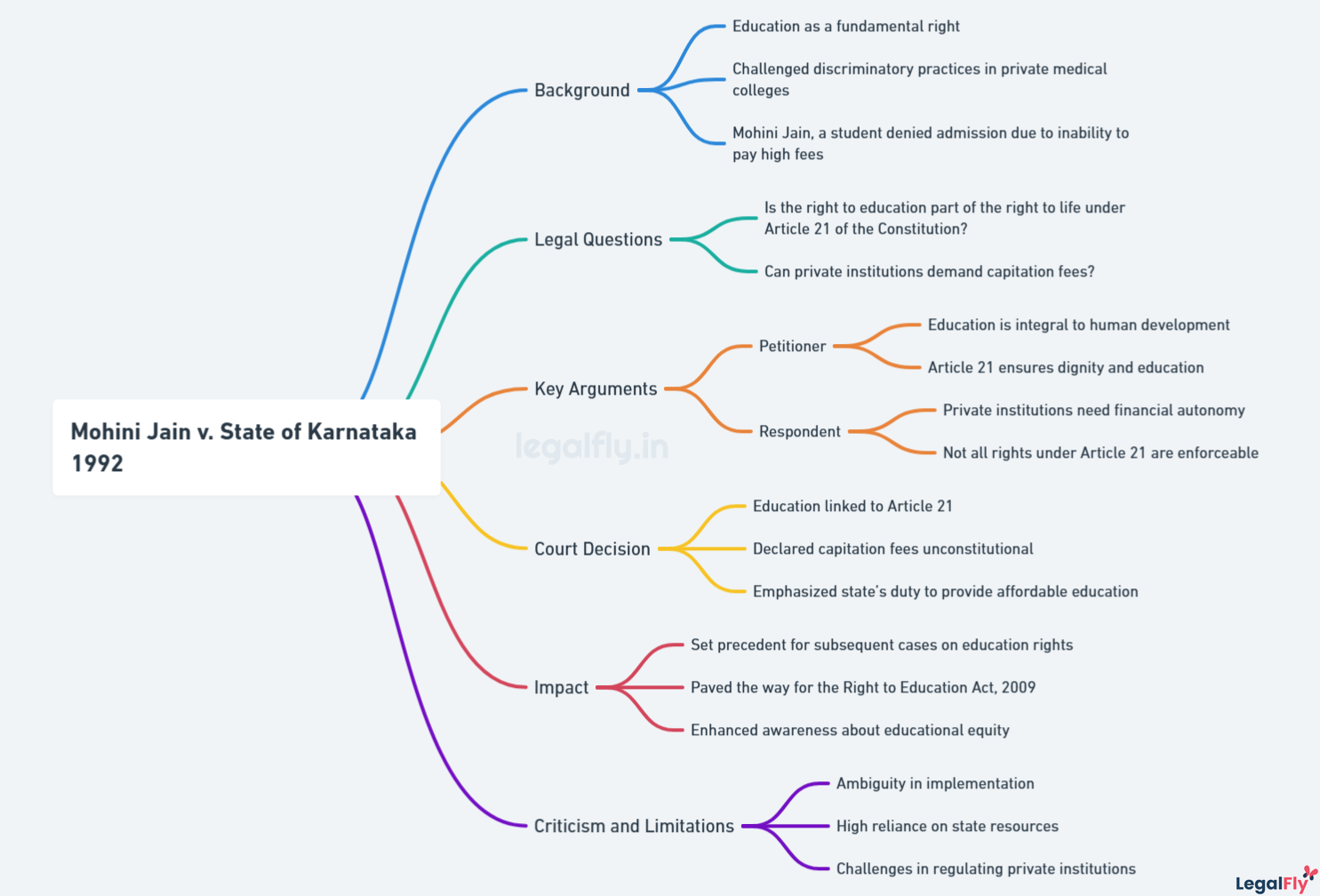
Miss Mohini Jain, a resident of Meerut, sought admission to the MBBS course at Sri Siddhartha Medical College, Tumkur, Karnataka. The college management asked her to deposit roughly Rs. 60,000 as tuition fee for the first year and to furnish a bank guarantee for the fees of the remaining years. Her father informed the management that paying such an amount was beyond his means, and she was consequently denied admission.
She challenged a Karnataka government notification that permitted private medical colleges to charge much higher fees from students admitted outside the "government seat" quota. Her core grievance was that linking access to professional education to a candidate's ability to pay, rather than to merit, was discriminatory and unconstitutional. She invoked Article 14 (equality) and the right to education said to flow from Article 21.
Capitation Fee and Its Implications
A capitation fee is a large, often unofficial, sum demanded by a private institution for admission, over and above regular tuition and outside any merit-based selection. In this case the management seat fees were several times higher than the government seat fees, creating a sharp divide based purely on wealth.
The petitioner argued that this practice commodified education: it turned a seat in a professional college into something to be bought rather than earned, shutting out qualified but economically weaker students. The Court treated this commercialisation of education as the central evil the Constitution did not permit.
Legal Framework and Previous Judgments
The Karnataka Educational Institutions (Prohibition of Capitation Fee) Act, 1984, was a legislative attempt to curb capitation fees. However, a government notification issued under the regulatory scheme allowed private colleges to charge substantially higher tuition for non-government-quota seats, which in practical effect reopened the door to capitation-style charges.
On the constitutional side, the Court drew on the expansive reading of Article 21 developed in earlier cases. There was, at this stage, no express fundamental right to education in the text of the Constitution; the right had to be inferred from Article 21 read with the Directive Principles. The Court used that interpretive route to recognise the right and to test the fee notification against it.
The Rights and Legal Provisions
The judgment turns on the interaction between the right to life (Article 21), the right to equality (Article 14), and the Directive Principles of State Policy dealing with education.
Article 21 and the Right to Life
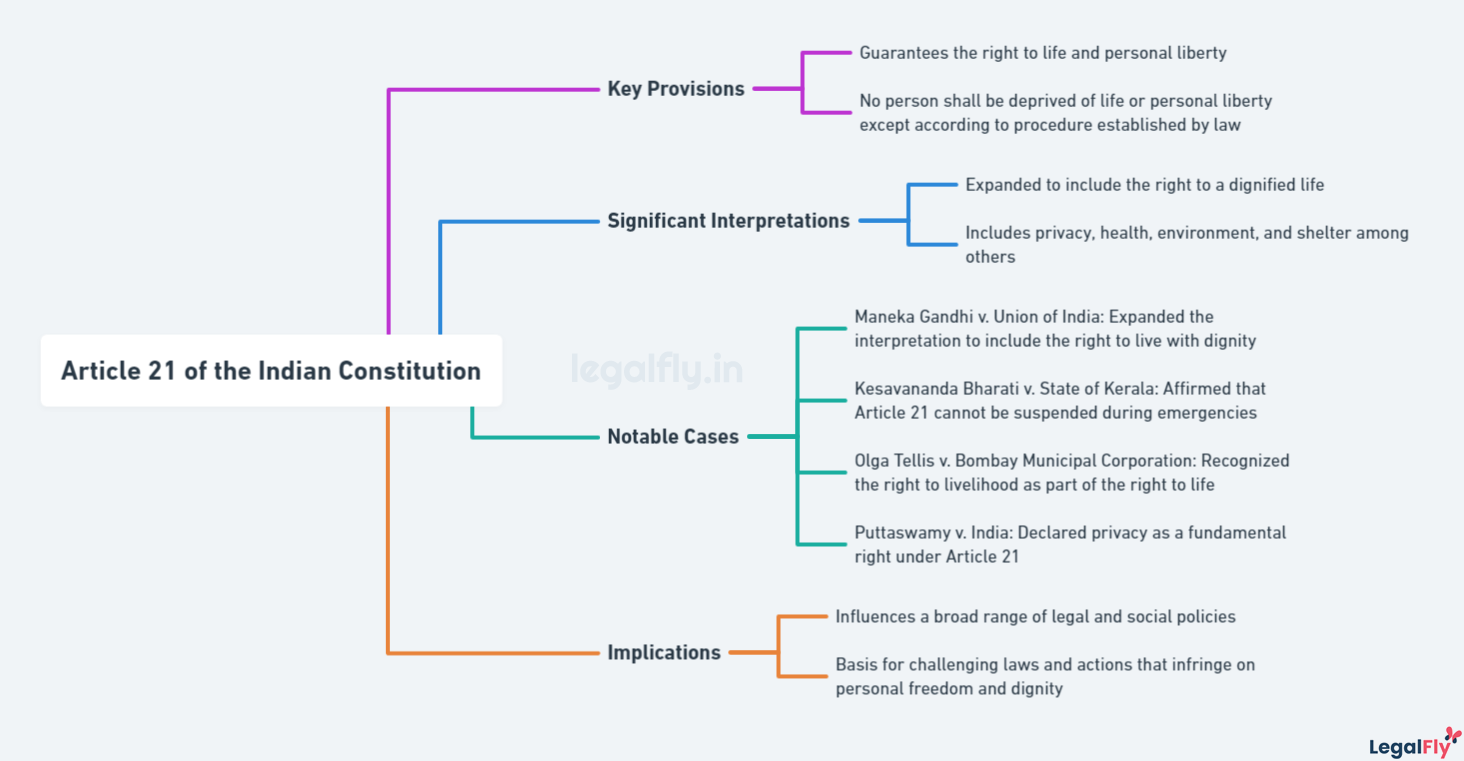
Article 21 guarantees the right to life and personal liberty. Through a line of cases, the Supreme Court has read "life" to mean a life with dignity, not mere animal existence. In Mohini Jain, the Court took the further step of holding that the dignity guaranteed by Article 21 cannot be assured without education, so the right to education is a necessary concomitant of the right to life.
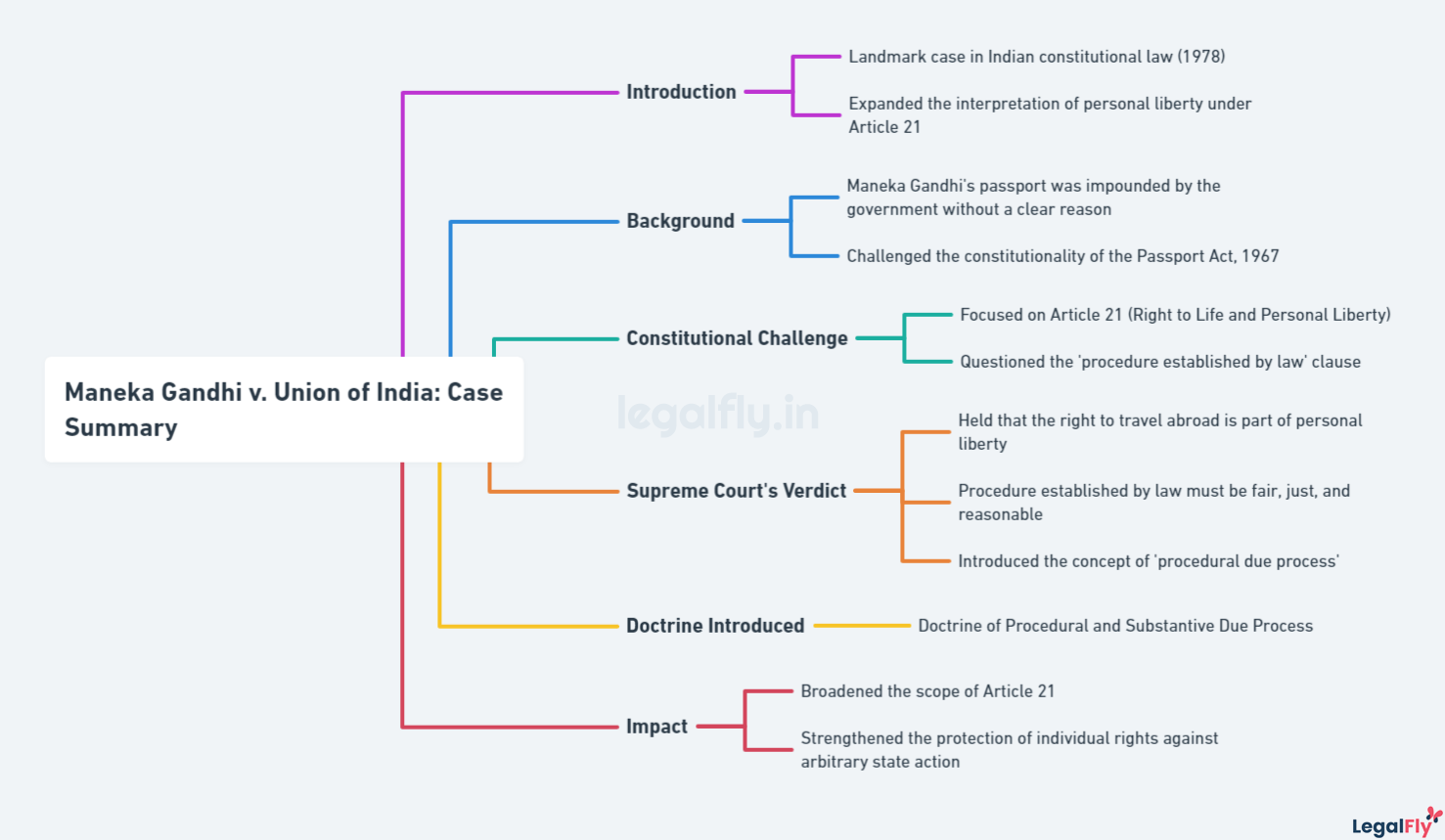
This builds on Maneka Gandhi v. Union of India, where the Court expanded Article 21 to cover a cluster of rights that make life meaningful. That expansive reading supplied the doctrinal foundation for treating the denial of education through capitation fees as an infringement of the right to life.
Article 14 and Right to Equality
Article 14 guarantees equality before the law and equal protection of the laws. The Court held that allowing some students to buy seats with capitation fees, while equally or more meritorious students were excluded for lack of money, was arbitrary and therefore violated Article 14. Treating admission as a function of wealth rather than merit could not be reconciled with the equality guarantee.
Fundamental Right to Education
The judgment's headline contribution was to recognise a right to education as part of the fundamental rights, drawn from Article 21 read with the dignity guarantee and the Directive Principles. The Court stated, in broad terms, that this right is available at every stage of education and that the State has an obligation to provide educational institutions and to ensure they do not deny that right.
This broad formulation is exactly the part that the Constitution Bench later qualified in Unni Krishnan (1993) — see the timeline below. Read on its own, Mohini Jain overstates the constitutional position; read with what followed, it is the starting point of a line that ends in Article 21A and the RTE Act.
Directive Principles of State Policy
The Directive Principles of State Policy in Part IV of the Constitution guide governance even though they are not directly enforceable. The Court relied on Articles 38, 39, 41 and 45 to give content to the right to education. Article 41 directs the State to make effective provision for the right to education within the limits of its economic capacity, and Article 45 (as it then stood) directed the State to endeavour to provide free and compulsory education for children up to the age of 14.
By reading these Directive Principles together with Article 21, the Court concluded that the State could not stand by while access to education was sold to the highest bidder, and that a scheme permitting capitation fees was inconsistent with the constitutional design.
Judgement and Rationale
The two-judge bench of Kuldip Singh and R. M. Sahai JJ. decided the matter in the petitioner's favour, holding the capitation-fee regime unconstitutional.
Analysis of the Karnataka Act
The Court examined the Karnataka Educational Institutions (Prohibition of Capitation Fee) Act, 1984, and the notification issued under the regulatory scheme. It held that any arrangement allowing private colleges to charge capitation fees, or fees so high that they operated as capitation fees, was arbitrary and could not survive scrutiny under Articles 14 and 21. The notification permitting differential, exorbitant fees for non-government-quota seats was struck down to the extent it enabled this.
Arguments and Deliberations
The petitioner, Miss Mohini Jain, argued that capitation fees discriminated on the basis of economic status and so violated Article 14, and that they denied the right to education flowing from Article 21. The State of Karnataka and the colleges defended the fees on the ground that private institutions needed the additional revenue to function and that they received no State aid.
The Court accepted the petitioner's position. It held that education is not a trade or business and cannot be commercialised, and that the State's duty to secure the right to education extends to ensuring that recognised private institutions do not defeat that right through exploitative charges. (Indian constitutional cases are decided by the bench; there is no jury.)
Implications for Private Educational Institutions
The ruling meant that private colleges could not demand capitation fees as a condition of admission. The Court signalled that the fees charged by recognised institutions are subject to constitutional discipline and cannot be set at a level that turns admission into a privilege of the wealthy. This set the stage for the more detailed regulatory scheme that the Court would design a year later in Unni Krishnan.
Impact of the Case
Mohini Jain is significant both for what it decided and for how quickly it was refined. Its real legacy lies in the chain of developments it set in motion.
What Came After: The Right to Education Timeline
A page on Mohini Jain that stops in 1992 is misleading, because the broad right it announced was reshaped almost immediately and then codified by amendment and statute. The following timeline shows how the law moved.
| Milestone | Year | What it did |
|---|---|---|
| Mohini Jain v. State of Karnataka | 1992 | Held the right to education flows from Article 21 and struck down capitation fees; stated, broadly, that education is a fundamental right at every level. |
| Unni Krishnan, J.P. v. State of Andhra Pradesh | 1993 | Five-judge Constitution Bench partly overruled Mohini Jain: the fundamental right to free education exists only up to the age of 14; beyond that it is subject to the State's economic capacity. It also framed a 50:50 "free"/"payment" seat scheme for private professional colleges. |
| Article 21A (86th Constitutional Amendment) | 2002 | Inserted Article 21A, making free and compulsory education a fundamental right for all children aged 6 to 14, to be provided in the manner the State determines by law. |
| T.M.A. Pai Foundation v. State of Karnataka | 2002 | Struck down the rigid Unni Krishnan 50:50 admission/fee scheme as an unconstitutional restriction on the autonomy of private unaided institutions (while retaining primary education as a fundamental right). |
| Right of Children to Free and Compulsory Education (RTE) Act | 2009 | Enacted the law contemplated by Article 21A, guaranteeing free and compulsory education for children aged 6 to 14; came into force on 1 April 2010. |
On Educational Accessibility and Fees
By declaring capitation fees impermissible, Mohini Jain made a strong statement against admission being decided by wealth. It pushed the regulation of private professional education onto the constitutional plane and forced the courts and the legislature to grapple with how to keep education accessible without destroying the viability of private institutions — a balance worked out (and reworked) in Unni Krishnan and T.M.A. Pai.
Precedent for Future Judgements
Mohini Jain is the doctrinal seed of the modern right to education in India: it first located that right in Article 21. But its precedential force is qualified. Unni Krishnan expressly disagreed with its claim that education is a fundamental right at all levels and confined the free-education right to children up to 14. The constitutional position was finally settled by Article 21A and the RTE Act. Mohini Jain therefore matters as the origin point of the line, not as the last word on it.
Conclusion
Mohini Jain v. State of Karnataka established, for the first time, that the right to education in India flows from the right to life and dignity under Article 21, and it struck down capitation fees as arbitrary and a violation of Articles 14 and 21.
Its broadest statement — that education is a fundamental right at every level — did not last. The Constitution Bench in Unni Krishnan (1993) narrowed it to free education up to age 14; Article 21A, inserted by the 86th Constitutional Amendment in 2002, gave that right express constitutional footing; and the RTE Act, 2009 supplied the implementing law. The Unni Krishnan seat scheme was itself later dismantled in T.M.A. Pai (2002).
Read in that sequence, Mohini Jain remains a landmark: not because every line of it is still good law, but because it opened the constitutional conversation about education as a right rather than a commodity that India has been refining ever since.