
Prakash Singh v. Union of India (2006)
In short
In 2006, the Supreme Court issued seven binding directives to all states compelling structural police reforms, including State Security Commissions, fixed tenures for the DGP and field officers, separation of investigation from law-and-order functions, Police Establishment Boards, Police Complaints Authorities, and a National Security Commission.
In this brief
- Background and Context
- The Pre-2006 Reform Landscape
- Why Prakash Singh Filed
- The Supreme Court Judgment and Seven Directives
- The Seven Directives
- Constitutional Grounding
- Implementation and Responses
- National and State-Level Compliance
- Challenges and Resistance
- Judicial Follow-Ups
- The BNSS and the Road Ahead
- Conclusion
The Indian police system endured decades of political interference and negligible accountability until one retired officer took the status quo to the highest court in the land. Prakash Singh — a 1959-batch IPS officer of the Uttar Pradesh cadre who served as DGP of Uttar Pradesh, DGP of Assam, and Director General of the Border Security Force (BSF) — filed a landmark Public Interest Litigation in 1996 seeking implementation of reforms that commissions had recommended since 1981 but governments had consistently shelved.
The Supreme Court's judgment on 22 September 2006 did not merely offer recommendations. It issued a writ of mandamus — seven binding directives — to the central and all state governments, compelling a structural overhaul of India's police architecture. The Court transformed police reform from a matter of political discretion into a constitutional obligation, creating a judicially-monitored framework that the states are still struggling to honour nearly two decades on.
Background and Context
The petition emerged from decades of documented failure. India's policing framework still rested on the colonial-era Indian Police Act, 1861 — a statute designed for an occupied country, not a democratic republic. Multiple high-level bodies had proposed comprehensive replacements, but successive governments declined to act.
The Pre-2006 Reform Landscape
- National Police Commission (1977–81): The most exhaustive post-independence review. Its eight reports documented pervasive political interference in appointments, transfers, and investigations, and proposed foundational structural reforms. All were shelved.
- Ribeiro Committee (1998): Appointed by the Supreme Court during the pendency of Prakash Singh's PIL. It reviewed and broadly endorsed the NPC's core recommendations.
- Padmanabhaiah Committee (2000): Focused on internal police reforms, recruitment, and modernisation.
The complete failure of the executive to act — even after the Supreme Court had referred the matter to a committee it appointed — persuaded the bench that judicial intervention was not only appropriate but constitutionally necessary.
Why Prakash Singh Filed
Singh's career gave him an unmatched vantage point. He had led three of India's most complex law-enforcement institutions and had firsthand experience of the systemic pressures that compromised police effectiveness: arbitrary transfers used as political punishment, the absence of any minimum tenure for station officers, and the complete absence of any independent body to receive public complaints against police misconduct. His PIL sought implementation of the NPC recommendations in full.
The Supreme Court Judgment and Seven Directives
On 22 September 2006, a bench of Chief Justice Y.K. Sabharwal, Justice C.K. Thakker, and Justice P.K. Balasubramanyan delivered the judgment. The Court noted that radical changes in India's political, social, and economic landscape since 1861 had never been accompanied by any corresponding review of the police system. It found that the existing structure permitted excessive political interference in police operations and issued binding directives pending the enactment of new state police legislation.
The Seven Directives
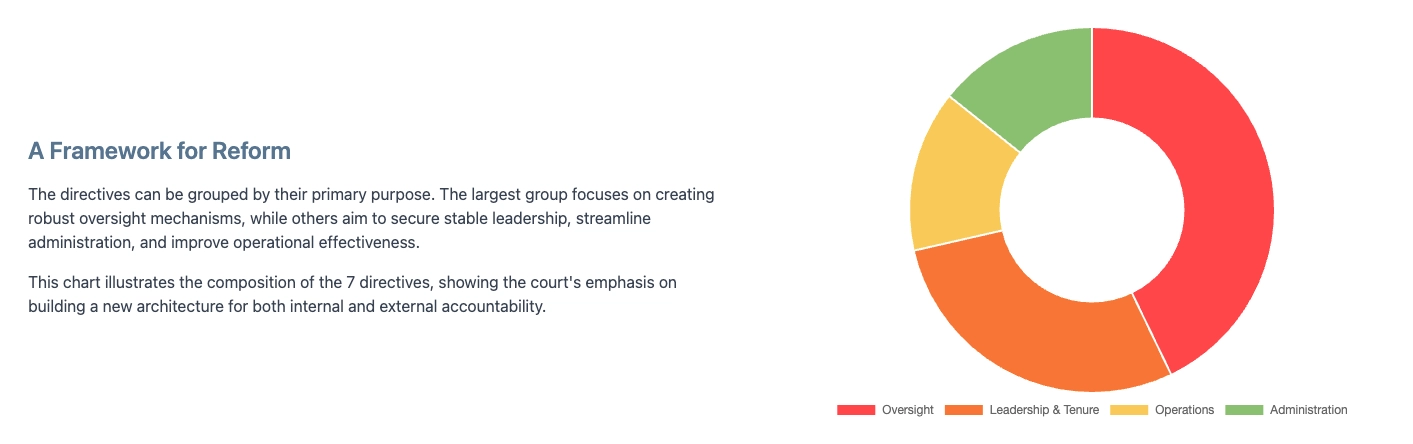
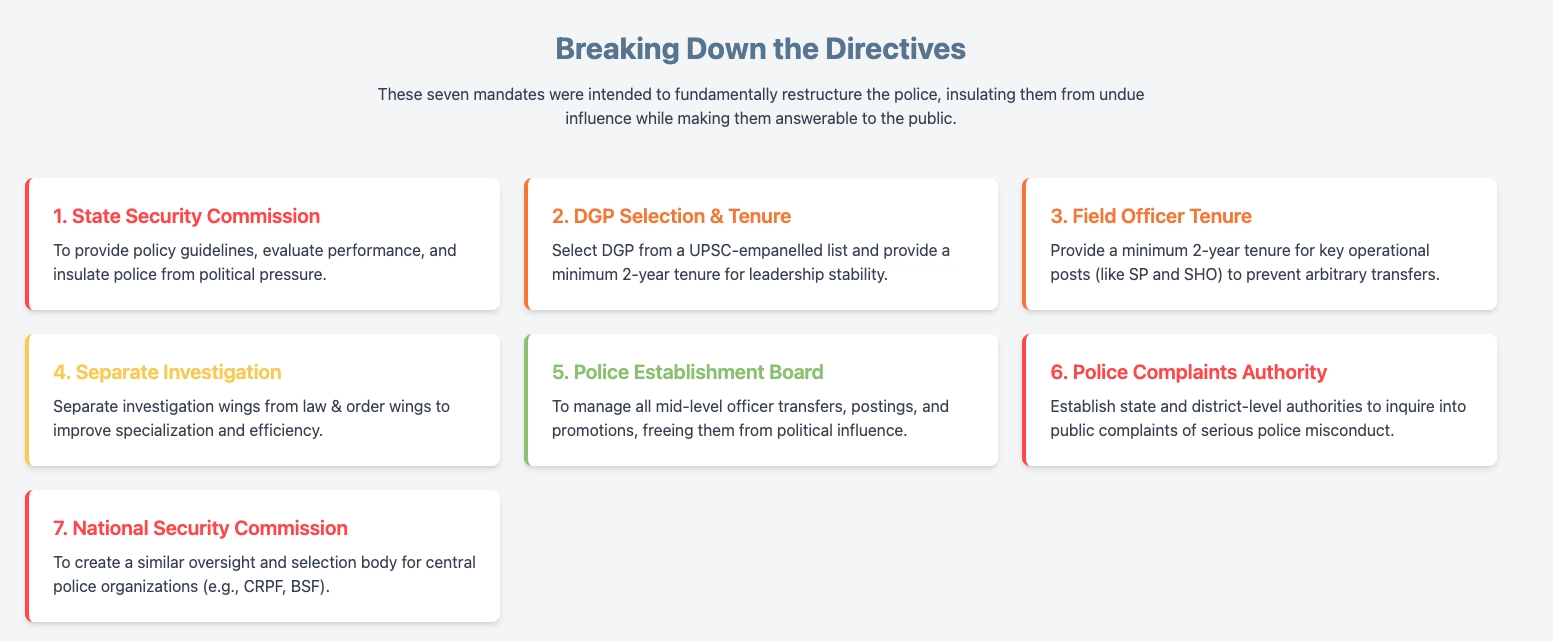
The Court issued seven binding directives under Article 32 of the Constitution, to operate as interim measures until states enacted legislation consistent with the Model Police Act. The directives addressed the full spectrum of structural reform:
| # | Directive | Core Requirement |
|---|---|---|
| 1 | State Security Commission (SSC) | Every state to constitute an SSC to lay down broad policing policy, evaluate performance, and insulate the force from undue political pressure. Headed by the Chief Minister or Home Minister; must include the Leader of the Opposition, a retired High Court judge, and independent civil society members. |
| 2 | DGP Selection and Minimum Tenure | The Director General of Police must be selected by the state government from a panel of the three seniormost eligible officers empanelled by the UPSC on the basis of length of service, record, and range of experience. Once selected, the DGP must be granted a minimum tenure of two years, irrespective of the date of superannuation. |
| 3 | Minimum Tenure for Field Officers | Officers on operational duty — Inspector General of Police, Superintendent of Police, and Station House Officer (SHO) — to be given a minimum posting tenure of two years to protect them from arbitrary, politically-motivated transfers. |
| 4 | Separation of Investigation from Law & Order | A phased programme to separate investigative functions from law-and-order policing in all cities and towns with a population of ten lakh or more. The objective is to professionalise criminal investigation and free it from the pressures of routine public-order duties. |
| 5 | Police Establishment Board (PEB) | A PEB — headed by the DGP and comprising four senior officers — to be constituted in every state to decide all transfers, postings, promotions, and other service matters for officers at and below the rank of Deputy Superintendent of Police. The Board's decisions may be appealed to the SSC. |
| 6 | Police Complaints Authority (PCA) | Independent PCAs to be established at both the state level (headed by a retired judge of the Supreme Court or High Court) and at the district level (headed by a retired district judge) to inquire into public complaints of serious misconduct — including custodial death, grievous hurt, rape, and wrongful arrest — by police personnel. |
| 7 | National Security Commission (NSC) | An NSC to be set up at the Union level, headed by the Union Home Minister, to prepare panels for selection of chiefs of Central Police Organisations (CPOs such as CRPF, BSF, CISF) and to review their service conditions and performance. |
Constitutional Grounding
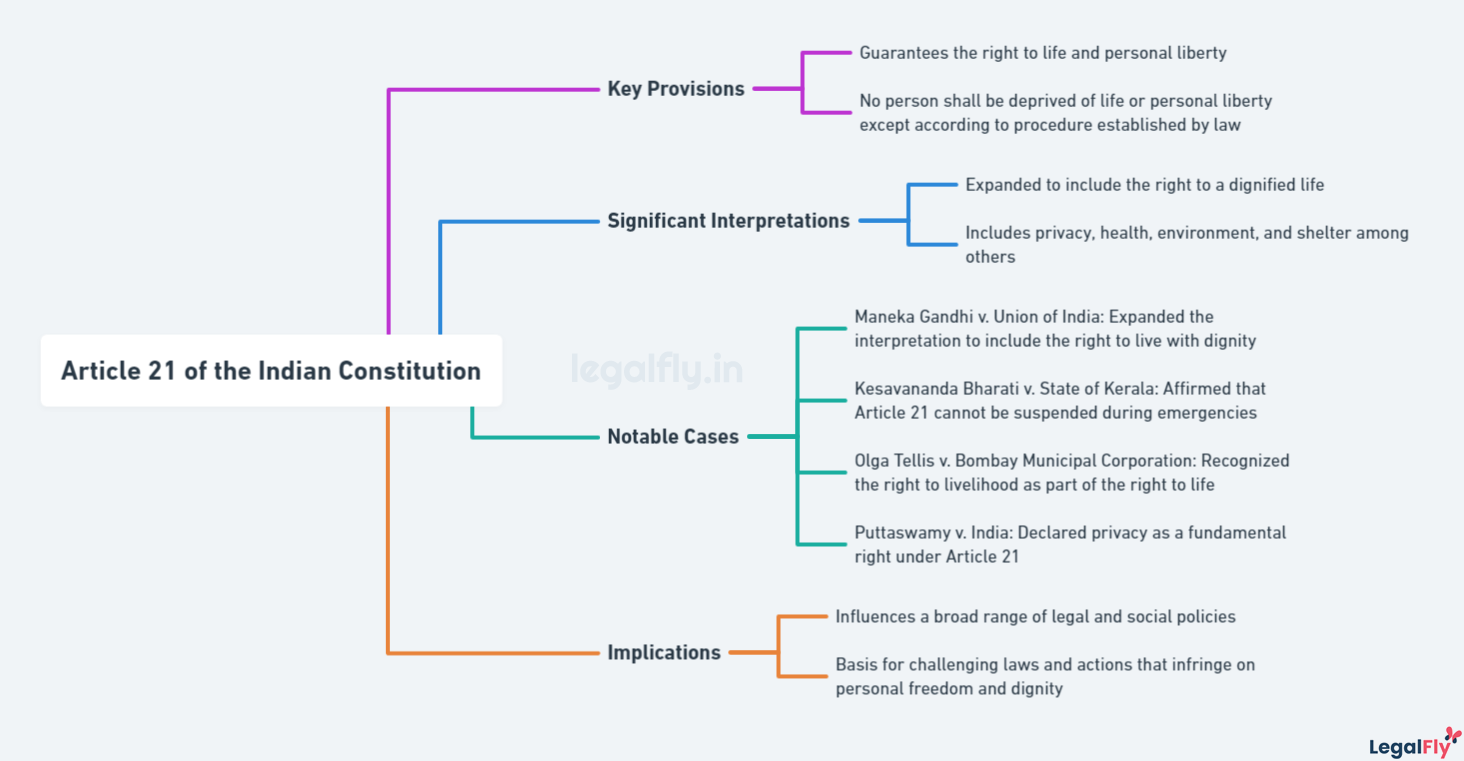
The Court grounded its directives in Articles 21 (right to life and personal liberty) and 32 (right to constitutional remedies). It reasoned that an un-reformed, politically subservient police force directly undermines the guarantee of life and liberty for ordinary citizens — particularly the poor and marginalised, who are most often the subjects of custodial abuse and whose complaints are most readily ignored.
The judgment carefully preserved the federal structure: police is a state subject under the Seventh Schedule, so the directives bound each state individually. At the same time, the Court held that the union's failure to enact model legislation — and the states' failure to act on NPC recommendations for twenty-five years — amounted to an abdication of constitutional duty that warranted judicial intervention.
The Court also insisted on experience and seniority criteria for senior appointments and required that civilian oversight bodies be headed by retired judicial officers — a design intended to keep them independent of both politicians and the police hierarchy.
Implementation and Responses
The Supreme Court set a compliance deadline of 31 December 2006. That deadline passed. So did every year since. Implementation has been the most contested and disappointing chapter of the Prakash Singh story.
National and State-Level Compliance
The central government responded by promulgating a Model Police Act, 2006 — drafted by a committee chaired by former Attorney General Soli Sorabjee — as a template for states to adopt. As of 2025, only 17 states have enacted new police legislation since the judgment. Even among those, most deviate significantly from the Model Act's intent, particularly on the composition and powers of the SSC and PCA.
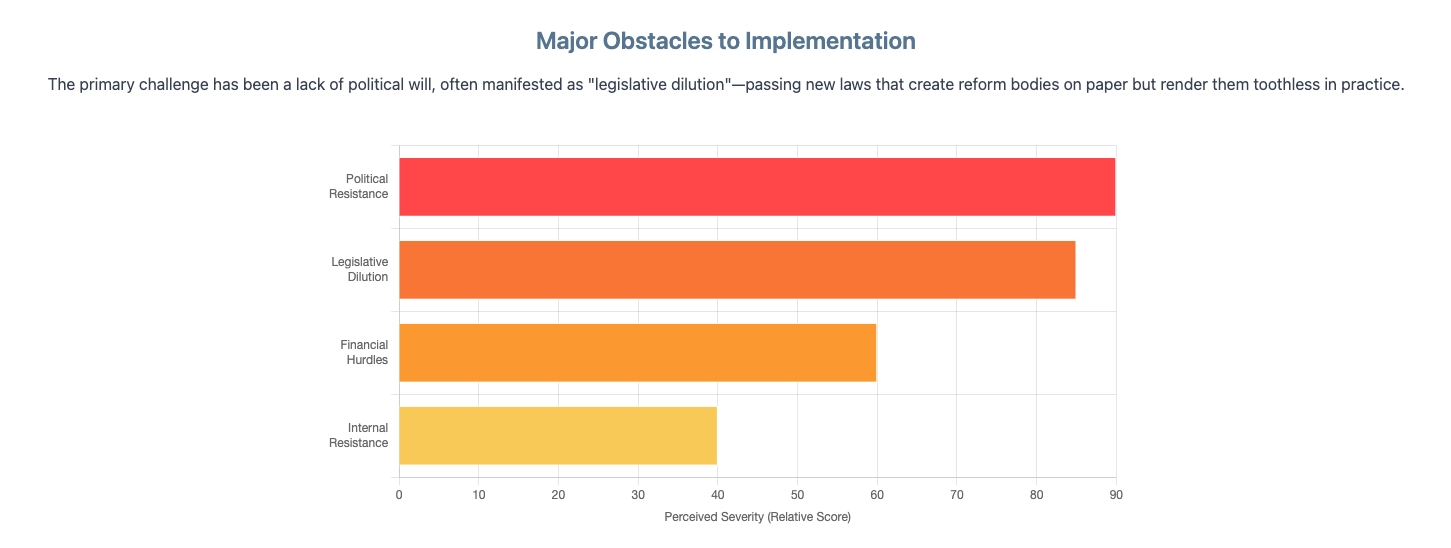
A 2024 assessment by the Commonwealth Human Rights Initiative (CHRI) found that no state has fully complied with all seven directives. States with relatively better compliance include Kerala, Meghalaya, and Tripura. Bihar, Jharkhand, and Uttar Pradesh — ironically, the state whose police Singh once led — ranked among the worst performers. Virtually every state that has passed new legislation has preserved the political executive's practical control over appointments and transfers, defeating the directives' central purpose.
Challenges and Resistance
The resistance has been both political and structural. State governments — across party lines — regard control over the police as an essential instrument of power. The directives on fixed tenures and UPSC empanelment of the DGP directly threaten that control, which explains why they are the least-honoured of the seven.
- State Security Commissions have been constituted in most states but are frequently stacked with government loyalists and meet rarely.
- Police Establishment Boards exist on paper in several states but are bypassed when inconvenient: transfers continue to be directed by political offices.
- Police Complaints Authorities — the mechanism with the most direct impact on citizens — remain non-functional or toothless in the majority of states.
- The separation of investigation and law-and-order functions has been implemented in very few urban areas and in a limited, largely nominal manner.
Judicial Follow-Ups
Recognising that a single judgment was insufficient, the Supreme Court has maintained continuous jurisdiction over the case for nearly two decades. This sustained oversight has included:
- Monitoring Committees: The Court appointed the Justice Thomas Committee and subsequent oversight bodies to assess and report on state-by-state compliance.
- Contempt Proceedings: The Court has repeatedly issued show-cause notices and initiated contempt proceedings against state governments and senior officials who failed to comply.
- Clarificatory Orders: When states enacted legislation that nominally complied but gutted the substance, the Court issued clarificatory orders reaffirming the binding nature of the directives.
The BNSS and the Road Ahead
The Bharatiya Nagarik Suraksha Sanhita, 2023 (BNSS) — which replaced the Code of Criminal Procedure, 1973 (CrPC) with effect from 1 July 2024 — modernises procedural criminal law but does not directly address the structural and governance concerns raised in Prakash Singh. The BNSS introduces timelines for investigation, mandatory videography of crime scenes, and expanded provisions on electronic evidence; it also retains and slightly expands police detention powers under Section 187 (corresponding to the old Section 167 CrPC). None of this alters the underlying problem the Court identified in 2006: the absence of structural independence from political control. Compliance with the Prakash Singh directives remains a separate, ongoing constitutional obligation that the BNSS does not discharge.
The Model Police Act, 2006 — still unadopted in full by any state — remains the most comprehensive legislative response available. Academics, civil society groups, and the Court itself have continued to call for its implementation. Without political will to enact genuine legislation, the seven directives remain aspirational for most of India's population.
Conclusion
Prakash Singh v. Union of India is simultaneously a triumph and a cautionary tale. It demonstrates the Supreme Court's capacity to step into a constitutional vacuum and compel structural reform through judicial mandate. It also illustrates the limits of that capacity: a writ of mandamus cannot by itself supply political will. Nearly twenty years later, the judgment stands as the most authoritative statement on what Indian policing must become — and the compliance record stands as an equally authoritative measure of how far it still has to go. For law students, practitioners, and policymakers, this case is essential reading on judicial activism, constitutional governance, and the enduring gap between a declared legal right and its ground-level realisation.