
Shah Bano Case (1985): Muslim Women & Maintenance
In short
In Mohd. Ahmed Khan v. Shah Bano Begum (1985), a five-judge bench led by Chief Justice Y.V. Chandrachud held that a divorced Muslim woman who cannot maintain herself is entitled to maintenance under Section 125 CrPC beyond the iddat period — the secular provision applies to all citizens regardless of religion. The political backlash led to the Muslim Women (Protection of Rights on Divorce) Act, 1986, which appeared to limit the husband's liability to iddat; but in Danial Latifi (2001) the Court read the Act down to require a fair lifetime provision, and in 2024 reaffirmed that Muslim women can still claim under Section 125.
In this brief
- Introduction
- Key takeaways
- Historical context and case overview
- The Shah Bano case
- Maintenance and personal law
- Legal proceedings and the Supreme Court judgment
- The landmark judgment
- Muslim personal law vs civil-law obligations
- Consequences and legislative response
- The aftermath of the judgment
- The 1986 Act and the controversy
- Impact on maintenance rights and gender equality
- Redefining maintenance rights — and Danial Latifi
- Advancing gender equality in personal laws
- Analysis and educational significance
- The Shah Bano case in legal education
- Personal law in the context of civil obligations
Introduction
Mohd. Ahmed Khan v. Shah Bano Begum, 1985 AIR 945 (popularly the "Shah Bano case"), is a landmark Supreme Court decision on the maintenance rights of divorced Muslim women. A five-judge Constitution Bench, led by Chief Justice Y.V. Chandrachud, held that a divorced Muslim woman who is unable to maintain herself is entitled to maintenance from her former husband under Section 125 of the Code of Criminal Procedure, 1973 (CrPC) — a secular provision that applies to all citizens, beyond the limited iddat period recognised by Muslim personal law.
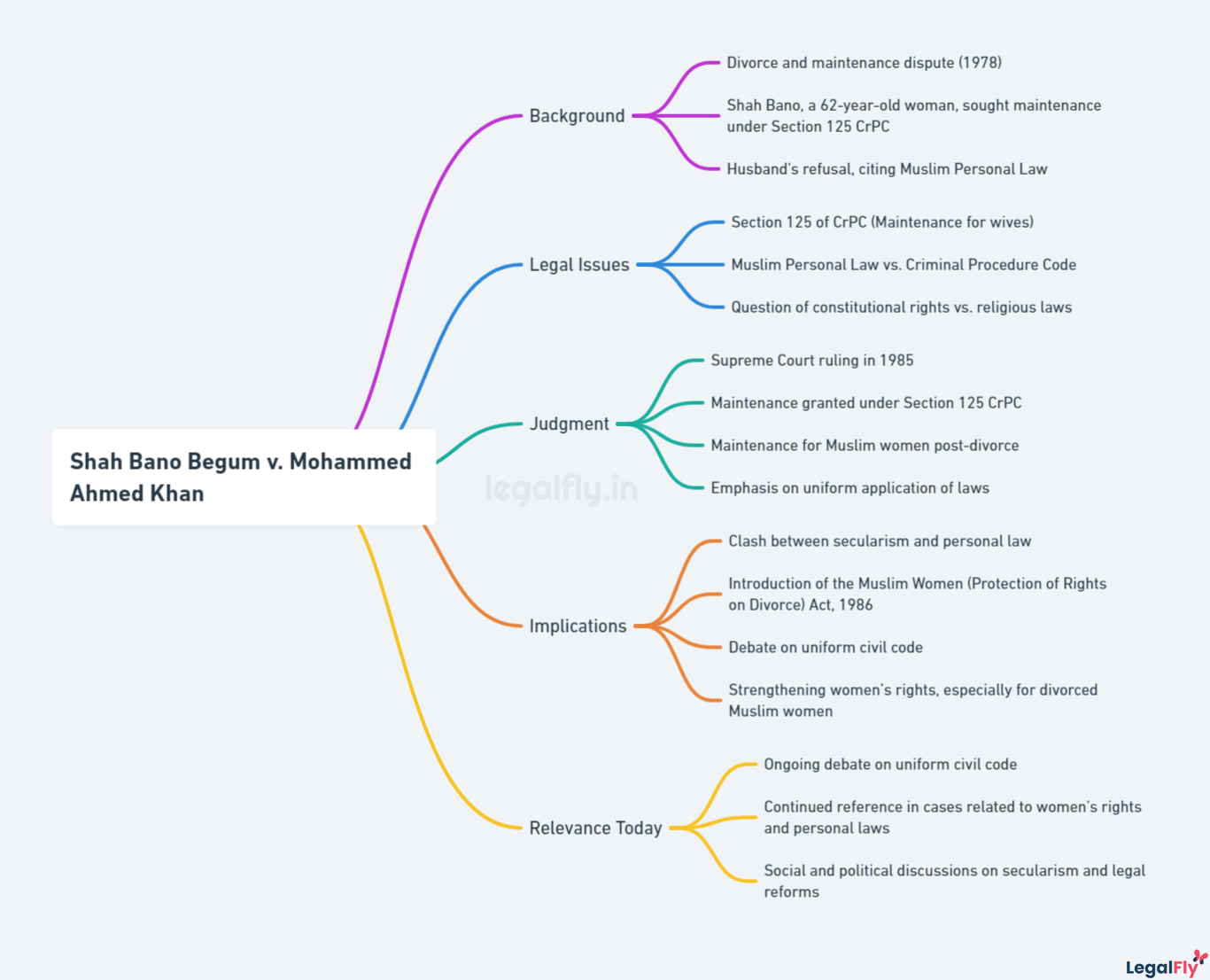
The decision triggered one of independent India''s most intense debates on secularism, gender justice and the relationship between religious personal law and the general law. It led Parliament to pass the Muslim Women (Protection of Rights on Divorce) Act, 1986 — and a further line of cases that has, in substance, preserved Shah Bano''s protection.
Key takeaways
- A divorced Muslim woman can claim maintenance under Section 125 CrPC, beyond the iddat period, if she cannot maintain herself.
- Section 125 is a secular, religion-neutral provision; it prevails over personal law where they conflict.
- The 1986 Act sought to limit the husband''s liability — but in Danial Latifi (2001) the Court read it to require a fair provision for the woman''s whole life, and a 2024 ruling reaffirmed the Section 125 route.
Historical context and case overview
The case forced the courts to decide whether a general, secular maintenance law could be invoked by a Muslim woman, or whether her rights were confined to what Muslim personal law provided on divorce.
The Shah Bano case
Shah Bano Begum, a woman in her sixties from Indore, was divorced by her husband, Mohd. Ahmed Khan (a lawyer), by triple talaq in 1978 after decades of marriage. Unable to maintain herself, she sought maintenance under Section 125 CrPC. A Magistrate granted her a small monthly sum, which the Madhya Pradesh High Court enhanced to about ₹179.20 per month. The husband appealed to the Supreme Court, arguing that under Muslim personal law his obligation ended after the iddat period (roughly three months after divorce) and that he had paid the dower (mahr).
Maintenance and personal law
The Supreme Court dismissed the husband''s appeal. It held that maintenance for a divorced Muslim woman is not confined to the iddat period: Section 125 CrPC, a secular provision intended to prevent destitution, applies to everyone irrespective of religion. The Court found no real conflict between Section 125 and Muslim personal law, but added that, where a conflict exists, the secular provision prevails. It controversially also offered its own reading of Quranic verses and urged the framing of a Uniform Civil Code under Article 44.
Legal proceedings and the Supreme Court judgment
The case squarely tested the relationship between civil maintenance obligations and religious personal law.
The landmark judgment
Shah Bano''s claim rested on Section 125 CrPC, which obliges a person with sufficient means to maintain a wife (including a divorced wife who has not remarried), children or parents who cannot maintain themselves.
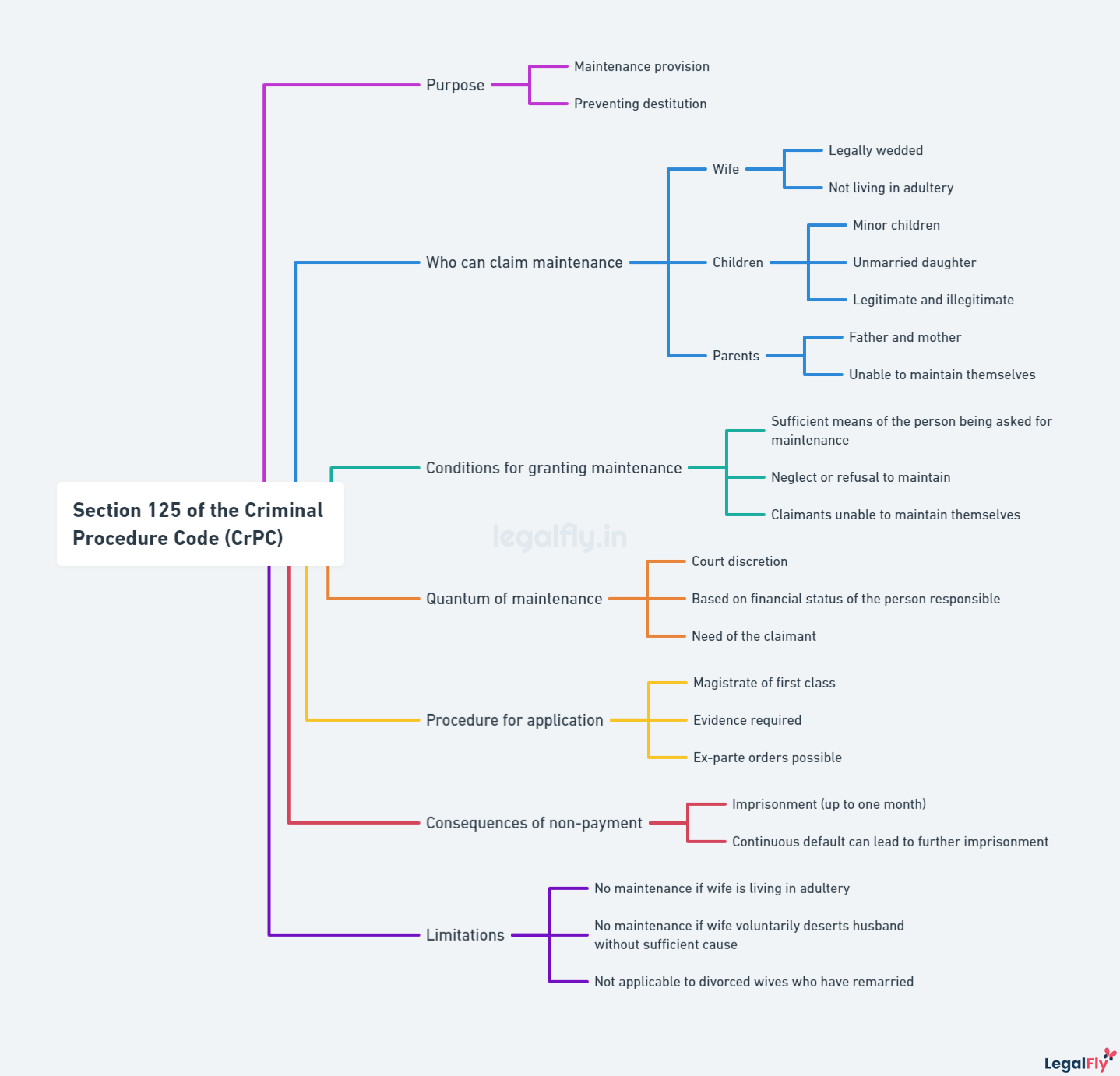
Chief Justice Chandrachud, writing for the Court, held that Section 125 overrides personal law to the extent necessary to prevent vagrancy and destitution, and that a divorced Muslim woman unable to support herself is entitled to maintenance under it beyond iddat. The ruling was hailed as a major advance for women''s rights — and immediately became a flashpoint in the debate over a Uniform Civil Code.
Muslim personal law vs civil-law obligations
Under a traditional reading of Muslim personal law, a husband''s maintenance obligation is limited to the iddat period (about three months). Section 125 CrPC, by contrast, makes maintenance a continuing civil obligation so long as the divorced wife cannot maintain herself and has not remarried.
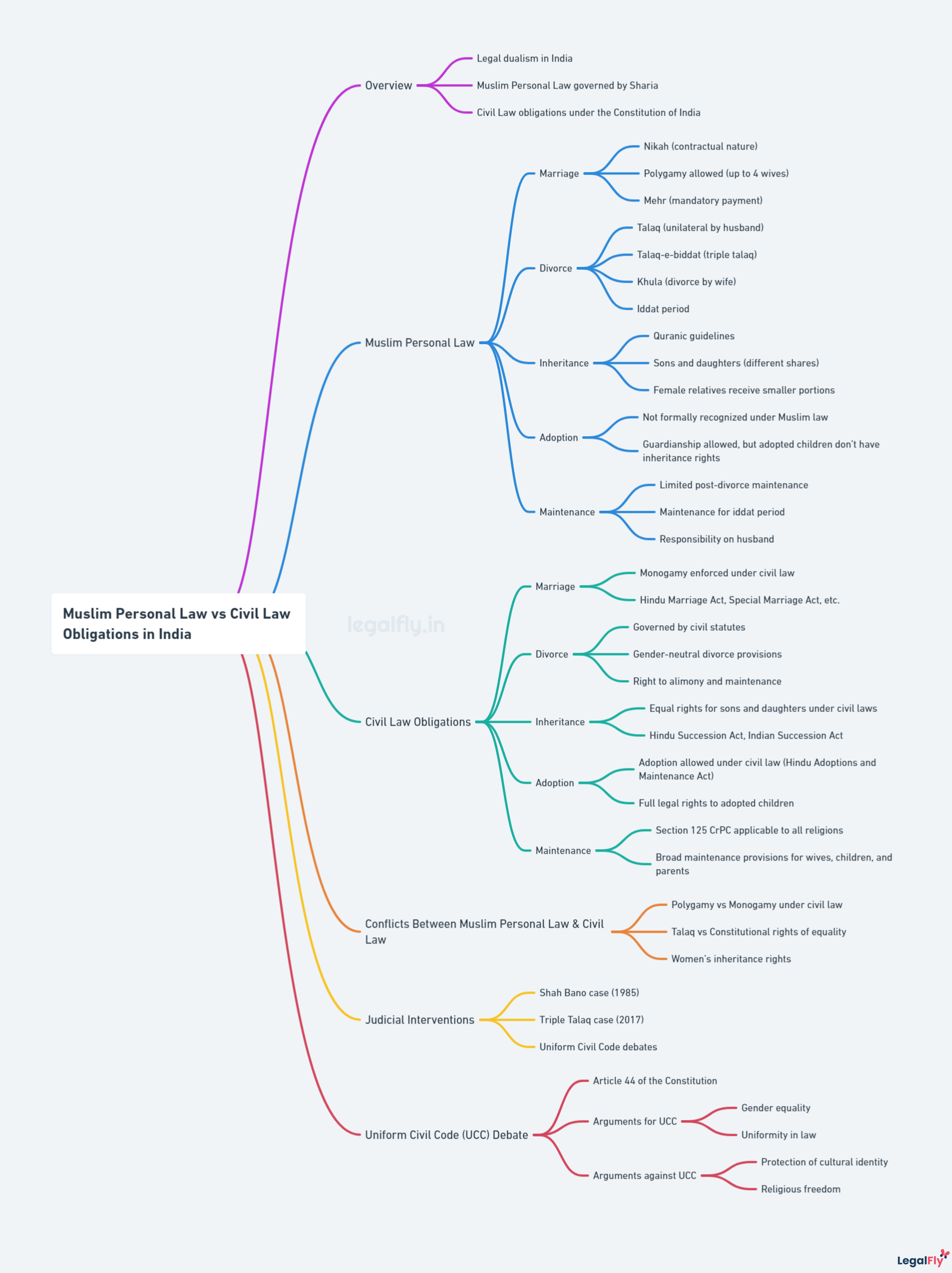
By applying the secular provision, the Court extended that protection to Muslim women — and it was precisely this extension that provoked the political and legislative reaction described below.
Consequences and legislative response
The judgment set off a national controversy and a swift legislative response.
The aftermath of the judgment
Women''s-rights advocates welcomed the decision as a milestone for gender justice. Many conservative Muslim organisations, including the All India Muslim Personal Law Board, opposed it as judicial interference in religious law, and the Court''s interpretation of religious texts drew particular criticism. The episode became a defining test of secular adjudication and minority rights.
The 1986 Act and the controversy
Responding to the backlash, the government led by Prime Minister Rajiv Gandhi enacted the Muslim Women (Protection of Rights on Divorce) Act, 1986. On its face the Act appeared to confine the husband''s liability to the iddat period, with maintenance thereafter to come from the woman''s relatives or the State Waqf Board. Critics saw it as a politically motivated move to overturn Shah Bano, and it intensified calls for a Uniform Civil Code. Crucially, however, the Act''s effect was later softened by the courts (see below).
Impact on maintenance rights and gender equality
Shah Bano reshaped the law on maintenance for Muslim women — but its final shape was set by the cases that followed.
Redefining maintenance rights — and Danial Latifi
The most important sequel is Danial Latifi v. Union of India (2001) 7 SCC 740. There, a Constitution Bench upheld the constitutionality of the 1986 Act but read it down: it held that the husband must make a "reasonable and fair provision" for the divorced wife''s future — sufficient to support her for the rest of her life (or until she remarries) — and that, while this provision must be arranged within the iddat period, it is not limited to the iddat period. The effect was to preserve the substance of Shah Bano despite the 1986 Act.
The position was reaffirmed in Mohd Abdul Samad v. State of Telangana (2024), where the Supreme Court held that a divorced Muslim woman may still seek maintenance under Section 125 CrPC (now Section 144 of the Bharatiya Nagarik Suraksha Sanhita, 2023); the 1986 Act, the Court said, operates in addition to — not in derogation of — Section 125, and the woman may choose either remedy or both.
Advancing gender equality in personal laws
Shah Bano put the gender-justice dimension of personal law on the national agenda. It exposed how a narrow reading of personal law could leave divorced women destitute, and it established that constitutional and secular protections cannot be displaced by such readings. Its legacy runs through later reforms touching Muslim women''s rights, including the Supreme Court''s 2017 ruling against instant triple talaq and the Muslim Women (Protection of Rights on Marriage) Act, 2019.
Analysis and educational significance
The case is a fixture of family-law and constitutional-law study because it shows the courts mediating between religious personal law and secular civil obligations.
The Shah Bano case in legal education
For students, Shah Bano illustrates how a secular, welfare-oriented provision (Section 125 CrPC) applies across religious communities to prevent destitution, and how the judiciary balances personal law against constitutional guarantees of equality and dignity. It is also a case study in the limits of judicial pronouncements: the legislative reversal in 1986 and the judicial "re-reversal" in Danial Latifi (2001) together teach how courts, Parliament and society interact on contested social questions.
Personal law in the context of civil obligations
The enduring lesson is that maintenance of a destitute divorced wife is treated as a civil obligation that personal law cannot defeat. The timeline below captures the journey:
| Year | Development |
|---|---|
| 1978 | Shah Bano is divorced by triple talaq; she seeks maintenance under Section 125 CrPC |
| 1985 | Supreme Court: a divorced Muslim woman can claim Section 125 maintenance beyond iddat |
| 1986 | Parliament enacts the Muslim Women (Protection of Rights on Divorce) Act |
| 2001 | Danial Latifi: Act upheld but read down — fair provision for the woman''s whole life, arranged within iddat |
| 2024 | Mohd Abdul Samad: Muslim women can still claim under Section 125 CrPC (now BNSS §144) |
Across these stages, the core principle of Shah Bano — that a divorced Muslim woman unable to maintain herself must not be left destitute — has survived intact.