
Case Summary: Entick v Carrington (1765)
In short
The Court of Common Pleas held unanimously that a general warrant from the Secretary of State had no legal basis. Every invasion of private property is a trespass, and government may do nothing unless the law expressly permits it.
In this brief
Entick v Carrington (1765) is a cornerstone of English and UK constitutional law. The Court of Common Pleas held unanimously that a general warrant issued by the Secretary of State had no basis in statute or common law. In doing so, Lord Camden CJ articulated the foundational rule-of-law principle: the state may do nothing unless the law expressly permits it; individuals may do anything the law does not forbid.
Facts
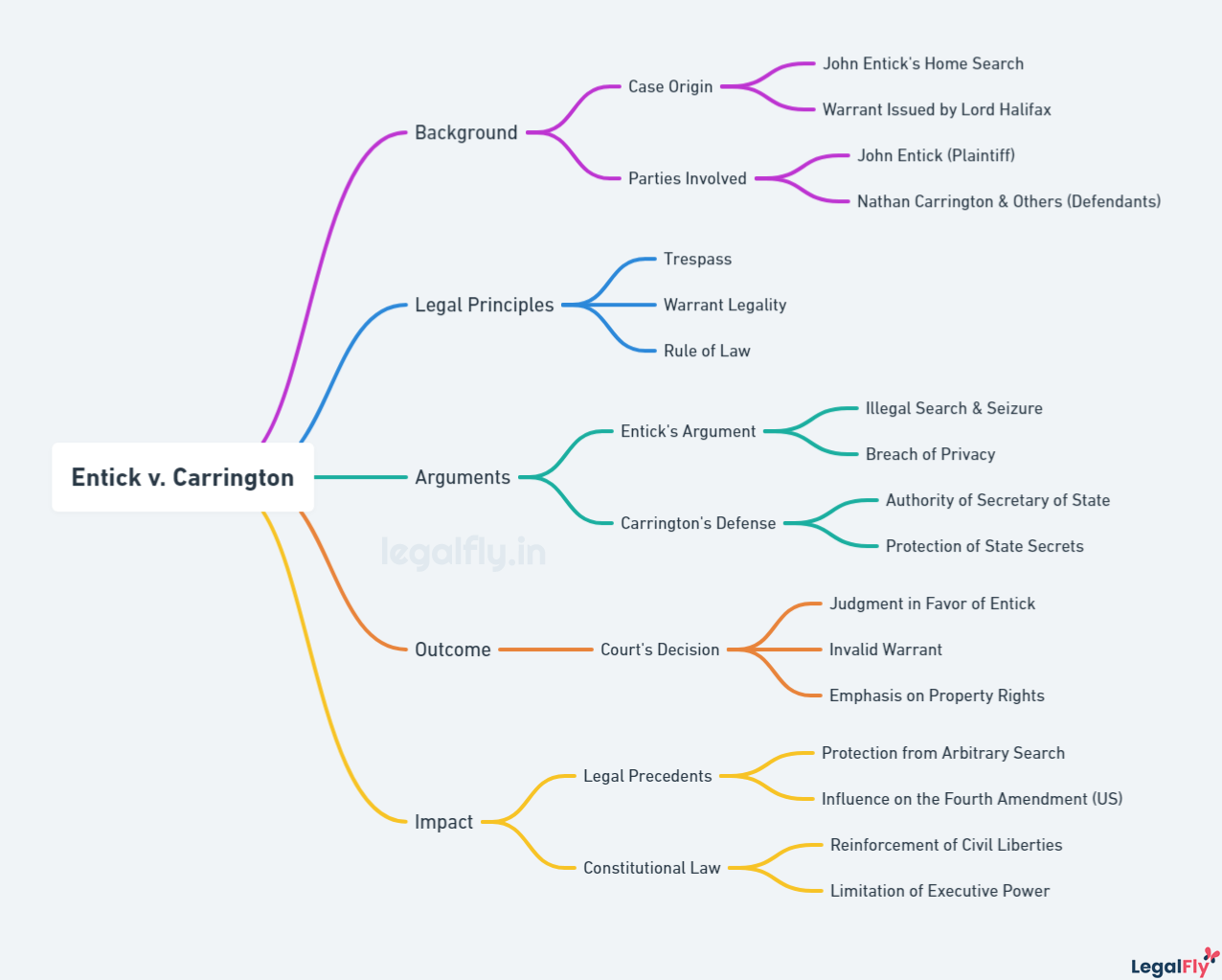
John Entick wrote and published The Monitor, or British Freeholder, a pamphlet critical of the government of King George III. On 11 November 1762, Nathan Carrington and three other King's Messengers entered Entick's London home under a warrant issued by the Earl of Halifax, Secretary of State. They spent four hours searching every room, breaking open locks, chests, and drawers, and seizing Entick's books and papers wholesale. The warrant was a general warrant: it did not name the specific documents to be seized and gave the messengers sweeping, unchecked authority to search and take whatever they found.
Entick sued Carrington and the other messengers for trespass. The defence was that the agents had acted under a valid warrant from a Crown officer with customary authority to issue such warrants.
Judgment — Lord Camden CJ (2 November 1765)
The Court of Common Pleas found unanimously for Entick and awarded £300 in damages. Lord Camden CJ — Charles Pratt, 1st Earl Camden, Chief Justice of the Common Pleas — held that the Earl of Halifax had no authority, whether in statute or in prior case law, to issue such a warrant. Long usage by Secretaries of State could not, by itself, create a legal power. He stated:
"If no excuse can be found or produced, the silence of the books is an authority against the defendant, and the plaintiff must have judgment."
On the sanctity of private property:
"By the laws of England, every invasion of private property, be it ever so minute, is a trespass. No man can set his foot upon my ground without my licence, but he is liable to an action though the damage be nothing."
On general warrants, Camden held that such a power in the Secretary of State's hands was "totally subversive of the liberty of the subject" — it could expose every person in the kingdom to arbitrary executive intrusion.
Key facts at a glance
| Element | Detail |
|---|---|
| Full citation | (1765) 19 St Tr 1029; 95 ER 807 |
| Court | Court of Common Pleas |
| Judge | Lord Camden CJ (Charles Pratt, 1st Earl Camden) |
| Date | 2 November 1765 |
| Plaintiff | John Entick (author, The Monitor, or British Freeholder) |
| Defendant | Nathan Carrington & three other King's Messengers |
| Warrant issued by | Earl of Halifax, Secretary of State |
| Outcome | Unanimous judgment for plaintiff; £300 damages |
| Core rule | Government may act only as law permits; individuals may do anything not forbidden by law |
Core legal principles
The rule of law
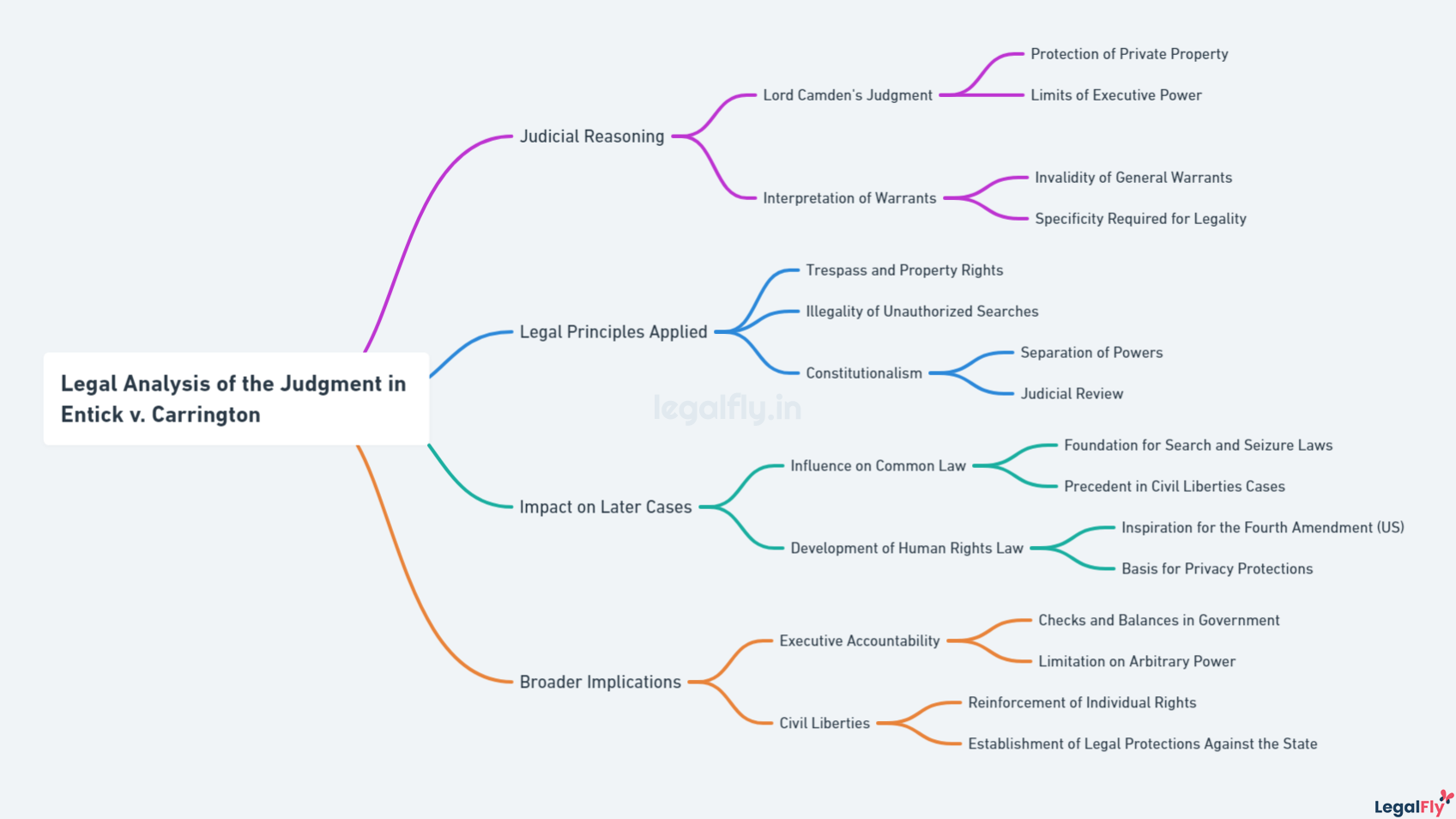
The most enduring legacy of the case is Camden's formulation of the rule-of-law principle: the state's authority is positive and bounded. It must point to an express source of legal power — statute or common law — for every act it takes against a citizen. Where that source does not exist, the courts will not supply it, however settled the practice. This contrasts with the position of private individuals, who are free to do anything the law does not prohibit.
General warrants
A general warrant names neither the specific person to be searched nor the particular items to be seized. Camden held such warrants entirely void. The companion case Wilkes v Wood (1763) had reached the same conclusion in connection with John Wilkes's political pamphlets. Together the two decisions effectively ended the Secretary of State's practice of issuing general warrants.
Private papers and self-incrimination
Camden treated private papers as especially intimate — closer in nature to the person than ordinary goods. Compelling their wholesale seizure on an untested suspicion edged toward forced self-incrimination. This reasoning was borrowed, in later centuries, by courts developing the modern right to privacy.
India: constitutional connections
Although decided in 18th-century England, Entick v Carrington has been expressly applied in Indian constitutional law:
- MP Sharma v Satish Chandra (1954) — The Supreme Court of India examined the Indian search-and-seizure regime (then under the CrPC) in light of the English common-law tradition shaped by Entick, noting that executive search powers must be specifically authorised by law and cannot be exercised on bare fiat.
- PUCL v Union of India (1997) — The Supreme Court struck down unchecked executive authorisation for telephone interception and required that the communication to be intercepted, the person, and the address all be specified — a direct application of the anti-general-warrant principle from Entick.
- KS Puttaswamy v Union of India (2017) — The nine-judge bench that recognised privacy as a fundamental right under Article 21 traced its intellectual genealogy through Entick v Carrington and successive Indian judgments (Kharak Singh, Gobind). After Puttaswamy, any search or surveillance must satisfy a three-part test: (i) legality — a law must exist authorising it; (ii) legitimate aim; and (iii) proportionality. This is the constitutional operationalisation of the Entick principle.
Influence on the US Fourth Amendment
The US Supreme Court described Entick as "one of the landmarks of English liberty" and "undoubtedly familiar to every American statesman at the time of the Constitutional Convention." The Fourth Amendment's particularity requirement — warrants must describe "the place to be searched, and the persons or things to be seized" — is a direct constitutional response to the general warrants Camden condemned. Key later decisions:
- Katz v United States (1967) — extended Fourth Amendment protection to what people reasonably expect to be private, not merely physical spaces.
- Kyllo v United States (2001) — applied Entick's reasoning to police use of thermal imaging to gather evidence from inside a private home without a warrant.
- United States v Jones (2012) — relied on Entick's property-trespass analysis to hold that attaching a GPS tracker to a vehicle was a "search."
- Carpenter v United States (2018) — invoked Entick in extending Fourth Amendment protection to historical cell-site location records as the digital-age equivalent of private papers.
Conclusion
Entick v Carrington is less a case about trespass than a case about the architecture of power. Camden's answer to "by what authority?" still echoes: the executive must point to a law. Where it cannot, the court finds against it. That discipline — government authority positively defined and bounded by law — is as live a principle in India today, through Puttaswamy and PUCL, as it was in 18th-century England.