
Case Summary: Indira Gandhi v. Raj Narain
In short
After the Allahabad High Court set aside Indira Gandhi's 1971 election for corrupt practices, the 39th Amendment inserted Article 329A to place her election beyond judicial review. On appeal, the Supreme Court (7 Nov 1975) struck down clause (4) of Article 329A for violating the basic structure — the first use of the Kesavananda doctrine against a constitutional amendment — but allowed her appeal on the merits because the Representation of the People Act had been amended retrospectively. The Emergency (declared 25 June 1975) followed the High Court verdict, not this judgment.
In this brief
Background of the Case
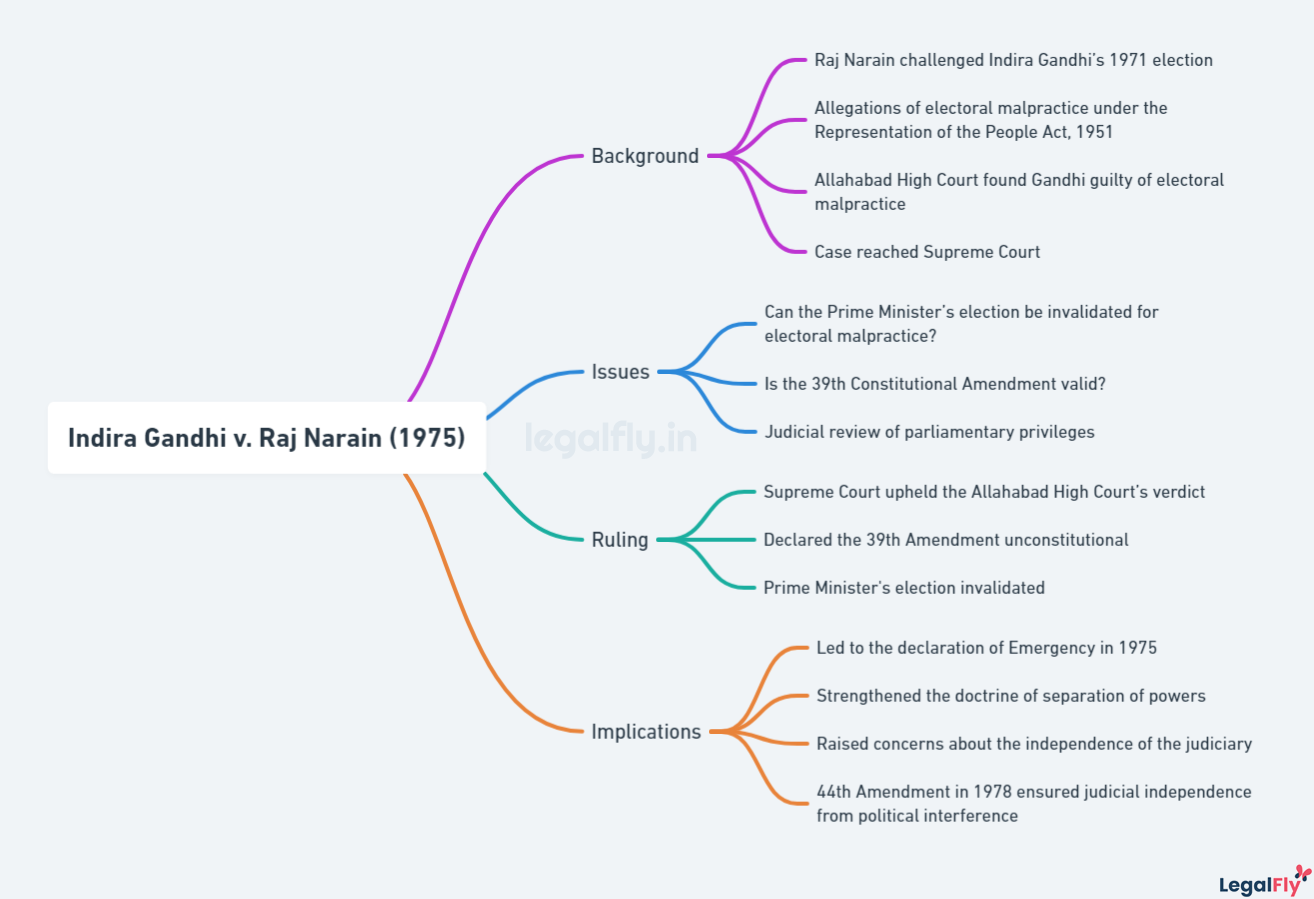
In the 1971 general election, Prime Minister Indira Gandhi contested the Rae Bareli Lok Sabha seat in Uttar Pradesh and won decisively. Her defeated rival, the veteran socialist Raj Narain of the Samyukta Socialist Party, refused to accept the result and filed an election petition in the Allahabad High Court alleging that she had won by corrupt electoral practices. What began as an ordinary election dispute ended up triggering the declaration of the Emergency and producing one of the most important constitutional judgments in Indian history.
| Element | Detail |
|---|---|
| Case | Indira Nehru Gandhi v. Raj Narain & Anr. |
| Citation | AIR 1975 SC 2299; 1975 Supp SCC 1 |
| Court / Bench | Supreme Court of India — 5 judges (Ray C.J., Khanna, Mathew, Beg, Chandrachud JJ.) |
| Decided | 7 November 1975 |
| Below | Raj Narain v. Indira Nehru Gandhi (Allahabad High Court, Sinha J., 12 June 1975) |
| Significance | First time a constitutional amendment was struck down for violating the basic structure |
Key Legal Issues
Two distinct questions sat at the heart of the case:
- The election dispute: Had Indira Gandhi committed "corrupt practices" within the meaning of the Representation of the People Act, 1951, so as to render her election void?
- The constitutional question: Was the Thirty-ninth Amendment — which inserted Article 329A to shield the Prime Minister's election from judicial scrutiny — itself valid, or did it violate the basic structure of the Constitution?
The High Court Verdict
On 12 June 1975, Justice Jagmohanlal Sinha of the Allahabad High Court found Indira Gandhi guilty of two corrupt practices under the Representation of the People Act and declared her 1971 election void, additionally disqualifying her from contesting elections for six years. Crucially, she was acquitted of the more sensational charges (such as bribery and large-scale misuse of funds); the conviction rested on two narrower findings:
- Yashpal Kapoor: she had obtained the assistance of Yashpal Kapoor, a gazetted government officer, in her campaign before his resignation from government service had taken effect.
- Government machinery: state officials had built rostrums and arranged power supply for loudspeakers at her election meetings — assistance from government servants that the Act forbids.
The verdict against a sitting Prime Minister was unprecedented and plunged the country into political crisis.
The Conditional Stay and the Emergency
Indira Gandhi appealed to the Supreme Court. On 24 June 1975, Justice V.R. Krishna Iyer (sitting as vacation judge) granted only a conditional stay: she could remain Prime Minister and attend Parliament, but could not vote in the House or draw a salary as a member until the appeal was decided.
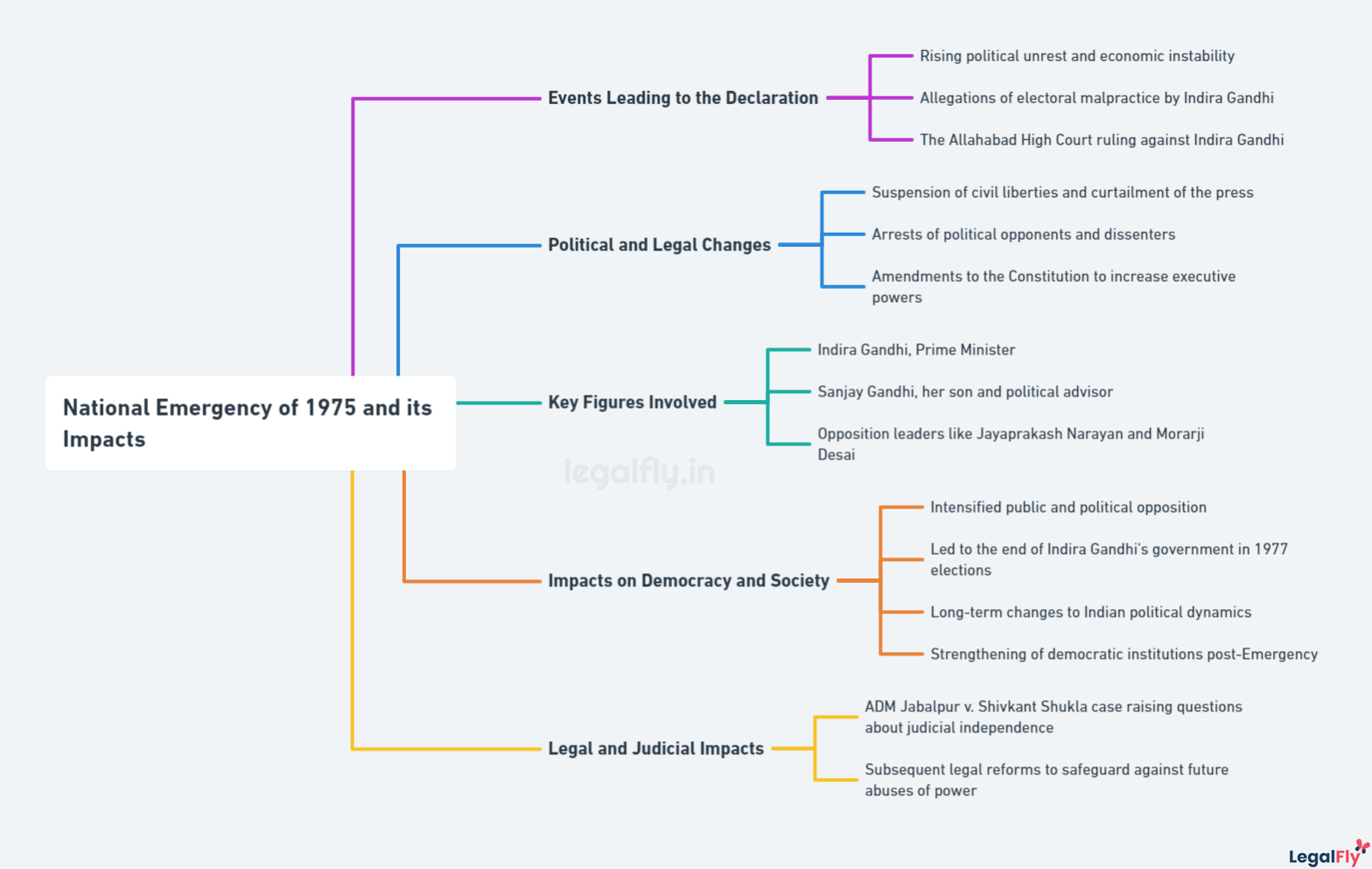
The very next day — 25 June 1975 — the government declared a national Emergency under Article 352. It is important to be precise about the sequence: the Emergency was the response to the High Court verdict and the limited relief on appeal, not to the Supreme Court's final judgment, which would not come until November. During the Emergency (which lasted until March 1977), civil liberties were suspended, the press was censored, and opposition leaders were jailed.
The 39th Amendment and Article 329A
While the appeal was pending, Parliament — with most of the opposition in jail — passed the Constitution (Thirty-ninth Amendment) Act, 1975. It inserted Article 329A, clause (4) of which declared that the election of the Prime Minister (and Speaker) could not be questioned in any court, retrospectively validated Indira Gandhi's election, and purported to wipe out the Allahabad High Court's finding. Parliament also amended the Representation of the People Act retrospectively, through the Election Laws (Amendment) Act, 1975, to remove the very grounds on which Sinha J. had convicted her.
The Supreme Court Judgment
On 7 November 1975, the five-judge bench delivered a judgment with two distinct limbs that are easy to confuse but point in opposite directions:
- On the Constitution: the Court struck down clause (4) of Article 329A as unconstitutional. Applying the basic structure doctrine laid down in Kesavananda Bharati (1973), the judges held that placing an election beyond all judicial scrutiny destroyed essential features of the Constitution — free and fair elections, the rule of law, equality and judicial review. This was the first occasion on which the Supreme Court used the basic structure doctrine to invalidate a constitutional amendment.
- On the election: the Court nonetheless allowed Indira Gandhi's appeal and upheld her election. Because the Representation of the People Act had been amended retrospectively, the two grounds on which she had been disqualified no longer amounted to corrupt practices, and Raj Narain's cross-appeal was rejected.
So she won her seat back on the merits, but the constitutional shield her government had built to protect it was demolished.
| Issue | Holding |
|---|---|
| Article 329A(4) | Struck down — violates the basic structure (free and fair elections, rule of law, judicial review) |
| Indira Gandhi's election | Upheld — corrupt-practice grounds removed by the retrospectively amended election law |
| Raj Narain's cross-appeal | Rejected |
Timeline at a Glance
| Date | Event |
|---|---|
| 1971 | Indira Gandhi wins Rae Bareli; Raj Narain files election petition |
| 12 Jun 1975 | Allahabad HC voids her election, disqualifies her for 6 years |
| 24 Jun 1975 | Supreme Court grants a conditional stay |
| 25 Jun 1975 | National Emergency declared under Article 352 |
| Aug 1975 | 39th Amendment inserts Article 329A; election law amended retrospectively |
| 7 Nov 1975 | Supreme Court strikes down Art 329A(4) but upholds her election |
Legacy of Indira Gandhi v. Raj Narain
The case is remembered less for who won the seat than for what it did to the basic structure doctrine. By striking down Article 329A(4), the Court converted Kesavananda Bharati's abstract principle into a working limit on Parliament's amending power — establishing that even a constitutional amendment cannot abolish free and fair elections, judicial review or the rule of law. The doctrine has since been used to test amendments in cases such as Minerva Mills (1980) and the S.R. Bommai line of authority.
After the Emergency ended, the Constitution (Forty-fourth Amendment) Act, 1978 reversed many of its excesses — tightening the conditions for declaring an Emergency under Article 352 and restoring procedural safeguards — so that the constitutional machinery could not be turned against democracy in the same way again.
Conclusion
Indira Gandhi v. Raj Narain shows constitutional democracy defending itself under pressure. A government tried to place its leader's election above the law by amending the Constitution itself; the Court let her keep the seat on the merits but refused to let the amendment stand, holding that some features of the Constitution are beyond Parliament's reach. The case cemented the basic structure doctrine as the ultimate check on the amending power and remains a defining moment in the relationship between India's judiciary and its executive.