
Kesavananda Bharati v. State of Kerala (1973): Case Summary
In short
In Kesavananda Bharati v. State of Kerala (1973), a 13-judge Supreme Court bench held by 7:6 that Parliament can amend any part of the Constitution under Article 368 but cannot destroy its 'basic structure'.
In this brief
- Introduction to the Kesavananda Bharati Case
- The Constitutional Amendments and the Challenge
- The Supreme Court's Verdict and Its Implications
- Analysing the Basic Structure Doctrine
- Key Arguments Presented by Both Sides
- Arguments by the Petitioner
- Defence by the State of Kerala
- The Role of the Largest Bench in Indian Judicial History
- Significance of the 13-Judge Bench
- How the Bench's Composition Influenced the Outcome
- The Aftermath of the Kesavananda Bharati Judgment
- Landmark Cases Influenced by Kesavananda Bharati
- Subsequent Cases Applying the Basic Structure Doctrine
- Role in Preserving Democracy
- Conclusion: The Enduring Legacy of Kesavananda Bharati v. State of Kerala
- Reflections on the Case's Legal Contribution
- Kesavananda Bharati's Place in Indian Legal History
Introduction to the Kesavananda Bharati Case
Kesavananda Bharati v. State of Kerala (1973) is the single most important decision in Indian constitutional law. Decided by a 13-judge bench — the largest ever assembled by the Supreme Court of India — it gave birth to the basic structure doctrine, which permanently limits Parliament's power to amend the Constitution under Article 368.
The petitioner, His Holiness Kesavananda Bharati Sripadagalvaru, was the senior pontiff and head of the Edneer Mutt (Matha), a Hindu monastery in Kasaragod district, Kerala. In February 1970, acting through the celebrated jurist Nani Palkhivala, he challenged two Kerala land reform statutes that restricted the management of the mutt's property, invoking his right to administer religious property under Article 26 of the Constitution.

What began as a religious-property dispute grew into a confrontation over the very limits of constitutional amendment. The hearing ran for 68 days — among the longest in the Court's history — and the verdict, delivered on 24 April 1973 by a thin 7:6 majority, reshaped the balance between Parliament and the judiciary.
The Constitutional Amendments and the Challenge
The case unfolded against a backdrop of conflict between the government of Prime Minister Indira Gandhi and the Supreme Court. After the Court held in Golak Nath v. State of Punjab (1967) that Parliament could not amend Fundamental Rights, Parliament responded with a wave of amendments to reassert and widen its amending power. Three of these were squarely in issue:
- 24th Amendment (1971) — expressly affirmed Parliament's power to amend any part of the Constitution, including Fundamental Rights, and made the President bound to assent to a Constitution Amendment Bill.
- 25th Amendment (1972) — curtailed the right to property and inserted Article 31C, which protected laws giving effect to the directive principles in Articles 39(b) and (c) and — in its controversial second part — sought to bar courts from even examining whether such a law actually furthered those principles.
- 29th Amendment (1972) — placed two Kerala land reform Acts in the Ninth Schedule, seeking to shield them from challenge under Article 31B.
Bharati's petition was widened to attack all three amendments. The core question was no longer about one mutt's land, but about whether there was any limit at all on Parliament's power to rewrite the Constitution.
The Supreme Court's Verdict and Its Implications
By a 7:6 majority, the bench reached a carefully balanced result. It partly overruled Golak Nath, holding that Parliament can amend any part of the Constitution, including Fundamental Rights, under Article 368 — but subject to one decisive limit: it cannot damage or destroy the basic structure of the Constitution.
Applying that test, the Court upheld the 24th Amendment in full and upheld the 29th Amendment. It upheld the first part of Article 31C (inserted by the 25th Amendment) but struck down its second part — the clause ousting judicial review — because judicial review is itself part of the basic structure. The table below summarises the outcome.
| Amendment challenged | What it did | Outcome |
|---|---|---|
| 24th Amendment (1971) | Affirmed Parliament's power to amend any part of the Constitution under Art. 368. | Upheld |
| 25th Amendment (1972) — Art. 31C, first part | Protected laws giving effect to Art. 39(b) and (c). | Upheld |
| 25th Amendment (1972) — Art. 31C, second part | Barred courts from reviewing such laws. | Struck down (violated judicial review) |
| 29th Amendment (1972) | Added two Kerala land reform Acts to the Ninth Schedule. | Upheld |
The result was a defeat for Bharati on the immediate land-reform question yet a watershed for constitutional law: for the first time, the Court declared that some constitutional features lie beyond Parliament's reach. The operative conclusions were recorded in a short document titled "View by the Majority," signed by nine of the thirteen judges — itself a point of later controversy, since the thirteen judges had delivered eleven separate opinions running to over 700 pages.
Analysing the Basic Structure Doctrine
The basic structure doctrine holds that certain foundational features of the Indian Constitution are so essential to its identity that no amendment under Article 368 may abrogate them. Parliament's amending power is wide but not unlimited; an amendment that destroys the basic structure is void.
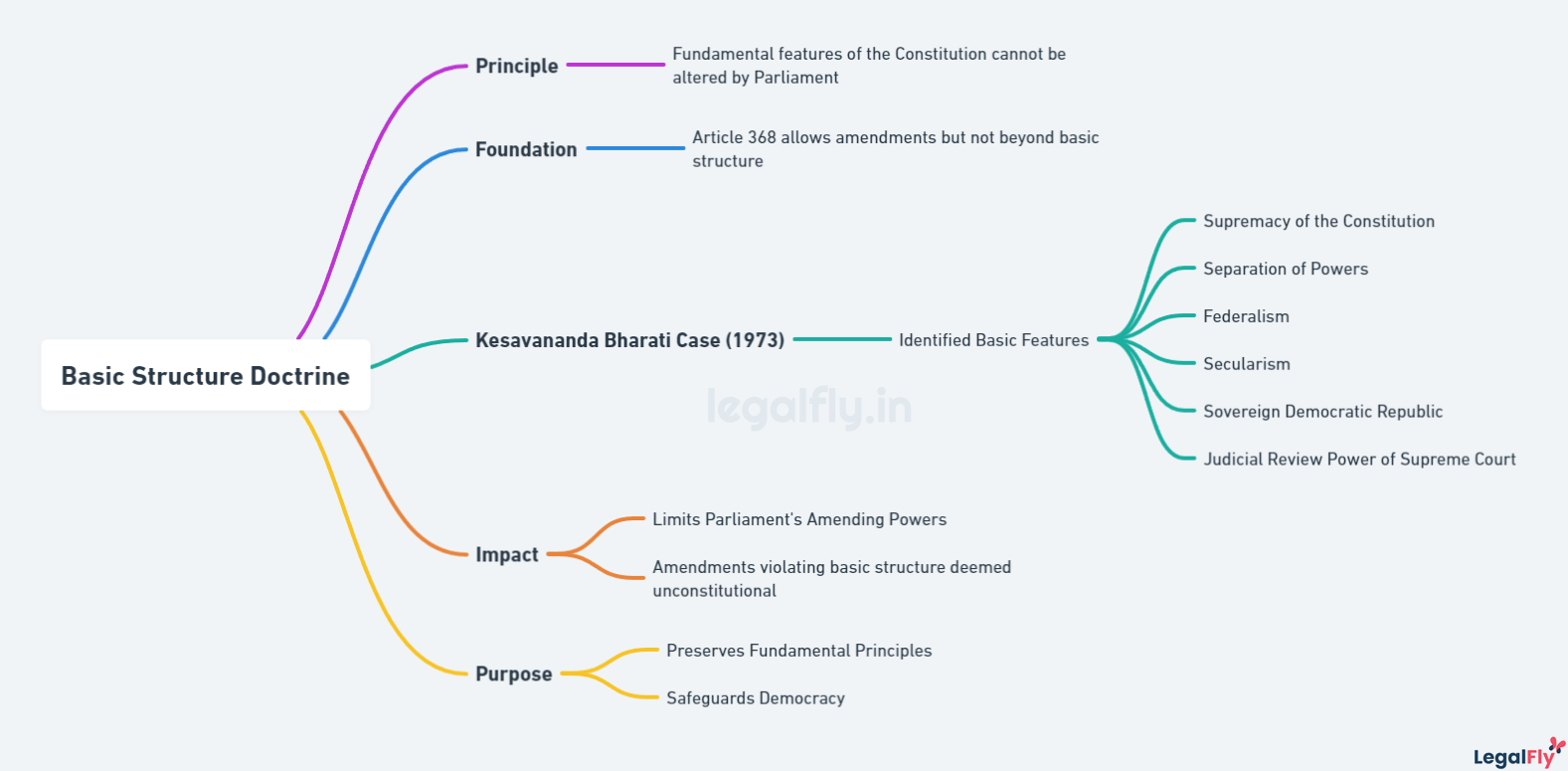
The judges did not give an exhaustive list — and deliberately so — but the majority opinions identified illustrative features. These have been expanded and refined in later cases.
| Within the basic structure | Not part of it (per this case) |
|---|---|
| Supremacy of the Constitution | The fundamental right to property (Art. 31), which could be amended |
| Rule of law and separation of powers | Any single Fundamental Right as an absolute, unamendable entitlement |
| Judicial review and an independent judiciary | — |
| Federalism and secularism | — |
| Sovereign, democratic, republican character of the polity | — |
| Free and fair elections; dignity of the individual | — |
The doctrine is open-ended by design: courts decide, case by case, whether a particular feature is "basic" and whether an amendment damages it. That flexibility is both its strength and the source of continuing debate.
Key Arguments Presented by Both Sides
Arguments by the Petitioner
Led by Nani Palkhivala, the petitioner argued that the word "amend" in Article 368 does not include the power to abrogate or rewrite the Constitution's essential framework. Parliament could change the Constitution, but it could not use that power to abolish Fundamental Rights, judicial review or the democratic structure itself. The 25th Amendment's attempt to oust the courts, he submitted, struck at the heart of the rule of law.
Defence by the State of Kerala
The State, supported by the Union, contended that Parliament's power to amend under Article 368 was plenary and unlimited, reaching every provision of the Constitution. The amendments, it argued, were valid exercises of that power and were needed to carry out land reform and the directive principles under Article 39, so that no implied limitation should be read into Article 368.
The Role of the Largest Bench in Indian Judicial History
The case was heard by a bench of 13 judges — the largest ever constituted by the Supreme Court of India, a record that still stands. The bench was assembled precisely because the case raised fundamental questions about the limits of constitutional amendment and required reconsideration of Golak Nath.
Significance of the 13-Judge Bench
The scale of the bench signalled the gravity of the issues. Bringing together the Chief Justice of India, S.M. Sikri, and twelve of the senior-most judges ensured that the decision would carry maximum authority. It also guaranteed that competing constitutional philosophies were represented, sharpening the debate and the eventual reasoning.
Because the judges delivered numerous separate opinions, the judgment is one of the most intricate in Indian legal history; the operative position had to be distilled into the brief "View by the Majority" signed by nine judges.
How the Bench's Composition Influenced the Outcome
The result turned on a single vote. The table below sets out the divide on the central question of whether Parliament's amending power is subject to implied limits.
| Majority (7) — power is limited by basic structure | Minority (6) — power is unlimited |
|---|---|
| CJI S.M. Sikri | A.N. Ray |
| J.M. Shelat | K.K. Mathew |
| K.S. Hegde | M.H. Beg |
| A.N. Grover | S.N. Dwivedi |
| B.K. Mukherjea (Mukherjee) | D.G. Palekar |
| P. Jaganmohan Reddy | Y.V. Chandrachud |
| H.R. Khanna (concurring on the limit) | — |
Justice H.R. Khanna's separate opinion provided the decisive seventh vote for the basic structure limit, even as he differed on some particulars. Had the composition tilted the other way, the doctrine that now anchors Indian constitutionalism might never have emerged.
The Aftermath of the Kesavananda Bharati Judgment
The verdict drew strong reactions. The government regarded it as a check on Parliament's authority, while much of the bar saw it as a safeguard for constitutional democracy. Its consequences were immediate and lasting:
- The day after the judgment, the government superseded three of the senior judges who had ruled against unlimited amending power and appointed Justice A.N. Ray as Chief Justice — a move widely criticised as an attack on judicial independence.
- The doctrine placed a permanent, judicially enforceable limit on Article 368, ending the idea of unbounded parliamentary sovereignty over the Constitution.
- It established the Supreme Court as the final arbiter of the validity of constitutional amendments, strengthening judicial review.
- It became the most-cited foundation for striking down later amendments that overreached, shaping the course of Indian constitutional law.
Landmark Cases Influenced by Kesavananda Bharati
The basic structure doctrine has been applied repeatedly to test — and sometimes invalidate — constitutional amendments and executive action.
Subsequent Cases Applying the Basic Structure Doctrine
| Case | Year | What it held | Basic structure feature |
|---|---|---|---|
| Indira Nehru Gandhi v. Raj Narain | 1975 | Struck down the clause of the 39th Amendment that placed the Prime Minister's election beyond judicial scrutiny. | Free and fair elections, judicial review |
| Minerva Mills v. Union of India | 1980 | Struck down parts of the 42nd Amendment, reaffirming judicial review and the balance between Fundamental Rights and directive principles. | Judicial review, limited amending power |
| S.R. Bommai v. Union of India | 1994 | Confirmed federalism and secularism as part of the basic structure, limiting misuse of Article 356. | Federalism, secularism |
| Kihoto Hollohan v. Zachillhu | 1992 | Read down the Tenth Schedule (anti-defection) to preserve judicial review of the Speaker's decisions. | Judicial review |
| Supreme Court Advocates-on-Record Assn. v. Union of India (NJAC) | 2015 | Struck down the 99th Amendment and the NJAC Act, restoring the collegium. | Independence of the judiciary |
Role in Preserving Democracy
By treating judicial review, free elections, federalism, secularism and the separation of powers as inviolable, the doctrine has guarded Indian democracy against the concentration of power in any single institution. It was most visibly tested during the Emergency, when the Court used it to defend the democratic structure against amendments designed to entrench executive control.
Conclusion: The Enduring Legacy of Kesavananda Bharati v. State of Kerala
Reflections on the Case's Legal Contribution
The case struck a deliberate balance: Parliament may amend any provision of the Constitution, including Fundamental Rights, but it cannot use that power to dismantle the Constitution's essential identity. By crafting the basic structure doctrine, the Supreme Court positioned itself as the guardian of the Constitution without freezing it in time — amendment remains possible, destruction does not.
Kesavananda Bharati's Place in Indian Legal History
More than fifty years on, Kesavananda Bharati remains the bedrock of Indian constitutional jurisprudence. Its 7:6 verdict, its record 13-judge bench and its open-textured doctrine continue to shape how amendments are tested and how the limits of state power are understood. It endures as the decision that ensured the Constitution could evolve while its core remained beyond the reach of any temporary majority.