
Olley v. Marlborough Court Ltd (1949): Exclusion Clauses
In short
The Court of Appeal held that a notice in a hotel bedroom disclaiming liability for stolen valuables was not part of the contract, because the contract was concluded at the reception desk before the guest could see the notice. An exclusion clause binds only if notice is given before or at the time the contract is made — and the hotel remained liable as a negligent bailee for Mrs Olley's stolen fur coat.
In this brief
Introduction to Olley v. Marlborough Court Ltd
Olley v. Marlborough Court Ltd [1949] 1 KB 532 is a landmark English contract law case on the incorporation of exclusion clauses. Decided by the Court of Appeal in 1949, it established a rule that students of the Indian Contract Act, 1872 and English contract law alike must know: an exclusion clause cannot become part of a contract if it is brought to the other party's notice only after the contract has already been made.
The case clarified the rules for incorporating terms by notice. The judgment held that a party cannot unilaterally add an exclusion clause to an existing agreement, and that timing is decisive — a point that still governs hotel disclaimers, parking tickets, car-park signs and online terms today.
Background and context
Exclusion (or exemption) clauses limit or exclude one party's liability. English courts of the early 20th century would enforce them if they were properly incorporated into the contract, but they were increasingly alert to their unfair use against consumers. Olley sits at that turning point: it tightened the requirement that a party be given reasonable notice of an exclusion clause before or at the moment the contract is concluded, and it showed that posting a notice after the event will not do.
Key facts of the case
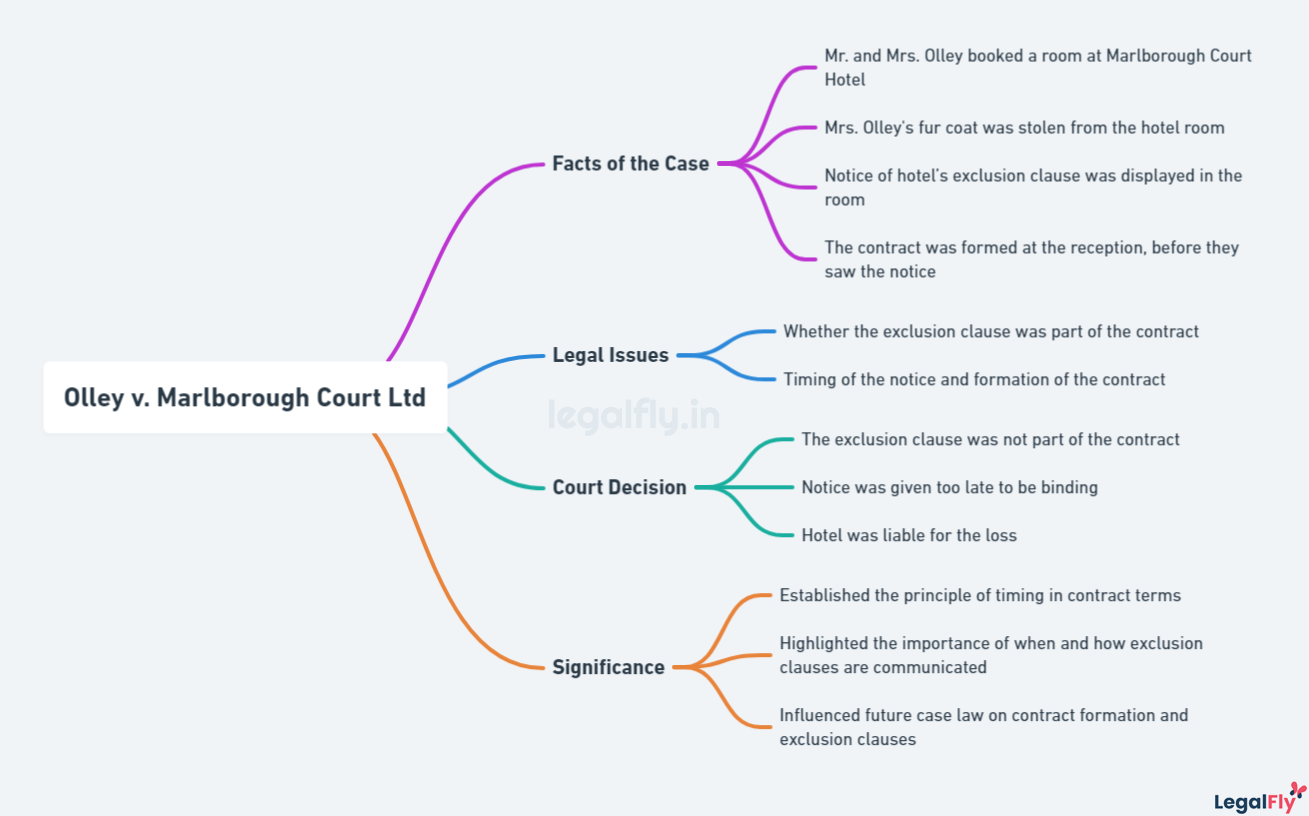
Mrs V.E. Olley and her husband stayed as paying guests at the Marlborough Court Hotel in London, a largely residential hotel, from 1945. The contract for their stay was concluded at the reception desk when they booked in. In the bedroom, on a wall, was a notice stating: "The proprietors will not hold themselves responsible for articles lost or stolen unless handed to the manageress for safe custody."
One day Mrs Olley left her room, hung her key on the board at the reception office as usual, and went out. A third party took the key from the hook, entered the room and stole her fur coat. Mrs Olley sued the hotel, arguing the loss was caused by the hotel's negligence in handling the key. The hotel relied on the bedroom notice to exclude its liability.
Legal issues addressed
Two questions arose:
- Incorporation/timing: Was the exclusion notice — which a guest could only read once inside the bedroom — part of the contract that had already been made downstairs at reception?
- Liability: If the clause was not incorporated, was the hotel liable for the loss of the coat?
Court's decision and rationale
The Court of Appeal (Denning LJ, Singleton LJ and Bucknill LJ) held in favour of Mrs Olley. The exclusion clause was not incorporated into the contract and so could not protect the hotel.
Denning LJ delivered the key reasoning. The contract was made at the reception desk when the guests booked in. At that moment the bedroom notice could not have been seen, so it formed no part of the agreement. In his words, the plaintiff "had no opportunity of seeing it until after the contract was made" — the notice "came too late". Because the hotel could not rely on the clause, and had been negligent in allowing the key to be taken, it was liable for the stolen coat.
The case illustrates the timing rule starkly:
| Stage | Where | Effect |
|---|---|---|
| Contract formed | Reception desk, on booking in | Terms agreed at this point bind the parties |
| Exclusion notice seen | Bedroom wall, after check-in | Too late — not part of the contract |
Implications of the judgment
For the hospitality industry, Olley meant hotels could no longer rely on bedroom notices to escape liability for guests' property; they had to improve security and provide safe-custody facilities. More broadly, it confirmed a general rule of contract: an exclusion clause binds only if reasonable notice of it is given before or at the time the contract is concluded. The decision sits alongside Parker v. South Eastern Railway (reasonable notice of printed terms) and was later applied in Thornton v. Shoe Lane Parking (1971), where a condition on a car-park ticket issued by a machine came too late because the contract was concluded when the motorist put money in.
Olley in Indian law
Although an English decision, Olley is routinely cited in Indian contract teaching because the Indian Contract Act, 1872 follows the same logic. A hotel that takes a guest's goods is a bailee and owes the duty of reasonable care under Sections 148, 151 and 152 of the Act; an exclusion notice that is not part of the contract at the time of formation cannot cut down that duty. The same incorporation-and-timing principle applies to tickets, receipts and standard-form terms in India, and unfair exclusion of liability in consumer transactions can additionally be challenged as a "deficiency in service" or an unfair contract term under the Consumer Protection Act, 2019.
Conclusion
The key takeaways from Olley v. Marlborough Court Ltd are:
- To be enforceable, an exclusion clause must be incorporated into the contract when it is formed — a notice posted afterwards is ineffective.
- Reasonable notice of the term must be given before or at the time of contracting; the more onerous the clause, the clearer the notice required.
- An exclusion clause does not automatically defeat a claim in negligence or against a bailee who has failed to take reasonable care.
- Businesses must present their terms at the point of contract — at reception, on the ticket, or on the screen before purchase — not after the deal is done.
The decision remains a foundational authority on the incorporation of terms and a standard reference point whenever a party tries to rely on an exclusion clause introduced too late.