
Parker v. South Eastern Railway (1877): Reasonable Notice
In short
Parker deposited a bag in a railway cloakroom and got a ticket reading "See back"; the back limited the company's liability to £10. His bag (worth more) was lost. The Court of Appeal held a person can be bound by printed conditions he has not read — but only if the company did what was reasonably sufficient to give him notice of them. Because that question of reasonable notice had not been properly put to the jury, the Court ordered a new trial. The case is the source of the "reasonable notice" test for incorporating exclusion clauses.
In this brief
- Introduction to Parker v. South Eastern Railway Company
- Case background and historical context
- Details of the incident
- Legal proceedings and arguments
- Court of Appeal''s decision
- Implications of the judgment
- Analysis of the legal principles involved
- Parker in Indian contract law
- Contemporary relevance of the case
- Conclusion
Introduction to Parker v. South Eastern Railway Company
Parker v. South Eastern Railway Company (1877) 2 CPD 416 is a leading English contract law case on the incorporation of exclusion clauses by notice. It is the original "ticket case": it decides when a person who receives a printed ticket is bound by conditions on it that he has not read.
Parker left a bag in the cloakroom of a railway station and was given a ticket; printed on it was a clause limiting the company''s liability for any deposited item to £10. When his bag was lost, the company relied on that limit. The Court of Appeal used the dispute to lay down the test that an exclusion clause binds a party only if the other side has taken reasonable steps to give notice of it.
Case background and historical context
The case arose in Victorian England, when the rapid spread of the railways forced the common law to work out how mass, standard-form contracts with the travelling public should operate. Railway companies routinely printed conditions on tickets and receipts limiting their liability. The question that had not been settled was whether a customer was bound by such conditions simply because they were printed on a ticket he may never have read. Parker gave the courts the chance to answer it.
Details of the incident
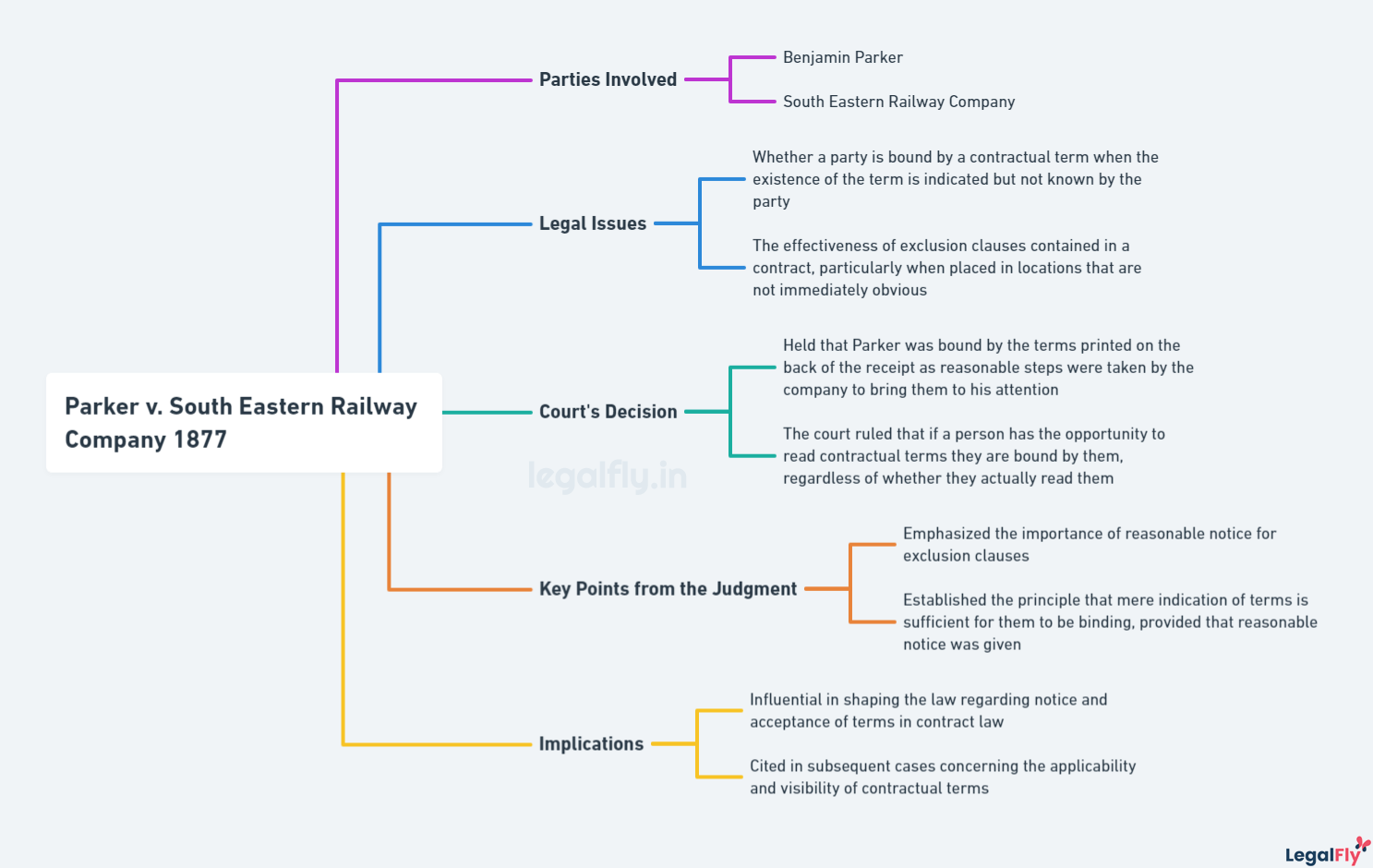
Parker deposited a bag in the cloakroom (left-luggage office) at the railway station, paid 2d, and received a ticket. On the face of the ticket was a number, the cloakroom opening hours, and the words "See back". On the back was a condition: "The company will not be responsible for any package exceeding the value of £10." A placard to the same effect hung in the cloakroom. Parker''s bag, worth more than £10, was lost, and he claimed its full value. The company relied on the £10 limit.
There was no personal injury and no luggage lost in transit — the dispute was purely about whether the printed £10 condition had become part of the cloakroom contract.
Legal proceedings and arguments
Parker argued he was not bound by the condition because he had not read it and did not know the ticket contained contractual terms — to him it was merely a receipt. The company argued that, by taking the ticket marked "See back", Parker had accepted the printed conditions.
At the first trial, the judge left the jury two questions: (1) had Parker read or known of the special condition? and (2) was he, in the circumstances, under any obligation to exercise reasonable caution to read it? The jury answered both "no", and judgment was entered for Parker. The company appealed.
Court of Appeal''s decision
The Court of Appeal (Mellish LJ delivering the leading judgment, with Baggallay and Bramwell LJJ) held that the trial judge had asked the wrong questions, and ordered a new trial. The correct question was not whether Parker had in fact read the condition, but whether the company had done what was reasonably sufficient to give him notice of it.
Mellish LJ set out three propositions that still frame the law on ticket conditions:
| What the customer knew | Bound by the conditions? |
|---|---|
| Did not know there was any writing on the ticket | No — not bound. |
| Knew there was writing, and knew or believed it contained conditions | Yes — bound. |
| Knew there was writing but did not know it contained conditions | Bound only if the company gave reasonable notice that the writing contained conditions. |
The third proposition is the heart of the case: where a person knows there is writing but not that it contains terms, he is bound if — and only if — the supplier took reasonably sufficient steps to bring the conditions to his attention. Whether that was done is a question of fact for the jury, which is why the matter had to be retried.
Implications of the judgment
Parker replaced any crude rule of "you took the ticket, so you are bound" with a fairness-based test. It established that a party relying on an exclusion clause in a standard-form document must take reasonable steps to give notice of it before or at the time of contracting. This protected customers against onerous terms buried in tickets and receipts, while still allowing properly-notified conditions to bind. It became the foundation of the modern law of incorporation by notice and shifted the focus from a customer''s actual knowledge to the supplier''s conduct in giving notice.
Analysis of the legal principles involved
The core principle is incorporation by reasonable notice. A printed condition is part of the contract only if reasonable notice of it has been given; the more unusual or onerous the term, the more is required to bring it home (a point later sharpened in Thornton v. Shoe Lane Parking (1971) and Interfoto v. Stiletto (1989), where Bingham LJ spoke of needing to do more to draw attention to a particularly onerous clause — the so-called "red hand" rule).
The line of authority runs directly into the other classic ticket and notice cases, including Olley v. Marlborough Court Ltd (1949), where a hotel''s bedroom notice came too late to be incorporated. Together they show that the timing and adequacy of notice — not whether the customer actually read the term — decide incorporation.
Parker in Indian contract law
The reasonable-notice principle is followed in India under the Indian Contract Act, 1872. Tickets, receipts and standard-form terms bind a party only if reasonable notice of the conditions has been given at the time of contracting. Indian courts have gone further in policing such contracts: in Central Inland Water Transport Corp. v. Brojo Nath Ganguly (1986) and LIC of India v. Consumer Education & Research Centre (1995), the Supreme Court held that unfair or unconscionable terms in standard-form contracts between unequal parties can be struck down as opposed to public policy (Section 23) and as arbitrary under Article 14. The Consumer Protection Act, 2019 now also lets consumers challenge "unfair contract terms" directly. Parker remains the starting point for teaching how a printed condition gets into the contract in the first place.
Contemporary relevance of the case
The reasoning in Parker applies squarely to today''s standard-form and digital contracts — parking tickets, booking confirmations, and online "I agree" terms. The same question recurs: did the business take reasonable steps to bring the conditions to the user''s attention before the contract was concluded?
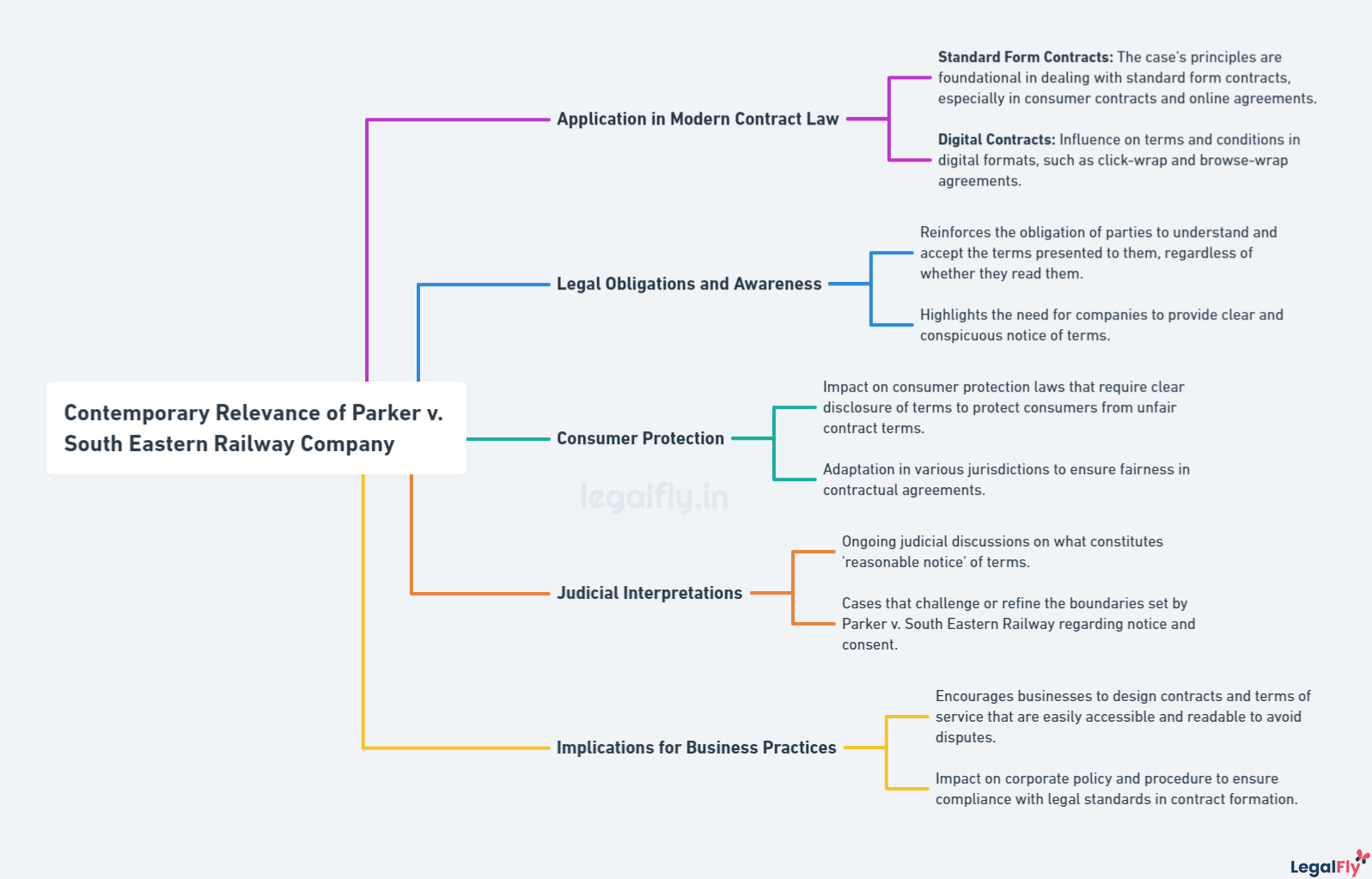
Courts continue to scrutinise terms hidden in fine print or behind a link, and onerous clauses still require something more than ordinary notice. Parker''s insistence on reasonable notice underpins modern consumer-protection rules that require key terms to be brought fairly to a customer''s attention.
Conclusion
The key takeaways from Parker v. South Eastern Railway Company are:
- A person can be bound by printed conditions he has not read — but only if reasonable notice of them was given.
- Mellish LJ''s three propositions turn on what the customer knew about the writing on the ticket and whether the supplier gave notice that it contained conditions.
- Whether reasonable notice was given is a question of fact, which is why the Court of Appeal ordered a new trial.
- The case is the foundation of incorporation by notice, applied in India and reflected in modern consumer-protection law.