
Sowmithri Vishnu v. Union of India (1985): Case Summary

In short
In Sowmithri Vishnu v. Union of India (1985), the Supreme Court (Chandrachud CJ) upheld Section 497 IPC, rejecting the challenge that the adultery offence was gender-discriminatory. Section 497 was finally struck down only in 2018 in Joseph Shine v. Union of India.
In this brief
- Introduction to Sowmithri Vishnu v. Union of India
- Background and Context
- Significance of the Case
- Key Facts of the Case
- Violation of Constitutional Rights
- The challenge to Section 497 IPC
- Arguments on Gender Discrimination
- Respondent's Arguments
- Court's Decision and Rationale
- Conclusion: The Legacy of Sowmithri Vishnu v. Union of India
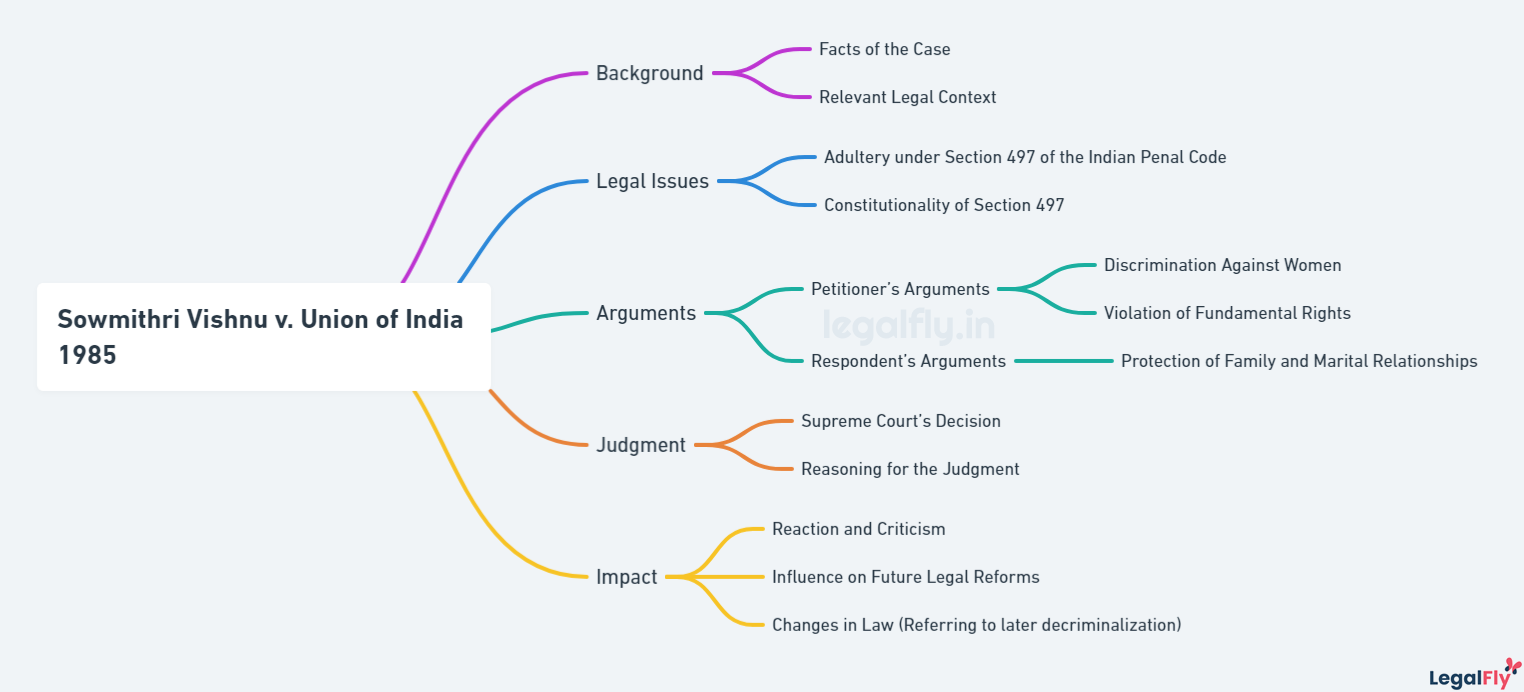
Sowmithri Vishnu v. Union of India (decided 27 May 1985) is the Supreme Court of India decision that upheld Section 497 of the Indian Penal Code — the offence of adultery — against a constitutional challenge under Articles 14, 15 and 21. A bench of Chief Justice Y.V. Chandrachud and Justice Ranganath Misra rejected the argument that the provision was arbitrary or discriminatory. Section 497 was finally declared unconstitutional more than three decades later, in Joseph Shine v. Union of India (2018).
| Field | Detail |
|---|---|
| Case name | Smt. Sowmithri Vishnu v. Union of India & Anr. |
| Court | Supreme Court of India |
| Bench | Y.V. Chandrachud CJ and Ranganath Misra J |
| Date of judgment | 27 May 1985 |
| Citation | 1985 Supp SCC 137; AIR 1985 SC 1618 |
| Provision challenged | Section 497, Indian Penal Code, 1860 (adultery) |
| Outcome | Petition dismissed — Section 497 IPC upheld |
Introduction to Sowmithri Vishnu v. Union of India
The case involved a constitutional challenge to Section 497 of the Indian Penal Code, the colonial-era provision that criminalised adultery. The petitioner asked the Supreme Court to strike the offence down as gender-discriminatory; the Court declined, holding that the provision did not violate the right to equality. The judgment is significant precisely because it upheld the law: it sits in the middle of a line of decisions that defended Section 497 until the offence was decriminalised in 2018.
Background and Context
Section 497 IPC, enacted in 1860, made it an offence for a man to have sexual intercourse with the wife of another man "without the consent or connivance of that man." Only the man could be prosecuted; the married woman could not be punished even as an abettor, and the wife of an adulterous husband had no right to prosecute. The right to set the law in motion rested with the husband of the woman involved.
The challenge in Sowmithri Vishnu followed the Supreme Court's earlier decision in Yusuf Abdul Aziz v. State of Bombay (1954), where the Court had upheld Section 497 by reading Articles 14 and 15(3) together — treating the exemption of women as a permissible "special provision" for women. By the 1980s the gendered design of the offence was being questioned more directly, and Sowmithri Vishnu became one of the leading challenges of that period.
Significance of the Case
Sowmithri Vishnu v. Union of India is best understood as one step in a four-decision arc on the constitutionality of the adultery offence. Each of the first three decisions upheld Section 497; only the fourth struck it down.
| Case | Year | What was challenged | Holding |
|---|---|---|---|
| Yusuf Abdul Aziz v. State of Bombay | 1954 | Section 497 IPC (only men punishable) | Upheld — valid as a special provision for women under Art. 15(3) |
| Sowmithri Vishnu v. Union of India | 1985 | Section 497 IPC (under Arts. 14, 15, 21) | Upheld — not arbitrary; man treated as the seducer |
| V. Revathi v. Union of India | 1988 | Section 497 IPC & Section 198(2) CrPC (wife cannot prosecute) | Upheld — scheme protects the sanctity of marriage |
| Joseph Shine v. Union of India | 2018 | Section 497 IPC & Section 198(2) CrPC | Struck down — violates Arts. 14, 15 & 21; adultery decriminalised |
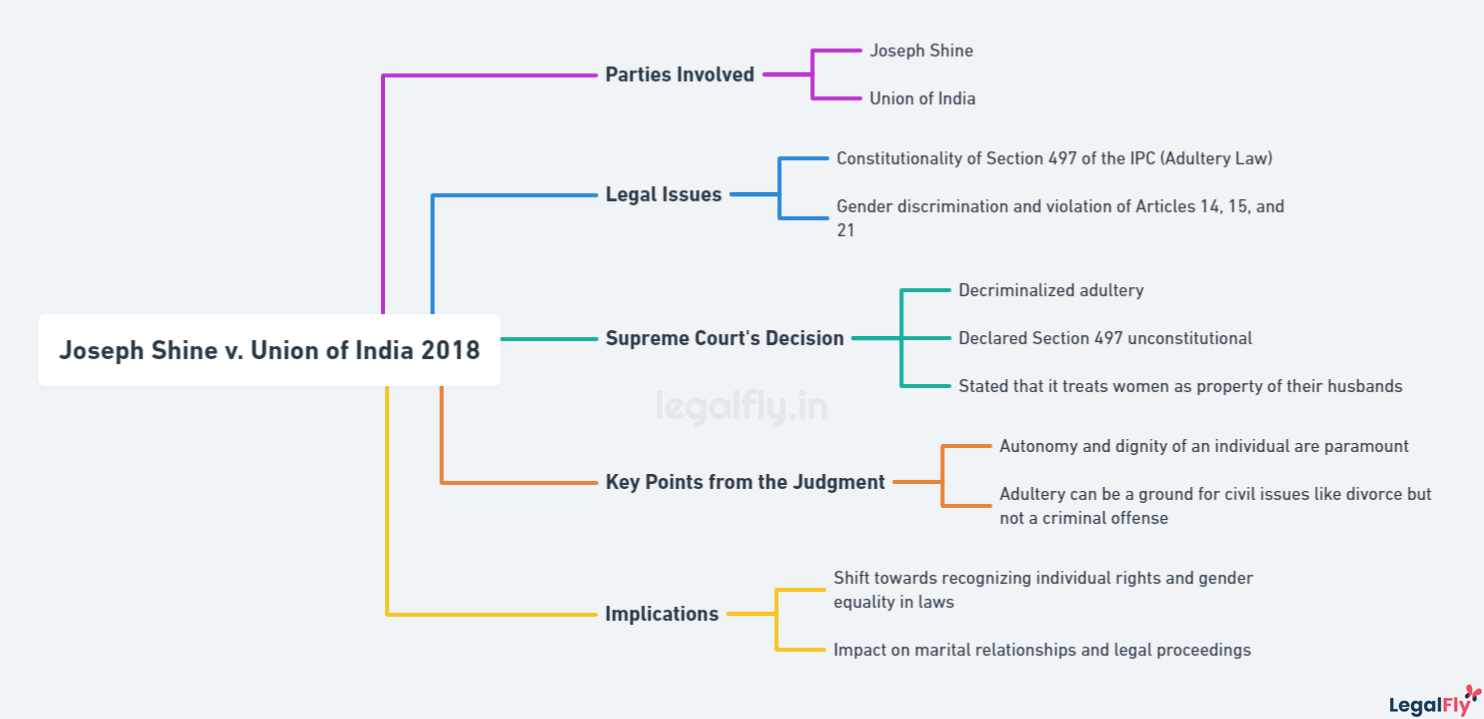
The arguments raised in Sowmithri Vishnu — that Section 497 was paternalistic and treated the wife as her husband's property — resonated through the decades and were ultimately accepted by a five-judge bench in Joseph Shine, which expressly overruled both Sowmithri Vishnu and V. Revathi.
Key Facts of the Case
While a divorce petition filed by her husband (on the grounds of desertion and adultery) was pending, the husband also lodged a complaint under Section 497 IPC against the man alleged to be involved with the petitioner. The petitioner, Sowmithri Vishnu, then approached the Supreme Court by writ petition, challenging the constitutional validity of Section 497.
The text of Section 497 IPC read: "Whoever has sexual intercourse with a person who is and whom he knows or has reason to believe to be the wife of another man, without the consent or connivance of that man, such sexual intercourse not amounting to the offence of rape, is guilty of the offence of adultery." Her case was that this design discriminated against women and should be struck down.
Violation of Constitutional Rights
The petitioner argued that Section 497 IPC was arbitrary and gender-biased and infringed fundamental rights.
The challenge to Section 497 IPC
The petitioner contended that:
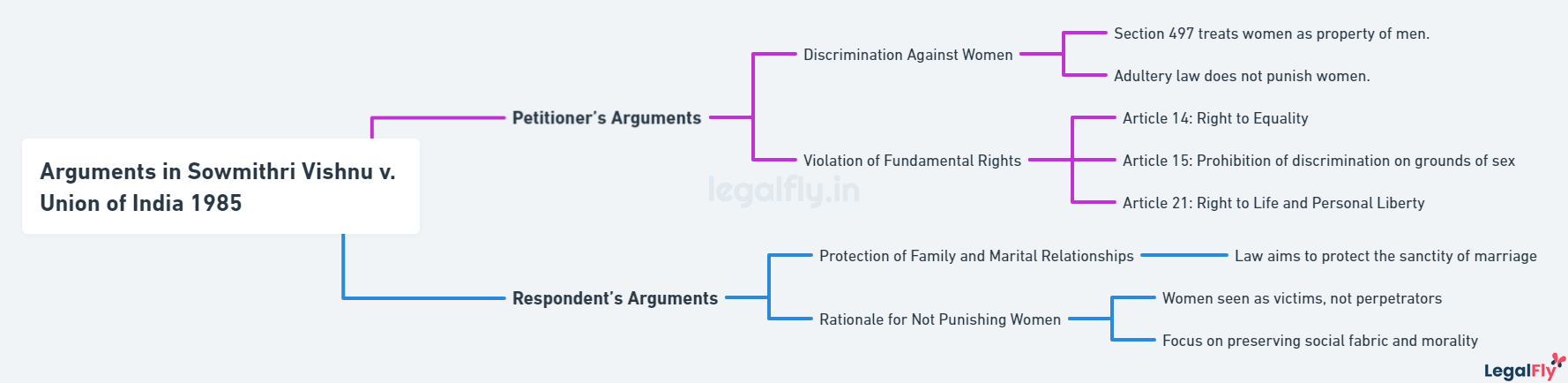
- Section 497 punished only the man and did not allow the woman to be prosecuted even as an abettor — an arbitrary classification said to violate Article 14.
- The provision conferred the right to prosecute on the husband alone; a wife had no corresponding right to proceed against an adulterous husband or the other woman.
- The "consent or connivance" exception treated the wife as her husband's property, denying her dignity and autonomy contrary to Article 21.
- By assuming the woman was merely a passive victim, the provision perpetuated gender stereotypes rather than protecting women as Article 15(3) intended.
Arguments on Gender Discrimination
The core criticism was that Section 497 reflected a patriarchal view of marriage: it allowed only the husband to set the criminal law in motion and gave the wife no equivalent standing. Critics argued the provision assumed a husband's control over his wife's sexuality and denied women equal agency, which they said offended the right to equality under Article 14.
Respondent's Arguments
The Union of India defended Section 497 as a measure to preserve the sanctity of marriage. It argued that decriminalising adultery would weaken the institution of marriage and that the provision rested on a legislative policy choice rooted in India's social conditions.
The State submitted that exempting the woman from punishment was not hostile discrimination but reflected the view that, in the prevailing social context, it was the man who was treated as the seducer. On this reasoning, the gender-specific structure of the offence was said to rest on an intelligible basis rather than arbitrary preference.
Court's Decision and Rationale
The Supreme Court dismissed the petition and upheld Section 497 IPC. The bench of Chief Justice Y.V. Chandrachud and Justice Ranganath Misra held that the provision did not violate Articles 14, 15 or 21.
Delivering the judgment, Chandrachud CJ treated adultery as an offence against the sanctity of the matrimonial home. The Court reasoned that, as a matter of legislative policy, "it is commonly accepted that it is the man who is the seducer and not the woman," so confining the offence to the man was a permissible choice. It declined to redraw the offence — for example, by extending liability to the woman or giving the wife a right to prosecute — holding that whether to recast the provision was a question for the legislature, not the courts.
The Court relied on its earlier ruling in Yusuf Abdul Aziz (1954) in treating the provision as constitutionally valid. The decision drew criticism for leaving the gendered design of Section 497 intact, but the Court considered that reform of the offence lay with Parliament rather than judicial intervention.
Conclusion: The Legacy of Sowmithri Vishnu v. Union of India
The 1985 decision is a key moment in the legal history of adultery in India — not because it changed the law, but because it preserved it. The Court upheld Section 497 while the petitioner's equality arguments went unanswered on the merits.
Key takeaways:
- The Supreme Court upheld Section 497 IPC; it did not strike adultery down. The offence remained on the statute book after this case.
- The decision followed Yusuf Abdul Aziz (1954) and was followed by V. Revathi (1988), both of which also upheld the provision.
- The Court left reform of the gendered offence to Parliament, declining to recast Section 497 itself.
- The equality arguments raised here were ultimately vindicated in Joseph Shine (2018), which struck Section 497 down and overruled Sowmithri Vishnu.
One point of currency: when the new criminal code, the Bharatiya Nyaya Sanhita, 2023, replaced the Indian Penal Code, adultery was not re-enacted — there is no successor offence to Section 497. This is consistent with Joseph Shine having already decriminalised adultery in 2018. Adultery today is relevant only in civil matters, principally as a ground for divorce, and is no longer a crime.