
Case Summary: Joseph Shine v. Union of India 2018
In short
In Joseph Shine (27 Sep 2018), a five-judge bench led by CJI Dipak Misra unanimously struck down Section 497 IPC and Section 198(2) CrPC, decriminalising adultery. The colonial provision punished only the man, treated the wife as her husband's property and denied women agency — violating equality (Arts 14, 15) and dignity/privacy (Art 21). Four concurring opinions (Misra-Khanwilkar, Nariman, Chandrachud, Indu Malhotra) overruled Yusuf Abdul Aziz (1954), Sowmithri Vishnu (1985) and V. Revathi (1988). Adultery remains a ground for divorce, but it was not re-enacted in the Bharatiya Nyaya Sanhita, 2023.
In this brief
Overview of Joseph Shine v. Union of India
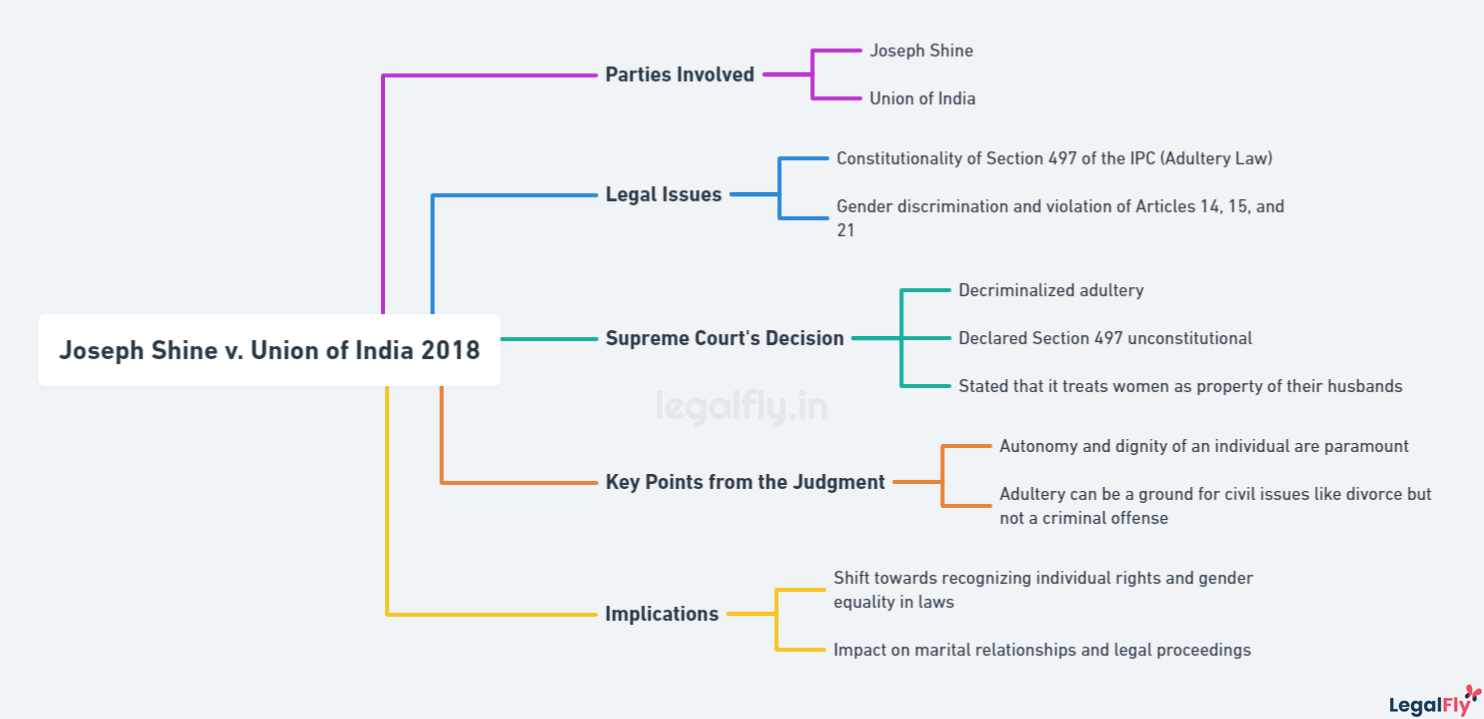
Joseph Shine v. Union of India (2018) is the judgment that decriminalised adultery in India. A five-judge Constitution Bench of the Supreme Court unanimously struck down Section 497 of the Indian Penal Code — and the linked procedural provision, Section 198(2) of the Code of Criminal Procedure — as a violation of the rights to equality, non-discrimination and dignity.
Section 497, enacted under colonial rule in 1860, made adultery a crime committed only by a man, who could be jailed up to five years for sexual intercourse with another man's wife "without the consent or connivance" of her husband. The wife could not be punished even as an abettor, and she had no right to prosecute an unfaithful husband. The provision treated the married woman as her husband's property and denied her any agency of her own.
| Element | Detail |
|---|---|
| Case | Joseph Shine v. Union of India |
| Citation | AIR 2018 SC 4898; (2019) 3 SCC 39 |
| Court / Bench | Supreme Court of India — 5-judge Constitution Bench (Misra C.J., Nariman, Khanwilkar, Chandrachud, Indu Malhotra JJ.) |
| Decided | 27 September 2018 (unanimous) |
| Struck down | Section 497 IPC and Section 198(2) CrPC |
| Overruled | Yusuf Abdul Aziz (1954), Sowmithri Vishnu (1985), V. Revathi (1988) |
Earlier challenges had failed: in Sowmithri Vishnu (1985) and V. Revathi (1988) the Court had upheld Section 497. In 2017 the businessman Joseph Shine filed a public interest petition asking the Court to reconsider, and — with the right to privacy now recognised in Puttaswamy (2017) — a five-judge bench agreed to revisit the question.
The Petitioner's Arguments
Joseph Shine argued that Section 497 was archaic, paternalistic and discriminatory, and that it violated Articles 14, 15 and 21 of the Constitution. His central points were:
- Inequality (Article 14): the section punished only the man and never the woman, an irrational classification resting on the stereotype that a woman lacks sexual agency.
- Sex discrimination (Article 15): the offence turned on the sex of the parties and on the husband's "consent," treating the wife as a possession.
- Dignity and privacy (Article 21): criminalising consensual intimacy intruded the State into the most private sphere of a person's life and denied married women autonomy and dignity.
The Supreme Court's Judgment
The Court struck down Section 497 (and Section 198(2) CrPC) unanimously. The bench delivered four opinions, all reaching the same conclusion: the leading opinion by Chief Justice Dipak Misra (for himself and Khanwilkar J.), and separate concurrences by Nariman J., Chandrachud J. and Indu Malhotra J. (the only woman on the bench).
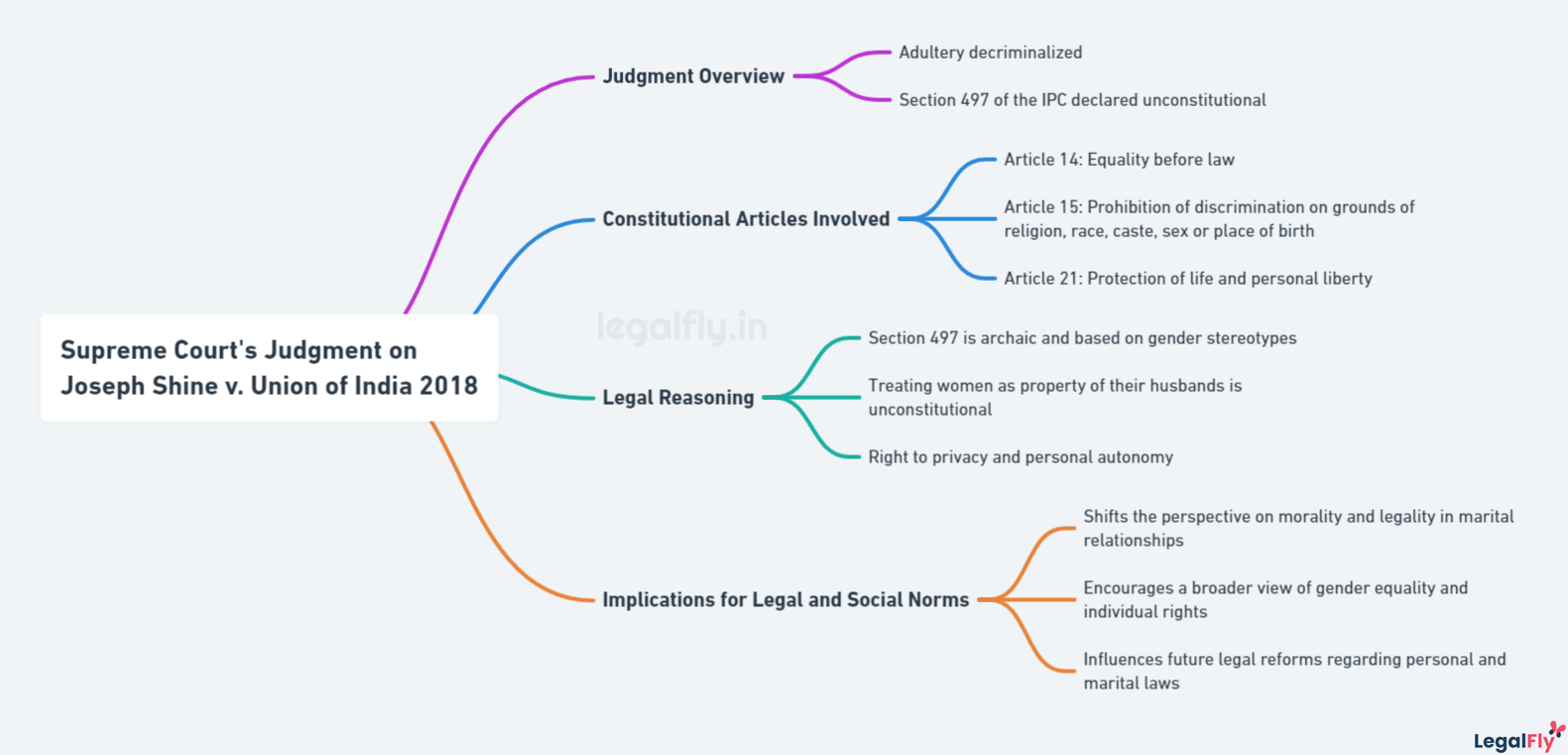
The threads running through the opinions were:
- Manifest arbitrariness: the section was struck down under Article 14 as manifestly arbitrary — it lacked any rational basis and rested on a Victorian morality that has no place in the constitutional order.
- The woman as an equal, not a chattel: Chandrachud J. held that the law treated the wife as her husband's property and denied her sexual autonomy and dignity; Justice Chandrachud notably overruled Sowmithri Vishnu, a judgment authored by his own father, Y.V. Chandrachud C.J.
- Privacy and autonomy (Article 21): building on Puttaswamy, the Court held that decisions about intimate relationships fall within the zone of privacy, and the criminal law should not enter the bedroom.
- Adultery as a civil, not criminal, matter: the Court was careful to say that adultery may remain a moral wrong and a valid ground for divorce — it simply cannot be a crime.
Implications and Impact
The immediate effect was that adultery ceased to be a criminal offence in India — no one can be jailed for it. The decision is widely seen as a milestone for gender equality: it dismantled a law built on the idea that a wife is her husband's property, and affirmed that constitutional protection of equality, dignity and privacy extends inside marriage.
Two practical points remain. First, adultery is still a valid ground for divorce and judicial separation under the various personal and matrimonial laws, so a spouse retains a civil remedy. Second, in a 2023 clarification the Supreme Court confirmed that the judgment does not disturb the Armed Forces provisions on "unbecoming conduct," under which adultery can still attract disciplinary action against service personnel.
Position Under the Bharatiya Nyaya Sanhita, 2023
When the IPC was replaced by the Bharatiya Nyaya Sanhita, 2023 (in force 1 July 2024), adultery was not re-enacted. There is no successor to Section 497, so the decriminalisation in Joseph Shine stands undisturbed. (A Parliamentary Standing Committee had suggested reintroducing a gender-neutral adultery offence, but Parliament did not adopt it.)
Comparative Perspective
India's decision tracks a broad global trend. Adultery has been removed from the criminal law in most of Western Europe — France, Germany, the Netherlands and the United Kingdom among them — and international human-rights bodies have long argued that criminalising consensual sex between adults violates privacy and disproportionately harms women. The Joseph Shine opinions drew on this comparative jurisprudence in grounding equality, liberty and privacy.
Conclusion
Joseph Shine v. Union of India retired one of the most patriarchal provisions of the colonial penal code. By holding Section 497 manifestly arbitrary and an affront to a woman's dignity and autonomy, the Supreme Court reaffirmed that the Constitution protects equality and privacy within marriage, not just outside it. Alongside Navtej Singh Johar and Puttaswamy, it forms part of the line of cases that redefined personal liberty in modern India — and its result has been carried forward, untouched, into the new criminal code.