
Unni Krishnan v. State of A.P. (1993): Right to Education
In short
A five-judge Constitution Bench held that the right to education flows from the right to life under Article 21, read with the Directive Principles. Free education is a fundamental right for every child up to age 14; beyond that, it is subject to the State's economic capacity (Article 41). The Court narrowed the wider ruling in Mohini Jain (1992), held that running an educational institution is not a trade for profit, and devised a "free seat / payment seat" scheme to curb capitation fees — a scheme later struck down in T.M.A. Pai Foundation (2002). The age 6–14 right is now an express fundamental right under Article 21A.
In this brief
- Introduction
- Key takeaways
- Background of the case
- Legal precedents
- Mohini Jain v. State of Karnataka
- The capitation fee issue
- Key legal aspects
- Article 21 and the right to life
- Part III and Part IV of the Constitution
- Directive Principles of State Policy
- Article 19(1)(g) and professional education
- The Supreme Court''s judgment
- Fundamental right to education
- Economic capacity and State responsibility
- Parameters for private educational institutions: the scheme
- Implications and impact
- On the Indian educational system
- Privatisation of higher education
- National policy and public interest
- Conclusion
Introduction
The landmark case of Unni Krishnan, J.P. v. State of Andhra Pradesh (1993) reshaped the law on education in India. A five-judge Constitution Bench of the Supreme Court, in a judgment led by Justice B.P. Jeevan Reddy (decided 4 February 1993), held that the right to education is implicit in the right to life under Article 21 of the Indian Constitution — but only up to a point.
The Court drew a crucial line: free education up to the age of 14 is a fundamental right, while education beyond that age is subject to the limits of the State''s economic capacity under Article 41. In doing so, it narrowed the broader ruling in Mohini Jain (1992) and built the constitutional foundation that later produced Article 21A and the Right to Education Act, 2009.
Key takeaways
- Free education up to age 14 is a fundamental right flowing from Article 21 read with the Directive Principles.
- Education beyond 14 is subject to the State''s economic capacity (Article 41) — there is no fundamental right to a professional degree.
- The case partly overruled Mohini Jain and led to the "free seat / payment seat" scheme — later struck down in T.M.A. Pai Foundation (2002).
Background of the case
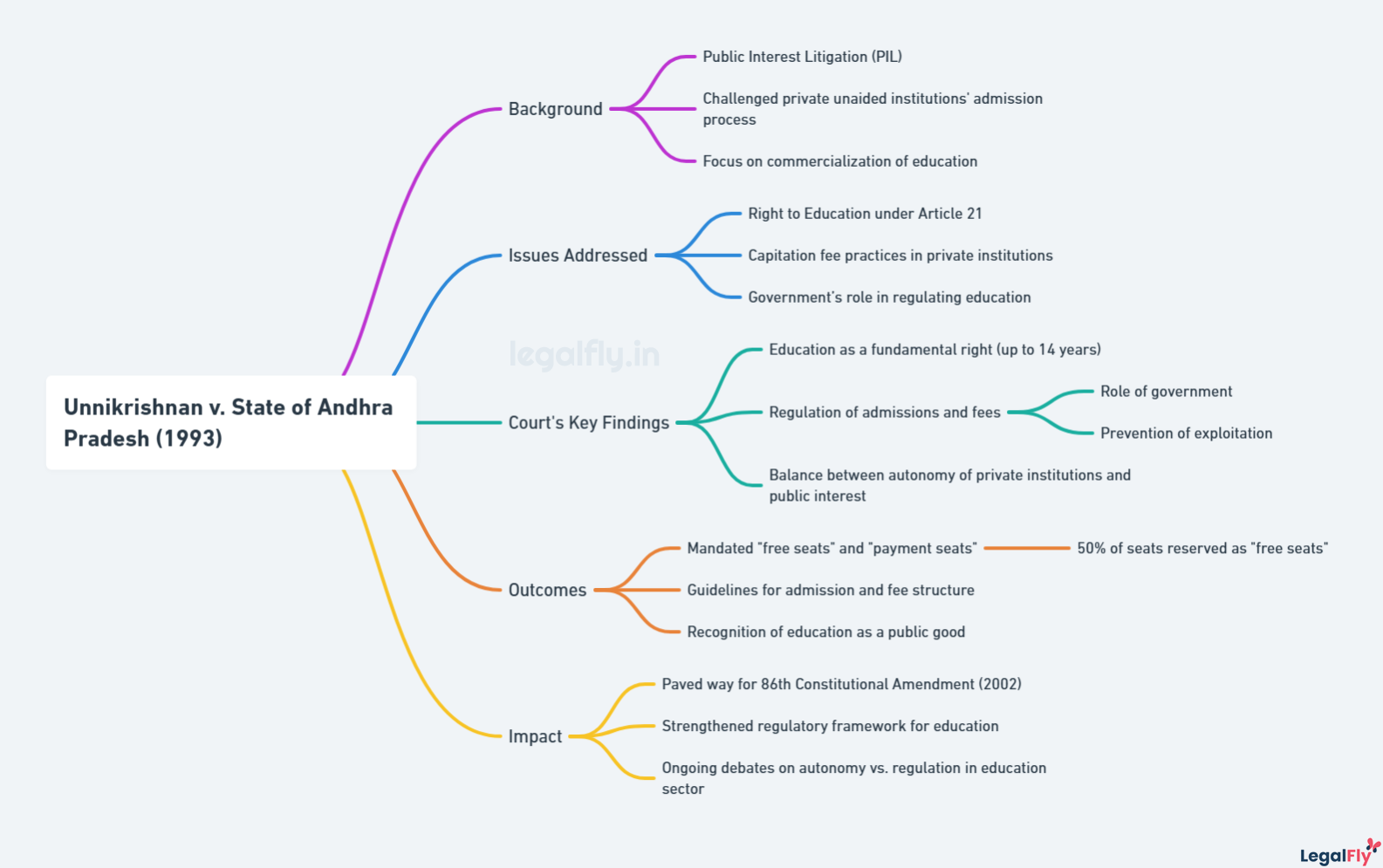
The case arose from challenges by private professional (medical and engineering) colleges in Andhra Pradesh, Karnataka, Maharashtra and Tamil Nadu to State laws regulating capitation fees and admissions. The petitioners — managements of private institutions — relied on the right in Mohini Jain and on the freedom to carry on an occupation. The resulting judgment settled both the constitutional status of the right to education and the limits on commercialising it.
Legal precedents
The case sat at the meeting point of Article 21 (right to life), Article 41 (right to work, education and public assistance "within the limits of its economic capacity") and the then Article 45 (free and compulsory education for children up to 14). Earlier rulings had expanded Article 21 to include rights essential to a dignified life; Unni Krishnan asked whether, and how far, education was one of them.
Mohini Jain v. State of Karnataka
In Mohini Jain v. State of Karnataka (1992), a two-judge bench struck down a Karnataka notification permitting private medical colleges to charge exorbitant capitation fees, holding that the right to education at all levels is a fundamental right flowing from the right to life and dignity under Article 21.
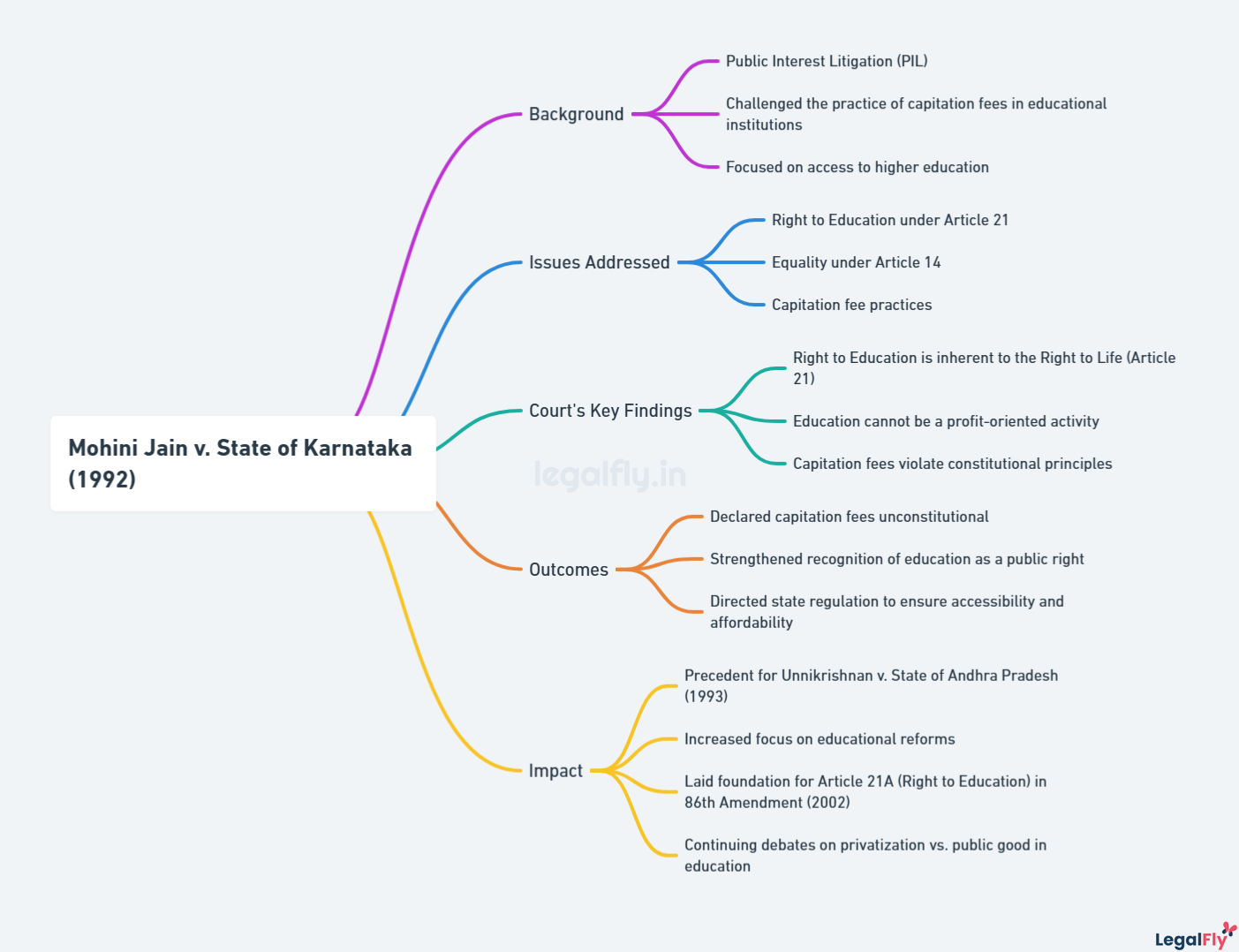
Unni Krishnan partly overruled Mohini Jain. The larger bench agreed that education is linked to Article 21, but disagreed that the State is bound to provide education at every level. It held the fundamental right extends only to free education up to age 14; beyond that, education depends on the State''s economic capacity. This narrowing is the single most important relationship to remember between the two cases.
The capitation fee issue
Capitation fees are amounts charged for admission over and above regular tuition. The Court held that charging them, and treating professional education as a money-making venture, was impermissible — education is in the nature of a charitable, not commercial, activity. Allowing seats to be sold for capitation fees made admission turn on wealth rather than merit, undermining equality of access.
Key legal aspects
The judgment connected the right to education to several constitutional provisions and defined its limits.
Article 21 and the right to life
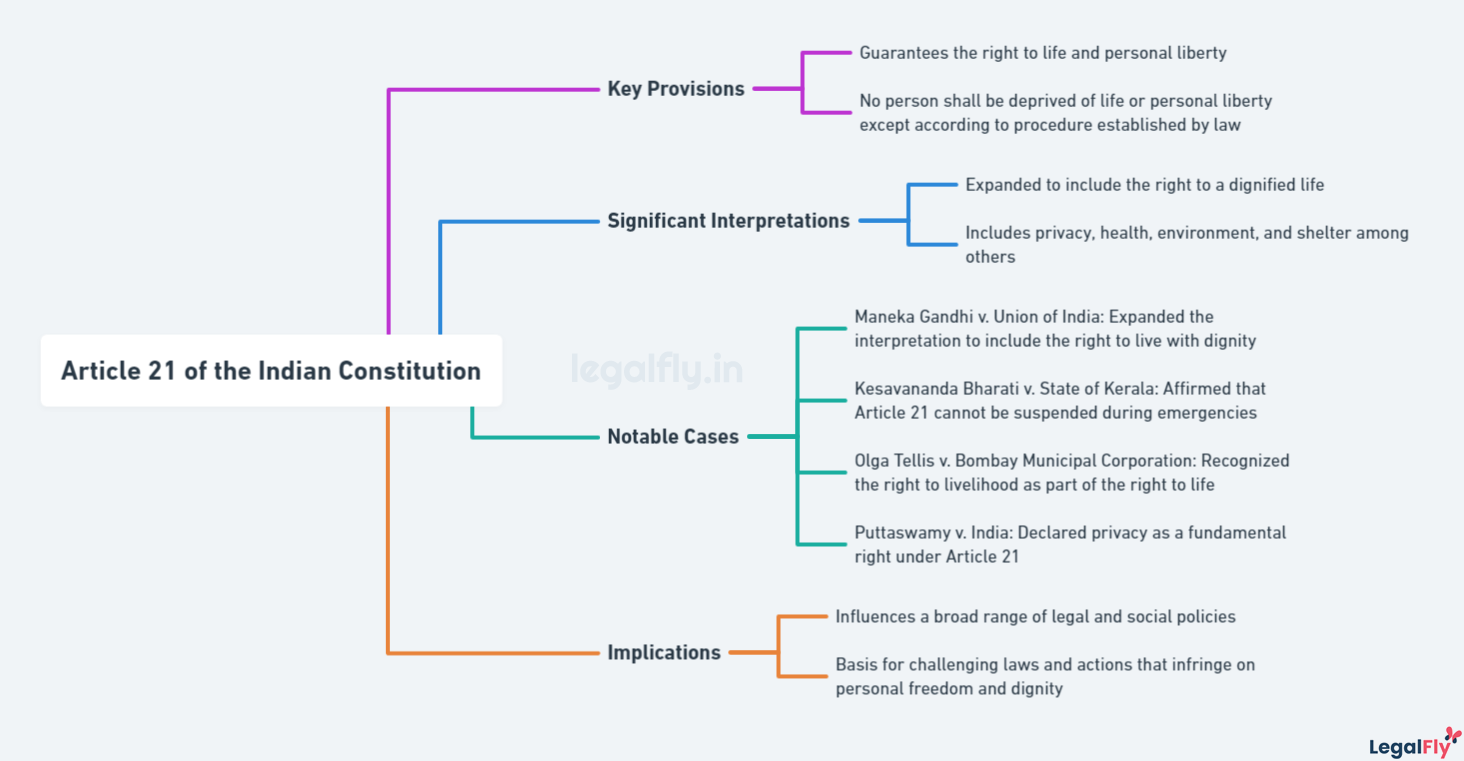
The Court held that the right to education is implicit in the right to life under Article 21, because life and dignity are meaningless without education. But the right is not unlimited: its content must be read in the light of the Directive Principles in Articles 41, 45 and 46. So read, every child has a fundamental right to free education until completing 14 years; thereafter the right is subject to the State''s economic capacity and development.
Part III and Part IV of the Constitution
A central move in the judgment was reading the Fundamental Rights (Part III) together with the Directive Principles (Part IV). Although the Directive Principles are not directly enforceable, the Court used them to give shape to the Article 21 right — treating the once "unenforceable" goal of free and compulsory education as enforceable, at least for children up to 14.
Directive Principles of State Policy
Article 45 (as it then stood) directed the State to provide free and compulsory education for all children until age 14 within ten years of the Constitution. The Court held that the passage of over four decades converted this aspiration, for that age group, into an enforceable obligation, anchored in Article 21.
Article 19(1)(g) and professional education
The private colleges argued that running an educational institution was a "profession" or "occupation" protected by Article 19(1)(g). The Court in Unni Krishnan rejected commercialisation, holding that education is not a trade or business carried on for profit. (This particular view was later modified in T.M.A. Pai Foundation (2002), which held that establishing and running an educational institution is an "occupation" under Article 19(1)(g), subject to reasonable regulation.)
The Supreme Court''s judgment
The ruling did two things: it fixed the constitutional status of the right to education, and it framed a scheme to regulate private professional colleges.
Fundamental right to education
The Court held that the right to free education up to the age of 14 is a fundamental right under Article 21, casting a duty on the State to provide it. Beyond 14, the right continues but is conditioned by Article 41 — i.e., by the State''s economic capacity. There is therefore no fundamental right to higher or professional education as such.
Economic capacity and State responsibility
The Court tied the obligation to provide education to the State''s resources. For children up to 14 the duty is unconditional; for education beyond that, the State must progressively expand provision within its means. This framing placed responsibility on governments to prioritise basic education while acknowledging the practical limits on funding higher education.
Parameters for private educational institutions: the scheme
To curb capitation fees while permitting private colleges, the Court devised a detailed admissions-and-fees scheme. Its key features were:
- Roughly half the seats ("free seats") filled by the Government/University strictly on merit at low fees.
- The remaining "payment seats" also filled on merit, among candidates willing to pay higher (but capped) fees.
- Fees fixed by a State-level committee, with no charging beyond approved limits and no capitation fee.
- Admissions only through a common, merit-based allotment process.
This scheme proved unworkable and was struck down in T.M.A. Pai Foundation v. State of Karnataka (2002) by an eleven-judge bench, which held it violated the autonomy of private unaided institutions under Article 19(1)(g). Importantly, T.M.A. Pai left intact the core holding that elementary education up to 14 is a fundamental right.
Implications and impact
The decision had far-reaching effects on Indian education law and policy.
On the Indian educational system
By making free education up to 14 enforceable, the judgment shifted education from a Directive Principle aspiration toward a justiciable right. It directly influenced the 86th Constitutional Amendment (2002), which inserted Article 21A making education for children aged 6–14 an express fundamental right, and the Right of Children to Free and Compulsory Education (RTE) Act, 2009, which operationalised it.
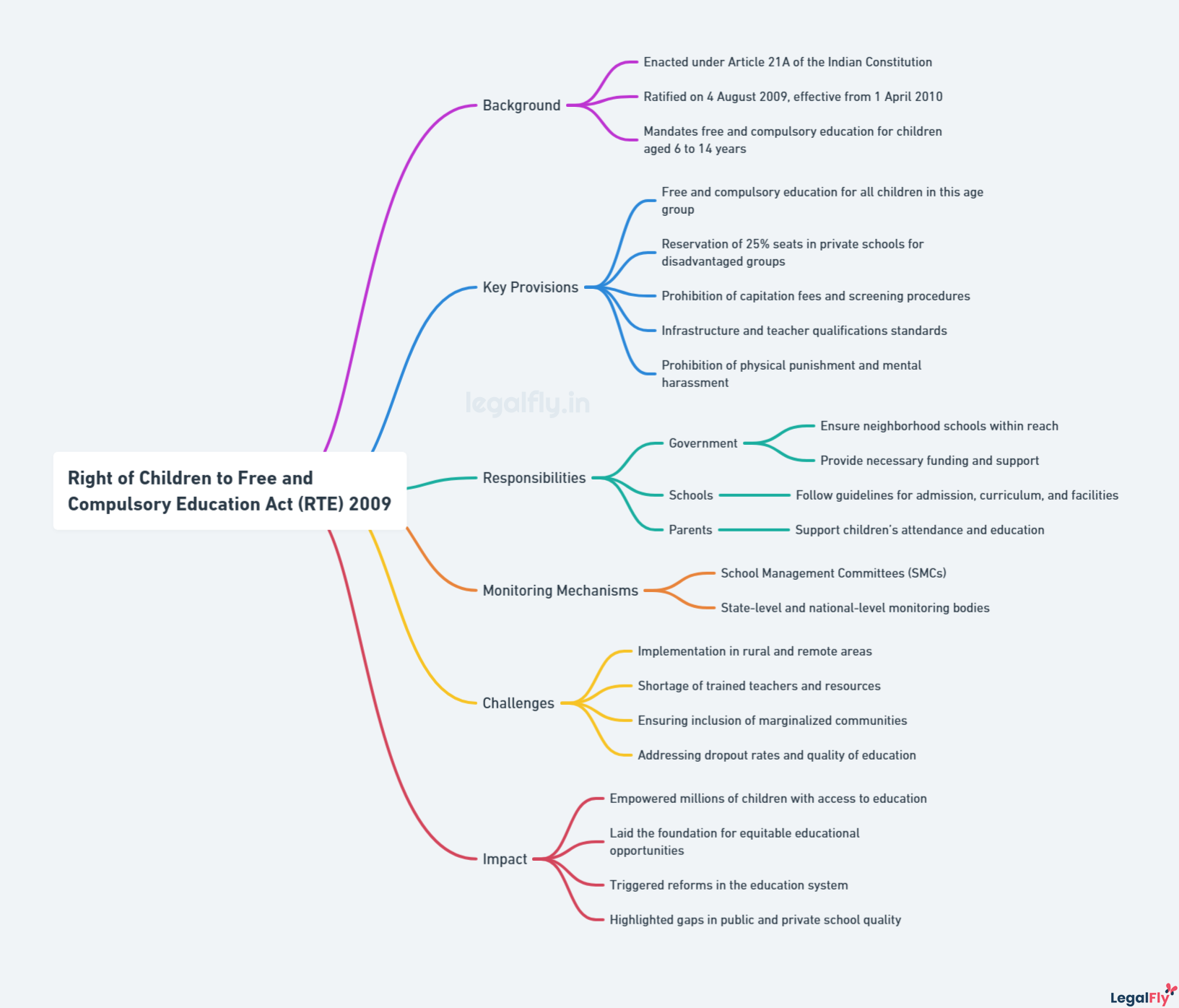
The lineage from this case to enforceable schooling can be set out simply:
| Year | Development |
|---|---|
| 1992 | Mohini Jain — right to education at all levels held a fundamental right (capitation fees struck down) |
| 1993 | Unni Krishnan — narrows it: free education a fundamental right only up to age 14; higher education subject to economic capacity |
| 2002 | 86th Amendment inserts Article 21A; T.M.A. Pai strikes down the Unni Krishnan admissions/fee scheme |
| 2009 | RTE Act gives effect to Article 21A — free and compulsory education for children 6–14 |
Privatisation of higher education
The judgment accepted that private institutions have a role in higher education but insisted they not be run for profit, and that there is no fundamental right to a professional degree. The tension between regulation and institutional autonomy that Unni Krishnan opened up was largely resolved later in T.M.A. Pai (2002) and P.A. Inamdar (2005), which recognised greater autonomy for private unaided institutions while permitting reasonable regulation of admissions and fees.
National policy and public interest
By treating basic education as a constitutional entitlement, the case shaped national education policy and the allocation of public resources, and reinforced the principle that access to education should turn on merit and need, not the ability to pay. Its insistence that education is not a commodity continues to inform debates on fee regulation and reservation of seats for weaker sections.
Conclusion
Unni Krishnan v. State of Andhra Pradesh is the case that turned the right to education from a Directive Principle into a fundamental right — but a carefully bounded one. Its enduring holding is that free education up to age 14 is guaranteed under Article 21, while education beyond that depends on the State''s economic capacity. By narrowing Mohini Jain and prompting Article 21A and the RTE Act, the decision set the trajectory of India''s right-to-education jurisprudence, even as its admissions scheme was later replaced by the framework in T.M.A. Pai.