
Case Summary: Hymowitz v. Eli Lilly & Co.
In short
Because the anti-miscarriage drug DES was sold generically by many makers, women injured in utero decades earlier could not identify which company made the pills their mothers took. In Hymowitz (1989, Wachtler C.J.) the New York Court of Appeals adopted a DES-specific national market-share liability: each defendant pays its share of the national DES market, liability is several only (not joint), and a maker cannot escape by proving it did not make the particular pill — it can exculpate only by showing it never marketed DES for pregnancy. The Court also upheld New York's statute reviving time-barred DES claims.
In this brief
Introduction to Hymowitz v. Eli Lilly & Co.
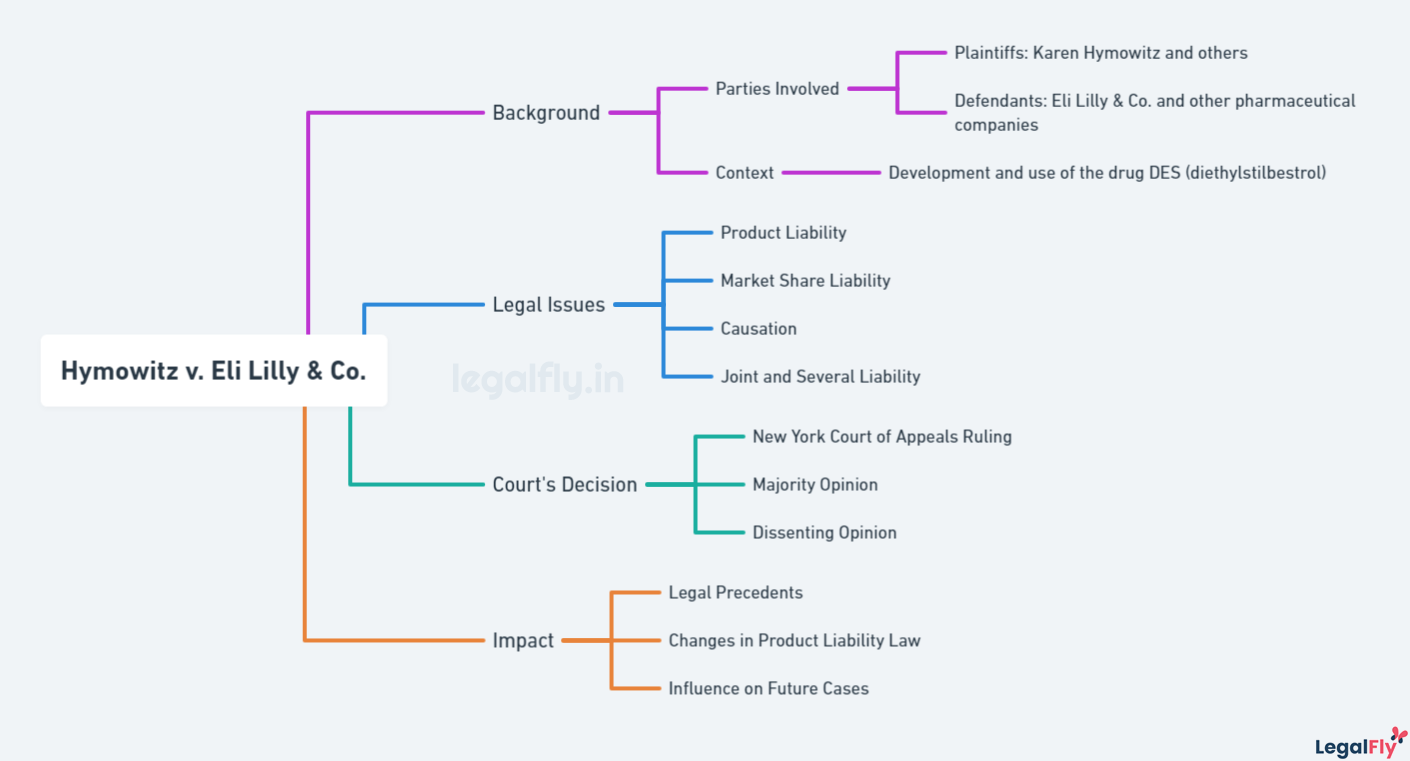
Hymowitz v. Eli Lilly & Co. (1989) is the New York Court of Appeals decision that fashioned a distinctive form of market-share liability for women injured by the drug diethylstilbestrol (DES). It let DES victims recover from manufacturers without proving which company made the specific pills their mothers had taken — apportioning responsibility instead by each maker's share of the national DES market.
| Element | Detail |
|---|---|
| Case | Hymowitz v. Eli Lilly & Co. |
| Citation | 73 N.Y.2d 487; 539 N.E.2d 1069 (1989) |
| Court | New York Court of Appeals (New York's highest court) |
| Decided | 1989 — majority opinion by Chief Judge Sol Wachtler |
| Doctrine | National market-share liability — several only, no exculpation |
Background on DES
DES is a synthetic oestrogen, first synthesised in 1938 and approved by the U.S. Food and Drug Administration in 1941. From the late 1940s it was widely prescribed to pregnant women to prevent miscarriage, until the FDA warned against that use in 1971 after research linked it to a rare vaginal cancer (clear-cell adenocarcinoma) in the daughters of women who had taken it. Millions of mothers and children were exposed. Beyond cancer, DES daughters faced higher rates of infertility and pregnancy complications; sons, genital abnormalities.
The Problem the Case Had to Solve
DES was a generic drug: roughly 300 companies made and sold it from an identical formula, the pills were interchangeable, and the injuries did not surface until decades later. By the time a DES daughter fell ill and sued, it was usually impossible to know which manufacturer's product her mother had actually ingested. Under ordinary tort law, that failure of causation would defeat the claim entirely, however clearly the class of manufacturers as a whole had caused the harm.
Two further hurdles arose. The claims were initially time-barred under the old rule that the limitation period ran from exposure; New York responded with a revival statute in 1986, switching to a discovery rule and reviving previously time-barred DES (and other latent-injury) claims for a one-year window. The Court of Appeals took up the consolidated DES appeals to resolve both the identification problem and the validity of that statute.
Legal Issues
- Could DES plaintiffs recover when they could not identify the specific manufacturer of the pills that injured them?
- Was New York's statute reviving time-barred DES claims constitutional?
Ruling and Rationale
The Court of Appeals, in an opinion by Chief Judge Wachtler, answered both questions in the plaintiffs' favour and crafted a DES-specific market-share rule with three defining features.
| Feature | What the Court held |
|---|---|
| National market | Liability is apportioned by each defendant's share of the national market for DES sold for pregnancy use — not a local market — because the goal is to gauge each maker's contribution to the overall risk. |
| Several liability only | Each manufacturer pays only its own market-share percentage; it is not jointly liable for the whole. A plaintiff may therefore recover less than 100% if some makers are absent or defunct. |
| No exculpation by the individual case | A defendant cannot escape by proving it did not make the particular pill the plaintiff's mother took. It can exculpate itself only by showing it never marketed DES for pregnancy use at all during the relevant period. |
The reasoning was openly policy-driven. Because the relevant fault is the risk each company created by putting DES into the national market, liability should follow that risk rather than an unprovable link to one plaintiff. As between innocent injured women and the manufacturers who profited from the drug, the latter were better placed to bear the loss. The Court also upheld the revival statute against a due-process challenge, finding it a reasonable response to the special problem of latent injuries.
The decision was not unanimous. Judge Mollen dissented in part: he agreed that the revival statute was valid and that a market-share theory was appropriate, but would have allowed a defendant to exculpate itself by proving it could not have caused the particular plaintiff's injury — and, to ensure full recovery, would have imposed joint and several liability on the remaining defendants.
Hymowitz vs. Sindell v. Abbott Laboratories
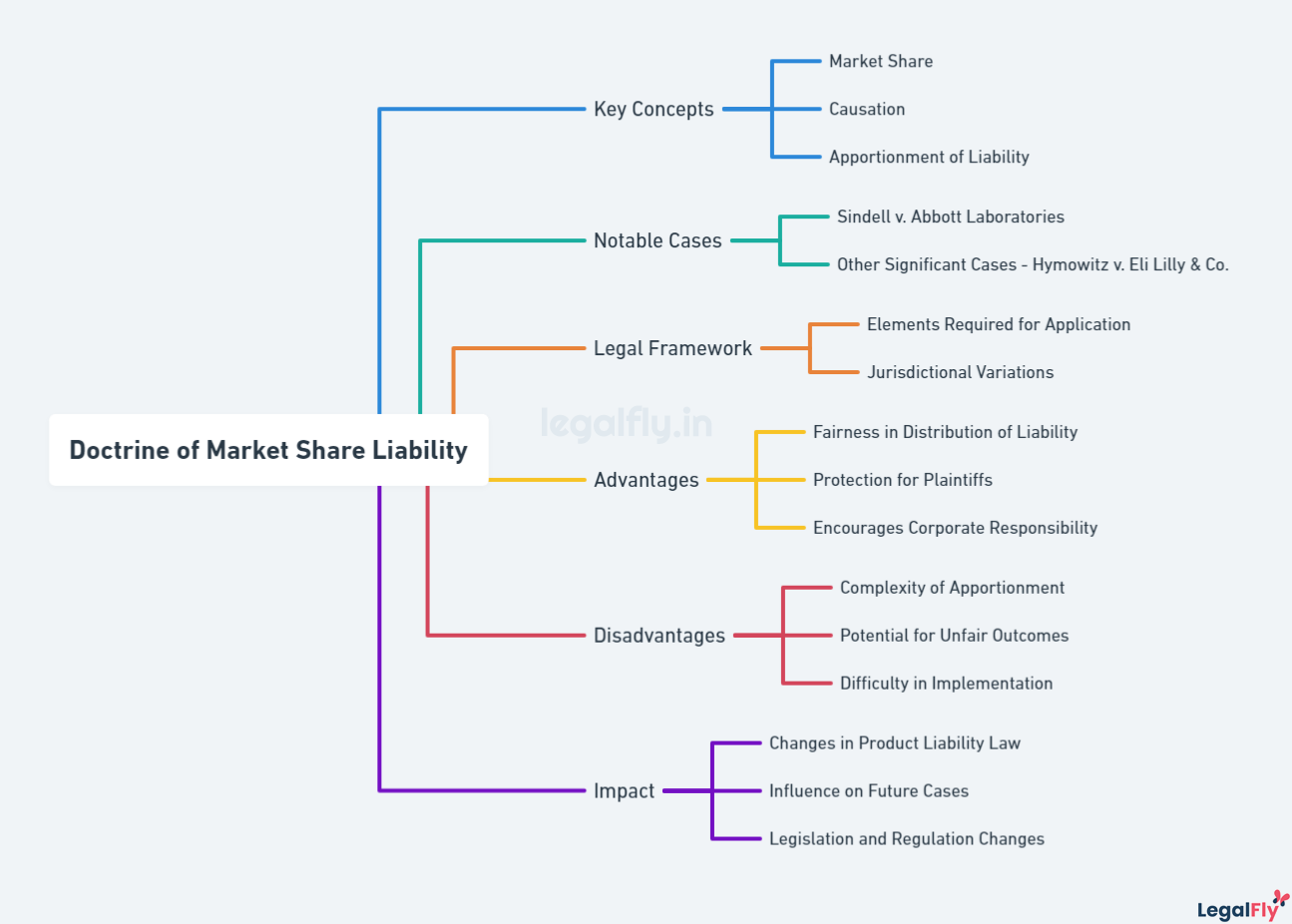
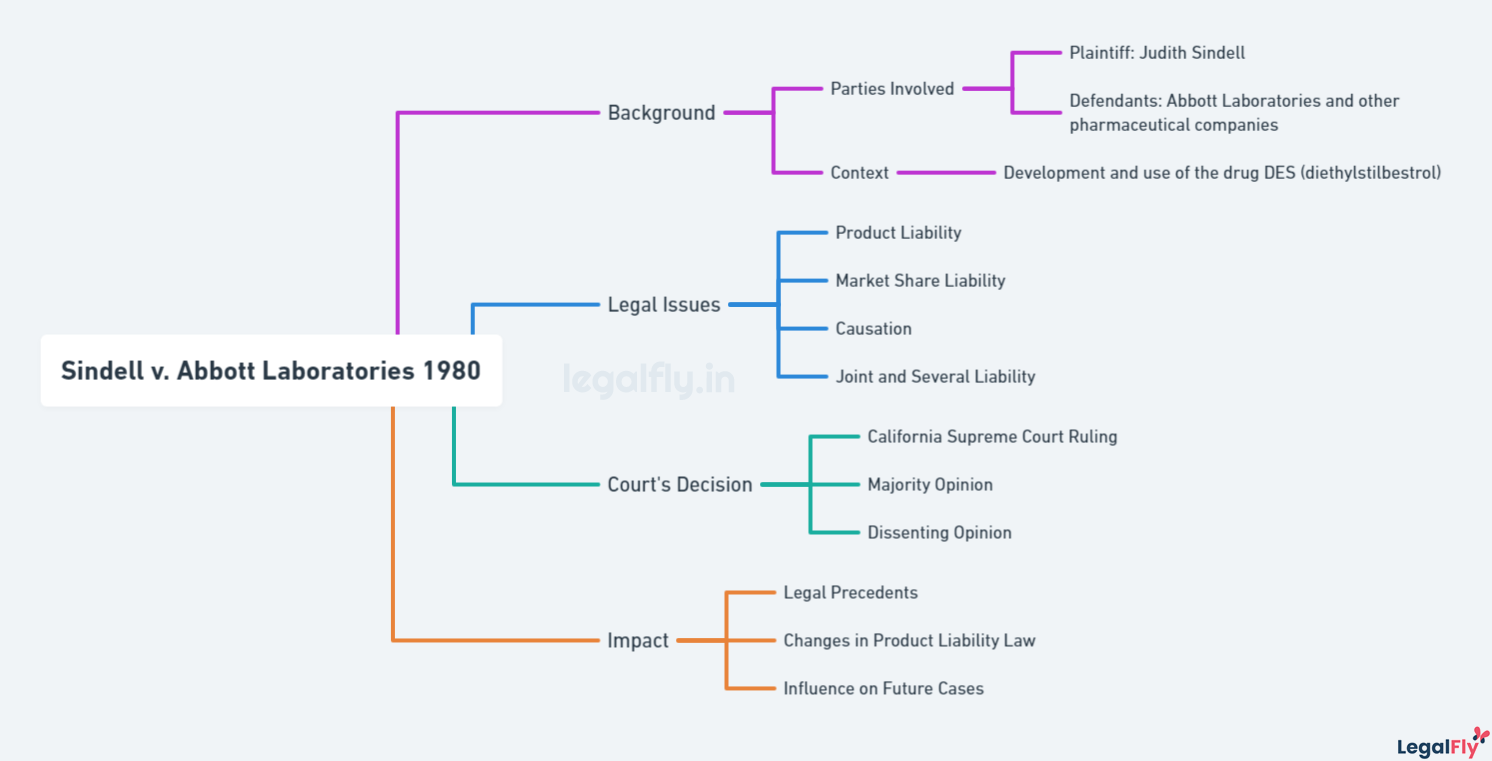
Hymowitz built on California's Sindell v. Abbott Laboratories (1980), the case that first recognised market-share liability for DES — but the two differ in important ways.
| Issue | Sindell (CA, 1980) | Hymowitz (NY, 1989) |
|---|---|---|
| Relevant market | Substantial share of the (local) market | National market for pregnancy-use DES |
| Exculpation | Allowed — a defendant could prove it didn't make the plaintiff's pill | Not allowed on that basis (only "never sold DES for pregnancy") |
| Nature of liability | Generally several, tied to the individual plaintiff's risk | Several only, tied to the public-wide risk created |
Criticisms
Market-share liability remains controversial. Critics argue it breaks with the core tort requirement that a defendant pay only for harm it actually caused; that it can burden larger firms simply for their market success while letting smaller ones escape; and that severing liability from individual causation may dull incentives for product safety. Several states have declined to follow it. Defenders reply that, faced with a genuine and blameless gap in proof, the rule fairly distributes loss among the very companies that created the risk.
Implications and a Comparative Note
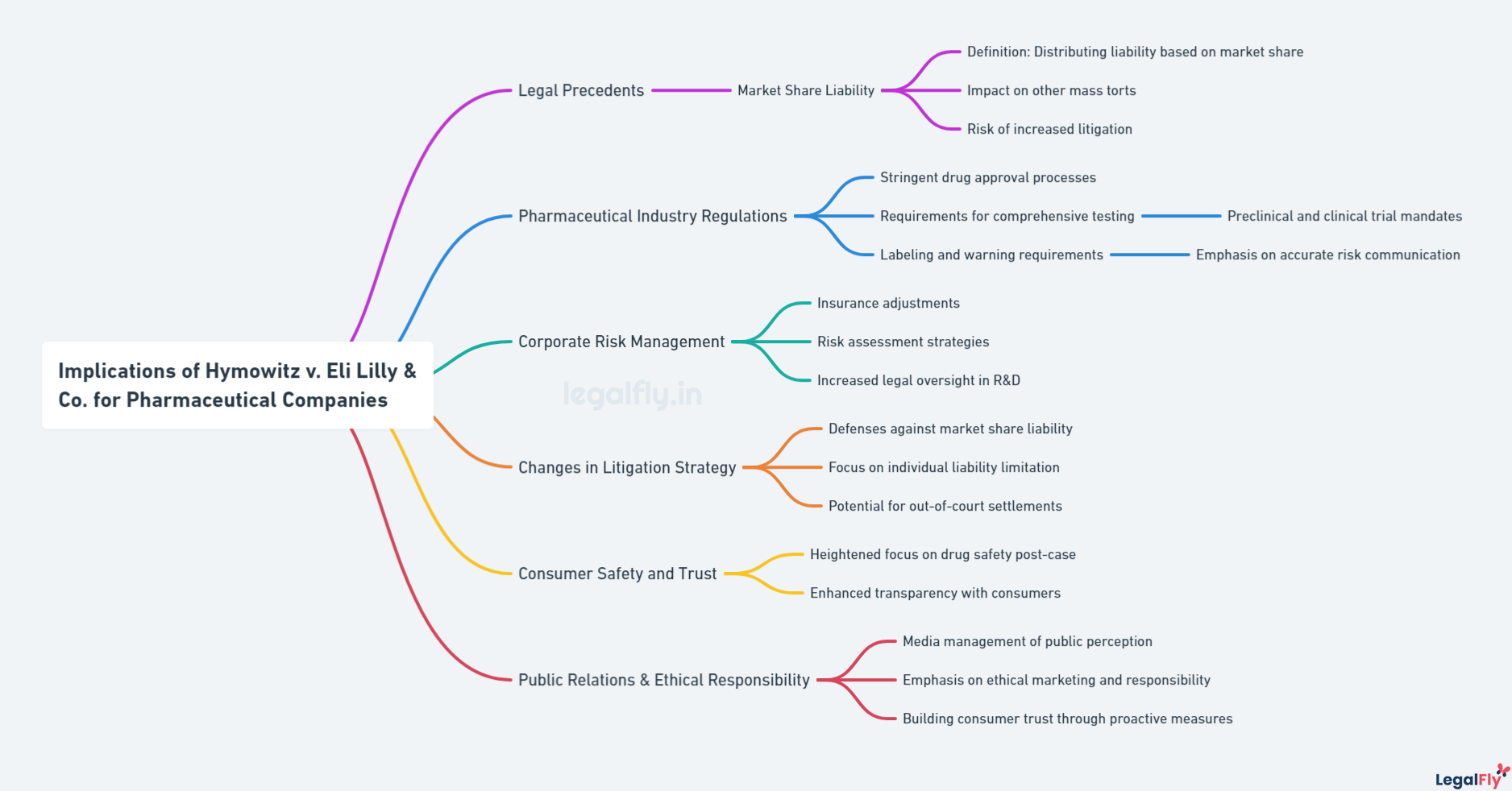
For manufacturers, Hymowitz signalled that producing a fungible, mass-marketed product could bring liability even without a provable causal link to a given victim — sharpening the case for rigorous long-term safety testing and honest labelling.
Indian tort law has not adopted market-share liability; it works within fault-based negligence and the strict/absolute-liability doctrines (see absolute liability). Hymowitz is studied in India mainly as a comparative illustration of how common-law courts can stretch causation to meet a mass-tort problem.
Conclusion
Hymowitz v. Eli Lilly & Co. is a textbook example of judicial creativity in tort law. By tying liability to each maker's share of the national risk — several, with no escape through the individual case — it gave DES victims a remedy that traditional causation rules would have denied, while keeping each defendant's exposure proportionate. Decades on, it remains the leading statement of market-share liability and a focal point in debates over how far tort law should bend to compensate the victims of mass-marketed products.