
What is the Doctrine of Absolute Liability in Indian Tort Law?
In this article
- Understanding absolute liability
- The origin of the principle
- Essentials and application
- Key differences between absolute and strict liability
- Strict liability and absolute liability: the underlying concepts
- The doctrine of strict liability
- Application of absolute liability in India
- Case study: the Oleum gas leak
- Legal ramifications and defences
- Defences in absolute liability cases
- The position of claimants
- The Public Liability Insurance Act and absolute liability
- Landmark cases and precedents
- The Bhopal Gas Tragedy and absolute liability
- Rylands v. Fletcher: the strict-liability foundation
Understanding absolute liability
Absolute liability is a doctrine of tort law under which a defendant is held liable for harm caused by a hazardous activity without the claimant having to prove fault or negligence — and, crucially, without any of the usual exceptions. Liability attaches simply because the enterprise carried on the dangerous activity and harm resulted.
It is a no-fault standard: the defendant is liable however much care was taken. The rationale is that enterprises which profit from inherently dangerous activities must bear the full cost of any harm they cause to the public — an application of the "polluter pays" principle and a strong incentive for safety.
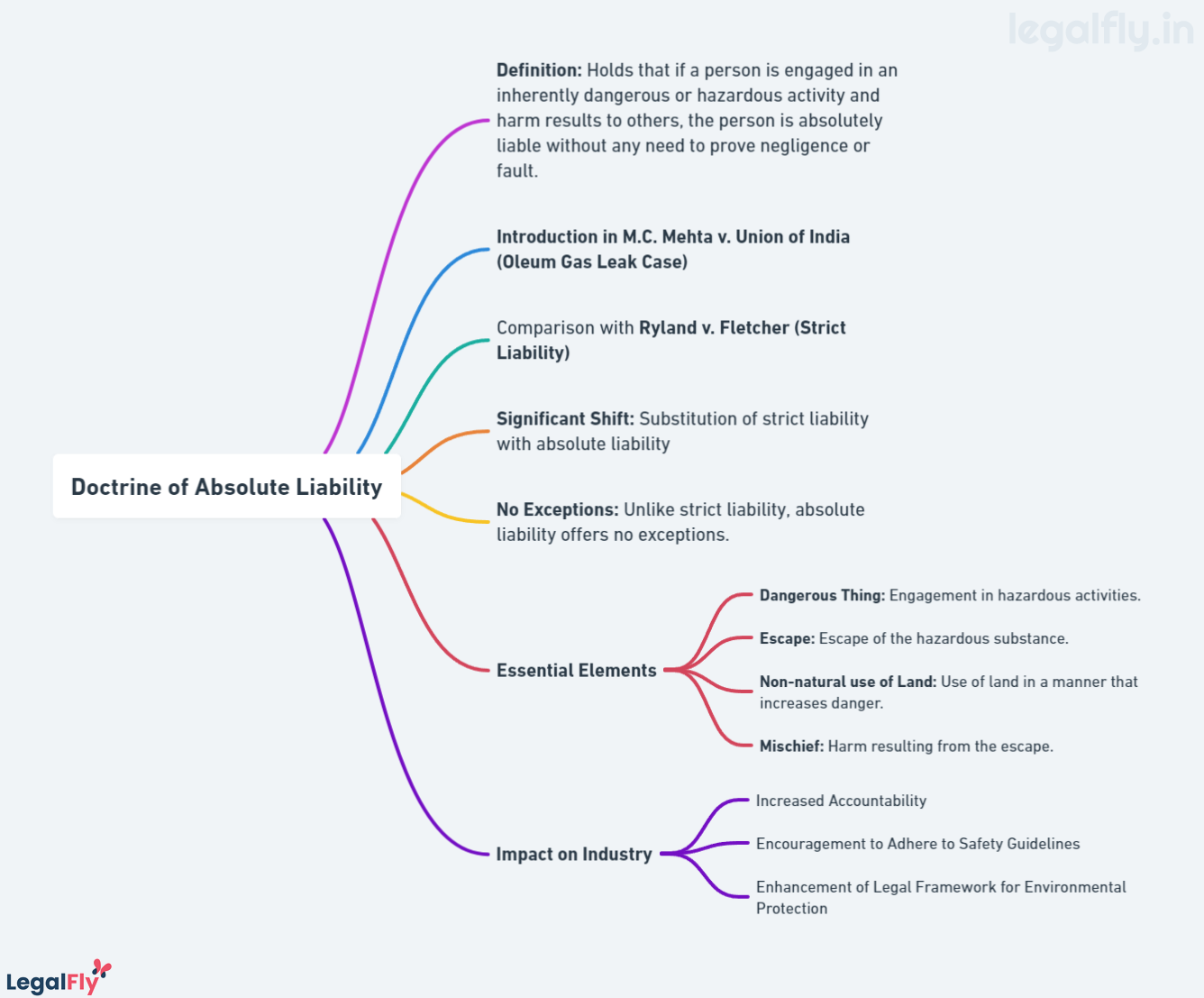
Absolute liability is stricter than strict liability. Under strict liability (the rule in Rylands v. Fletcher), a defendant can escape liability by relying on recognised exceptions — act of God, the act of a stranger, the claimant''s own fault, consent, or statutory authority. Under absolute liability, none of those exceptions is available.
The origin of the principle
Absolute liability was created in India in M.C. Mehta v. Union of India, (1987) 1 SCC 395 — the Oleum gas leak case — decided by a Constitution Bench led by Chief Justice P.N. Bhagwati in December 1986. The case arose from a leak of oleum gas from the Shriram Foods and Fertiliser Industries plant in Delhi in 1985 (this was Shriram, not the Bhopal/Union Carbide plant).
The Supreme Court held that the strict-liability rule of Rylands v. Fletcher, with its many exceptions, was inadequate for the hazards of modern industry. It therefore evolved a new and stricter rule. Bhagwati CJ held that an enterprise engaged in a hazardous or inherently dangerous activity owes an absolute and non-delegable duty to the community, and is "absolutely liable to compensate for the harm" caused, subject to no exceptions. He added that the compensation must be deterrent — correlated to the size and capacity of the enterprise — so that it is a real incentive to safety.
Essentials and application
To establish absolute liability, the claimant need only show that:
- the defendant was engaged in a hazardous or inherently dangerous activity;
- that activity caused the escape or release of a dangerous substance (though, unlike Rylands, even this is not strictly required — the enterprise is liable for harm "to anyone" inside or outside the premises); and
- the activity caused the harm complained of.
There is no need to prove negligence, intention, "non-natural use" or escape in the technical Rylands sense, and the defendant cannot rely on having taken reasonable care. The doctrine applies to enterprises handling hazardous substances and to environmental harm; distinct no-fault regimes (for example, no-fault liability for road accidents under the Motor Vehicles Act) operate under their own statutes and should not be confused with the M.C. Mehta rule.
Key differences between absolute and strict liability
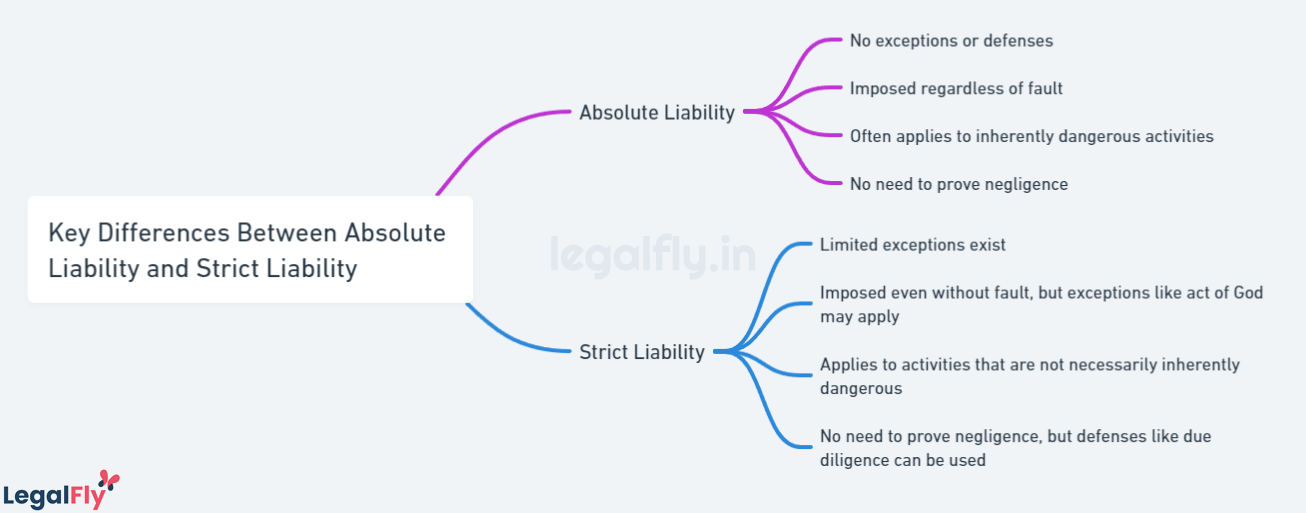
Both are no-fault doctrines — neither depends on negligence — but they differ sharply on exceptions and scope:
| Aspect | Strict liability (Rylands v. Fletcher) | Absolute liability (M.C. Mehta) |
|---|---|---|
| Basis | Non-natural use of land + escape of a dangerous thing | Carrying on any hazardous or inherently dangerous activity |
| Exceptions / defences | Available — act of God, act of a stranger, claimant''s own fault, consent, statutory authority | None — liability is absolute |
| "Escape" required? | Yes — the thing must escape from the defendant''s land | No — covers harm to persons inside and outside the premises |
| Measure of damages | Ordinary compensatory damages | Deterrent — correlated to the enterprise''s size and capacity |
| Origin | Rylands v. Fletcher (1868), England | M.C. Mehta v. Union of India (1987), India |
In short, absolute liability removes the escape requirement and every exception that softens strict liability. It is a distinctively Indian development designed to make hazardous enterprises fully accountable.
Strict liability and absolute liability: the underlying concepts
The doctrine of strict liability
Strict liability holds a defendant liable for harm caused by their conduct regardless of fault — the claimant need only show that the defendant''s activity caused the loss. It originates in the English case Rylands v. Fletcher (1868), which established that a person who, for their own purposes, brings and keeps a dangerous thing on their land which then escapes is liable for the damage it causes, even without negligence — provided the use of land was "non-natural". Unlike negligence, strict liability does not require a breach of a duty of care or foreseeability of damage. But it is qualified by the recognised exceptions noted above.
Application of absolute liability in India
After M.C. Mehta, the absolute-liability principle was reinforced by legislation and later cases. The Public Liability Insurance Act, 1991 made owners handling hazardous substances liable to give immediate, no-fault relief to victims, backed by compulsory insurance. The National Green Tribunal Act, 2010 created specialised environmental courts that apply no-fault and absolute-liability principles when awarding compensation. The Supreme Court has consistently extended the doctrine to industrial pollution and the dumping of hazardous waste, ensuring victims are compensated and industries exercise the highest care.
Case study: the Oleum gas leak
The leak occurred in December 1985 at the Shriram Foods and Fertiliser Industries plant in Delhi, releasing oleum gas that is harmful to health.
Facts of the case
- Oleum gas escaped from the Shriram plant and spread to surrounding areas, affecting many people; the leak was reportedly linked to the death of one person (an advocate).
- It caused breathing difficulty, irritation and other harm among local residents.
- The incident, coming barely a year after the Bhopal disaster, exposed serious gaps in industrial safety and emergency planning.
Decision of the Supreme Court
- The Court laid down the new rule of absolute liability: an enterprise in a hazardous activity owes an absolute, non-delegable duty and is liable for resulting harm with no exceptions.
- It held that compensation should be deterrent and proportionate to the enterprise''s capacity.
- It set conditions for the plant''s operation (including financial guarantees) and directed that victims'' claims be processed, while encouraging specialised machinery for environmental and industrial-hazard cases.
Analysis and implications
- The judgment established absolute liability as a distinct, stricter Indian doctrine for hazardous industries.
- It reinforced the polluter-pays principle and the duty of care owed by enterprises handling dangerous substances.
- It influenced later legislation (the 1991 PLIA and the 2010 NGT Act) and the growth of environmental adjudication.
- It underscored the human cost of industrial accidents and the need for prevention and preparedness.
Legal ramifications and defences
Defences in absolute liability cases
This is the defining feature of the doctrine: in a true absolute-liability case there are no defences. Because liability does not depend on negligence or intention, the enterprise cannot escape by showing it took reasonable care, nor can it rely on act of God, the act of a stranger, the claimant''s consent or statutory authority — the exceptions that would defeat strict liability. The most a defendant can usually do is contest whether its activity in fact caused the harm, or argue on the quantum of compensation. The exceptions listed for strict liability (above) belong to Rylands v. Fletcher, not to absolute liability.
The position of claimants
The doctrine is deliberately claimant-friendly: a victim of a hazardous-activity accident need only establish that the enterprise''s activity caused the harm, without proving fault. This lowers the evidential barrier that ordinary negligence claims impose and is intended to ensure that those injured by industrial hazards are compensated quickly and fully.
The Public Liability Insurance Act and absolute liability
The Public Liability Insurance Act, 1991 gives statutory form to no-fault liability for hazardous substances, providing immediate relief to victims. Its key features include:
- Compulsory insurance: owners handling hazardous substances must hold liability insurance, ensuring a ready source of compensation.
- No-fault relief: the owner is liable to give specified relief regardless of fault or negligence.
- Environmental Relief Fund: a central fund to provide relief beyond the insurance cover.
Critics note that the relief amounts prescribed under the Act are modest and inadequate for catastrophic disasters — the compensation issues in the Bhopal case being the standard illustration — so its effectiveness in large-scale calamities is debated.
Landmark cases and precedents
The Bhopal Gas Tragedy and absolute liability
The Bhopal Gas Tragedy (December 1984) — the leak of methyl isocyanate from the Union Carbide plant, one of the world''s worst industrial disasters — was the catalyst that drove Indian courts to rethink liability for hazardous industry. It is important to be precise about the legal history: the absolute-liability doctrine was actually laid down in the Oleum case (M.C. Mehta), not in the Bhopal litigation. The Bhopal claims were ultimately resolved by a controversial settlement in Union Carbide Corporation v. Union of India (1989) for US$470 million — widely criticised as inadequate — rather than by a full application of absolute liability. Bhopal thus provided the urgency; the Oleum case provided the principle. Later, in Indian Council for Enviro-Legal Action v. Union of India (1996, the Bichhri case), the Supreme Court squarely applied absolute liability together with the polluter-pays principle.
Rylands v. Fletcher: the strict-liability foundation
Rylands v. Fletcher (1868) laid the 19th-century foundation of strict liability: a person who keeps a dangerous thing on their land in the course of a non-natural use is liable if it escapes and causes harm, even without negligence — but subject to the recognised exceptions. This rule shaped tort law across the common-law world, including India, until the Supreme Court found it too narrow for modern industrial hazards and replaced it, for such cases, with the stricter rule of absolute liability.
For a deeper look, see our detailed case summaries of Rylands v. Fletcher and M.C. Mehta v. Union of India (Oleum gas leak).