
Krell v. Henry (1903): Case Summary & Frustration of Purpose
In short
Krell v. Henry (1903) is the famous "coronation case" that established frustration of purpose in contract law. Henry hired a London flat purely to watch Edward VII's coronation procession; when the King fell ill and the procession was cancelled, the Court of Appeal held the contract was frustrated and Henry did not have to pay the balance — even though the room could still physically be used. Note: Krell, the owner, lost.
In this brief
Introduction
Krell v. Henry (1903) is one of the most famous cases in contract law and the leading authority on the doctrine of frustration of purpose. Decided by the English Court of Appeal, it is one of the "coronation cases" that arose when the coronation of King Edward VII was suddenly postponed. A man who had hired a flat purely to watch the coronation procession refused to pay when the procession was cancelled — and the court agreed that the contract had been frustrated.
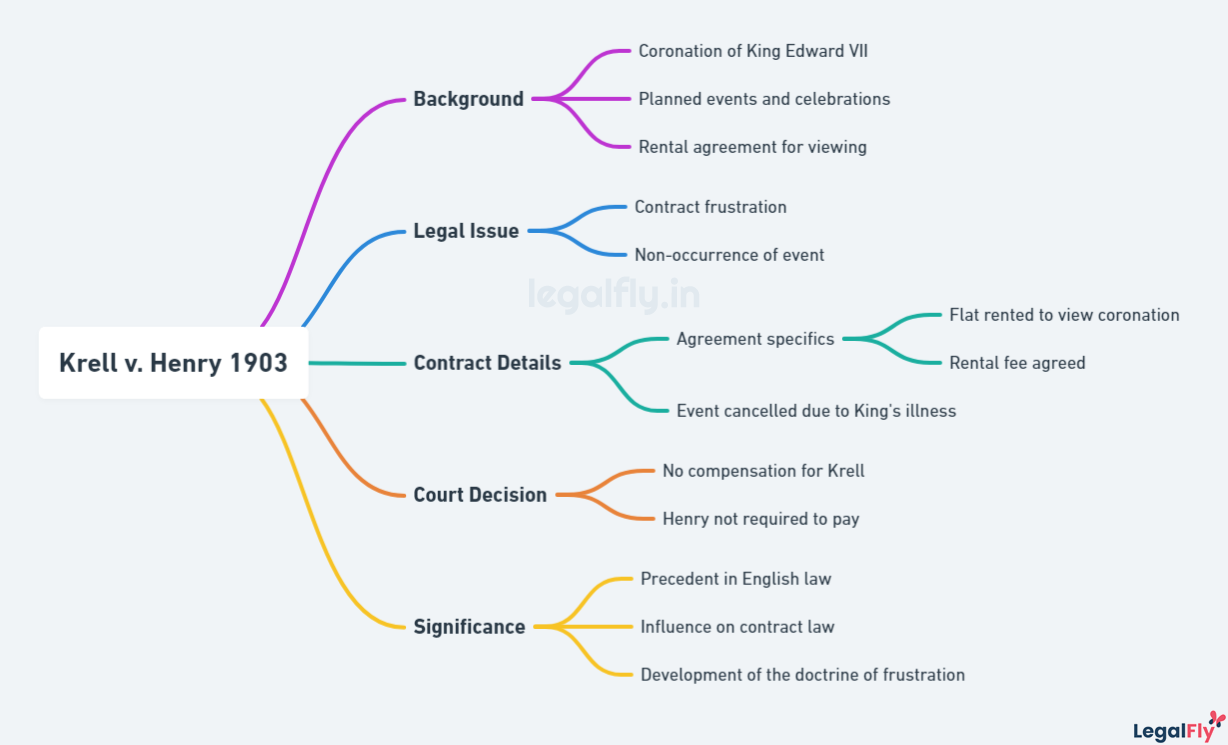
The Court of Appeal held that where an unforeseen event destroys the very foundation of a contract — even though performance is still physically possible — the contract may be discharged. It is essential to note the outcome: the owner, Krell, lost; the hirer, Henry, was released from his obligation to pay the balance.
Background of the Case
Paul Krell owned a flat at 56A Pall Mall in London, on the route of Edward VII's coronation procession. C.S. Henry agreed to hire the rooms for the two days of the planned processions to watch them. The agreement, made through letters, did not actually mention the coronation in so many words — but both parties plainly understood that viewing the procession was the whole point of the hire.
Henry paid a deposit of £25 towards the agreed price of £75, with the balance of £50 due before the event. The King then fell ill (appendicitis) and the coronation processions were postponed. Henry refused to pay the £50 balance, and Krell sued to recover it. The key legal questions were:
- Was watching the coronation procession the foundation of the contract, even though the written terms did not say so?
- Could a contract be discharged when performance was still possible, but its purpose had been defeated?
- What are the limits of this doctrine of frustration?
Facts of the Case
The flat had a clear view of the procession route, and Krell let the rooms for the daytime of the coronation days at a high price reflecting that special demand — not as ordinary residential accommodation. Henry hired the rooms solely to watch the procession.
When the King's illness forced the processions to be postponed, Henry refused to pay the outstanding £50. Krell sued for that balance; Henry resisted, arguing the cancellation had destroyed the purpose of the hire. The dispute went to the Court of Appeal (not, as is sometimes wrongly stated, the House of Lords), where it became the landmark authority on frustration of purpose.
The Central Issue: Frustration of Purpose
It is worth clearing up a common confusion first. Krell v. Henry is not a case about contractual capacity — that is a separate doctrine, concerned with whether a party (a minor, a person of unsound mind, or someone intoxicated) is legally able to contract at all.
Both Krell and Henry were fully capable adults; capacity was never in doubt. The real issue was frustration of purpose: whether an unforeseen event after the contract was formed had destroyed the basis on which both parties had contracted. The room could still physically be hired — so this was not a case of impossibility. The question was whether the loss of the reason for the hire was enough to discharge the contract.
Court's Ruling
The Court of Appeal ruled in favour of Henry (the defendant). It held that the contract was frustrated by the cancellation of the procession, so Henry was discharged from his obligation to pay the £50 balance. Krell, the owner, therefore lost — he could not recover the unpaid sum.
The court reasoned that, although the written agreement did not mention the coronation, viewing the procession was, on the facts, the foundation of the contract as understood by both parties. Once that foundation disappeared, holding Henry to the bargain would be to enforce something fundamentally different from what the parties had agreed.
Court's Reasoning
Vaughan Williams LJ, giving the leading judgment, built on the impossibility principle from Taylor v. Caldwell (1863) — where a contract to hire a music hall was discharged after the hall burned down — and extended it. The question, he said, was: what was the substance of the contract, and was that substance destroyed by the event?
Here, the procession was the very substance of the deal. Its cancellation did not make performance physically impossible (the rooms still existed), but it removed the entire point of the contract. The court therefore distinguished impossibility (performance cannot be done) from frustration of purpose (performance can be done, but is now pointless), and held that frustration could discharge a contract in the latter situation too.
Krell v. Henry vs. Herne Bay Steam Boat Co v Hutton
Krell is best understood next to its companion coronation case, Herne Bay Steam Boat Co v Hutton (1903), decided around the same time — where frustration failed. There, a boat was hired both to watch the royal naval review and to cruise around the fleet. When the review was cancelled, the court held the contract was not frustrated, because the naval review was not the sole foundation of the contract — the cruise around the assembled fleet was still possible.
The contrast gives the rule its edge: frustration of purpose applies only where the frustrated event was the entire basis of the contract (Krell), not merely one of several purposes or a matter of reduced profit (Herne Bay).
Frustration of Purpose in India
In India, frustration is governed by Section 56 of the Indian Contract Act, 1872, which provides that an agreement to do an act that becomes impossible or unlawful after the contract is made becomes void. In Satyabrata Ghose v. Mugneeram Bangur & Co. (1954), the Supreme Court held that, in India, frustration is a positive rule of law contained in Section 56 — not the English "implied term" theory — and that "impossible" in Section 56 includes acts that become impractical or useless having regard to the object the parties had in view. Krell-type reasoning therefore feeds into Indian law through Section 56.
Impact and Significance
Krell v. Henry firmly established frustration of purpose as a ground for discharging a contract and shaped how courts interpret agreements — looking to the parties' shared purpose, not just the literal words. It encouraged a more purposive reading of contracts and confirmed that the doctrine extends beyond strict impossibility.
Practically, the decision prompted parties to allocate such risks expressly, which is why modern contracts routinely include force majeure clauses spelling out what happens if unforeseen events disrupt performance. The case remains a fixture of contract-law courses worldwide.
Criticisms and Debates
The decision was unanimous — there was no dissent in the Court of Appeal — but it has generated lasting academic debate:
- Too generous? Critics worry that frustration of purpose lets parties escape bargains too easily when circumstances merely become less profitable.
- Unclear boundaries. The line between Krell (frustration) and Herne Bay (no frustration) can be hard to draw, producing uncertain results in later cases.
- Allocation of loss. Some argue an all-or-nothing outcome is harsh; modern statutes (such as the UK's Law Reform (Frustrated Contracts) Act 1943) now allow a fairer adjustment of sums paid and payable.
- Foreseeability. Scholars debate how far a foreseeable risk should be capable of "frustrating" a contract at all.
Modern Relevance
More than a century on, Krell v. Henry is still cited whenever a court must decide whether an unforeseen event has discharged a contract — from natural disasters to pandemics and government bans. The specific facts will never recur, but the core question it framed endures: has an intervening event destroyed the very foundation of the bargain, or merely made it less profitable? That distinction, drawn so clearly in the coronation cases, continues to guide courts in India and across the common-law world.