
ADM Jabalpur v. Shivkant Shukla (1976): Case Summary
In short
ADM Jabalpur v. Shivkant Shukla (1976), the "Habeas Corpus Case", is widely seen as the Supreme Court's darkest hour: by 4-1 it held that during the Emergency even the right to life under Article 21 could not be enforced. Justice H.R. Khanna's lone dissent cost him the Chief Justiceship — and was vindicated when the case was finally overruled in Puttaswamy (2017).
In this brief
- Introduction to ADM Jabalpur v. Shivkant Shukla
- The Legal Context and Emergency Provisions
- Understanding Articles 21 and 226 of the Indian Constitution
- The National Emergency of 1975 and its Impacts
- The Supreme Court's Judgement
- Implications of the Ruling
- Effects on Civil Liberties
- The Role of the Judiciary During a National Emergency
- Critical Analysis of the Decision
- The Aftermath and Legal Reforms
- Conclusion
Introduction to ADM Jabalpur v. Shivkant Shukla
ADM Jabalpur v. Shivkant Shukla (1976) — popularly called the Habeas Corpus Case — is widely regarded as the most controversial decision in Indian constitutional history. Decided by the Supreme Court during the 1975-77 Emergency, it asked a stark question: when fundamental rights are suspended, can a person locked up by the State still go to court?
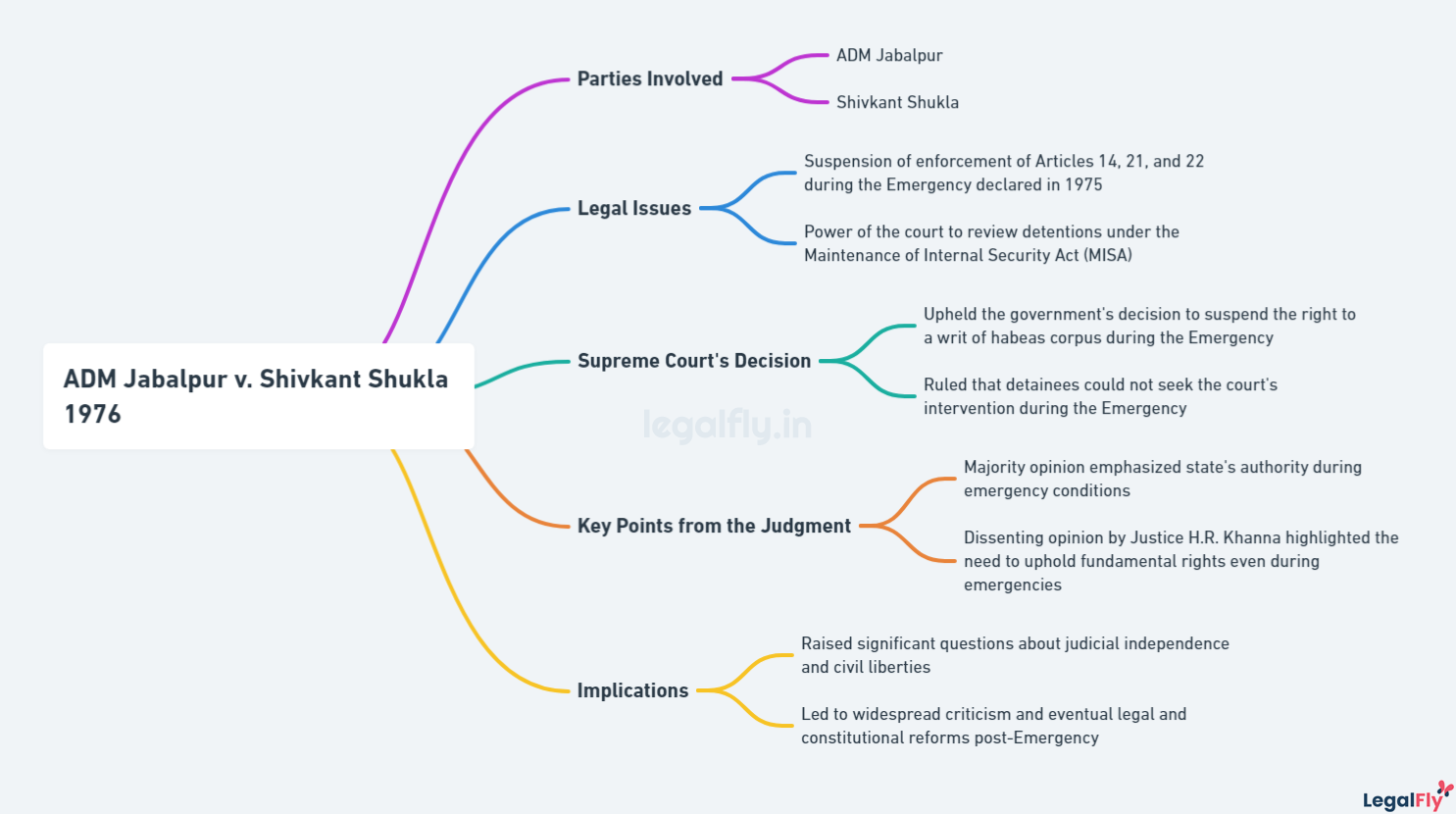
During the Emergency, the government detained thousands of people — opposition leaders, activists and ordinary citizens — without trial under the Maintenance of Internal Security Act (MISA). Many of them approached the High Courts by writ of habeas corpus, and several High Courts ruled that a detention could still be tested even with rights suspended. The government appealed those rulings to the Supreme Court; Shivkant Shukla was one of the detenus on the other side of the case. The lead appellant was the Additional District Magistrate, Jabalpur — which is how the case got its name.
By a majority of 4-1, the Supreme Court sided with the government. Only Justice H.R. Khanna dissented — a stand that cost him the Chief Justiceship but made him an enduring symbol of judicial courage.
The Legal Context and Emergency Provisions
India's Constitution contains provisions in Part XVIII that let the central government declare an emergency and exercise extraordinary powers. The case turned on how far those powers reached.
Understanding Articles 21 and 226 of the Indian Constitution
Article 21 guarantees the fundamental right to life and personal liberty: "No person shall be deprived of his life or personal liberty except according to procedure established by law." Article 226 empowers the High Courts to issue writs — including habeas corpus — to enforce rights (the Supreme Court has the same power under Article 32). Habeas corpus is the writ that forces the State to justify holding a person in custody.
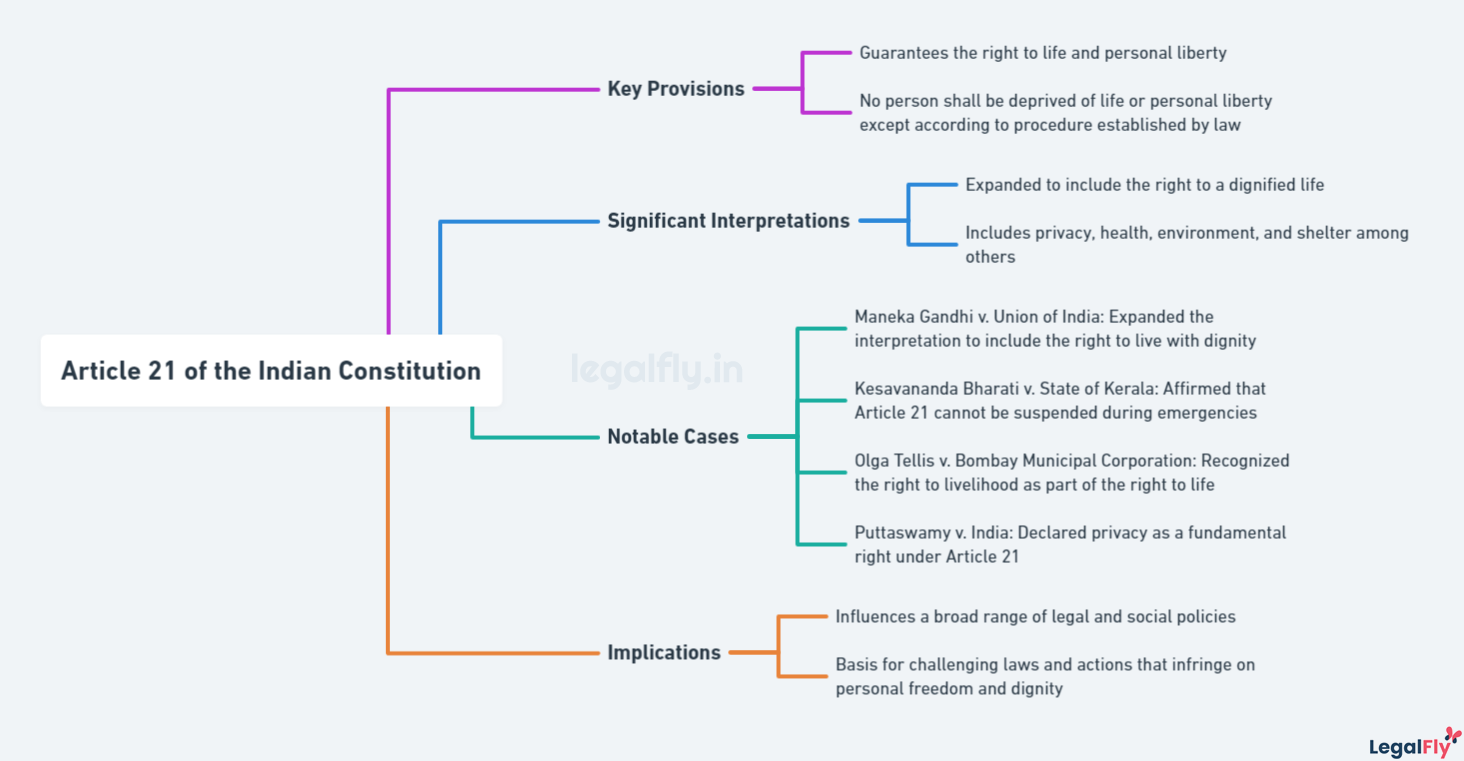
Under Article 359, the President can suspend the right to move the courts for the enforcement of specified fundamental rights during an emergency. On 27 June 1975 a Presidential Order did exactly that for Articles 14, 21 and 22 — the question was whether this also shut the courtroom door on someone challenging an unlawful detention.
The National Emergency of 1975 and its Impacts
In June 1975, Prime Minister Indira Gandhi advised the declaration of a national emergency under Article 352, citing threats to internal security. The Emergency suspended elections, curtailed civil liberties and saw thousands imprisoned without trial.
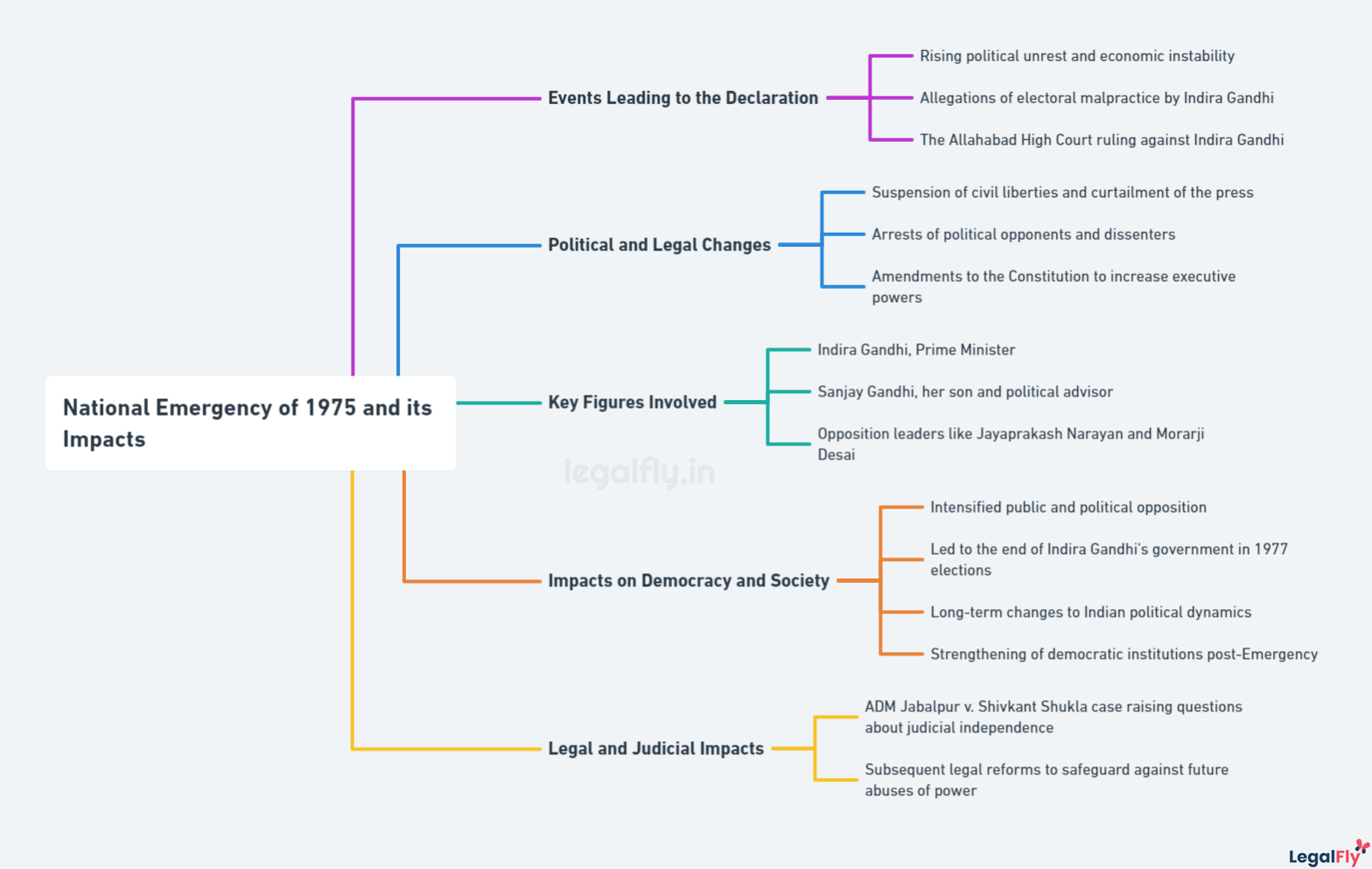
The press was muzzled through censorship. With the enforcement of fundamental rights suspended, the central question of this case became urgent: could a detainee still ask a court to examine whether their detention was even lawful?
The Supreme Court's Judgement
The judgement was delivered on 28 April 1976 by a five-judge Constitution Bench:
- Chief Justice A.N. Ray
- Justice M.H. Beg
- Justice Y.V. Chandrachud
- Justice P.N. Bhagwati
- Justice H.R. Khanna
The majority (Ray CJI, Beg, Chandrachud and Bhagwati JJ) ruled for the government. They held that once the right to move the courts for Article 21 was suspended by the Presidential Order, a detenu had no locus standi to file a habeas corpus petition — Article 21 was the "sole repository" of the right to life and liberty, so with its enforcement suspended, there was no other source to fall back on.
How far this went became clear during the hearing. When Justice Khanna asked the Attorney General, Niren De, whether there would be any remedy if a police officer killed a detainee out of personal enmity, the Attorney General conceded that, given the suspension, there would be no judicial remedy while the Emergency lasted. It was a chilling admission that framed the stakes of the case.
Justice H.R. Khanna dissented. He held that the right to life and liberty did not originate only in Article 21 — it is a basic value that predates the Constitution — and that the State could not deprive a person of life or liberty without the authority of law, even during an emergency. He famously wrote that even a temporary suspension could not mean the State had the power to act lawlessly. Khanna knew the price: he reportedly told his sister that he had "prepared his judgment, which is going to cost me the Chief Justiceship." It did — he was superseded by Justice Beg as Chief Justice in 1977, and resigned.
Implications of the Ruling
The decision had far-reaching consequences for civil liberties and for how the judiciary saw its own role in a crisis.
Effects on Civil Liberties
The majority verdict left detainees with no way to challenge their imprisonment in court for the duration of the Emergency. By holding that even Article 21 could not be enforced, the Court effectively allowed indefinite detention without due process. It was a devastating blow to personal liberty at the very moment people most needed protection.
The Role of the Judiciary During a National Emergency
The case exposed how readily the highest court could defer to executive power in a crisis. The institution meant to be the guardian of rights chose not to stand in the government's way. Justice Khanna's dissent pointed the other way — showing that a judge could uphold constitutional values whatever the circumstances — and it is his opinion, not the majority's, that Indian law ultimately embraced.
Critical Analysis of the Decision
The judgement has drawn sustained criticism. The majority opinion is routinely described as a "low point" in the Supreme Court's history — a failure of the independent judiciary to act as a check on state power exactly when that check mattered most.
Justice Khanna's dissent, by contrast, is celebrated. The New York Times wrote at the time that if India ever returned to freedom, his name would be remembered; the tribute proved accurate. His stand embodied judicial independence and personal courage.
The deeper criticism is doctrinal: by treating Article 21 as the only source of the right to life, the majority denied that there is any baseline of legality the State must always respect. That reasoning handed the executive near-unlimited power and set a dangerous precedent on the scope of rights during emergencies.
The Aftermath and Legal Reforms
The backlash against the judgement helped drive major reform.
The 44th Constitutional Amendment (1978) changed the rules so that the rights under Articles 20 and 21 can never be suspended, even during an emergency. The core guarantees of life, liberty and protection against arbitrary punishment were placed beyond the reach of any future Emergency.
The Supreme Court itself moved away from ADM Jabalpur almost immediately, expanding Article 21 in Maneka Gandhi v. Union of India (1978) to require fair, just and reasonable procedure. The repudiation became complete in K.S. Puttaswamy v. Union of India (2017), the Right to Privacy case, where a nine-judge bench expressly overruled ADM Jabalpur, calling its majority view "seriously flawed". In a striking twist, the opinion burying it was written by Justice D.Y. Chandrachud — son of Justice Y.V. Chandrachud, who had been part of the 1976 majority.
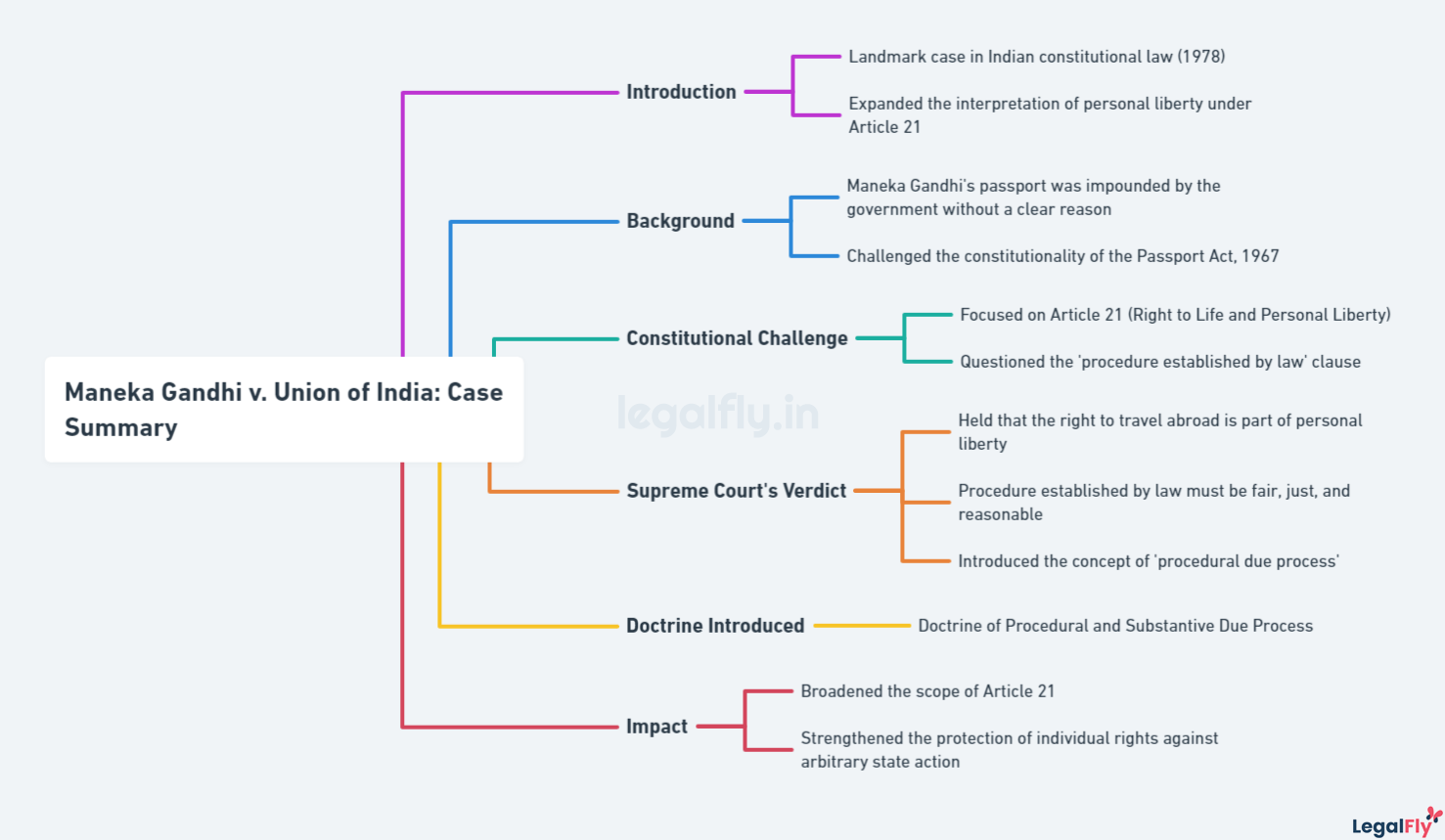
So while ADM Jabalpur marked the darkest moment for civil liberties in independent India, its aftermath produced reforms that strengthened the judiciary's role as guardian of constitutional rights.
Conclusion
ADM Jabalpur v. Shivkant Shukla leaves a complex legacy. The majority ruling is remembered as the Supreme Court's failure to protect liberty during the 1975-77 Emergency, while Justice Khanna's lone dissent is remembered as one of the finest defences of fundamental rights in Indian history.
The case is no longer good law — it was overruled in 2017 — but it endures as a cautionary tale about the abuse of emergency powers and the cost of judicial deference. Its key lessons remain sharply relevant: rights are most fragile precisely when they are most needed, and an independent judiciary is the last line of defence against unchecked power.