
Mithu v. State of Punjab (1983): Mandatory Death Penalty
In short
A five-judge Constitution Bench led by Chief Justice Y.V. Chandrachud struck down Section 303 of the IPC — which made the death penalty the only punishment for a life convict who commits murder — as unconstitutional. By removing all judicial discretion and barring any consideration of mitigating circumstances, the section was arbitrary (Article 14) and imposed an unjust, unfair and unreasonable procedure (Article 21). After Mithu, such murders fall under Section 302, where the death penalty is discretionary and reserved for the "rarest of rare" cases.
In this brief
- Introduction: overview of Mithu v. State of Punjab
- The constitutional challenge against Section 303 IPC
- The Supreme Court''s judgment and its implications
- Impact on sentencing and judicial discretion
- Sentencing before and after Mithu
- The role of the judiciary in protecting constitutional rights
- Capital punishment under the Bharatiya Nyaya Sanhita, 2023
- Legislative reform and mandatory death penalties
- Conclusion
Introduction: overview of Mithu v. State of Punjab
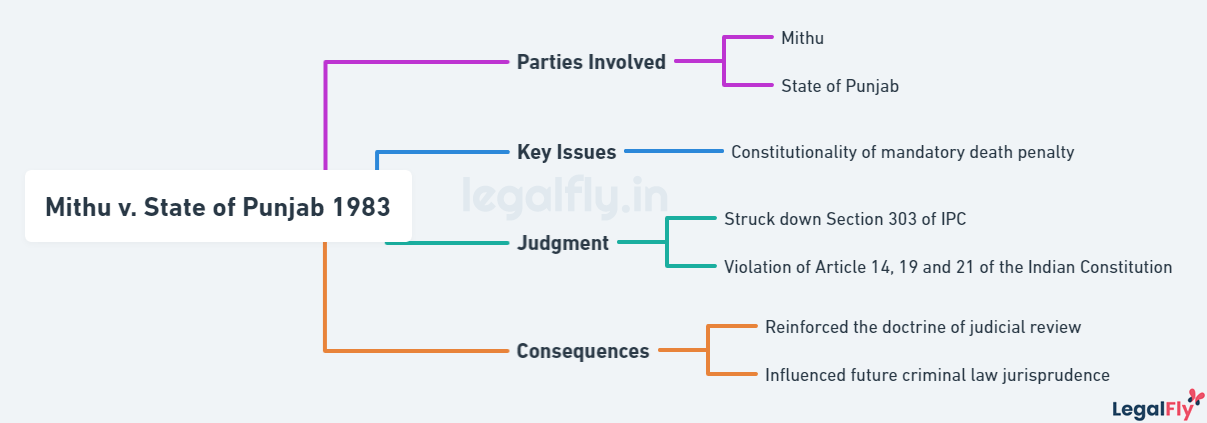
Mithu v. State of Punjab, (1983) 2 SCC 277, is a landmark judgment of a five-judge Constitution Bench of the Supreme Court, led by Chief Justice Y.V. Chandrachud and decided on 7 April 1983. It struck down Section 303 of the Indian Penal Code, 1860, which made the death penalty the only punishment for a person already serving a life sentence who commits murder.
The appellant, Mithu, had been sentenced to death under Section 303 for committing murder while serving a life term. He challenged the provision as unconstitutional.
The constitutional provisions at the heart of the case were:
- Article 14 — equality before the law.
- Article 21 — the right to life and personal liberty, and the guarantee of a just, fair and reasonable procedure.
The Court held that Section 303 violated Articles 14 and 21, and declared it void. It is one of the most important decisions on the death penalty and judicial discretion in sentencing.
The constitutional challenge against Section 303 IPC
Section 303 IPC provided that a person under a sentence of life imprisonment who commits murder "shall be punished with death" — there was no option of any lesser sentence. The challenge to it rested on three connected arguments:
- No judicial discretion: the section made death the sole, mandatory punishment, so the court could not weigh the facts of the case, the manner of the killing, or any mitigating circumstance.
- Arbitrary classification: it singled out life convicts as a class and presumed every murder by them deserved death, with no rational basis for treating them differently from every other murderer (who is sentenced under Section 302, where death is only one option).
- Conflict with the "rarest of rare" rule: just three years earlier, in Bachan Singh v. State of Punjab (1980), the Court had held that life imprisonment is the rule and death the exception, to be imposed only in the "rarest of rare" cases after considering aggravating and mitigating factors. A mandatory death sentence was irreconcilable with that framework.
The Supreme Court''s judgment and its implications
The Court struck down Section 303 as unconstitutional. Its reasoning rested on two pillars:
- Article 14: the section drew an arbitrary, unreasonable distinction between life convicts and other offenders, with no rational nexus to any legitimate object. There was no basis to assume that a murder by a life convict is always so grave that no sentence but death could ever be just.
- Article 21: a law that takes life without allowing the court to consider the circumstances of the offence and the offender does not provide the "just, fair and reasonable procedure" that Article 21 demands. By foreclosing all mitigation, Section 303 inflicted death through an arbitrary and oppressive procedure.
The consequence was significant: after Mithu, there is no mandatory death sentence for murder by a life convict. All such cases now fall to be sentenced under Section 302 IPC, where the court chooses between life imprisonment and death, applying the "rarest of rare" test. The judgment reaffirmed judicial review of penal statutes and deepened the due-process content of Article 21.
Impact on sentencing and judicial discretion
By invalidating a mandatory death sentence, Mithu entrenched the principle that capital sentencing must be individualised. Judges must weigh the aggravating and mitigating circumstances of each case before deciding on punishment, and cannot be compelled by statute to impose death automatically. The decision aligned Indian capital sentencing with the proportionality principle and with the safeguards in Section 354(3) of the Code of Criminal Procedure (now carried into the Bharatiya Nagarik Suraksha Sanhita, 2023), which requires a court to record "special reasons" before awarding death.
Sentencing before and after Mithu
| Before Mithu (under Section 303) | After Mithu (under Section 302) | |
|---|---|---|
| Punishment for murder by a life convict | Death — mandatory and only option | Death or life imprisonment |
| Judicial discretion | None | Full — court weighs the facts |
| Mitigating circumstances | Could not be considered | Must be considered |
| Governing standard | Automatic death | "Rarest of rare" (Bachan Singh) |
The shift moved Indian sentencing from an automatic, one-size-fits-all rule to a case-by-case assessment grounded in constitutional values, reducing the arbitrary application of the death penalty.
The role of the judiciary in protecting constitutional rights
Mithu illustrates the judiciary''s role as guardian of fundamental rights against arbitrary state power — including the power to punish. By holding that a legislature cannot compel courts to impose death without regard to the circumstances of the crime, the Court protected both the equality guarantee and the due-process content of the right to life. It established that mandatory sentences foreclosing all discretion are constitutionally suspect, a principle later applied to other mandatory-sentence provisions.
Capital punishment under the Bharatiya Nyaya Sanhita, 2023
The Bharatiya Nyaya Sanhita (BNS), 2023 — which replaced the IPC with effect from 1 July 2024 — has now given statutory effect to the principle in Mithu.
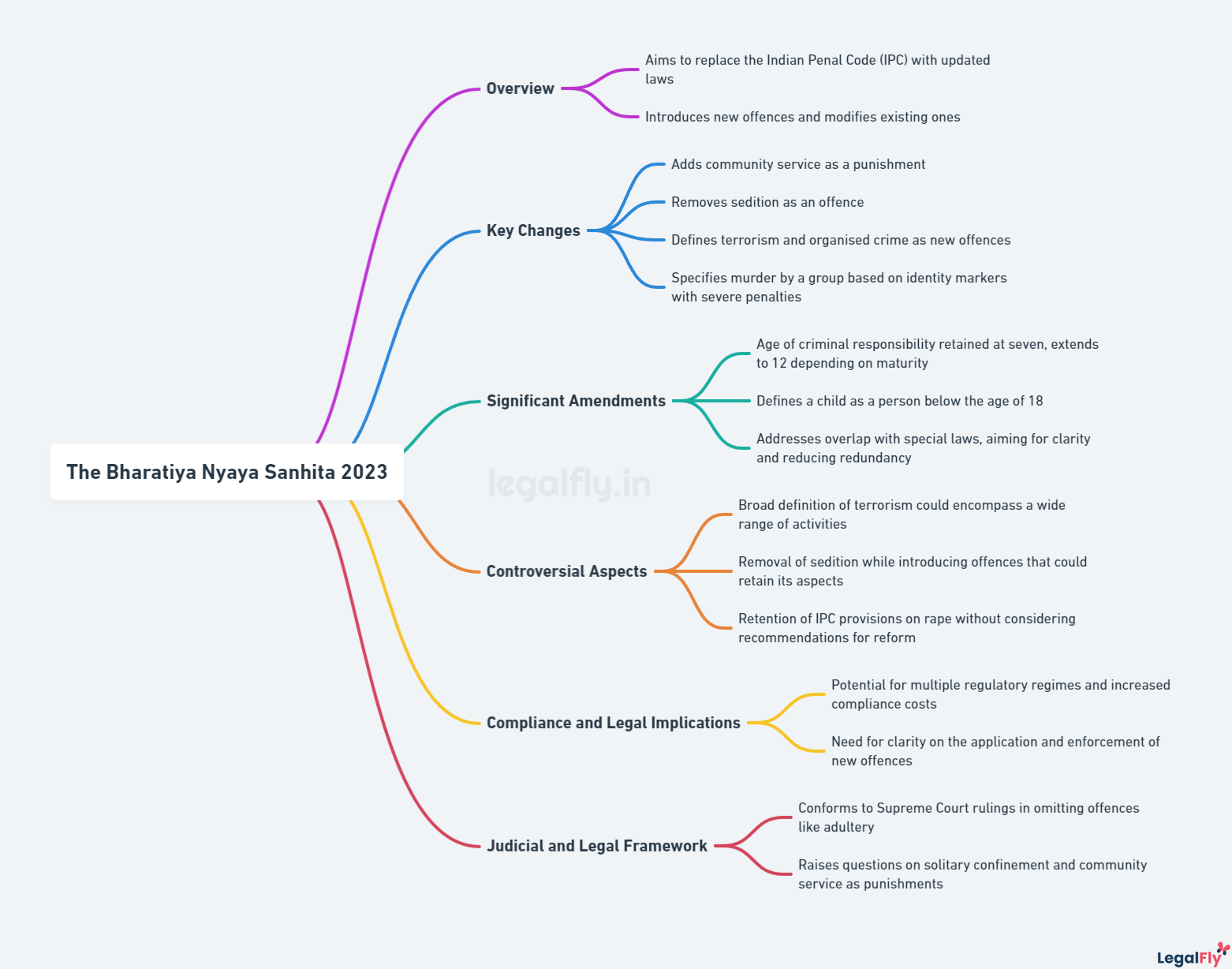
The successor to Section 303 IPC is Section 104 of the BNS. Crucially, it is no longer mandatory: it provides that a life convict who commits murder "shall be punished with death or with imprisonment for life, which shall mean the remainder of that person''s natural life." In other words, the BNS has codified the discretionary approach that Mithu required — the court may impose death or life imprisonment, depending on the circumstances. The BNS retains the death penalty for a range of grave offences (such as murder, certain terrorist acts and the rape of a girl below twelve years), but the mandatory death sentence struck down in Mithu has not been revived.
Legislative reform and mandatory death penalties
Mithu was an early and influential step against mandatory capital punishment. Its reasoning has since been applied to strike down other mandatory death-sentence provisions in special statutes (for example, the Supreme Court invalidated the mandatory death penalty under Section 27(3) of the Arms Act in State of Punjab v. Dalbir Singh, 2012). The Law Commission of India has likewise questioned mandatory capital sentences as inconsistent with modern penology, and the BNS now reflects the discretionary model. The broader debate — between retaining the death penalty for the "rarest of rare" cases and abolishing it altogether — continues, but the era of mandatory death sentences for murder is over.
Conclusion
Mithu v. State of Punjab remains a cornerstone of Indian sentencing jurisprudence. By striking down Section 303 IPC, the Supreme Court held that the State cannot take a life through an automatic, discretion-less rule that ignores the circumstances of the crime and the criminal. The decision reinforced Articles 14 and 21, entrenched the "rarest of rare" approach, and shaped a more individualised, rights-based model of capital sentencing — a model now embodied in Section 104 of the Bharatiya Nyaya Sanhita, 2023.