
Case Summary: D.K. Basu v. State of West Bengal

In short
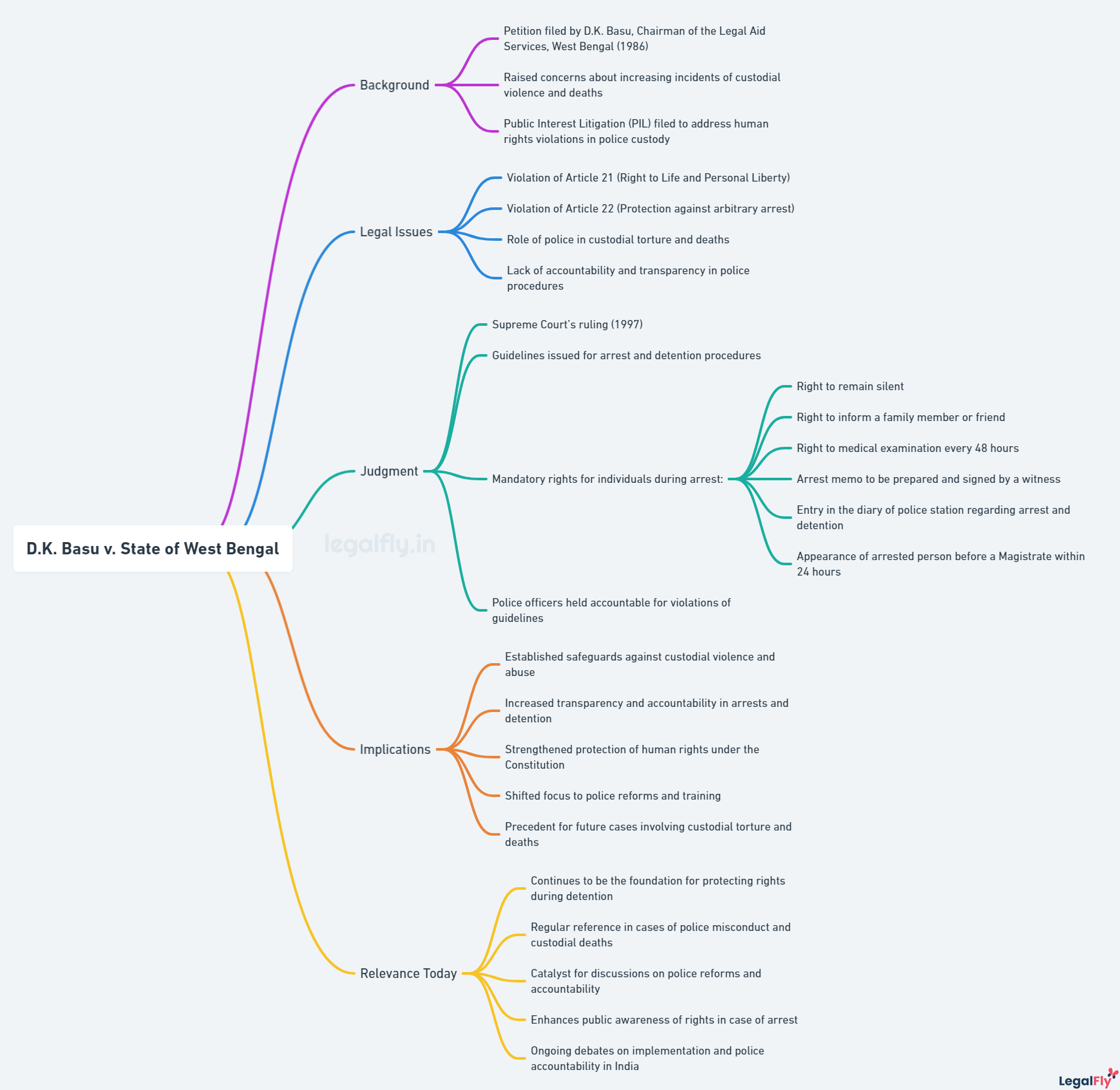
Acting on a letter treated as a PIL, the Supreme Court (Kuldip Singh and A.S. Anand JJ., 18 Dec 1996) laid down 11 mandatory guidelines to prevent custodial torture and deaths — including visible police identification, an attested arrest memo, the right to have a relative informed, and a medical examination every 48 hours — as requirements flowing from Articles 21 and 22. Breach attracts departmental action, contempt, and public-law compensation (building on Nilabati Behera). The guidelines were later codified into the CrPC (§§41B, 41C, 41D, 50A, 55A) and now continue under the Bharatiya Nagarik Suraksha Sanhita, 2023.
In this brief
Introduction
D.K. Basu v. State of West Bengal (1997) is the case that gave India its charter against custodial torture. Confronted with a stream of deaths and beatings in police lock-ups, the Supreme Court laid down eleven mandatory guidelines that must be followed in every arrest and detention — a set of practical safeguards rooted in the rights to life and against arbitrary detention under Articles 21 and 22 of the Constitution.
| Element | Detail |
|---|---|
| Case | D.K. Basu v. State of West Bengal |
| Citation | AIR 1997 SC 610; (1997) 1 SCC 416 |
| Court / Bench | Supreme Court of India — Kuldip Singh & A.S. Anand JJ. (opinion by Anand J.) |
| Decided | 18 December 1996 (reported 1997) |
| Rights engaged | Articles 21 and 22 of the Constitution |
| Outcome | 11 binding arrest/detention guidelines + public-law compensation for breach |
Background of the Case
How the Case Began
In 1986, Dr D.K. Basu, Executive Chairman of Legal Aid Services, West Bengal, wrote a letter to the Chief Justice of India drawing attention to recurring custodial deaths and police brutality, and asking the Court to develop "custody jurisprudence." The Court treated the letter as a writ petition (epistolary jurisdiction) and, over the following years, heard the matter alongside related complaints from other states.
The Court drew on its earlier custodial-death rulings — notably Nilabati Behera v. State of Orissa (1993), which had established that the State must pay compensation under public law for a death in custody, and that sovereign immunity is no defence to a breach of fundamental rights.
The Issue
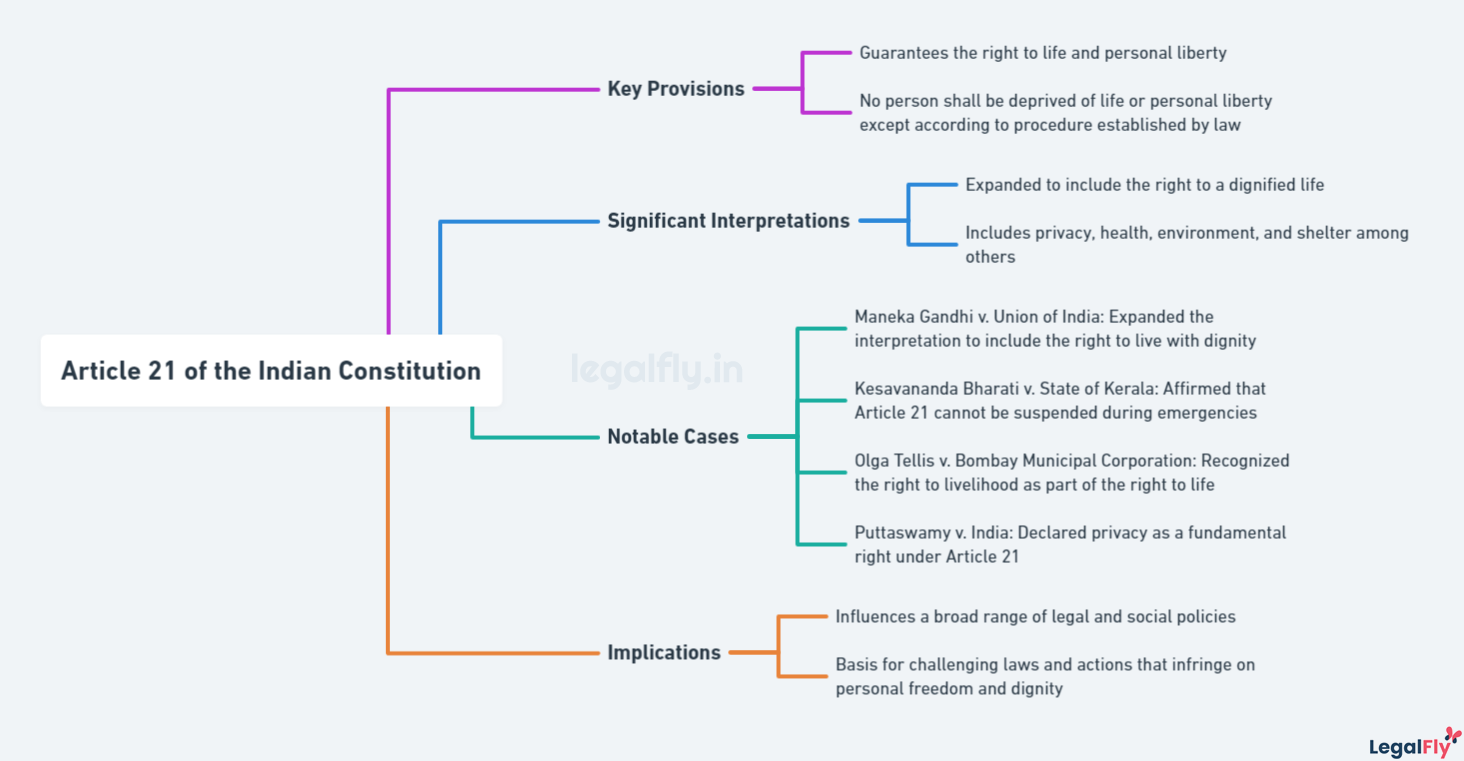
The central question was how to give real protection to the rights under Articles 21 and 22 when a person is most vulnerable to abuse — alone, in police custody, with no witnesses. The Court recognised that custodial torture is a calculated assault on human dignity, and that existing law on paper had failed to prevent it. The answer was not to create a new right but to spell out enforceable procedural safeguards.
The 11 D.K. Basu Guidelines
The Court issued the following eleven requirements, to be followed in all cases of arrest and detention until statutory provisions are made; non-compliance renders the officer liable to departmental action and to punishment for contempt of court.
| # | Guideline |
|---|---|
| 1 | Police carrying out the arrest and interrogation must wear accurate, visible name tags with designations; their particulars are recorded in a register. |
| 2 | An arrest memo is prepared at the time of arrest, attested by at least one witness (a family member or respectable person of the locality) and countersigned by the arrestee, with the time and date. |
| 3 | The arrestee is entitled to have a relative, friend or well-wisher informed of the arrest and place of detention as soon as practicable. |
| 4 | If that person lives outside the district, the time, place of arrest and venue of custody must be notified through the district Legal Aid Organisation and the local police station within 8–12 hours. |
| 5 | The arrested person must be told of this right to have someone informed, as soon as he is arrested. |
| 6 | An entry is made in the case diary at the place of detention, recording who was informed and which officers had custody. |
| 7 | On request, the arrestee is examined at the time of arrest; major and minor injuries are recorded in an "Inspection Memo" signed by both the arrestee and the arresting officer, with a copy given to the arrestee. |
| 8 | The arrestee undergoes a medical examination every 48 hours during custody by a doctor on a panel of approved doctors. |
| 9 | Copies of all documents, including the arrest memo, are sent to the Illaqa (area) Magistrate for record. |
| 10 | The arrestee may meet his lawyer during interrogation, though not throughout. |
| 11 | A police control room at every district and State headquarters must be told of the arrest and place of custody within 12 hours, and the information displayed on a notice board. |
Why These Safeguards Matter
Each guideline closes a door through which abuse used to pass. Identification ends anonymity; the arrest memo and diary entry create a paper trail; informing a relative ensures someone on the outside knows where the detainee is; and the medical examination every 48 hours makes it far harder for the police to inflict — or deny — injuries. Together they convert the abstract promise of Article 21 into checkable, day-to-day police practice.
Legal Recourse and Remedies
Production Before a Magistrate
The guidelines operate alongside the bedrock rule that an arrested person must be produced before a magistrate within 24 hours of arrest. That requirement comes from Article 22(2) of the Constitution and Section 57 of the Code of Criminal Procedure (not the Penal Code) — now Section 58 of the Bharatiya Nagarik Suraksha Sanhita, 2023. The magistrate reviews the legality of the detention and can inquire into allegations of custodial torture.
Compensation and Accountability
The Court reaffirmed that a victim of custodial violence — or the family of someone who dies in custody — can claim monetary compensation as a public-law remedy under Articles 32 and 226, separate from any private suit or criminal prosecution of the officers. This builds on Rudal Shah and Nilabati Behera, and treats compensation as the way the State acknowledges and redresses a breach of fundamental rights.
Impact, Codification and the BNSS, 2023
The D.K. Basu guidelines did not stay mere directions for long. Many were written into statute by the Code of Criminal Procedure (Amendment) Act, 2008, which inserted:
| Safeguard | CrPC (2008) | BNSS, 2023 |
|---|---|---|
| Arrest procedure, memo, identification | Section 41B | Section 36 |
| Control room / designated arrest officer | Section 41C | Section 37 |
| Right to meet an advocate during interrogation | Section 41D | Section 38 |
| Duty to inform a relative/friend of the arrest | Section 50A | Section 48 |
| Health and safety of the person in custody | Section 55A | Section 56 |
With the new criminal codes in force from 1 July 2024, these safeguards continue under the Bharatiya Nagarik Suraksha Sanhita, 2023, and a magistrate's inquiry into a custodial death (former CrPC §176(1A)) is now mandated by BNSS §196. The D.K. Basu framework therefore survives the repeal of the CrPC intact.
Conclusion
D.K. Basu v. State of West Bengal turned the constitutional guarantees against torture and arbitrary detention into a concrete, enforceable code of conduct for the police. By pairing eleven practical safeguards with public-law compensation for breach, the Supreme Court made the rights in Articles 21 and 22 meaningful at the one moment they matter most — inside the lock-up. Its continuing life in the BNSS, 2023 shows how a judgment can outlast even the statute it was decided under.