
What is Public Interest Litigation (PIL) in India? - Study Notes

In this article
Introduction
Public Interest Litigation (PIL) refers to litigation filed in a court to protect a public interest — not merely the private interests of the petitioner. In India, PIL is a unique judicial instrument that allows any citizen with sufficient interest to approach the Supreme Court (under Article 32) or a High Court (under Article 226) to enforce constitutional or legal rights on behalf of persons who are unable to access the courts themselves.
PIL emerged in the late 1970s as Indian courts began relaxing the traditional rule of locus standi — the requirement that only the person directly aggrieved may sue. Justices V.R. Krishna Iyer and P.N. Bhagwati played pioneering roles in treating letters and newspaper reports as writ petitions, transforming the Supreme Court into an accessible instrument of social justice.
Legal Framework
PIL's constitutional pillars:
- Article 32: The right to move the Supreme Court directly to enforce fundamental rights. The Court held in Hussainara Khatoon v State of Bihar (1979) that Art 32 empowered it to act on letters from concerned citizens on behalf of the oppressed.
- Article 226: Power of High Courts to issue writs. PIL filed in a High Court invokes this provision.
- Article 21: The right to life and personal liberty — interpreted expansively in PIL cases to include the right to a speedy trial, a healthy environment, livelihood, and dignity.
Key judgments expanding PIL:
- SP Gupta v Union of India (1982) — broadened locus standi; any person with sufficient interest in ensuring observance of public duty may file.
- Bandhua Mukti Morcha v Union of India (1984) — newspaper reports and letters to judges may be treated as writ petitions in human rights matters.
- Sheela Barse v State of Maharashtra (1983) — letter petitions admitted as PILs to provide easy access to justice.
How to File a PIL
Eligibility
Any person or organization may file a PIL if they are acting in good faith and in genuine public interest — not for personal gain, publicity, or vendetta. The petitioner need not be personally aggrieved; it is sufficient that they represent a class of persons who are unable to approach the courts themselves.
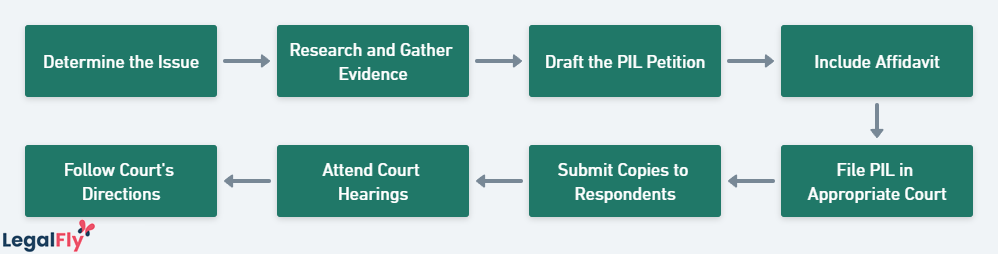
Filing Process
- Identify the public cause, gather evidence, and confirm jurisdiction (SC for national issues; HC for state-level matters).
- Draft the petition — identify the fundamental or legal right violated, the respondents, and the relief sought.
- File the petition at the registry with the prescribed copies and fees.
- The court will admit or reject the petition at the preliminary stage; notice will be issued to respondents if admitted.
- The court may pass interim orders and appoint commissioners to investigate; final judgment may include structural directions.
Landmark PIL Cases
Hussainara Khatoon v State of Bihar (1979)
Journalist Kapila Hingorani wrote to the Supreme Court highlighting undertrials in Bihar languishing in jail for years without trial. The Court treated the letter as a writ petition, held their detention violated the right to a speedy trial under Article 21, and ordered the release of over 40,000 undertrials. This is widely regarded as the first major PIL in India.
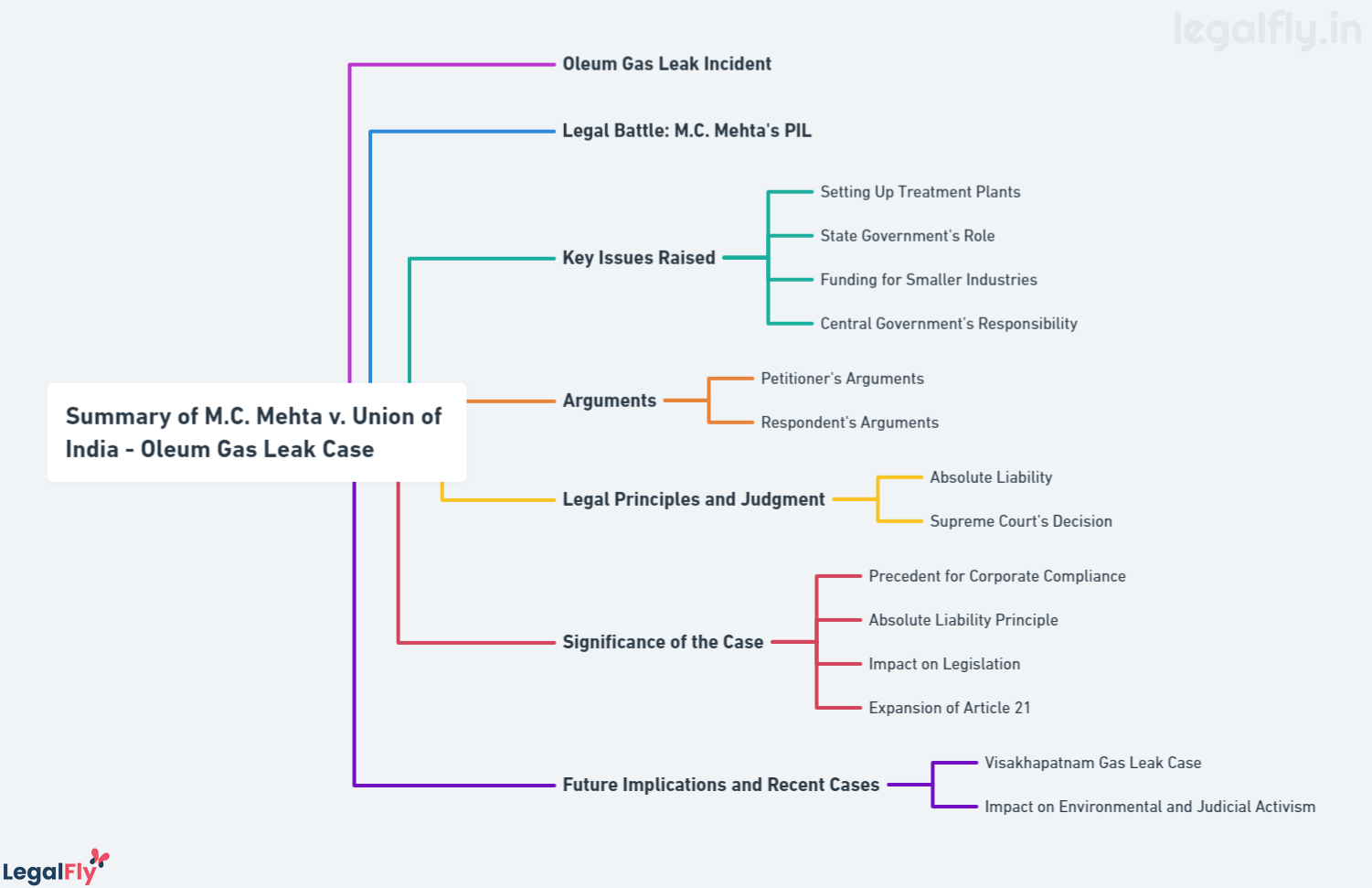
M.C. Mehta v Union of India — Oleum Gas Leak (1987)
Following a gas leak at the Shriram Industries plant in Delhi, M.C. Mehta filed a PIL. The Supreme Court laid down the doctrine of absolute liability (no exceptions to liability for ultra-hazardous activities) — going beyond the English rule in Rylands v Fletcher. The Court also held that Art 21 includes the right to a healthy environment. (Note: this case concerned Shriram Industries — distinct from the Bhopal Gas Tragedy, which was litigated separately against Union Carbide.)
Top 10 Landmark PIL Cases
| Case | Year | Key contribution |
|---|---|---|
| Hussainara Khatoon v State of Bihar | 1979 | Right to speedy trial; release of 40,000+ undertrials |
| M.C. Mehta v Union of India (Oleum) | 1986–87 | Absolute liability; right to healthy environment (Art 21) |
| Vishaka v State of Rajasthan | 1997 | Sexual harassment guidelines at workplace → POSH Act 2013 |
| PUCL v Union of India (right to food) | 2001 | Directed distribution of food grain to the needy |
| Olga Tellis v Bombay Municipal Corporation | 1985 | Right to livelihood as part of Art 21 |
| Indian Council for Enviro-Legal Action v UoI | 1996 | "Polluter pays" principle in environmental law |
| Bandhua Mukti Morcha v Union of India | 1984 | Bonded labour; letters admissible as writ petitions |
| T.N. Godavarman Thirumulkpad v Union of India | 1996 | Forest definition expanded; ongoing environmental monitoring |
| NALSA v Union of India | 2014 | Transgender rights; third gender recognition |
| People's Union for Democratic Rights v UoI | 1982 | Labour rights at Asian Games construction sites |
Role in Social Justice
PIL has significantly expanded access to justice for India's most vulnerable populations. It has been used to enforce the rights of undertrials, bonded labourers, women, children, inmates of remand homes, and persons with disabilities. PIL also operates as a tool of environmental governance — citizens and NGOs can file against pollution, illegal mining, or deforestation without requiring formal party status.
Criticisms and Challenges
- Judicial overreach: Critics argue that PIL has led the judiciary to issue executive-style directions in governance matters (urban planning, pollution control, traffic management), blurring the separation of powers.
- Frivolous and motivated PILs: The low filing cost and easy access have enabled misuse — PILs filed for personal rivalry, publicity, or commercial interests. The Supreme Court has imposed exemplary costs on frivolous PILs and tightened admission scrutiny.
- Privatisation of public law: Powerful interests have at times used PIL to challenge government policy that inconveniences them, inverting PIL's original pro-poor purpose.
Future of PIL
PIL continues to evolve. Emerging areas include digital rights, data protection, AI governance, and climate litigation. The Court has increasingly used PIL to issue continuing mandamus orders in long-running matters (forest cases, air quality). Proposed reforms include dedicated PIL benches, clearer threshold tests for admission, and stronger sanctions for misuse.
PIL remains an indispensable instrument of Indian constitutionalism — a mechanism that translates the Constitution's transformative promise into enforceable rights for those who would otherwise be voiceless.