
Case Summary: Golaknath v. State of Punjab
In short
An 11-judge bench held 6:5 that Parliament has no power to amend Part III to abridge Fundamental Rights, reasoning that an amendment is "law" under Article 13(2). To avoid chaos, Chief Justice Subba Rao applied prospective overruling, leaving past amendments intact. Parliament replied with the 24th Amendment (1971), and Kesavananda Bharati (1973) overruled Golaknath, replacing its absolute bar with the basic structure doctrine.
In this brief
Introduction to Golaknath v. State of Punjab
I.C. Golaknath v. State of Punjab (1967) is one of the defining constitutional cases of independent India. By the narrowest of margins — 6:5 — an eleven-judge bench of the Supreme Court held that Parliament has no power to amend Part III of the Constitution so as to take away or abridge the Fundamental Rights. Reaching that result, the Court overruled its own earlier decisions and, for the first time, treated a constitutional amendment as ordinary "law" controlled by Article 13.
A word of caution at the outset, because this case is frequently misremembered: Golaknath did not create the "basic structure" doctrine. It went further — it put Fundamental Rights entirely beyond the reach of the amending power. That absolute position proved unworkable and was overruled six years later in Kesavananda Bharati v. State of Kerala (1973), which replaced it with the more flexible basic structure doctrine. Golaknath is best understood as the precursor that Kesavananda corrected.
Key Facts of the Case
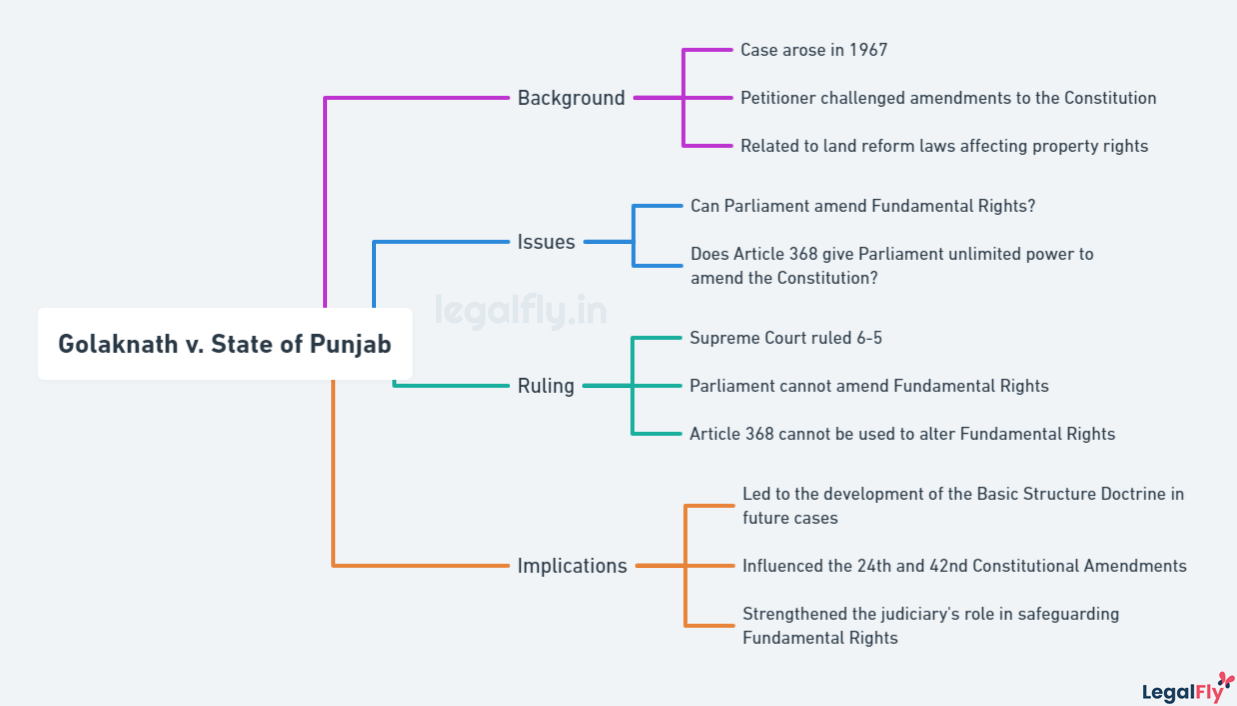
The Golak Nath family of Jalandhar, Punjab, held over 500 acres of farmland. Under the Punjab Security of Land Tenures Act, 1953, the State took the view that the family could retain only a small fraction of that land, with the surplus declared available for redistribution to tenants and landless cultivators. The Act had been shielded from challenge by being placed in the Ninth Schedule through the Constitution (Seventeenth Amendment) Act, 1964.
Rather than merely contest the land ceiling, the petitioners mounted a frontal attack on the amending power itself. They filed a petition under Article 32 arguing that the First, Fourth and Seventeenth Amendments — each of which had curtailed property and other rights — were unconstitutional because Parliament could not amend the Constitution to abridge Fundamental Rights guaranteed by Part III (here, the right to property under the then Articles 19(1)(f) and 31, and equality under Article 14).
| Element | Detail |
|---|---|
| Case | I.C. Golaknath & Ors. v. State of Punjab & Anr. |
| Citation | AIR 1967 SC 1643; (1967) 2 SCR 762 |
| Court / Bench | Supreme Court of India — 11 judges |
| Decided | 27 February 1967 |
| Majority | 6:5, opinion of the Court by Chief Justice K. Subba Rao |
| Impugned law | Punjab Security of Land Tenures Act, 1953 (and the 1st, 4th, 17th Amendments) |
| Core question | Can Parliament amend Part III to take away Fundamental Rights? |
Legal Issues Addressed
- Is a constitutional amendment "law" under Article 13? Article 13(2) forbids the State from making any "law" that takes away or abridges Fundamental Rights. The central question was whether an amendment passed under Article 368 is such a "law" — and therefore void to the extent it abridges Part III.
- What is the scope of Parliament's amending power? Is the power to amend the Constitution unlimited (a "constituent" power immune from Article 13), or is it subject to the guarantees in Part III?
- Should the earlier rulings be reconsidered? Shankari Prasad v. Union of India (1951) and Sajjan Singh v. State of Rajasthan (1965) had both upheld Parliament's power to amend Fundamental Rights. The Court had to decide whether those decisions were correctly decided.
Court's Decision and Rationale
By a 6:5 majority, the Supreme Court held that Parliament cannot amend the Constitution to take away or abridge the Fundamental Rights in Part III. The opinion of the Court, delivered by Chief Justice K. Subba Rao for himself and four colleagues, rested on a single decisive proposition: a constitutional amendment under Article 368 is "law" within the meaning of Article 13(2). Because Article 13(2) bars any "law" that abridges Fundamental Rights, an amendment that did so was equally void.
On this reasoning, the majority overruled Shankari Prasad (1951) and Sajjan Singh (1965), which had drawn the opposite conclusion by treating amending power as a special constituent power outside Article 13. Justice M. Hidayatullah agreed with the result in a separate concurring opinion, making the majority six.
The five dissenting judges (Wanchoo, Bachawat, Ramaswami, Bhargava and Mitter JJ.) took the orthodox view: the power to amend is a constituent power distinct from ordinary legislation, an amendment is not "law" under Article 13, and Parliament could therefore validly amend any part of the Constitution, Fundamental Rights included.
| Bloc (11 judges) | Judges | View |
|---|---|---|
| Majority (6) | Subba Rao C.J., Shah, Sikri, Shelat, Vaidialingam JJ. (opinion of the Court) + Hidayatullah J. (concurring) | Amendment is "law" under Art. 13; Parliament cannot abridge Fundamental Rights |
| Minority (5) | Wanchoo, Bachawat, Ramaswami, Bhargava, Mitter JJ. | Amending power is constituent power; Fundamental Rights are amendable |
Prospective Overruling
The logic of the majority created an obvious problem: if amendments abridging Fundamental Rights were void, the First, Fourth and Seventeenth Amendments — under which extensive land reform and redistribution had already taken place — would be struck down retrospectively, throwing settled rights into chaos. To avoid that, Chief Justice Subba Rao imported from American jurisprudence the doctrine of prospective overruling, using it for the first time in Indian constitutional law.
The effect was carefully calibrated: the past amendments and everything done under them would remain valid, but from the date of this judgment onward, Parliament would have no power to amend the Constitution to abridge Fundamental Rights. In practical terms the petitioners therefore lost on the facts — the land reforms stood — yet won the larger constitutional point for the future.
What Golaknath Did Not Decide
Because Golaknath is so closely linked in memory to Kesavananda Bharati, it is worth being precise about what it actually held — and did not.
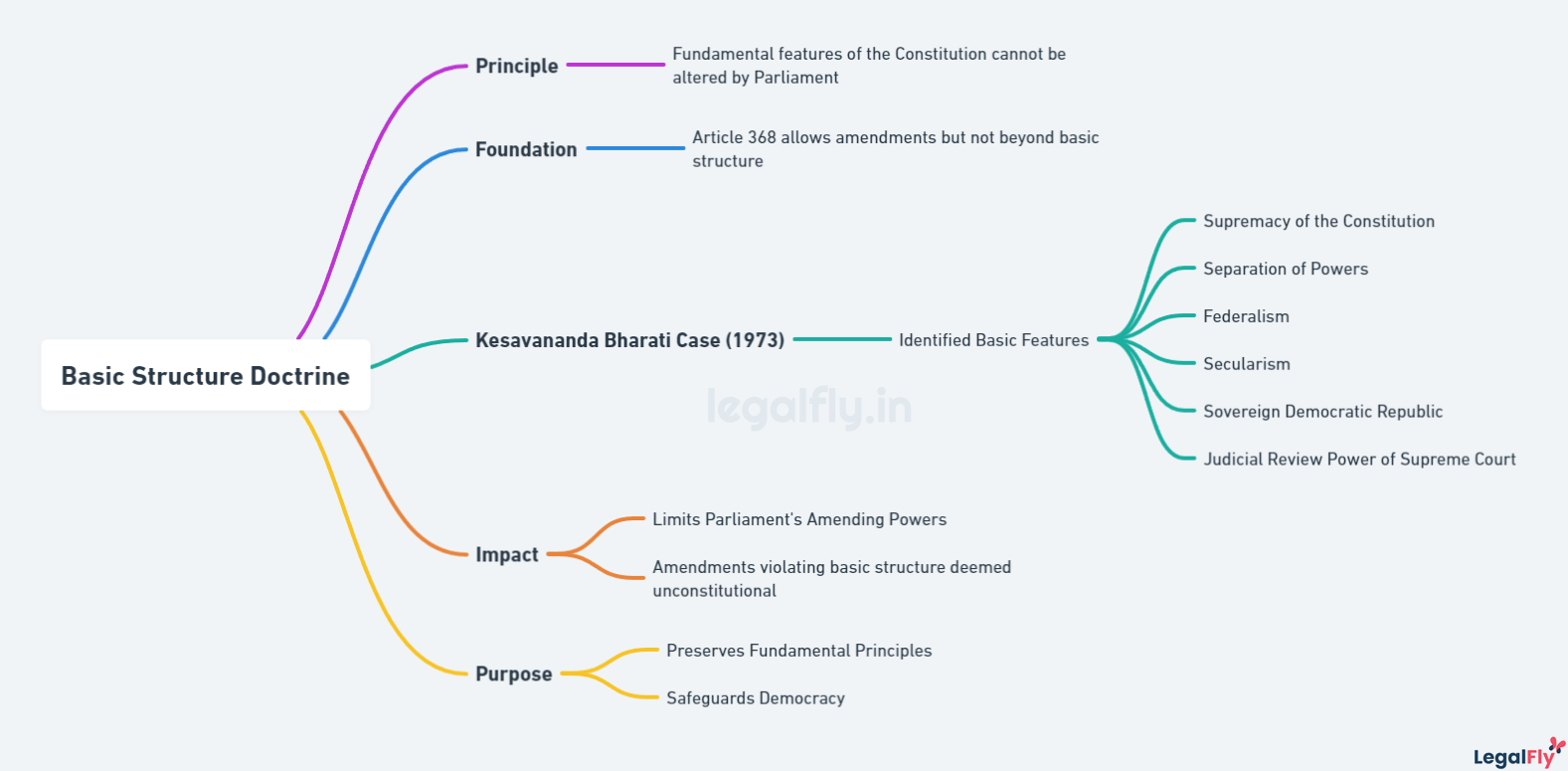
- Golaknath did not lay down the "basic structure" doctrine. That doctrine — that Parliament can amend Fundamental Rights but cannot destroy the Constitution's essential features — was first articulated in Kesavananda Bharati (1973).
- Golaknath took a stricter position: Fundamental Rights were placed wholly beyond the amending power. There was no question of a "core" that survives while other parts may be amended — Part III as a whole was off-limits.
- Its central reasoning — that an amendment is "law" under Article 13(2) — was the very holding that Kesavananda later declared "erroneous" and overruled.
Aftermath and Legacy
Golaknath set off a direct confrontation between Parliament and the judiciary. Parliament responded with the Constitution (Twenty-fourth Amendment) Act, 1971, which amended both Article 13 and Article 368 to make explicit that (a) Parliament has the power to amend any part of the Constitution, including Part III, and (b) such an amendment is not "law" for the purposes of Article 13 — directly undoing Golaknath's reasoning.
The validity of the 24th Amendment, and the whole question of the amending power, came before a thirteen-judge bench in Kesavananda Bharati v. State of Kerala (1973). That Court overruled Golaknath, upheld Parliament's power to amend Fundamental Rights, but held — through the new basic structure doctrine — that no amendment may damage or destroy the essential features of the Constitution. This compromise has governed Indian constitutional law ever since.
| Stage | Year | Position on amending Fundamental Rights |
|---|---|---|
| Shankari Prasad / Sajjan Singh | 1951 / 1965 | Parliament can amend Fundamental Rights (amendment is not "law") |
| Golaknath | 1967 | Parliament cannot amend Fundamental Rights at all (prospectively) |
| 24th Amendment | 1971 | Parliament reasserts power to amend any part, including Part III |
| Kesavananda Bharati | 1973 | Parliament can amend Fundamental Rights, but not the basic structure |
Conclusion
Golaknath v. State of Punjab was a bold but short-lived assertion of judicial supremacy over the amending power. Its enduring contributions are twofold: it introduced prospective overruling into Indian law, and — even in being overruled — it framed the great debate about the limits of constitutional amendment that Kesavananda Bharati would ultimately resolve. Read correctly, Golaknath is not the source of the basic structure doctrine but the case whose overreach made that doctrine necessary.