
Case Summary: Masterpiece Cakeshop v. Colorado Civil Rights Commission
In short
Baker Jack Phillips refused to make a custom wedding cake for a same-sex couple on religious grounds, and the Colorado Civil Rights Commission found he had violated the state public-accommodations law. The Supreme Court reversed 7-2 (Kennedy J.), but narrowly: it held the Commission had shown unconstitutional hostility to Phillips's faith — a commissioner had likened his beliefs to defenses of slavery and the Holocaust, and the Commission had treated other bakers more leniently. The Court did not decide whether a business has a free-speech or free-exercise right to refuse such services; that question was later answered (for expressive products) in 303 Creative v. Elenis (2023).
In this brief
- Introduction
- Background of the Case
- Initial Proceedings
- Up Through the Colorado Courts
- The Competing Rights
- Free Exercise of Religion
- Free Speech and Compelled Expression
- The Supreme Court's Decision
- Why the Commission Lost: Religious Hostility
- The Separate Opinions
- A Deliberately Narrow Ruling
- Aftermath: 303 Creative and a Second Round
- Conclusion
Introduction
Masterpiece Cakeshop, Ltd. v. Colorado Civil Rights Commission (2018) is the case in which a Colorado baker refused, on religious grounds, to design a wedding cake for a same-sex couple. It became a flashpoint in the clash between anti-discrimination law and the First Amendment — yet the Supreme Court ultimately decided it on remarkably narrow grounds, leaving the big questions for another day.
| Element | Detail |
|---|---|
| Case | Masterpiece Cakeshop, Ltd. v. Colorado Civil Rights Commission |
| Citation | 584 U.S. 617 (2018) |
| Court | Supreme Court of the United States |
| Argued / Decided | 5 December 2017 / 4 June 2018 |
| Vote | 7-2; majority opinion by Justice Anthony Kennedy |
| Holding | The Commission's religious hostility violated the Free Exercise Clause; broader questions left open |
Background of the Case
Initial Proceedings
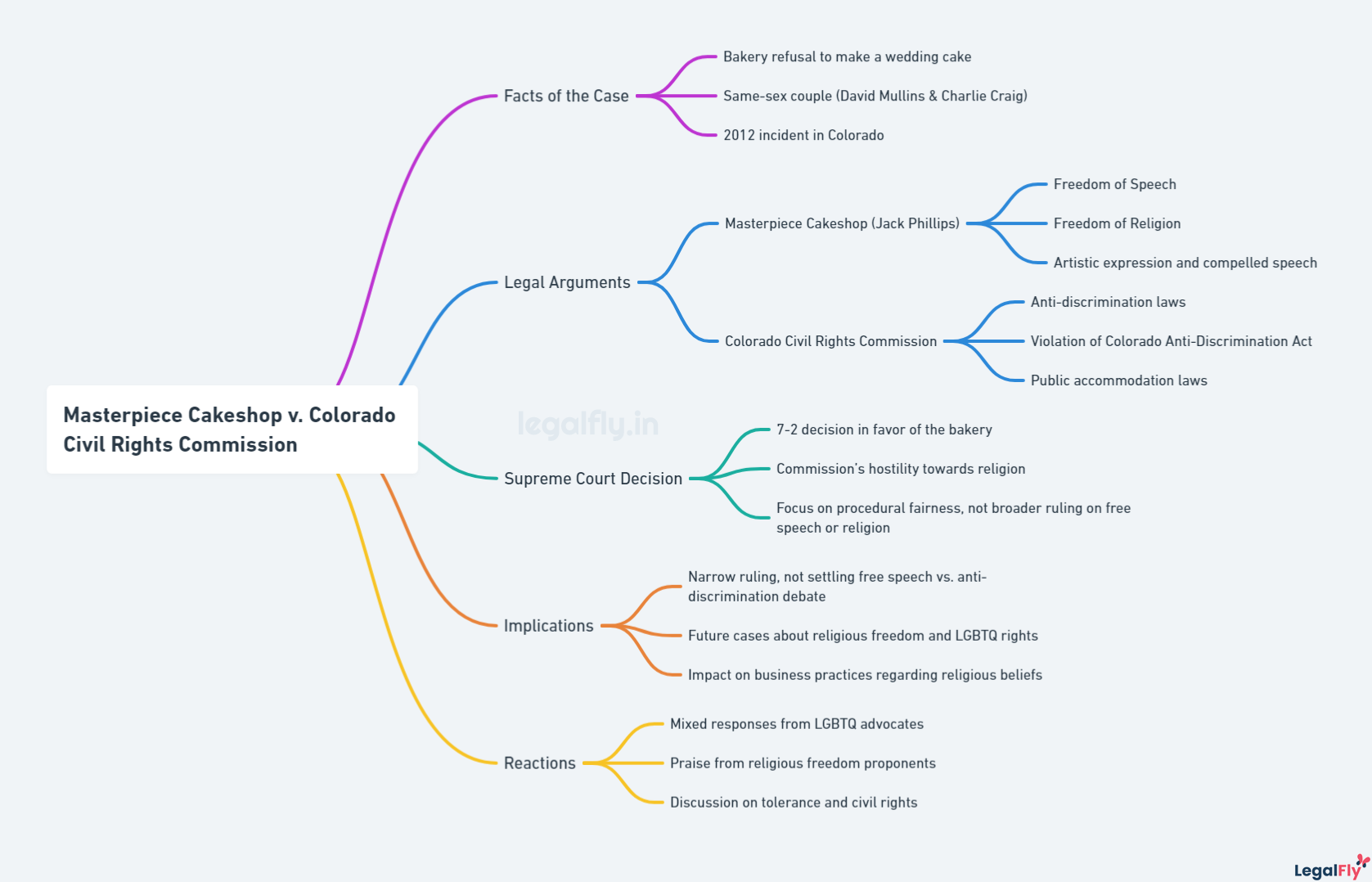
In 2012, Charlie Craig and David Mullins visited Masterpiece Cakeshop in Lakewood, Colorado, to order a custom cake for their wedding. The owner, Jack Phillips, declined, saying that designing a cake for a same-sex wedding would violate his Christian beliefs (though he offered to sell them any other baked goods). The couple filed a complaint under the Colorado Anti-Discrimination Act, which bars businesses serving the public from discriminating on the basis of sexual orientation.
The Colorado Civil Rights Commission ruled against Phillips, ordering him to serve same-sex weddings on the same terms as opposite-sex ones and to undertake remedial measures.
Up Through the Colorado Courts
Phillips argued that being compelled to create the cake violated his First Amendment rights to free speech and the free exercise of religion. The Colorado Court of Appeals affirmed the Commission, holding that making a cake was not protected expressive conduct and that the anti-discrimination law was a neutral, generally applicable rule. The U.S. Supreme Court then granted certiorari.
The Competing Rights
Free Exercise of Religion
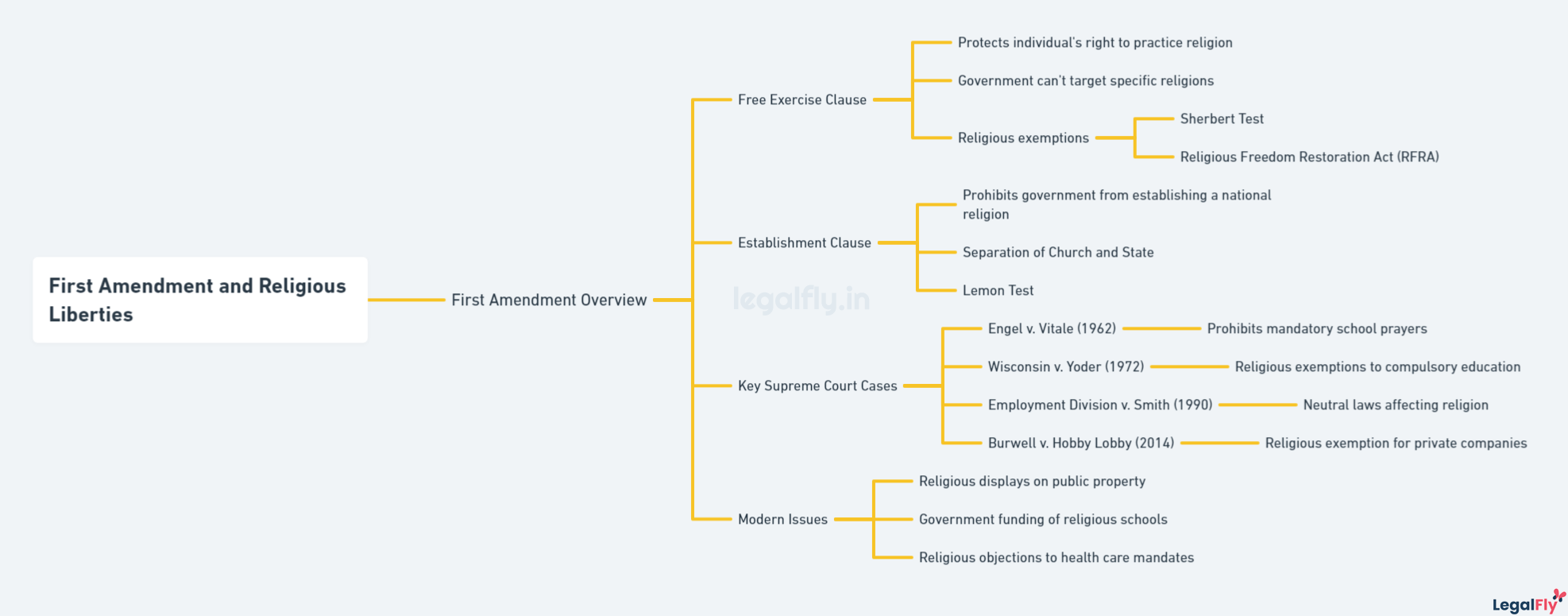
The Free Exercise Clause protects the right to practise one's religion free of government hostility. A core principle is that the State must remain neutral toward religion: it cannot base a decision on hostility to, or disparagement of, a person's faith. As it turned out, this neutrality principle — not the cake itself — decided the case.
Free Speech and Compelled Expression
Phillips also argued that a custom cake is a form of artistic expression, so that forcing him to make one would be compelled speech — making him convey a message he rejects. The Court acknowledged the difficulty of this question but expressly declined to resolve it, leaving open where the line falls between a public-accommodation good and protected expression.
The Supreme Court's Decision
Why the Commission Lost: Religious Hostility
Writing for a 7-2 majority, Justice Kennedy reversed — but on the narrowest available ground. The problem was not the anti-discrimination law itself, which the Court reaffirmed states may enact; it was the way the Commission had treated Phillips. Two features showed impermissible hostility:
- The commissioners' comments. At a public hearing, a commissioner called Phillips's invocation of his faith "one of the most despicable pieces of rhetoric that people can use," and likened religious justifications to those once used for slavery and the Holocaust — remarks no one on the Commission disavowed.
- Inconsistent treatment. Around the same time, the Commission had sided with other bakers (the "William Jack" cases) who refused to create cakes with anti-same-sex-marriage messages — treating their conscience claims more favourably than Phillips's.
Because a fair and neutral decision-maker is required when free-exercise rights are at stake, this hostility tainted the ruling against Phillips, and the Court set it aside.
The Separate Opinions
| Opinion | Justices | Thrust |
|---|---|---|
| Majority | Kennedy (joined by Roberts, Breyer, Alito, Kagan, Gorsuch, Thomas) | Commission showed religious hostility; both dignity and faith deserve respect |
| Concurrence | Kagan (with Breyer) | Result is right, but anti-discrimination law remains fully valid |
| Concurrence | Gorsuch (with Alito) | Stresses robust protection for religious conscience |
| Concurrence (in judgment) | Thomas (with Gorsuch) | Cake design is protected expression — a free-speech basis |
| Dissent | Ginsburg (with Sotomayor) | The commissioners' stray remarks did not justify overturning a valid discrimination finding |
A Deliberately Narrow Ruling
Because it turned on the Commission's conduct in this one case, Masterpiece Cakeshop set no broad precedent. It did not grant businesses a right to refuse service to LGBTQ customers, and it expressly reaffirmed that states may protect them from discrimination in public accommodations. Its lesson for government was procedural: regulators must apply anti-discrimination laws without contempt for the religious views of those they regulate. The deeper conflict — between equal access and expressive freedom — was left for future cases.
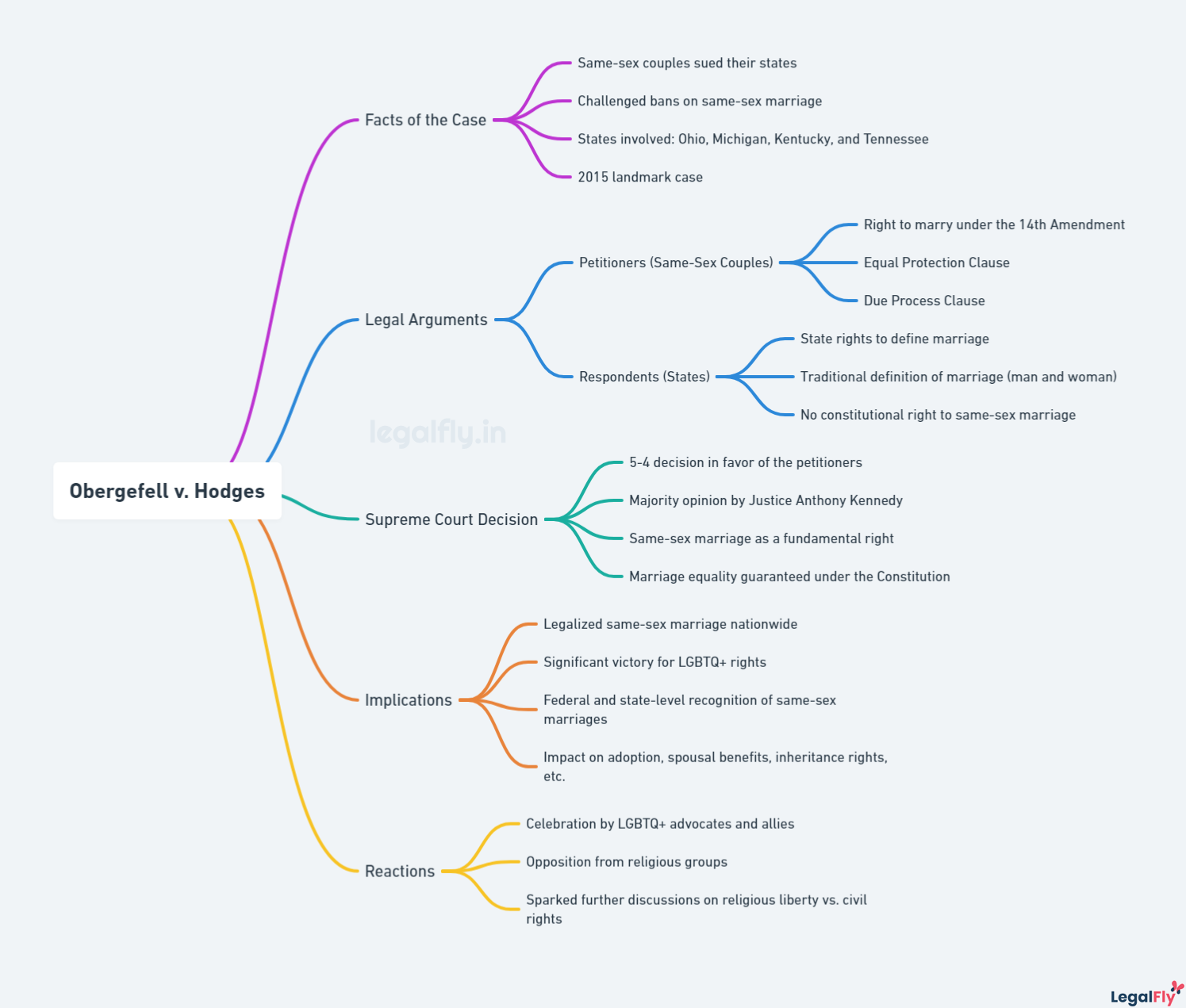
The tension traces back to Obergefell v. Hodges (2015), which legalised same-sex marriage nationwide and brought such conscience claims to the fore.
Aftermath: 303 Creative and a Second Round
The question Masterpiece left open returned five years later. In 303 Creative LLC v. Elenis (2023), the Supreme Court held 6-3 that Colorado could not compel a website designer who created custom wedding sites to design them for same-sex weddings — this time deciding squarely on free-speech (compelled-speech) grounds. 303 Creative thus answered, at least for genuinely expressive products, the issue Masterpiece had ducked: the government may not force an artist to create speech that conveys a message she rejects.
Jack Phillips himself was not done with the courts. A separate suit, Scardina v. Masterpiece Cakeshop — over his refusal in 2017 to make a cake celebrating a gender transition — wound through the Colorado courts until the Colorado Supreme Court dismissed it in 2024 on procedural (standing) grounds, again without a definitive ruling on the merits.
Conclusion
Masterpiece Cakeshop is best understood as a case the Supreme Court decided as narrowly as it could — vindicating one baker because of how he was treated, while pointedly refusing to settle whether religion or free speech can override anti-discrimination law. That larger battle moved on to 303 Creative, where the free-speech argument finally prevailed for expressive work, leaving the boundary between equal service and compelled expression still being drawn.