
Pyare Lal Bhargava v. State of Rajasthan (AIR 1963 SC 1094)
In short
The Supreme Court held that a government servant who temporarily took property without the owner's consent, causing wrongful loss even briefly, was guilty of theft under IPC §378/379. Temporary taking suffices — permanent deprivation is not required.
In this brief
- Introduction
- Case at a Glance
- Background
- Legal Provisions
- Theft — IPC §378 / BNS §303
- Confessions under inducement — Evidence Act §24 / BSA §23
- Issues Before the Court
- Arguments of the Parties
- Appellant (Pyare Lal Bhargava)
- Respondent (State of Rajasthan)
- Judgment
- Trial Court
- Rajasthan High Court
- Supreme Court
- Significance & Continuing Relevance
- Law Update: IPC → BNS / Evidence Act → BSA (from 1 July 2024)
Introduction
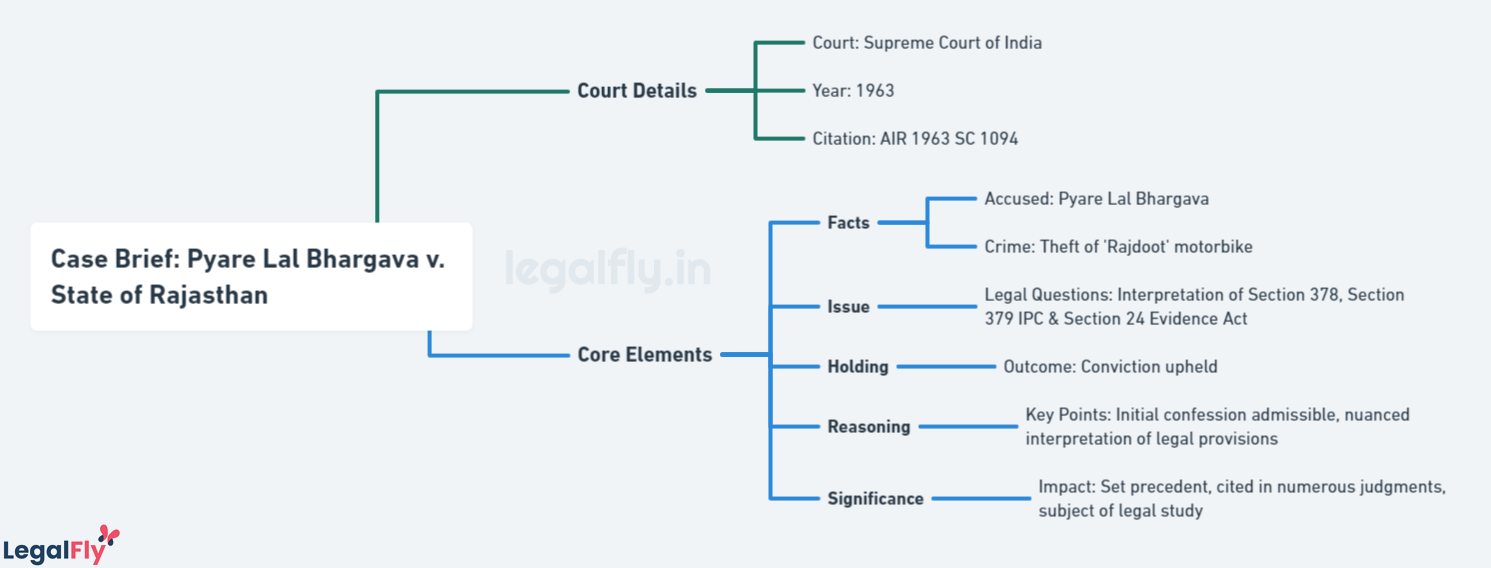
Pyare Lal Bhargava v. State of Rajasthan (AIR 1963 SC 1094) is a foundational Supreme Court judgment on the scope of theft under Section 378 of the Indian Penal Code (IPC) — now Section 303 of the Bharatiya Nyaya Sanhita (BNS), 2023. The case settled a key question: does temporary taking of property, without intent to permanently deprive the owner, amount to theft? The Supreme Court answered yes. It also examined the admissibility of confessions made under inducement under Section 24 of the Indian Evidence Act (now Section 23 of the Bharatiya Sakshya Adhiniyam, 2023).
Case at a Glance
| Detail | Particulars |
|---|---|
| Case Name | Pyare Lal Bhargava v. State of Rajasthan |
| Citation | AIR 1963 SC 1094 |
| Court | Supreme Court of India |
| Year | 1963 |
| Petitioner | Pyare Lal Bhargava (government servant) |
| Respondent | State of Rajasthan |
| Offence charged | Theft — IPC §379 (now BNS §303(2)) |
| Key statutory provisions | IPC §378, §379; Indian Evidence Act §24 |
| BNS/BSA equivalents | BNS §303 (theft); BSA §23 (inadmissible confessions) |
| Outcome | Conviction upheld by Supreme Court |
Background
Pyare Lal Bhargava was a government servant in Rajasthan. He was accused of taking a government document/file without authorisation and temporarily removing it from official custody. The prosecution charged him under Section 379 IPC (punishment for theft). During the investigation, Bhargava made a confession, which he subsequently retracted, claiming it was induced by a threat from a superior officer (the Chief Engineer).
Legal Provisions
Theft — IPC §378 / BNS §303
Section 378 IPC defines theft as the dishonest taking of movable property out of the possession of another person without that person's consent. Crucially, it does not require an intent to permanently deprive. The equivalent provision under the Bharatiya Nyaya Sanhita, 2023 (in force from 1 July 2024) is Section 303(2) BNS. The definition of theft and its essential ingredients remain materially identical.
Confessions under inducement — Evidence Act §24 / BSA §23
Section 24 of the Indian Evidence Act rendered a confession inadmissible if it appeared to have been caused by inducement, threat, or promise from a person in authority, calculated to give the accused grounds to suppose it would be advantageous to confess. Under the Bharatiya Sakshya Adhiniyam, 2023, the equivalent is Section 23 BSA, which preserves the same rule.
Issues Before the Court
- Whether temporary taking of property — without intent to permanently deprive — constitutes theft under IPC §378.
- Whether Bhargava's confession, alleged to have been induced by a threat from his superior, was admissible under Section 24 of the Indian Evidence Act.
Arguments of the Parties
Appellant (Pyare Lal Bhargava)
- The confession was induced by a threat from the Chief Engineer and was therefore inadmissible under Section 24 of the Evidence Act. The word "appear" in Section 24 sets a low threshold — only a reasonable probability of inducement is required.
- There was no dishonest intention to permanently deprive the government of the document; the taking was temporary and does not satisfy the definition of theft.
Respondent (State of Rajasthan)
- The act caused wrongful loss to the government, even if only temporary, and falls squarely within IPC §378.
- The confession was voluntary and corroborated by independent evidence; any alleged inducement did not in fact operate on the accused's mind.
Judgment
Trial Court
The trial court convicted Bhargava under Section 379 IPC, relying on the confession and corroborating witness evidence. He was sentenced to rigorous imprisonment.
Rajasthan High Court
The High Court upheld the conviction and dismissed the appeal, finding the confession to have been made voluntarily. The court affirmed that the act fell within the definition of theft.
Supreme Court
The Supreme Court dismissed the appeal and upheld the conviction, but provided an authoritative interpretation of the two key provisions:
- On theft (IPC §378): The court held that theft does not require an intent to permanently deprive the owner of property. An intent to cause wrongful loss, even if only temporary, is sufficient. A person who dishonestly takes property — knowing that the taking will cause wrongful loss to the owner — commits theft regardless of whether he intends to return it.
- On confessions (Evidence Act §24): The court clarified that the standard under Section 24 is whether the inducement, threat, or promise appeared likely to lead the accused to make the confession. A higher standard of certainty is not required. However, on the facts, the court found the confession admissible as the alleged inducement had not been established to the required degree.
Significance & Continuing Relevance
This judgment remains a leading authority on two points of Indian criminal law:
- Scope of theft: Courts consistently apply the principle that temporary wrongful taking is theft. The fact that the taker intended to return the property is not a defence if the taking was dishonest and caused wrongful loss at the time. This is equally applicable under the BNS, 2023 (§303), whose definition of theft tracks IPC §378.
- Confessions under inducement: The case is regularly cited for the proposition that the standard under Evidence Act §24 (now BSA §23) is one of reasonable appearance — not proof beyond doubt — that an inducement operated on the accused's mind.
The case is included in the syllabi of leading Indian law universities and is frequently cited by the Supreme Court and High Courts in theft and confession-related matters.
Law Update: IPC → BNS / Evidence Act → BSA (from 1 July 2024)
| Old provision | Subject | New provision (BNS/BSA, 2023) |
|---|---|---|
| IPC §378 | Theft (definition) | BNS §303(2) |
| IPC §379 | Punishment for theft | BNS §303(2) |
| Evidence Act §24 | Inadmissible confessions | BSA §23 |
The substantive law on theft and induced confessions is unchanged under the new codes. Cases filed before 1 July 2024 continue to be tried under the IPC and Evidence Act; new cases use BNS and BSA.