
Case Summary: Indian Young Lawyers Association v. State of Kerala 2018
In short
Five-judge Constitution bench (28 September 2018) held 4:1 that Rule 3(b) of the Kerala Hindu Places of Public Worship Rules 1965 — which barred women aged 10–50 from Sabarimala — was unconstitutional: not an essential religious practice, and a violation of Arts 14, 15, 17 and 25. CJI Misra + Khanwilkar J. (joint majority); Nariman J. and Chandrachud J. wrote concurring opinions; Malhotra J. dissented. Multiple review petitions were referred to a 9-judge bench in Nov 2019; hearings concluded May 2026, judgment reserved.
In this brief
Background
The Sabarimala temple in the Pathanamthitta district of Kerala, dedicated to Lord Ayyappa, is one of India's largest annual pilgrimage sites with over 50 million visitors each year. A long-standing temple custom barred women between the ages of 10 and 50 — women of menstruating age — from entering the shrine. This exclusion was given statutory form by Rule 3(b) of the Kerala Hindu Places of Public Worship (Authorisation of Entry) Rules, 1965, which permitted temple authorities to exclude women from worship as part of "immemorial custom and usage."
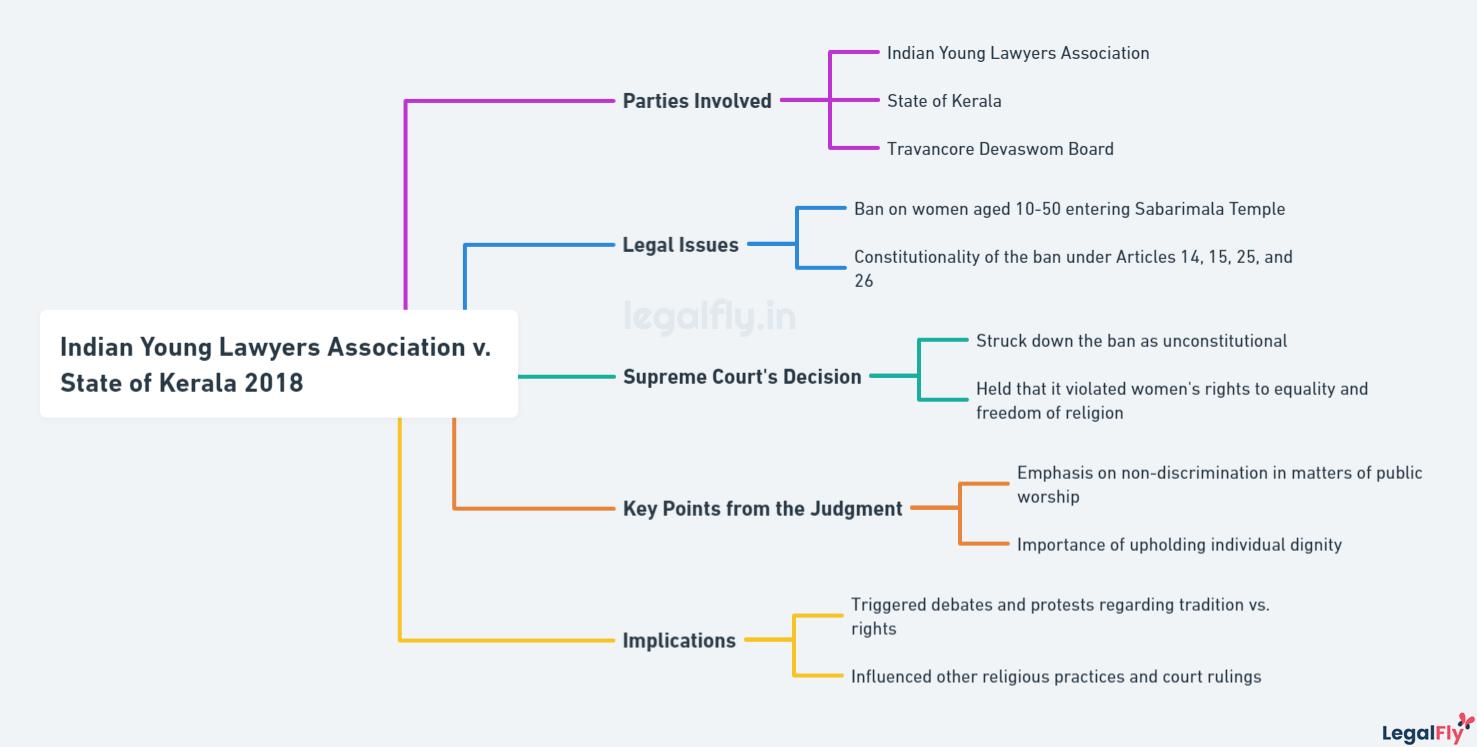
In 2006, the Indian Young Lawyers Association filed a Public Interest Litigation before the Supreme Court, arguing the restriction violated the constitutional rights of Hindu women. The matter was referred to a five-judge Constitution bench, which delivered its judgment on 28 September 2018.
Issues Before the Court
- Is the exclusion of women aged 10–50 from Sabarimala an "essential religious practice" of the Ayyappa faith, protected by Article 25?
- Does Sabarimala qualify as a "religious denomination" with autonomy over its practices under Article 26?
- Does Rule 3(b) violate the parent Act (which bars discrimination based on section or class of Hindus) and the fundamental rights under Articles 14, 15, 17, and 25?
The Judgment — 4:1
The bench struck down Rule 3(b) by a 4:1 majority, holding the age-based exclusion of women unconstitutional. Four separate opinions were delivered.
CJI Dipak Misra & Khanwilkar J. (majority opinion)
The main majority opinion held that the exclusion fails the essential practices test: there is no scriptural evidence that Lord Ayyappa's celibacy requires the exclusion of women; it is therefore not an essential religious practice entitled to constitutional protection. Further, the restriction violates Article 17 (abolition of untouchability) by treating menstruation as a form of "impurity," and Articles 14, 15, and 21 by denying women of a specific age group equal access to a public place of worship. Constitutional morality must override popular morality.
Nariman J. (concurring)
Justice Nariman concurred primarily on the ground that Rule 3(b) directly violates Section 4 of the parent Act, which prohibits the exclusion of any section or class of Hindus from temple entry. Rule 3(b) is therefore void as ultra vires the parent statute, independently of constitutional grounds.
Chandrachud J. (concurring)
Justice Chandrachud wrote the most expansive opinion, holding that the practice is rooted in an exclusionary notion of bodily "purity" incompatible with constitutional dignity. He argued that treating physiological characteristics as a basis for exclusion from the public sphere violates the constitutional guarantee of non-discrimination on the ground of sex. He also questioned the traditional "essential practices" doctrine as sometimes overly deferential to majority religious opinion.
Malhotra J. (dissent)
Justice Indu Malhotra dissented, holding that in a secular polity, courts should not ordinarily interfere with centuries-old religious customs unless the practice constitutes a social evil or pernicious harm. She reasoned that notions of the sacred and the religious are not subject to judicial scrutiny under the lens of constitutional morality: the worshippers' own sense of faith and devotion must be respected. She was not persuaded the petitioners (who were not devotees) had standing to challenge the practice.
Bench Votes at a Glance
| Judge(s) | Vote | Key ground |
|---|---|---|
| CJI Misra & Khanwilkar J. | Strike down | Not essential practice; violates Arts 14, 15, 17, 25; constitutional morality |
| Nariman J. | Strike down | Rule 3(b) ultra vires parent Act (§4 bars caste/class exclusion of Hindus) |
| Chandrachud J. | Strike down | Physiological exclusion = sex discrimination; dignity + non-discrimination |
| Malhotra J. | Uphold (dissent) | Courts should not interfere with bona fide religious practices; standing issue |
Aftermath and Subsequent Proceedings
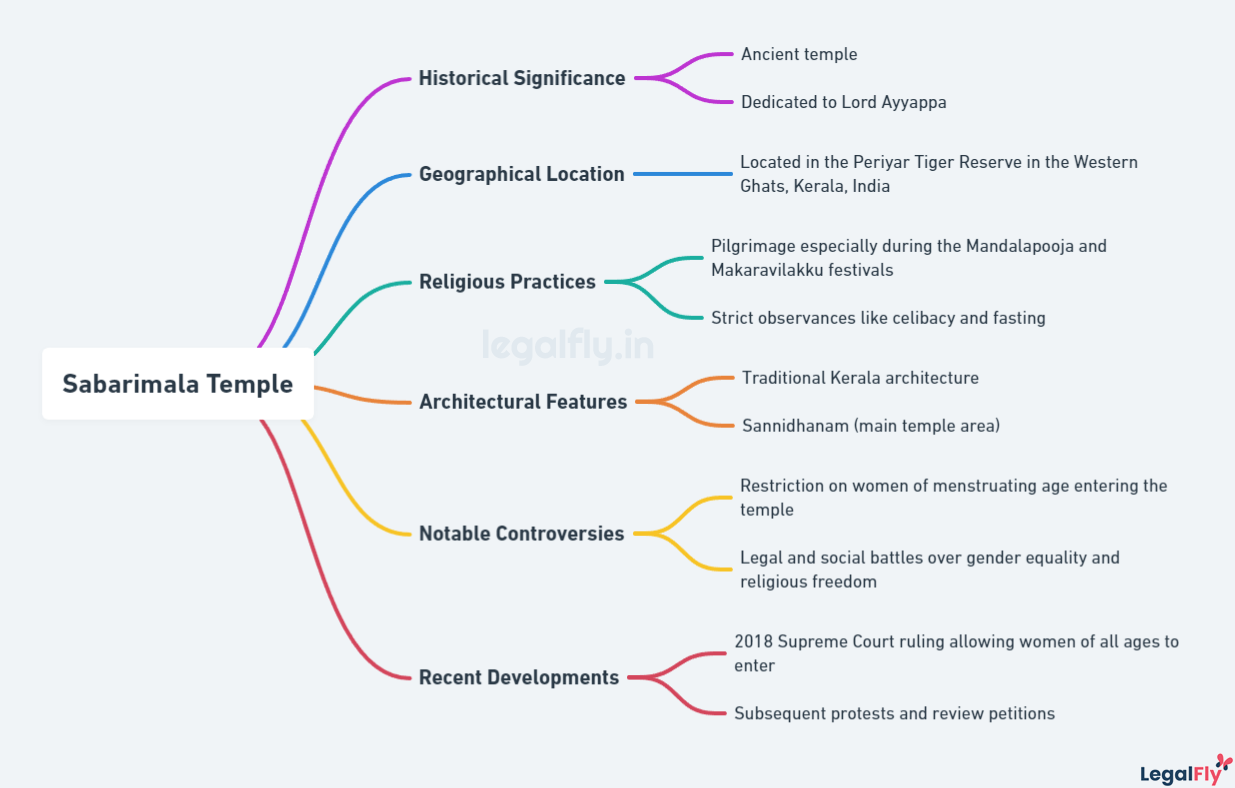
The verdict triggered large protests in Kerala. Initial attempts by women activists to enter the temple after the judgment were blocked. On 2 January 2019, two women — Bindu Ammini and Kanakadurga — entered the Sabarimala sanctum under police protection, the first time women of menstruating age had done so in recent memory. Their entry provoked further protests and violence.
More than 50 review petitions were filed challenging the 2018 judgment. In November 2019, a five-judge bench (3:2) referred the matter — along with related constitutional questions about the right of religious denominations to exclude women in other faiths — to a larger bench without staying the original judgment. The matter was ultimately escalated to a nine-judge Constitution bench (CJI Surya Kant presiding), which heard arguments for 16 days starting 7 April 2026 and reserved judgment on 14 May 2026. The nine-judge bench's ruling will authoritatively settle the interplay between religious freedom (Art 25–26) and gender equality (Arts 14, 15) across multiple religions.
Significance
- Essential practices test: The majority narrowed the test — a practice must have clear scriptural backing to be "essential." Malhotra J.'s dissent exposes the tension between this approach and genuine pluralism.
- Constitutional morality vs popular morality: The Misra/Chandrachud opinions firmly assert that constitutional values prevail over social consensus — a significant statement for progressive jurisprudence.
- Article 17 (untouchability): Applying Art 17 to menstruation-based exclusion is doctrinally bold and contested; the 9-judge bench is expected to address this squarely.
- Broader impact: The 2018 judgment (and the pending reference) has prompted fresh challenges to exclusionary practices at mosques, dargahs, and other religious sites across India.