
What is Jurisprudence? An Introduction to Legal Theory

In this article
- What is Jurisprudence in Law: A Simple Explanation
- Defining the Concept of Law
- Understanding Law: Basic Definitions
- Law According to Various Jurists
- Statutory Meanings of Law in Different Contexts
- Key Questions Surrounding the Concept of Law
- Role of Jurisprudence in Understanding Law
- Understanding the Fundamentals of Law: Decoding Key Internal Concepts
- Major Branches of Jurisprudence
- The Evolution of Jurisprudence
- Classical Schools of Jurisprudence
- Modern Perspectives on Jurisprudence
- Challenges and Critiques in Jurisprudence
- Conclusion
- Watch: Introduction to Jurisprudence
What is Jurisprudence in Law: A Simple Explanation
Jurisprudence is the theory and philosophy of law — the study of what law is, where it comes from, how it works and what it ought to be. It goes beyond knowing individual rules to ask the deeper questions: why do laws exist, what makes them legitimate, and how should they be interpreted?
That perspective is useful whether you are a law student, a practitioner, or simply curious about the rules that govern society. Jurisprudence gives you a lens for examining the legal world rather than just memorising it.

Defining the Concept of Law
Understanding Law: Basic Definitions
At its simplest, law is a set of rules that guides behaviour within society — a rulebook of what we can and cannot do, and a statement of our rights and responsibilities towards one another. But law is also a system for resolving conflicts and delivering justice: when someone breaks the rules, the law provides the response, whether that is a penalty or an order to pay compensation.
Law According to Various Jurists
Different jurists have defined law in different ways, each capturing a part of the picture.
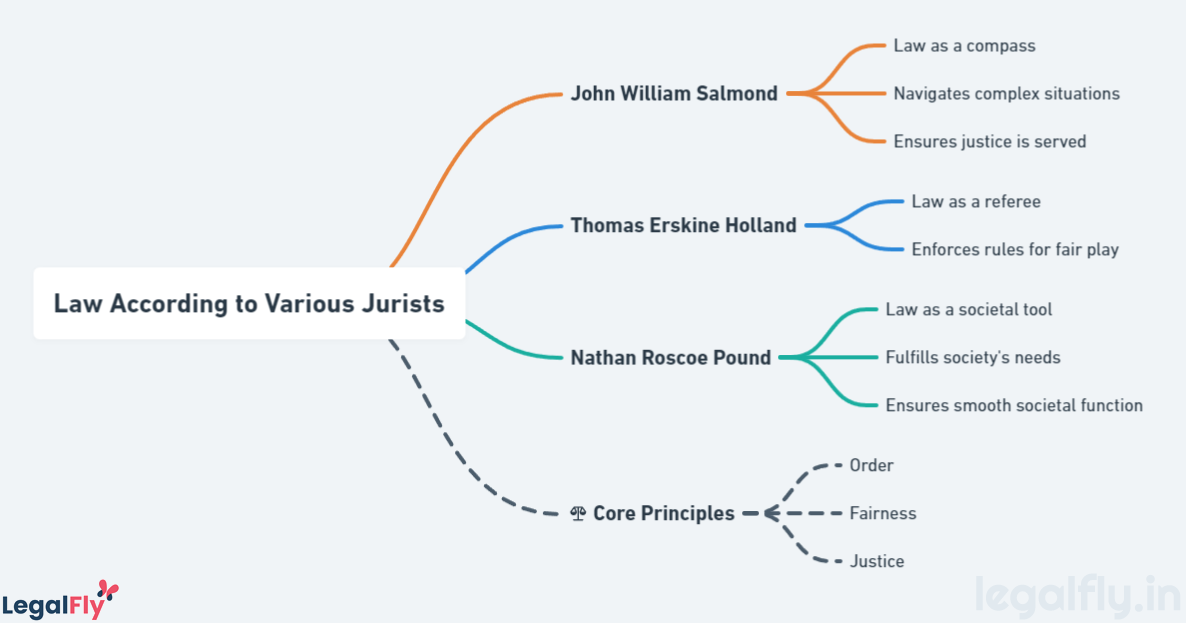
- John Salmond: law is the body of principles recognised and applied by the State in the administration of justice. For Salmond, law is inseparable from the courts that apply it to do justice.
- Thomas Erskine Holland: law is a general rule of external human action enforced by a sovereign political authority. On this view, law is like a referee — it does not play the game but enforces the rules.
- Roscoe Pound: law is a form of social engineering — an instrument the State uses to balance competing interests and meet the needs of society.
- John Austin: law is the command of the sovereign, backed by a sanction. This "command theory" is the foundation of the analytical/positivist school.
However it is defined, law is ultimately about securing order, fairness and justice in society.
Statutory Meanings of Law in Different Contexts
In a statutory sense, "law" takes its meaning from its purpose. The Indian Contract Act, for example, sets out the law of contracts — when a promise becomes legally binding. The Constitution of India, by contrast, is the fundamental law of the land, laying down the framework of government and the principles by which its organs must operate.
Key Questions Surrounding the Concept of Law
- Origins and authority of laws: Where does law come from? Is it the command of a sovereign, a reflection of divine or natural order, or the gradual product of a society's evolution?
- Logic and object of laws: What principle or purpose lies behind a given law? Understanding the object of a law is central to understanding how it functions.
- Legal terminology: Grasping the technical vocabulary used across different laws is essential to reading and applying them correctly.
Role of Jurisprudence in Understanding Law
Understanding the Fundamentals of Law: Decoding Key Internal Concepts
Jurisprudence answers these questions. It explains the internal concepts of law, the logic behind legal rules, and the terminology used across legal texts, acting as a bridge between past and present legal thought.
For a law student, this matters in practice. A grounding in jurisprudence makes it easier to analyse legal problems critically, build well-reasoned arguments, and understand why the law takes the shape it does — not just what it says.
Major Branches of Jurisprudence
Jurisprudence is usually divided into three broad branches: analytical (positive), normative, and comparative.
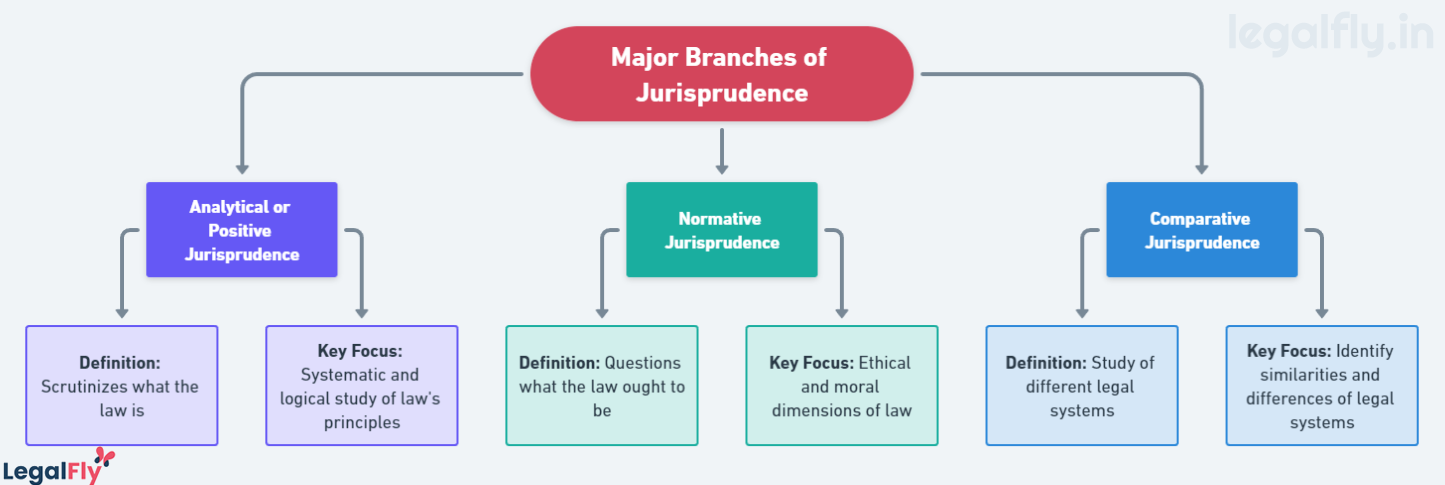
| Branch | Central question | Key focus |
|---|---|---|
| Analytical (Positive) Jurisprudence | What is the law? | The systematic, logical study of legal principles — dissecting the structure and function of law as it exists. |
| Normative Jurisprudence | What ought the law to be? | The ethical and moral dimension — how laws can be shaped to promote fairness, justice and the social good. |
| Comparative Jurisprudence | How do legal systems differ? | Comparing different legal systems to identify their similarities, differences and the reasons behind them. |
The Evolution of Jurisprudence
Classical Schools of Jurisprudence
The classical schools each offer a distinct view of the nature and purpose of law:
- Natural Law School: certain principles of law are inherent in nature and morality; an unjust law is not true law.
- Analytical / Positivist School: law is what is laid down by the sovereign or the State, studied as it is, separate from morality (Bentham, Austin).
- Historical School: law grows organically from a community's customs, traditions and history (Savigny).
- Sociological School: law cannot be understood apart from society; it both shapes and is shaped by social needs (Pound, Ihering).
Studying these schools side by side helps law students appreciate the many-sided nature of law and think critically about its role in society.
Modern Perspectives on Jurisprudence
Modern jurisprudence engages directly with contemporary problems — human rights, social justice and globalisation. In the human-rights context, it asks how legal systems can guarantee and protect fundamental rights, exploring the delicate balance between law and morality.
As the world becomes more interconnected, modern jurisprudence also grapples with international law: how different legal systems can be harmonised, and how international norms can be enforced. Its strength is its adaptability — it keeps the study of law responsive to changing times rather than fixed in rigid theory.
Challenges and Critiques in Jurisprudence
Jurisprudence is shaped by ongoing debate. A few influential critiques show how the field advances:
- Critique of legal formalism: Justice Oliver Wendell Holmes Jr. challenged the idea that judges decide cases by pure, mechanical logic, arguing that judges are also influenced by experience and social, political and personal factors — the foundation of legal realism.
- Critique of natural law: H.L.A. Hart argued for separating law from morality — not every law is moral, and not every moral principle is law — refining modern legal positivism.
- Critique of legal positivism: Lon Fuller responded to Hart that law cannot be entirely divorced from morality, pointing to Nazi Germany, where deeply immoral rules were enacted in legal form. The famous Hart–Fuller debate frames much of modern legal philosophy.
- Critique of the utilitarian theory of punishment: Jeremy Bentham's view that punishment is justified mainly as a deterrent has been criticised for potentially justifying excessively harsh penalties at the expense of individual rights.
These debates keep jurisprudence dynamic — constantly reshaped by critique and counter-argument in step with society's changing needs.
Conclusion
Jurisprudence, the philosophy of law, is an essential tool for anyone navigating legal principles. As the law adapts to social change, jurisprudence provides a flexible framework for understanding its foundations — including the central tension between what the law is and what it ought to be.
For students, scholars and practitioners alike, the real value of jurisprudence is the question it keeps asking: how can the insights of legal theory be used to build a fairer, more impartial and more responsive legal system?
Watch: Introduction to Jurisprudence
For a video walkthrough of the meaning of law and the key questions of jurisprudence, watch our explainer: