
R v. Dudley and Stephens (1884): Necessity & Murder
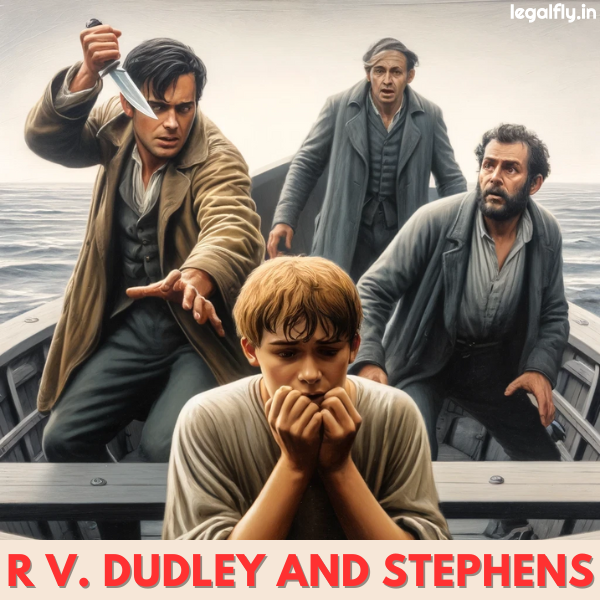
In short
After the yacht Mignonette sank, four men were cast adrift. About 20 days in, Captain Dudley and Stephens killed the dying cabin boy, Richard Parker, and ate his body to survive; a third man, Brooks, refused to take part. A five-judge Divisional Court (Lord Coleridge CJ) held that necessity is no defence to the murder of an innocent person. The two were sentenced to death, later commuted to six months' imprisonment.
In this brief
- Overview of R v. Dudley and Stephens
- Background of the case
- Events leading to the tragic decision
- Charges and legal framework
- The defence of necessity
- Legal precedent set by the case
- The moral dilemma faced by Dudley and Stephens
- Influence on later legal decisions
- Dudley and Stephens in Indian law
- Lessons learned from R v. Dudley and Stephens
Overview of R v. Dudley and Stephens
R v. Dudley and Stephens (1884) 14 QBD 273 is the leading English authority on the defence of necessity in criminal law. After a shipwreck left four men adrift, two of them killed and ate the weakest, a 17-year-old cabin boy, to survive. The Queen''s Bench Division held that necessity is no defence to murder: however desperate the circumstances, the law does not permit the intentional killing of an innocent person to save oneself.
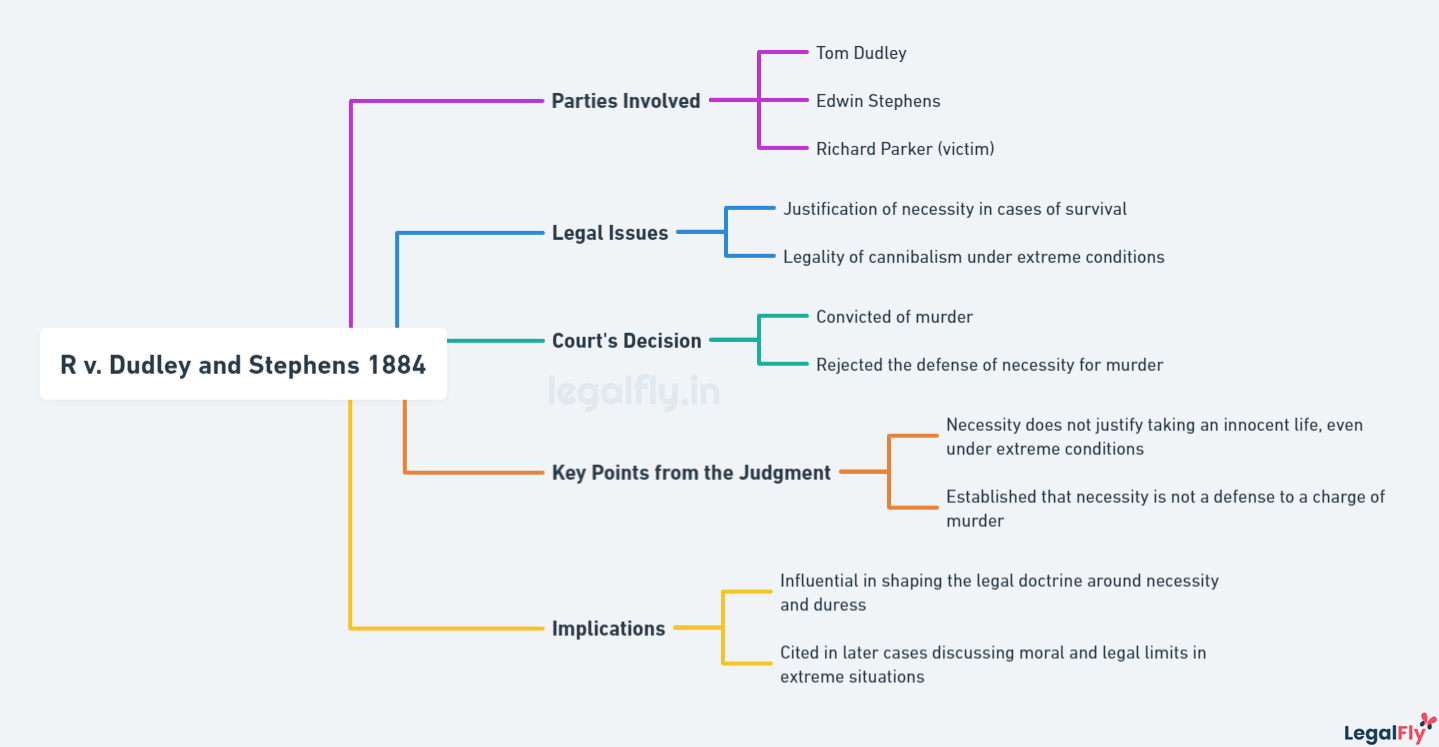
The defendants, Tom Dudley and Edwin Stephens, were convicted of murder and sentenced to death — a sentence the Crown later commuted to six months'' imprisonment. The case remains a staple of law schools worldwide for the questions it raises about law, morality and survival.
Background of the case
In May 1884, the yacht Mignonette set sail from Southampton, England, bound for Sydney, Australia. Four men were aboard: Tom Dudley (the captain), Edwin Stephens, Edmund Brooks, and Richard Parker, a 17-year-old cabin boy. On 5 July 1884, the yacht was overwhelmed by a wave and sank. The men escaped in a small open boat with almost no provisions — two tins of turnips and, for a few days, a turtle they caught — and no fresh water.
Events leading to the tragic decision
Adrift in the South Atlantic, the men soon exhausted their food. Parker, against advice, drank seawater, fell ill and slipped towards a coma. By about the twentieth day, all four were starving and severely dehydrated. Dudley proposed that one should be sacrificed to save the rest. On 24 July 1884, with Parker apparently near death, Dudley killed him with a penknife while Stephens assented; Brooks refused to take part. The three survivors fed on Parker''s body until they were rescued on 29 July by a passing ship, the Moctezuma, and returned to England.
Charges and legal framework
On their return, Dudley and Stephens were arrested and charged with the murder of Richard Parker. Brooks, who had not participated, was not charged and instead became a witness.
The case was tried at the Devon and Exeter Assizes before Baron Huddleston, who steered the jury towards a special verdict — that is, the jury found the facts of the ordeal but left the legal question (whether those facts amounted to murder, or were excused by necessity) to be decided by a higher court. The matter was then determined by a five-judge Divisional Court of the Queen''s Bench Division.
The defence of necessity
Dudley and Stephens argued the defence of necessity: that killing Parker was the only way to avoid all of them dying, and that the law should excuse a killing committed to preserve life in an extreme emergency. They stressed that Parker was already close to death, that they had endured some twenty days before acting, and that without food they reasonably believed none of them would survive.
The difficulty was that Parker had done nothing to threaten them. Unlike self-defence, this was the deliberate killing of an innocent, passive victim chosen by the others. The question for the Court was whether necessity could ever justify such a killing.
Legal precedent set by the case
On 9 December 1884, the Divisional Court (Lord Coleridge CJ, with Grove and Denman JJ and Pollock and Huddleston BB) held that necessity is not a defence to murder, affirmed the conviction, and sentenced the men to death.
Lord Coleridge CJ reasoned that to admit necessity here would be to make the person who kills the judge of the value of another''s life — and there was no principled way to say whose life was worth more. He rejected the idea that self-preservation is always the highest duty, observing that it may instead be a person''s plain duty to sacrifice their own life. He acknowledged the agony of the defendants'' position with the famous concession: "We are often compelled to set up standards we cannot reach ourselves, and to lay down rules which we could not ourselves satisfy."
Crucially, the judgment insisted that law and morality, though distinct, cannot be wholly separated. In Coleridge CJ''s words: "Though law and morality are not the same, and many things may be immoral which are not necessarily illegal, yet the absolute divorce of law from morality would be of fatal consequence." The decision thus upheld the sanctity of innocent human life as a legal rule, even against deep public sympathy for the defendants.
The moral dilemma faced by Dudley and Stephens
- An impossible choice: after weeks adrift without food or water, the men believed they faced certain death unless one was sacrificed.
- A passive victim: Parker, ill and weakened, posed no threat — making this very different from killing in self-defence.
- One life against several: the defendants framed it as sacrificing one to save three, but the Court refused to let survival become a licence to choose who dies.
- Law versus conscience: the case is studied precisely because the legal answer (guilty of murder) and many people''s moral intuitions pull in different directions.
- Mercy after judgment: the law''s firmness was tempered by the executive, which commuted the death sentences to six months'' imprisonment.
Influence on later legal decisions
The case fixed the rule that necessity cannot excuse the deliberate killing of an innocent person, and it has been applied and discussed ever since. It was distinguished, not overturned, in Re A (Conjoined Twins) (2000), where the Court of Appeal permitted the surgical separation of conjoined twins that would kill the weaker to save the stronger — treating that exceptional situation differently from a free choice to kill. Necessity remains a narrow and carefully policed doctrine, and Dudley and Stephens is still the starting point for any argument that survival justified a killing.
Dudley and Stephens in Indian law
Indian criminal law reaches the same result. The general exception of necessity appears in Section 81 of the Indian Penal Code (re-enacted as Section 19 of the Bharatiya Nyaya Sanhita, 2023): an act done without criminal intent, in good faith to prevent or avoid other harm, may be excused. But it is well understood — consistent with Dudley and Stephens — that this cannot justify the intentional killing of an innocent person merely to save oneself. The point is reinforced by the defence of duress in Section 94 IPC (now Section 32 BNS), which expressly does not extend to murder or to offences against the State punishable with death. So, in India too, neither necessity nor compulsion is a defence to murdering an innocent.
Lessons learned from R v. Dudley and Stephens
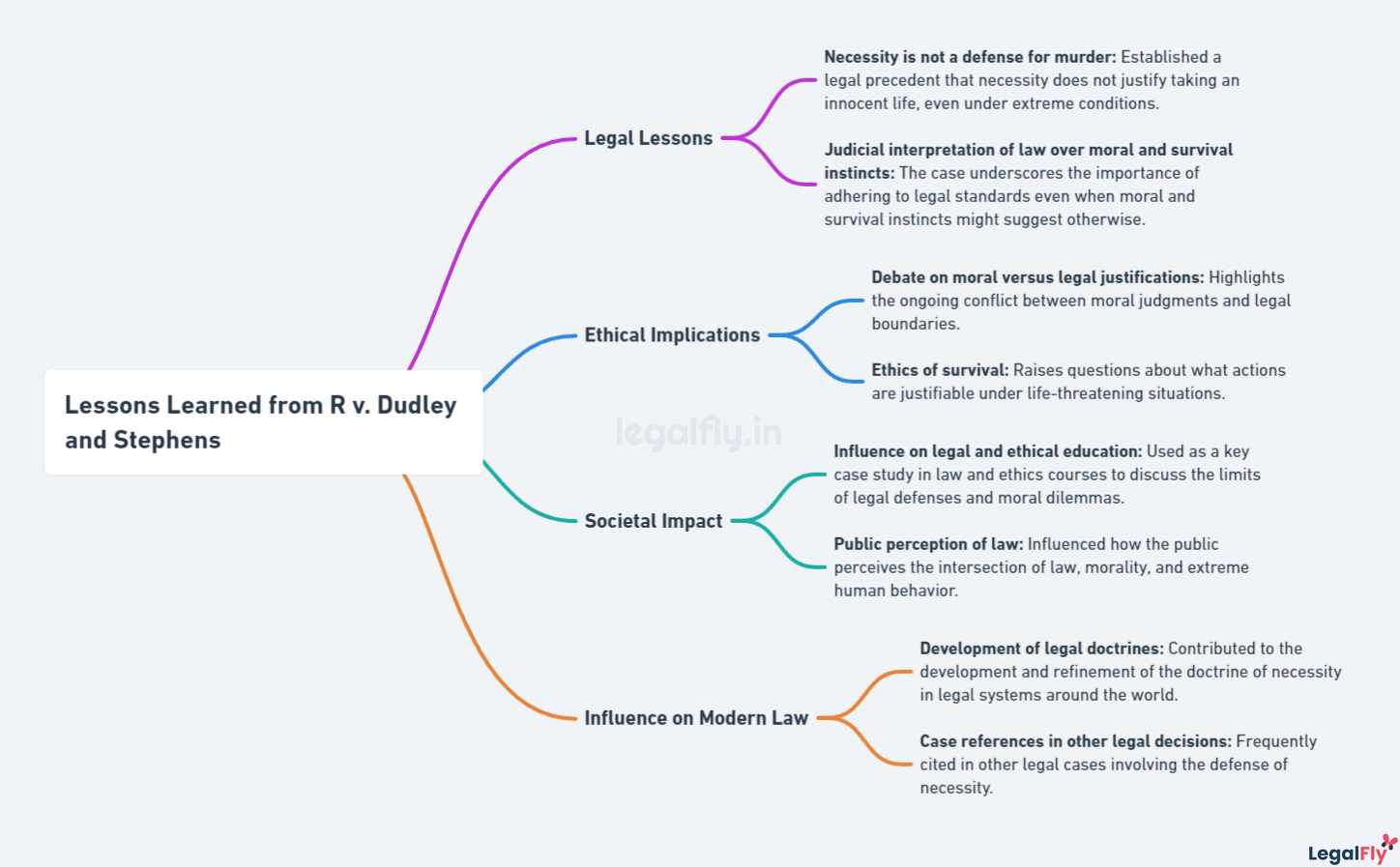
- Necessity is no defence to murder. Even in a genuine life-or-death emergency, the deliberate killing of an innocent is unlawful.
- All lives are equal before the law. The Court refused to weigh the cabin boy''s life as worth less than the survivors''.
- Moral pressure does not override the law. Sympathy for the defendants could not make their act legally permissible — though it justified mercy in sentencing.
- Law and morality stay connected. Coleridge CJ insisted that completely severing law from morality would be of fatal consequence.
- The principle endures. More than a century on, the rule still anchors the law of necessity in England, India and across the common-law world.