
State of West Bengal v. Anwar Ali Sarkar (1952) Case Summary

In short
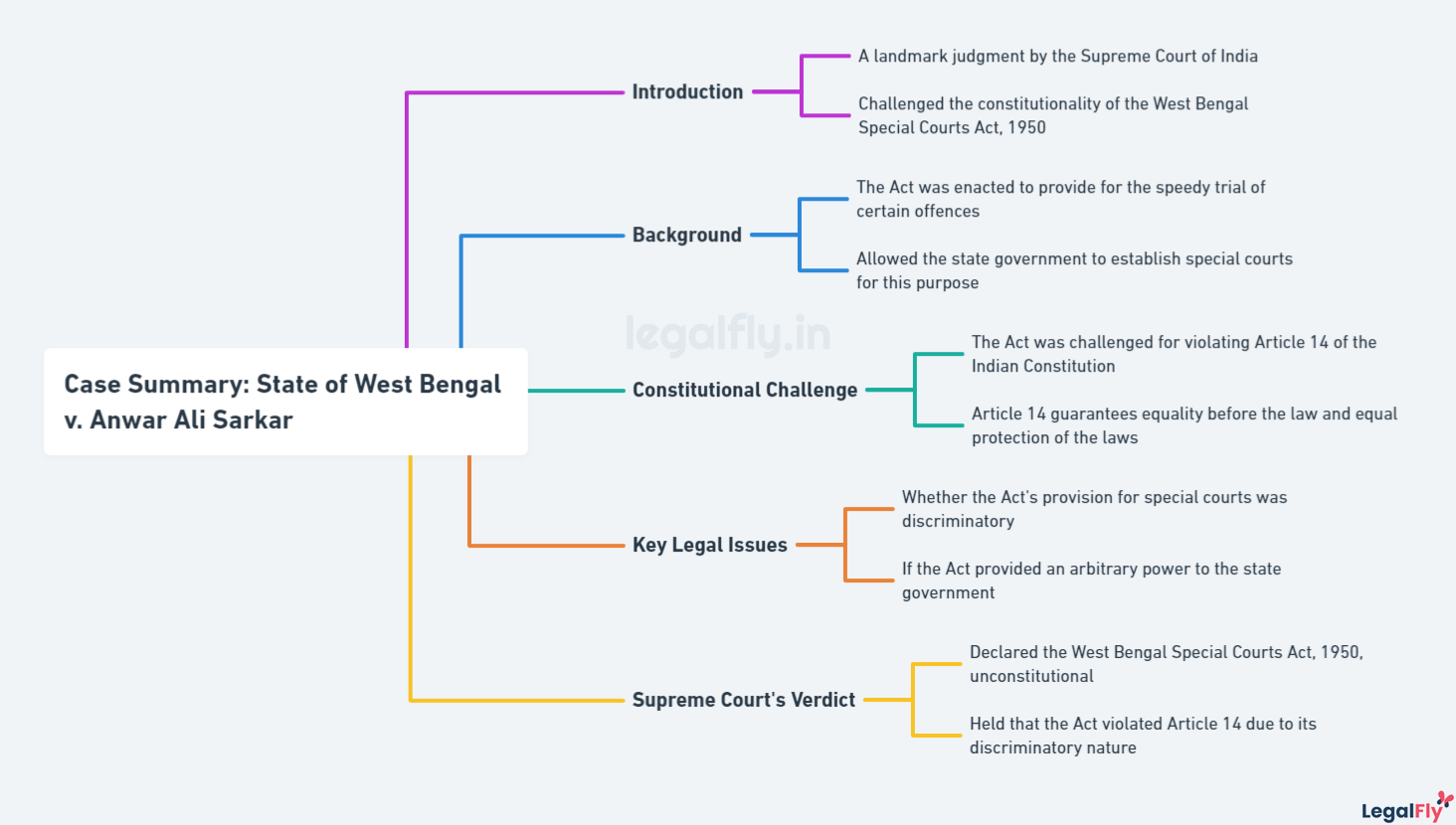
A seven-judge Supreme Court bench, by 6:1 (Patanjali Sastri C.J. dissenting), struck down Section 5(1) of the West Bengal Special Courts Act, 1950 as violating Article 14. Letting the government pick individual "cases" for a special court with a truncated procedure — with no guiding policy in the statute — was an arbitrary classification bearing no rational nexus to the Act's stated object of "speedier trial".
In this brief
- Introduction to State of West Bengal v. Anwar Ali Sarkar
- Background of the case
- Key legal questions addressed
- The West Bengal Special Courts Act, 1950
- Supreme Court's judgment and reasoning
- The Court's analysis on Article 14
- The doctrine of equality before the law
- Implications of the judgment
- Impact on the legal framework and future legislation
- The role of judicial review in protecting fundamental rights
- Critical analysis of the judgment
- Scholarly perspective on the case
- The dissenting opinion and its significance
- The aftermath and legal legacy
- Subsequent cases applying the doctrine
- The evolution of Article 14 interpretations
- Conclusion
Introduction to State of West Bengal v. Anwar Ali Sarkar
State of West Bengal v. Anwar Ali Sarkar, AIR 1952 SC 75, is one of the earliest and most important Indian constitutional law decisions on the right to equality. Decided on 11 January 1952 by a seven-judge bench, it struck down Section 5(1) of the West Bengal Special Courts Act, 1950 and laid the foundation for the doctrine of reasonable classification under Article 14 of the Indian Constitution.
Background of the case
In the unsettled years after Partition, the West Bengal legislature passed the Special Courts Act, 1950 to provide for the "speedier trial" of certain offences. Section 5(1) empowered the State Government, by notification, to direct that "offences", "classes of offences", "cases" or "classes of cases" be tried by a Special Court following a procedure that dispensed with several ordinary safeguards (such as committal proceedings and trial by jury). Anwar Ali Sarkar was convicted by such a Special Court after his case was referred to it by a government notification under Section 5(1). He challenged both his conviction and the validity of the Act under Article 14.
Key legal questions addressed
The central question was whether Section 5(1) violated Article 14, which guarantees "equality before the law" and "equal protection of the laws". The State defended the provision as a reasonable classification meant to deal with disturbed conditions; the accused argued that letting the executive single out particular cases for a harsher, truncated procedure — with no standard laid down in the Act — was arbitrary and discriminatory. The Court therefore had to define when a law may validly treat one class of persons differently from another.
The West Bengal Special Courts Act, 1950
The Act set up Special Courts to dispose of cases quickly. Its key features were:
- Constitution of Special Courts to try offences referred to them by the State Government.
- A power in Section 5(1) to refer any "offence", "class of offences", "case" or "class of cases" to a Special Court by notification.
- A modified trial procedure that omitted committal proceedings, trial by jury and certain rights available under the ordinary Code of Criminal Procedure.
The controversy lay in the breadth of Section 5(1): because the statute itself laid down no policy or yardstick for choosing which cases would face the special procedure, the choice rested on the unguided discretion of the executive. Two persons accused of the very same offence could be tried under entirely different procedures depending on a government notification.
Supreme Court's judgment and reasoning
By a majority of 6:1, the Supreme Court declared Section 5(1) unconstitutional and void for violating Article 14, and quashed the convictions. The majority comprised Fazl Ali, Mahajan, Mukherjea, Das, Chandrasekhara Aiyar and Vivian Bose JJ.; Chief Justice M. Patanjali Sastri delivered the lone dissent. Justices Vivian Bose and S.R. Das wrote influential concurring opinions explaining why the unguided power offended equality.
The Court's analysis on Article 14
The Court accepted that Article 14 does not forbid all classification — the State may classify persons and things for legitimate purposes. But any classification must satisfy a twin test:
| Requirement | What it means |
|---|---|
| Intelligible differentia | The classification must rest on a real, identifiable distinction that separates those grouped together from those left out. |
| Rational nexus | That distinction must have a rational relationship to the object the legislation seeks to achieve. |
Section 5(1) failed the test. The only stated object was "speedier trial", which the Court said was not, by itself, an intelligible basis for singling out particular cases — every prosecution could be said to need speed. With no policy in the Act to guide the executive's choice, the provision permitted arbitrary, case-by-case discrimination and so denied equal protection of the laws.
The doctrine of equality before the law
The judgment cemented the idea that equality before the law is breached not only by overt discrimination but also by laws that confer unguided discretion enabling discriminatory treatment. Vivian Bose J. famously asked whether the law would be regarded as fair by reasonable, fair-minded people — pushing Article 14 beyond a narrow, formal reading toward a substantive guarantee against arbitrariness.
Implications of the judgment
The decision had a lasting effect on Indian legislation and on the relationship between the legislature, the executive and the courts.
Impact on the legal framework and future legislation
By striking down Section 5(1), the Court established that a statute cannot hand the executive open-ended power to subject selected people to a harsher process without a discernible standard. Legislatures thereafter had to build a guiding policy and a rational nexus into laws that classify — a discipline that still governs the drafting of special-courts and fast-track legislation (now read with the Code's successor, the Bharatiya Nagarik Suraksha Sanhita, 2023).
The role of judicial review in protecting fundamental rights
Coming just two years after the Constitution took effect, the case was an early and confident assertion of judicial review. The Court signalled that it would test ordinary legislation against the fundamental rights and strike down arbitrary state action — establishing its role as guardian of the Constitution at the very outset of the Republic.
Critical analysis of the judgment
The judgment is widely regarded as a foundational defence of equality, though the majority and dissent reflected a genuine difference about how far courts should defer to an elected legislature.
Scholarly perspective on the case
Commentators have praised the case for reading Article 14 as a substantive check on arbitrary power rather than a formal guarantee, and for setting out the intelligible-differentia and rational-nexus tests that courts still apply. It is routinely cited as the source of the modern reasonable-classification doctrine in Indian constitutional law.
The dissenting opinion and its significance
Chief Justice Patanjali Sastri's lone dissent took a more deferential view. He held that securing a "speedier trial" of offences in disturbed conditions was itself a legitimate object, and that the discretion conferred on the government should be presumed to be exercised reasonably and in good faith. On his view, the classification had a sufficient basis and the Court should not readily strike down a law passed by an elected legislature. The disagreement — judicial restraint versus active protection of equality — has echoed through Article 14 litigation ever since.
The aftermath and legal legacy
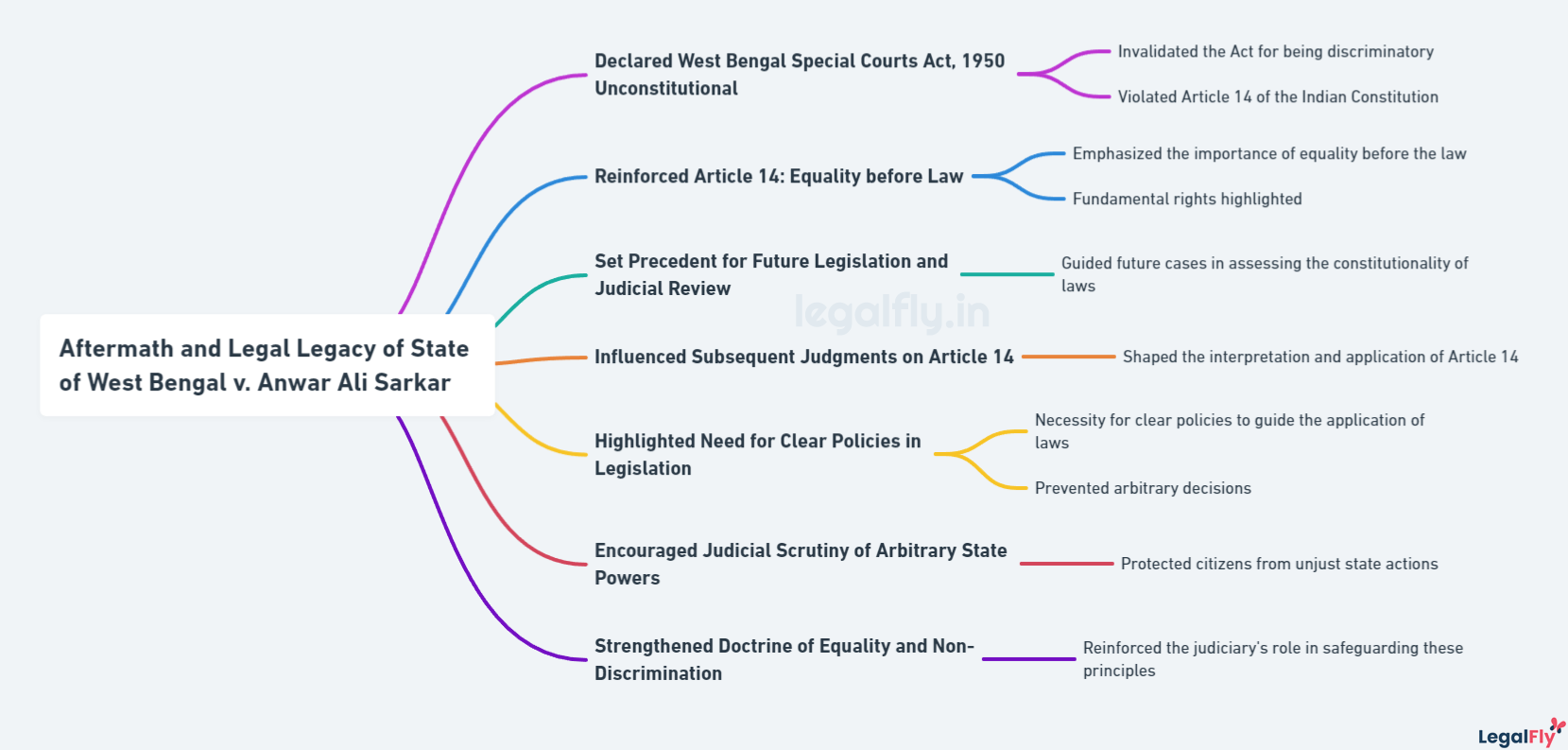
Anwar Ali Sarkar shaped the line of cases that defined when classification is permissible under Article 14.
Subsequent cases applying the doctrine
The contrast with Kathi Raning Rawat v. State of Saurashtra, AIR 1952 SC 123 — decided weeks later — is the classic illustration of the test in action:
| Anwar Ali Sarkar (1952) | Kathi Raning Rawat (1952) | |
|---|---|---|
| Outcome | Section 5(1) struck down | Ordinance upheld |
| Stated object | Only "speedier trial" — too vague | Public safety, peace and order, set out in the preamble |
| Guiding policy | None in the statute → unguided discretion | Preamble disclosed a clear policy guiding the classification |
| Article 14 result | Arbitrary classification; no rational nexus | Intelligible differentia with a rational nexus to the object |
In Budhan Choudhry v. State of Bihar, AIR 1955 SC 191, a Constitution Bench upheld Section 30 of the Code of Criminal Procedure and restated the twin test, confirming that classification is valid where it rests on an intelligible differentia having a rational relation to the object of the law. Together these cases settled the working framework: classification is permissible, arbitrariness is not.
The evolution of Article 14 interpretations
The reasonable-classification test built in Anwar Ali Sarkar remained the dominant Article 14 doctrine for decades. It was later supplemented — not displaced — by the "new" doctrine in E.P. Royappa v. State of Tamil Nadu (1974) and Maneka Gandhi v. Union of India (1978), which held that equality is antithetical to arbitrariness, and by cases such as Air India v. Nargesh Meerza (1981) insisting that a classification not be arbitrary or unreasonable. Modern Article 14 analysis thus runs on two tracks: the classification test of Anwar Ali Sarkar and the anti-arbitrariness test of Royappa.
Conclusion
State of West Bengal v. Anwar Ali Sarkar is the case that gave Article 14 its analytical backbone. By striking down a provision that let the executive choose, without any statutory standard, who would face a harsher criminal procedure, the Supreme Court held that equality forbids not just open discrimination but also unguided discretion that makes discrimination possible. Its twin test — intelligible differentia and rational nexus — remains the starting point for every challenge to a classifying law in India today.