
Lucy v. Zehmer (1954): Case Summary & Objective Theory
In short
Lucy v. Zehmer (1954) is the classic "was it a joke?" contract case. Zehmer scrawled an agreement to sell his farm for $50,000 on the back of a restaurant check after an evening of drinking, then claimed he was only joking. The Supreme Court of Appeals of Virginia held the contract binding: under the objective theory of contracts, what matters is how a reasonable person would read your words and acts — not your secret intention.
In this brief
Introduction to Lucy v. Zehmer
Lucy v. Zehmer (1954) is one of the most famous contract-law cases ever taught — the "was it a joke?" case. After an evening of drinking, A.H. Zehmer wrote out an agreement to sell his farm to W.O. Lucy for $50,000, signed it, and then insisted he had only been joking. The Supreme Court of Appeals of Virginia disagreed and held him to the deal.
The case is the textbook illustration of the objective theory of contracts: what matters is how a reasonable person would interpret your words and conduct, not the private intention you kept in your head.
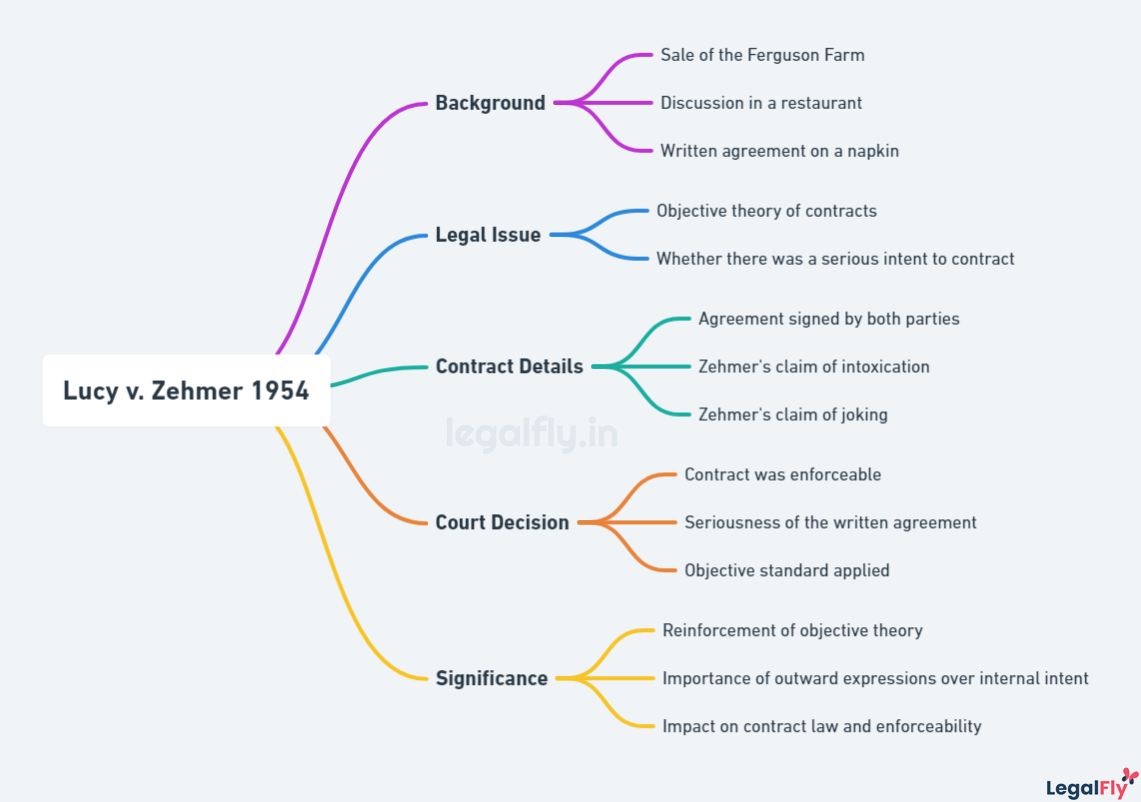
The dispute was about the sale of the Ferguson Farm, a 471-acre tract in Dinwiddie County, Virginia. W.O. Lucy, the buyer, sued to enforce the agreement; A.H. Zehmer, the owner, argued no real contract had been formed. The central question was whether there had been a genuine "meeting of the minds".
Facts of the Case
Events Leading Up to the Contract
On the night of 20 December 1952, W.O. Lucy stopped by Zehmer's restaurant in Dinwiddie County. Lucy had tried for years to buy Zehmer's farm, and the two men — who had been drinking — got to talking about it again. Zehmer dared Lucy to put up $50,000, then took a restaurant check and wrote on the back: "I do hereby agree to sell to W.O. Lucy the Ferguson Farm for $50,000 complete."
Lucy told Zehmer he should change it to "we", because Zehmer's wife would have to sign too. Zehmer tore up the first writing and wrote a new one — "We hereby agree to sell to W.O. Lucy the Ferguson Farm complete for $50,000, title satisfactory to buyer" — and both A.H. Zehmer and his wife Ida Zehmer signed it. The whole exchange, including back-and-forth over the title, lasted around 40 minutes. When Lucy offered $5 to seal the deal, Zehmer told him he did not need any money — the signed agreement was enough.
The next day Zehmer refused to go through with the sale, saying the whole thing had been a drunken joke. Lucy sued for specific performance — a court order forcing Zehmer to transfer the farm. (Note: it is often retold as a deal scribbled on a "napkin", but the agreement was actually written on the back of a restaurant check.)
Legal Issues Presented
The core question was whether a binding contract existed even though Zehmer claimed he never seriously intended to sell. That turned on whether there was mutual assent — a "meeting of the minds" — judged not by Zehmer's secret state of mind but by how his words and acts would appear to a reasonable person.
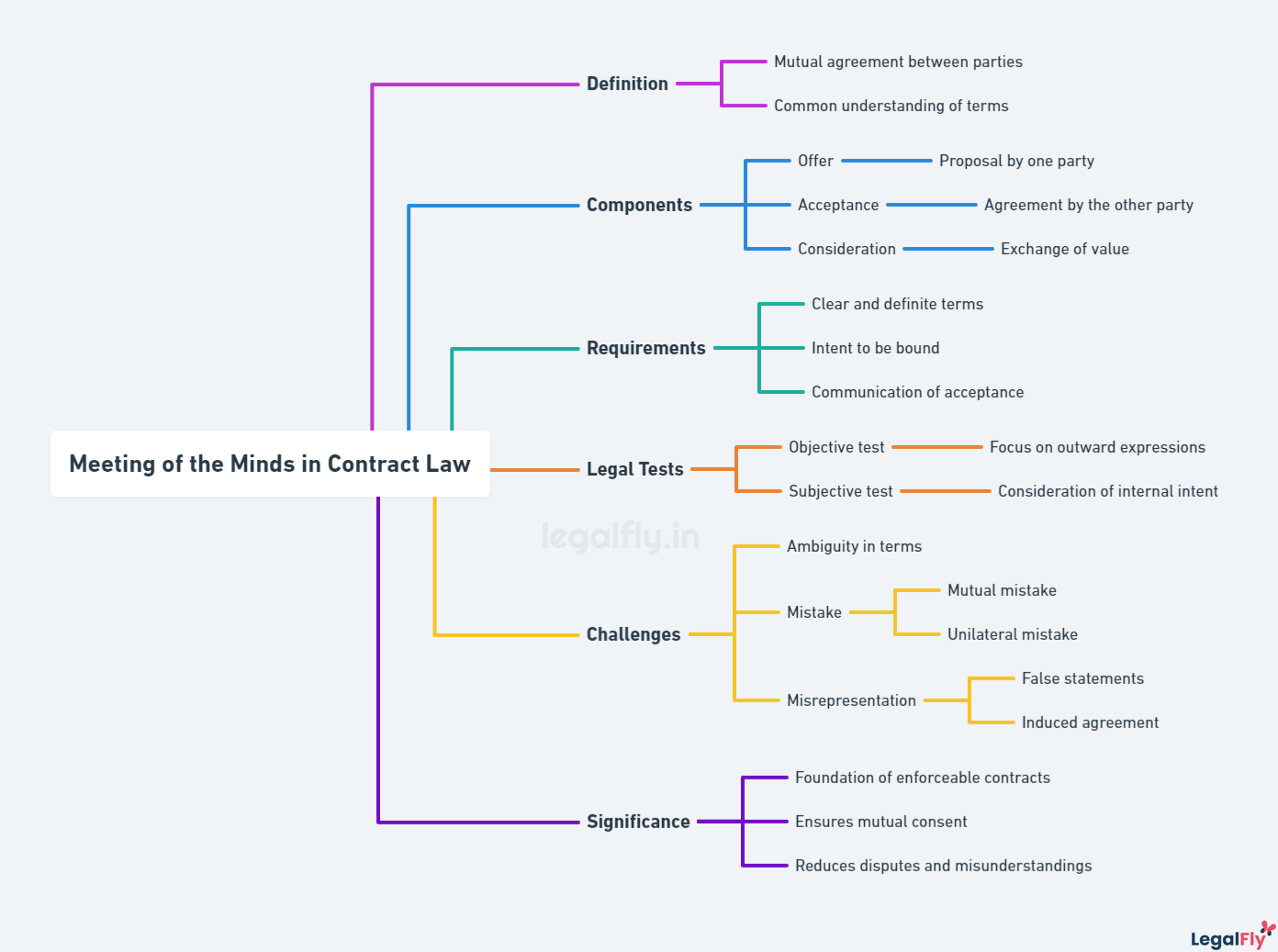
Zehmer's defence was twofold: that he was too drunk to contract, and that the agreement was a joke. Lucy's position was that the signed writing, the negotiation over title, and Zehmer's whole course of conduct objectively showed a serious agreement.
The Trial Court's Decision
Lucy first brought his suit for specific performance in the Circuit Court of Dinwiddie County.
Initial Findings and Ruling
The trial court sided with Zehmer. Despite the signed writing, the judge accepted that Zehmer had not genuinely intended to sell the farm and dismissed Lucy's bill, holding that he had failed to establish a right to specific performance.
Arguments from Both Sides
Lucy argued that the signed writing plainly constituted a contract: the language, the two signatures, the agreed price and the discussion of title all showed an agreement. Zehmer countered that he had no serious intention to sell, that he signed only to call what he thought was Lucy's bluff, and that both men had been drinking — so there was no real meeting of the minds. At the trial level, that argument carried the day.
Supreme Court Ruling
On appeal, the Supreme Court of Appeals of Virginia reversed and ordered Zehmer to convey the farm to Lucy.
The Court applied the objective theory of contracts: the outward expression of agreement controls, not a party's hidden, unexpressed intention. In its most-quoted passage, the Court said:
"We must look to the outward expression of a person as manifesting his intention rather than to his secret and unexpressed intention. The law imputes to a person an intention corresponding to the reasonable meaning of his words and acts. If his words and acts, judged by a reasonable standard, manifest an intention to agree, it is immaterial what may be the real but unexpressed state of his mind."
On the facts, the Court found that Zehmer was not so intoxicated as to be incapable of understanding what he was doing, and that the lengthy, detailed discussion — including rewriting the note so his wife could sign and insisting the title be "satisfactory to buyer" — would lead any reasonable person in Lucy's position to believe a serious agreement had been made. Zehmer's later claim that he was only joking was therefore irrelevant.
Legal Principles Established
Lucy v. Zehmer is the leading illustration of the objective theory of contracts. The principle is simple: if your words and conduct, measured by a reasonable standard, show an intention to agree, you are bound — regardless of any private reservation. A "secret joke" is no defence if you outwardly behaved as though you meant it.
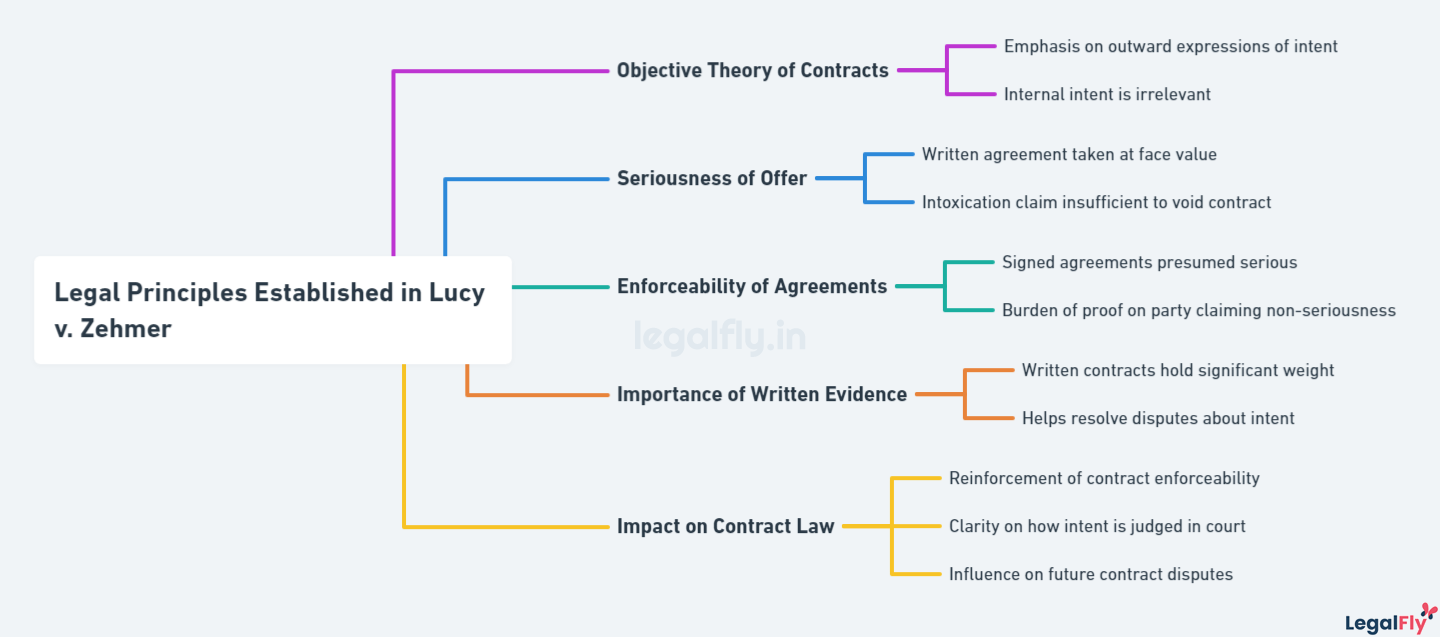
The case also confirms that a contract need not be formal to be enforceable. A handwritten note on the back of a restaurant check can satisfy the requirements of offer, acceptance and consideration just as well as a typed deed, provided the objective elements are present.
Impact and Legacy of the Case
Lucy v. Zehmer remains a staple of first-year contracts courses and is frequently cited for the objective approach to contract formation. It sits alongside other classic objective-theory cases such as Embry v. Hargadine, McKittrick Dry Goods Co. (1907) and Judge Learned Hand's well-known statement of the rule in Hotchkiss v. National City Bank (1911).
It is worth contrasting it with Raffles v. Wichelhaus (1864), the "two ships Peerless" case. There the objective theory did not save the contract, because each party reasonably understood a different thing and there was a genuine latent ambiguity — a reminder that the objective test has limits where the outward expressions themselves point in two directions.
Common Misconceptions
"A deal made while drinking or joking can't be binding." Lucy v. Zehmer shows that is wrong. As long as a person is not so intoxicated as to lack understanding, and their outward words and acts reasonably signal agreement, a court can enforce the deal — even one struck in a bar.
"You need formal, technical language for a binding contract." Also wrong. Plain words written informally can still show mutual assent. Courts look at the whole of the parties' conduct rather than demanding rigid formalities.
Conclusion
Lucy v. Zehmer established principles that still govern contract law today:
- The objective theory of contracts controls: outward, reasonable meaning beats secret intention.
- A contract needs offer, acceptance and consideration judged objectively — unexpressed intentions are irrelevant.
- Even an informal, "joking" or alcohol-fuelled agreement can be enforceable if it meets the objective requirements.
- Courts weigh the totality of the circumstances to decide whether an enforceable contract was formed.
The practical lesson is timeless: be careful what you sign and how you behave in a negotiation, because the law will hold you to what a reasonable person would understand you to have meant — not to what you privately intended.