
Sources of Law in Jurisprudence: Primary, Secondary & Tertiary

In this article
- Introduction to the Sources of Law in Jurisprudence
- Primary Sources of Law
- Constitutions: The Foundation of Legal Systems
- Legislation: Statutes and Acts
- Judicial Precedents: Case Law as a Source
- Customs: Traditional Laws and Practices
- Secondary Sources of Law
- Legal Scholarships and Commentaries
- Official Reports and Records
- Legal Dictionaries and Encyclopedias
- Tertiary Sources of Law
- Understanding Tertiary Legal Materials
- The Role of Tertiary Sources in Legal Research and Education
- Application of Sources in Judicial Decisions
- Case Studies: Application of Multiple Sources of Law in Landmark Judgments in India
- Kesavananda Bharati v. State of Kerala (1973)
- Maneka Gandhi v. Union of India (1978)
- Vishaka v. State of Rajasthan (1997)
- Navtej Singh Johar v. Union of India (2018)
- Joseph Shine v. Union of India (2018)
- Comparative Analysis of Legal Systems in Jurisprudence
- Civil Law vs. Common Law Systems
- The Influence of Religious Laws in Jurisprudence
- Modern Developments in the Sources of Law
- Conclusion: The Evolving Nature of Legal Sources
Introduction to the Sources of Law in Jurisprudence
The "sources of law" are the origins from which legal rules, principles and norms are derived. They are what gives law its authority — the reason a rule is binding and can be enforced by the State. Identifying the right source, and knowing how much weight it carries, is one of the most basic skills in jurisprudence.
The sources of law in jurisprudence have evolved over centuries — from ancient customs and religious codes to modern legislation and international treaties. Relying on recognised sources is what makes a legal system consistent, stable and predictable.
Sources of law are usually grouped into three classes:
| Type | What it is | Examples | Binding? |
|---|---|---|---|
| Primary | Authoritative law that creates binding rules | Constitution, legislation, judicial precedent, custom | Yes — binding |
| Secondary | Material that explains and interprets primary law | Legal commentaries, journal articles, official reports | No — persuasive only |
| Tertiary | Finding and reference tools | Legal dictionaries, encyclopedias, research guides | No — reference only |
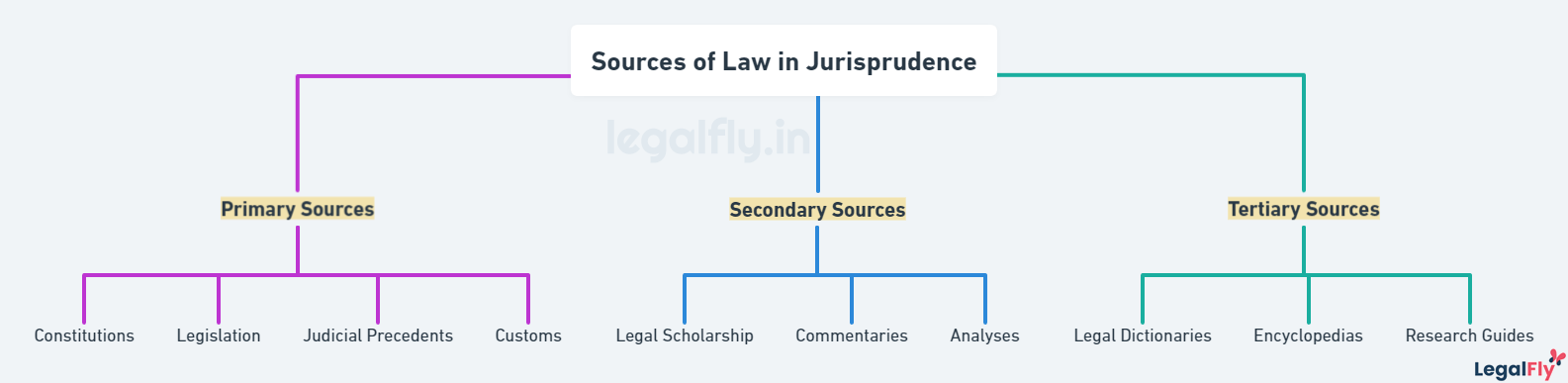
- Primary sources — constitutions, legislation, judicial precedents and customs. These establish binding law and the general principles courts must apply. They are the foremost authoritative origins from which legal rules get their validity.
- Secondary sources — legal scholarship, commentaries and analyses that explain and interpret primary law. They guide understanding but are not themselves binding.
- Tertiary sources — finding tools such as legal dictionaries, encyclopedias and research guides that help locate primary and secondary material.
Primary Sources of Law
Primary sources of law are the authoritative, binding sources that actually create law. They are produced by the organs of the State — the legislature, the executive and the judiciary — and form the foundation of a country's legal system. The four most important are constitutions, legislation, judicial precedents and customs.
Constitutions: The Foundation of Legal Systems
A constitution is a country's supreme law and the source of authority for all other laws. It sets up the structure of government and the relationship between the State and its citizens, and it spells out fundamental rights, directive principles and the powers of each branch of government. A constitution usually cannot be changed by any one branch acting alone; it requires a special amendment procedure. In India, any law that conflicts with the Constitution can be struck down by the courts.
Legislation: Statutes and Acts
Legislation is law enacted by the legislature or Parliament, in the form of statutes, acts, codes and ordinances. It covers everything from crime to education to healthcare. The legislature can make new laws, amend existing ones and repeal those that are obsolete — as India did in 2023 when it replaced the Indian Penal Code, the Criminal Procedure Code and the Evidence Act with the Bharatiya Nyaya Sanhita, the Bharatiya Nagarik Suraksha Sanhita and the Bharatiya Sakshya Adhiniyam. Statutes make up the bulk of the law that governs day-to-day life.
Judicial Precedents: Case Law as a Source
Judicial precedents are the body of case law built up through written court decisions. Under the doctrine of stare decisis ("let the decision stand"), lower courts are bound to follow the principles laid down by higher courts in similar cases. The reasoning of landmark judgments (the ratio decidendi) becomes an authoritative primary source. This is the engine of a common-law system like India's.
Customs: Traditional Laws and Practices
Customary law consists of established practices and traditions that carry the force of law within a community. Many countries, including India, recognise custom as a source of law, especially in personal matters like marriage, inheritance and land rights. Custom draws its authority from long-standing community use rather than formal enactment — but to be valid it must satisfy legal tests such as being ancient, continuous, reasonable and not contrary to statute.
Secondary Sources of Law
Secondary sources of law explain, analyse and provide context for primary sources. They are not binding, but they help researchers and judges understand and interpret the law. The main types are:
Legal Scholarships and Commentaries
Legal scholarship and commentaries analyse and interpret the law. Written by scholars and experts and published in law reviews, journals, treatises and books, they offer informed argument about the state of the law and legal theory. Although not binding, well-regarded scholarship can influence how the law develops, and judges sometimes cite it in their decisions.
Official Reports and Records
Official reports and records are published by courts, legislatures and government bodies. They include:
- Committee reports on bills and acts
- Records of legislative proceedings and debates
- Reports of government commissions and law commissions
These shed light on the purpose and intent behind a law. They are not binding, but they help courts interpret and apply legislation correctly.
Legal Dictionaries and Encyclopedias
Legal dictionaries and encyclopedias define and explain legal terms, concepts and procedures — for example, Black's Law Dictionary and Corpus Juris Secundum. They are a useful starting point for research and help clarify the meaning of primary sources, though they create no binding precedent.
Tertiary Sources of Law
Tertiary sources provide background and help organise and locate the law. They explain and point to primary and secondary material but are not authoritative in themselves.
Understanding Tertiary Legal Materials
Tertiary sources digest and summarise authoritative material — legal encyclopedias, dictionaries, textbooks, treatises and research guides that explain the law without creating binding precedent. They gather primary and secondary sources in one place and offer overviews and commentary, helping researchers grasp the context and implications of the law.
The Role of Tertiary Sources in Legal Research and Education
Tertiary sources do several jobs. They act as finding tools that point researchers to primary and secondary material; they play an explanatory role in summarising complex doctrines; and, in legal education, they give students foundational overviews of legal systems and core concepts. They are not binding, but they are vital for putting the binding authority of primary sources and the persuasive authority of secondary sources into context.
Application of Sources in Judicial Decisions
Which sources a court uses depends on the case. The primary sources — the Constitution, legislation, precedent and custom — work together in a clear hierarchy.
Legislation provides the framework: the court reads the relevant statute and interprets how it applies. Precedent guides interpretation, and lower courts must follow binding decisions of higher courts under stare decisis. Custom may be applied where local practice has legal validity, especially in personal and tribal law.
When sources conflict, the hierarchy decides the outcome. The Constitution prevails over everything; valid legislation overrides precedent and custom; and a binding precedent prevails over an inconsistent custom (though a court may "distinguish" a precedent on the facts). This ordering keeps the law coherent.
Case Studies: Application of Multiple Sources of Law in Landmark Judgments in India
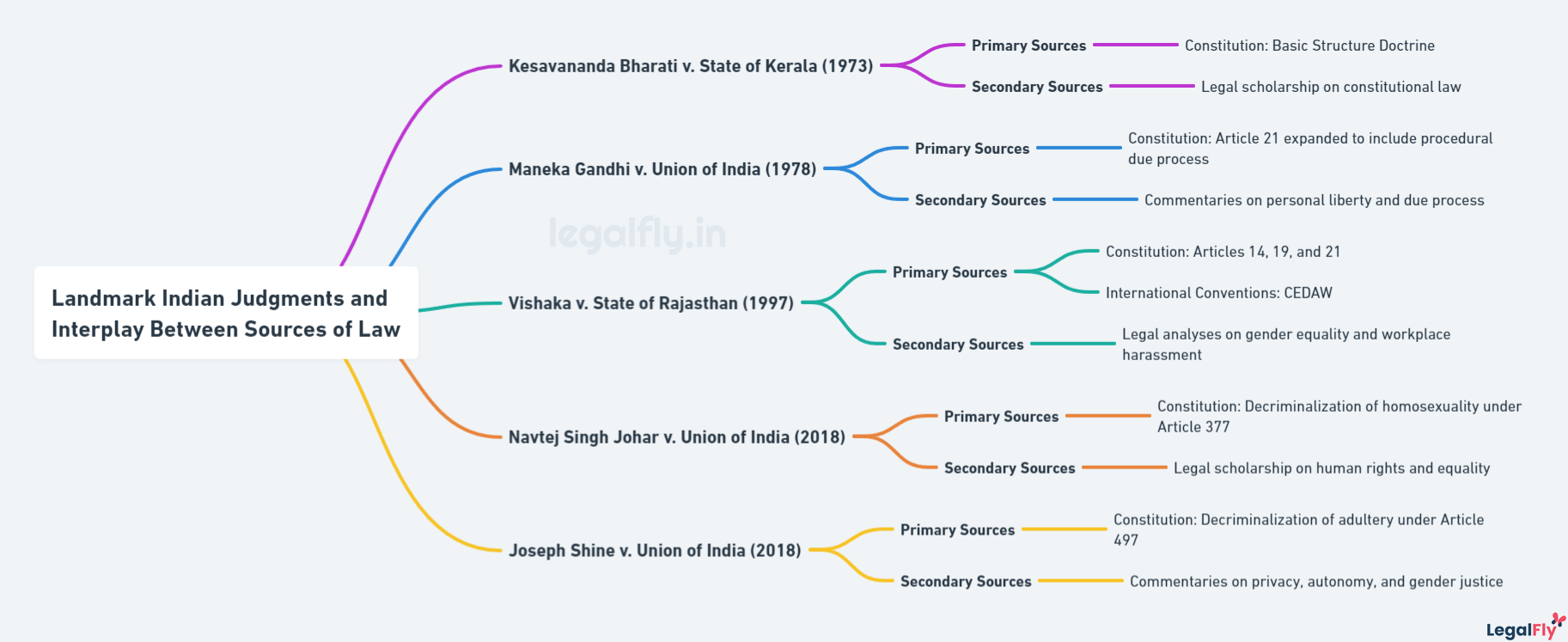
Indian jurisprudence is full of judgments where courts drew on several sources at once. The cases below show how primary sources are interpreted, expanded and sometimes reshaped with the help of secondary sources.
Kesavananda Bharati v. State of Kerala (1973)
In Kesavananda Bharati v. State of Kerala (1973), the Supreme Court held that Parliament cannot alter the "basic structure" of the Constitution. The Constitution was the primary source, while scholarly writing on constitutional law served as secondary support. The decision confirmed the Constitution's place as the supreme, living source of law in India.
Maneka Gandhi v. Union of India (1978)
In Maneka Gandhi v. Union of India, the Court widened Article 21 to include procedural due process and the right to live with dignity. It showed how secondary sources — commentaries on personal liberty and due process — can help reinterpret the Constitution, a primary source, to better protect individual rights against arbitrary State action.
Vishaka v. State of Rajasthan (1997)
In the Vishaka v. State of Rajasthan case, with no statute yet covering workplace sexual harassment, the Court drew on primary sources (Constitution Articles 14, 19 and 21) and an international convention (CEDAW), supported by secondary writing on gender equality, to frame the Vishaka Guidelines. Those guidelines later became the Sexual Harassment of Women at Workplace (Prevention, Prohibition and Redressal) Act, 2013 — an example of judge-made law turning into legislation.
Navtej Singh Johar v. Union of India (2018)
In Navtej Singh Johar v. Union of India, the Court read down Section 377 of the then Indian Penal Code to decriminalise consensual same-sex relations. The Constitution's guarantees of privacy, dignity and equality were the primary source, supported by secondary scholarship on human rights. (The IPC has since been replaced by the Bharatiya Nyaya Sanhita, 2023.)
Joseph Shine v. Union of India (2018)
In Joseph Shine v. Union of India (2018), the Court struck down Section 497 of the then Indian Penal Code, which criminalised adultery, as unconstitutional. The ruling rested on the constitutional values of equality, dignity and privacy, informed by commentary on autonomy and gender justice — another instance of a primary source being reinterpreted to change long-standing law.
Comparative Analysis of Legal Systems in Jurisprudence
Legal systems around the world fall into broad families. The two largest are civil law and common law.
Civil Law vs. Common Law Systems
Civil law systems originated in continental Europe and are based on Roman law. They rely heavily on codified statutes and written codes, and judges play a relatively limited role in interpreting them.
Common law systems developed in England and rely on judicial precedent and case law. Here judges play a central role in interpreting and refining the law, and oral argument and judicial discretion carry more weight. India is largely a common-law system, with codified statutes layered on top.
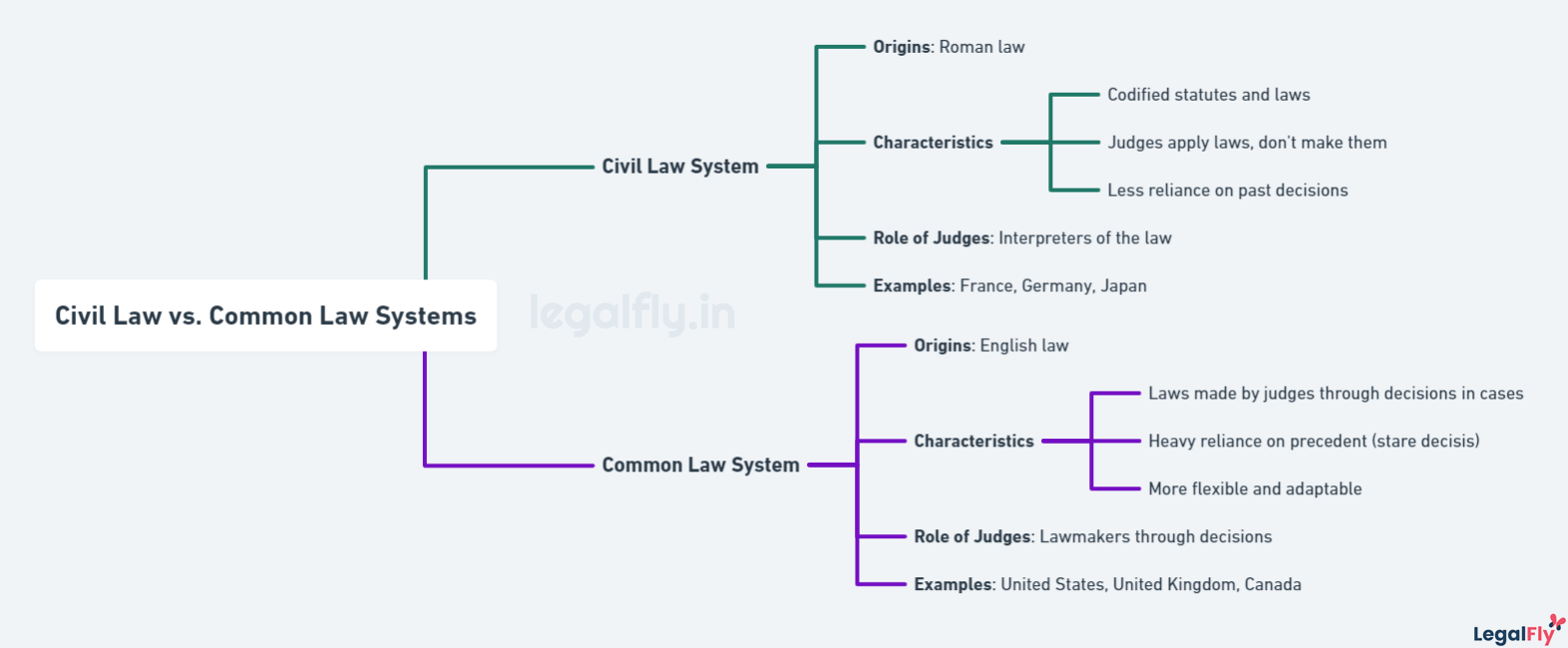
Key differences include adversarial versus inquisitorial proceedings, the reasoning style of judgments, and flexibility versus rigidity in interpretation.
The Influence of Religious Laws in Jurisprudence
Religious law has shaped many legal systems. Islamic law (sharia) guides legal systems in many Muslim-majority countries; Jewish law (halakha) has influenced Israeli law; and Hindu law, Christian canon law and Buddhist principles have all left their mark. In India, religion-based personal laws still govern much of marriage, divorce and inheritance.
While secular codes and statutes have largely superseded religious law, its influence remains significant. Debates over the balance between religious and State law — and between individual rights and community duties — continue to shape these systems.
Modern Developments in the Sources of Law
International law and treaties now play a major part. Once ratified, treaties create binding obligations and often become part of domestic law; regional instruments like the European Convention on Human Rights have reshaped legal systems across borders. International law increasingly influences national rules on human rights, trade and the environment.
The digital revolution has also transformed how law is found and used. Legislation and case law are now available instantly through government portals and legal databases, making research faster and access wider. The flip side is information overload, which puts a premium on good search skills and the ability to tell reliable sources from unreliable ones.
Conclusion: The Evolving Nature of Legal Sources
The sources of law are where legal rules and principles come from. Primary sources — constitutions, legislation, precedent and custom — set the binding framework. Secondary sources like scholarship and commentary explain and interpret it. Tertiary sources serve as reference and research aids.
In practice, courts weave these together according to the case, following a clear hierarchy when they conflict: the Constitution prevails, then valid legislation, then precedent and custom. Comparative jurisprudence shows the balance shifts between traditions — codes dominate in civil-law systems, precedent in common-law ones.
These sources are dynamic, not static. As society changes — and as international law and technology grow more influential — new ways of making and finding law will keep emerging. But the foundational trio of constitution, legislation and precedent will remain the pillars on which legal systems rest.