
Case Summary: Union of India v. Sankalchand Himatlal Sheth

In short
Five-judge constitution bench (3:2 majority, 19 Sep 1977) held that "consultation" with the CJI under Art 222 is not a mere formality — the CJI's opinion carries primacy and judicial independence (a basic feature) limits the executive's transfer power. Superseded for appointments by the collegium cases (1993, 1998) but the basic-structure principle remains foundational.
In this brief
Overview
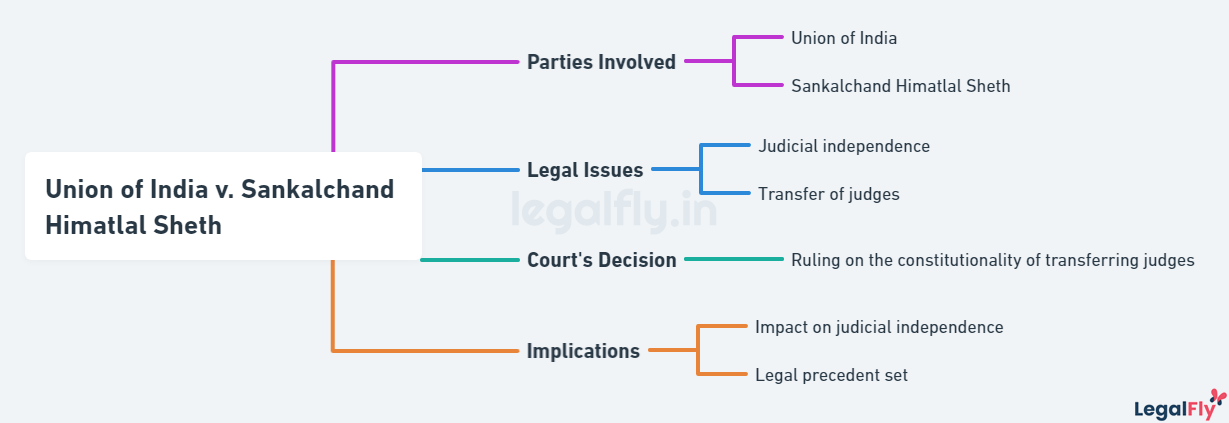
Union of India v. Sankalchand Himatlal Sheth, AIR 1977 SC 2328 / (1977) 4 SCC 193, is the Supreme Court's first major ruling on the scope of the executive's power to transfer High Court judges under Article 222 of the Constitution. The five-judge constitution bench held (3:2) that "consultation" with the Chief Justice of India in that article is not a rubber-stamp formality — the CJI's opinion carries primacy, and the judiciary's independence (a basic feature of the Constitution) constrains the executive from making arbitrary or punitive transfers.
Key Facts at a Glance
| Aspect | Detail |
|---|---|
| Citation | AIR 1977 SC 2328; (1977) 4 SCC 193 |
| Date of judgment | 19 September 1977 |
| Bench | Five-judge constitution bench (3:2 majority) |
| Provision at issue | Article 222(1), Constitution of India — transfer of High Court judges |
| Facts | Justice Sheth (Gujarat HC) transferred to Andhra Pradesh HC without his consent by Presidential order (27 May 1976); he challenged the transfer under Art 32 |
| Key holding | CJI's opinion carries primacy in transfer matters; transfers must not be arbitrary or punitive; judicial independence is a basic feature |
Background and Facts
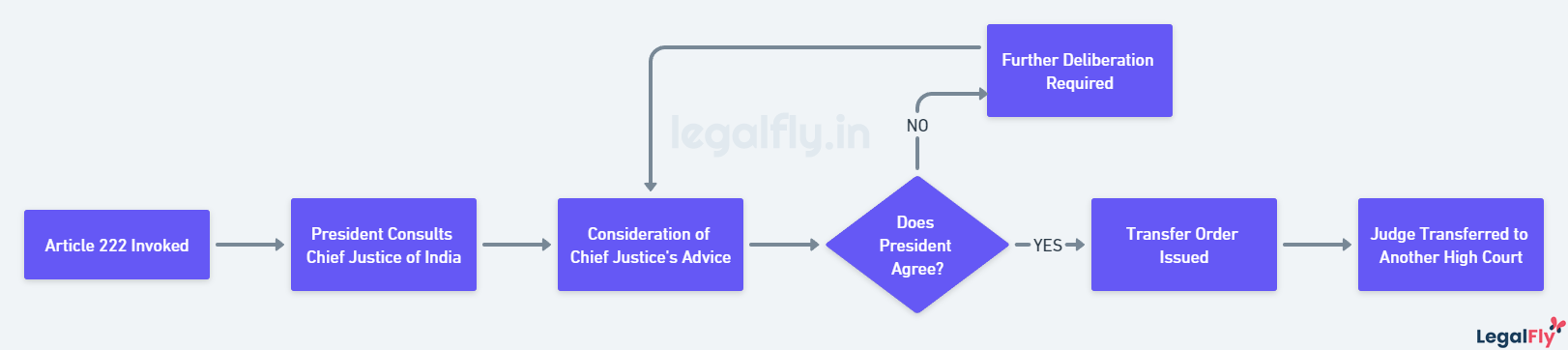
On 27 May 1976, the President of India issued a notification under Article 222(1) of the Constitution transferring Justice Sankalchand Himatlal Sheth from the Gujarat High Court to the Andhra Pradesh High Court. The order recited that it was issued "after consultation with the Chief Justice of India." Justice Sheth was directed to join the Andhra Pradesh High Court within four weeks.
Justice Sheth complied with the order — he reported to the Andhra Pradesh HC — but before assuming office he filed a writ petition in the Gujarat High Court challenging the constitutional validity of the transfer. The Gujarat HC dismissed his petition. The case came to the Supreme Court on appeal.
Article 222 — Transfer of Judges
Article 222(1) of the Constitution provides: "The President may, after consultation with the Chief Justice of India, transfer a Judge from one High Court to any other High Court." The article says nothing about: (a) what that consultation must comprise, (b) whether the transferred judge's consent is required, (c) the grounds on which a transfer may be made, or (d) the role of judicial independence as a limiting principle.
Issues Raised
- Is the "consultation" with the CJI under Art 222 a mere formality, or must it be effective and meaningful?
- Does the CJI's opinion carry primacy over the executive's preference?
- Can a judge be compulsorily transferred without any cogent reason in the public interest?
- Does judicial independence — as a basic feature of the Constitution — limit the executive's transfer power?
Supreme Court's Decision (3:2 Majority)
The constitution bench upheld Justice Sheth's challenge and set aside the transfer order. The majority's key propositions:
- Consultation must be meaningful: The word "consultation" in Art 222 does not mean the CJI is to be merely informed. The President must genuinely seek and give proper weight to the CJI's opinion. A consultation in which the CJI's view is routinely overridden would be illusory.
- CJI's opinion carries primacy: In matters of judicial transfers, the CJI's assessment of a judge's fitness, conduct, and the administrative needs of the courts is entitled to primary weight. The executive cannot override it without compelling reasons.
- Judicial independence is a basic feature: The independence of the judiciary — including security of tenure and freedom from arbitrary transfer — is part of the basic structure of the Constitution. Article 222 must be interpreted consistently with this constraint.
- Transfers must not be punitive: A transfer that is intended to punish a judge for inconvenient decisions, or that is made arbitrarily without public-interest justification, is constitutionally impermissible.
Subsequent Developments — The Collegium Journey
Sankalchand was the first case to assert the judiciary's primacy in transfer matters, but the law evolved significantly through a series of landmark cases:
| Case | Key shift |
|---|---|
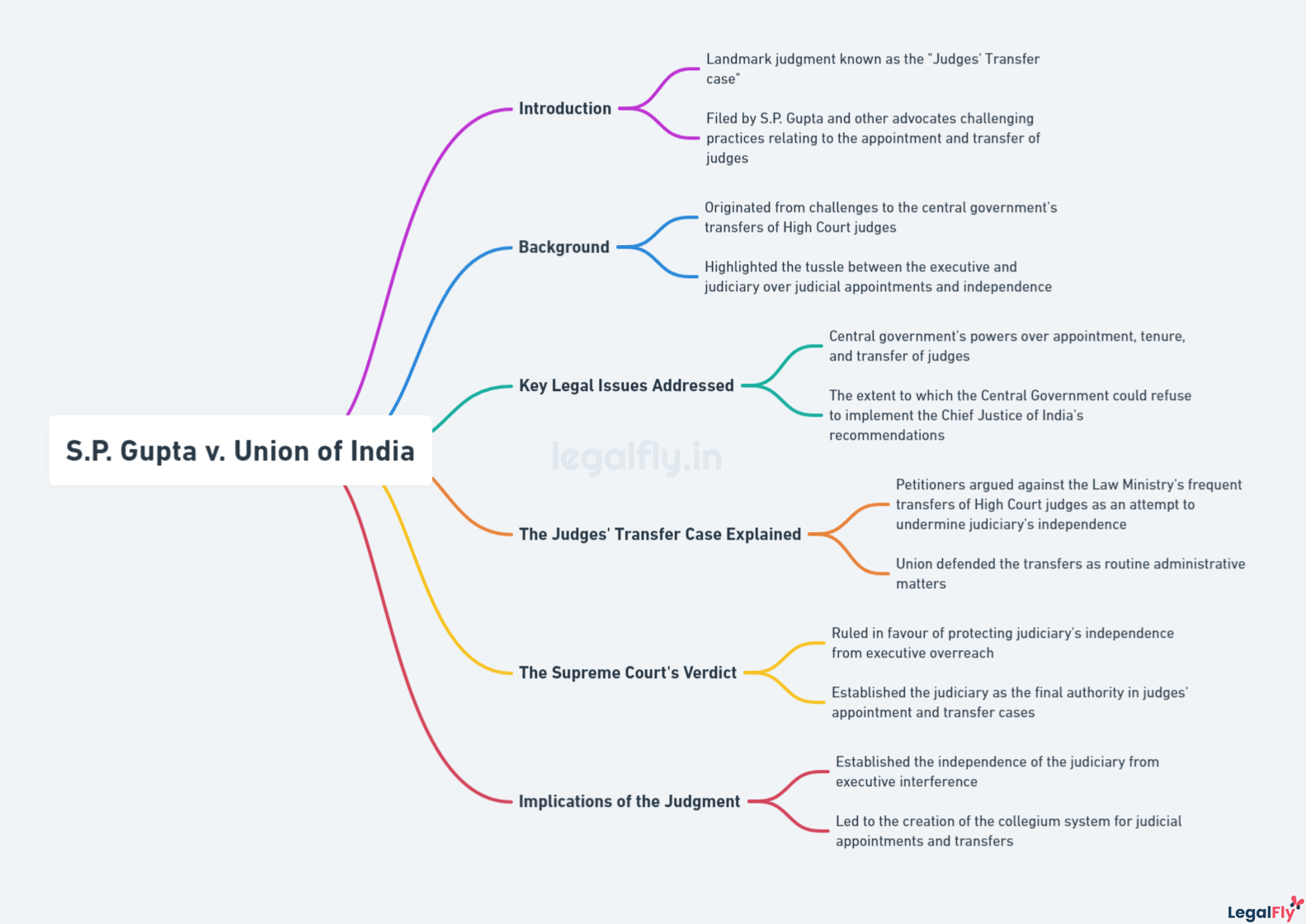
| S.P. Gupta v. Union of India (1981) — First Judges Case | Seven-judge bench (4:3) held that "consultation" in Arts 124/217/222 does not mean "concurrence" — the executive retains primacy; CJI's view is important but not binding. Partially retreated from Sankalchand on executive primacy for appointments. |
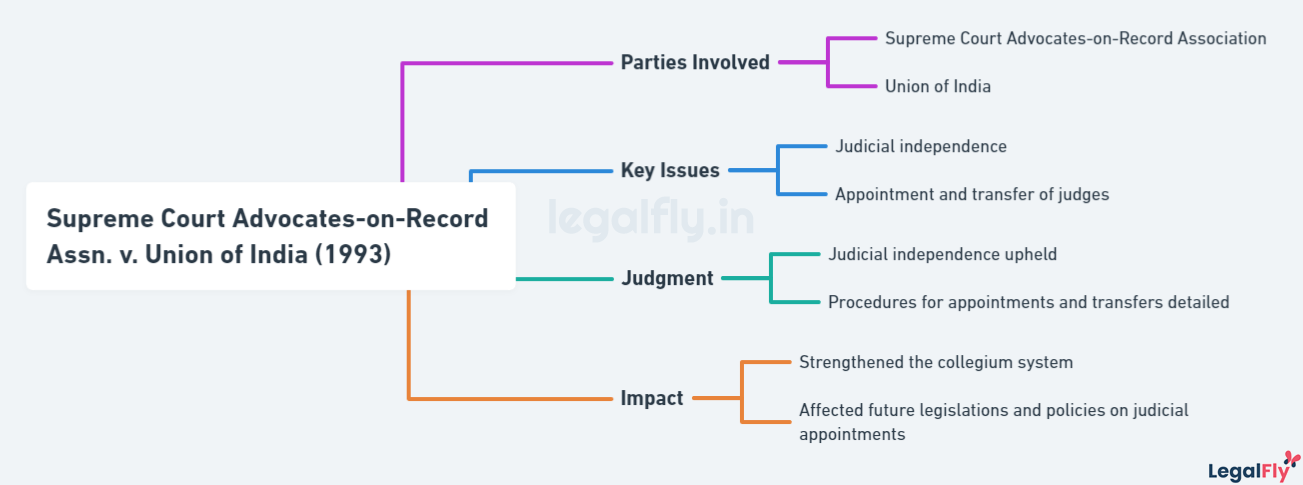
| Supreme Court Advocates-on-Record Assn. v. Union of India (1993) — Second Judges Case | Nine-judge bench (7:2) overruled S.P. Gupta on appointments: held CJI's opinion IS binding for appointments (Art 217); established the collegium system (CJI + 2 senior-most SC judges). Executive primacy rejected for appointments. |
| In re Special Reference No. 1 of 1998 — Third Judges Case | Nine-judge advisory opinion extended collegium to transfers under Art 222: collegium for transfers = CJI + 4 senior-most SC judges; their collective recommendation is binding on the executive. |
Current Position on Judicial Transfers
After the Third Judges Case (1998), transfers of High Court judges are governed by the following framework:
- The collegium of the Supreme Court (CJI + 4 senior-most judges) recommends transfers; the executive must act on that recommendation.
- The executive can return a recommendation for reconsideration once; if the collegium reiterates, the executive is bound.
- The individual judge's consent is not a constitutional requirement, but the collegium takes it into account as one of several factors (other factors: anti-corruption rationale, administrative exigency, disciplinary grounds).
- The basic-structure principle from Sankalchand — that arbitrary or punitive transfers are unconstitutional — continues to apply.
Significance
Sankalchand's lasting contribution is threefold:
- It planted the basic-structure flag on judicial independence in transfer matters. Even though S.P. Gupta (1981) partly reversed Sankalchand's executive-primacy outcome, the principle that arbitrary/punitive transfers are unconstitutional as a basic-structure violation survived and was reaffirmed in 1993 and 1998.
- It began the "consultation means more than mere consultation" jurisprudence that eventually produced the collegium system — arguably the most distinctive feature of India's judicial appointment and transfer regime.
- It exemplifies the Emergency-era judicial pushback. The transfer order was made in 1976, during the Emergency. The Supreme Court's willingness to read structural limits into bare constitutional text was a significant post-Emergency reassertion of judicial independence.
Conclusion
Union of India v. Sankalchand Himatlal Sheth (1977) is the foundational precedent for the principle that the executive's power under Article 222 is not untrammelled — the Chief Justice of India's opinion carries primacy, and judicial independence as a basic feature of the Constitution restrains punitive or arbitrary transfers. The case triggered the judicial-appointments jurisprudence that culminated in the collegium system (Second and Third Judges Cases). Although the collegium's collective decision (not individual judge's consent) now governs transfers, Sankalchand's core constitutional insight — that the judiciary must not be subordinated to executive will in transfer matters — remains the bedrock of that entire structure.