
Section 498A IPC (Now Section 85 BNS): Cruelty Explained
In this article
- Introduction to Section 498A
- Overview of the Law
- Section 498A IPC to BNS: quick mapping
- The Role of Section 498A in Protecting Women
- Controversies and Criticisms
- Key Legal Cases Involving Section 498A
- Sushil Kumar Sharma v. Union of India (2005)
- Arnesh Kumar v. State of Bihar (2014)
- Rajesh Sharma v. State of U.P. (2017)
- Social Action Forum for Manav Adhikar v. Union of India (2018)
- Safeguards against misuse: timeline
- Current Status of Section 498A
- Statistics on Section 498A Enforcement and Outcomes
- Conclusion
Introduction to Section 498A
Section 498A of the Indian Penal Code was inserted in 1983 as part of criminal-law reforms to address cruelty against married women by their husbands and in-laws. It was a direct response to the rising number of dowry-related deaths, harassment and suicides in the early years of marriage, at a time when there was no dedicated penal provision for cruelty within the matrimonial home.
Important update: The Indian Penal Code has been replaced by the Bharatiya Nyaya Sanhita, 2023 (BNS), in force from 1 July 2024. Section 498A IPC now continues, in substantially identical language, as Section 85 BNS, while the definition of "cruelty" sits separately in Section 86 BNS. Offences committed before 1 July 2024 are still tried under the IPC; the substance of the offence is unchanged.
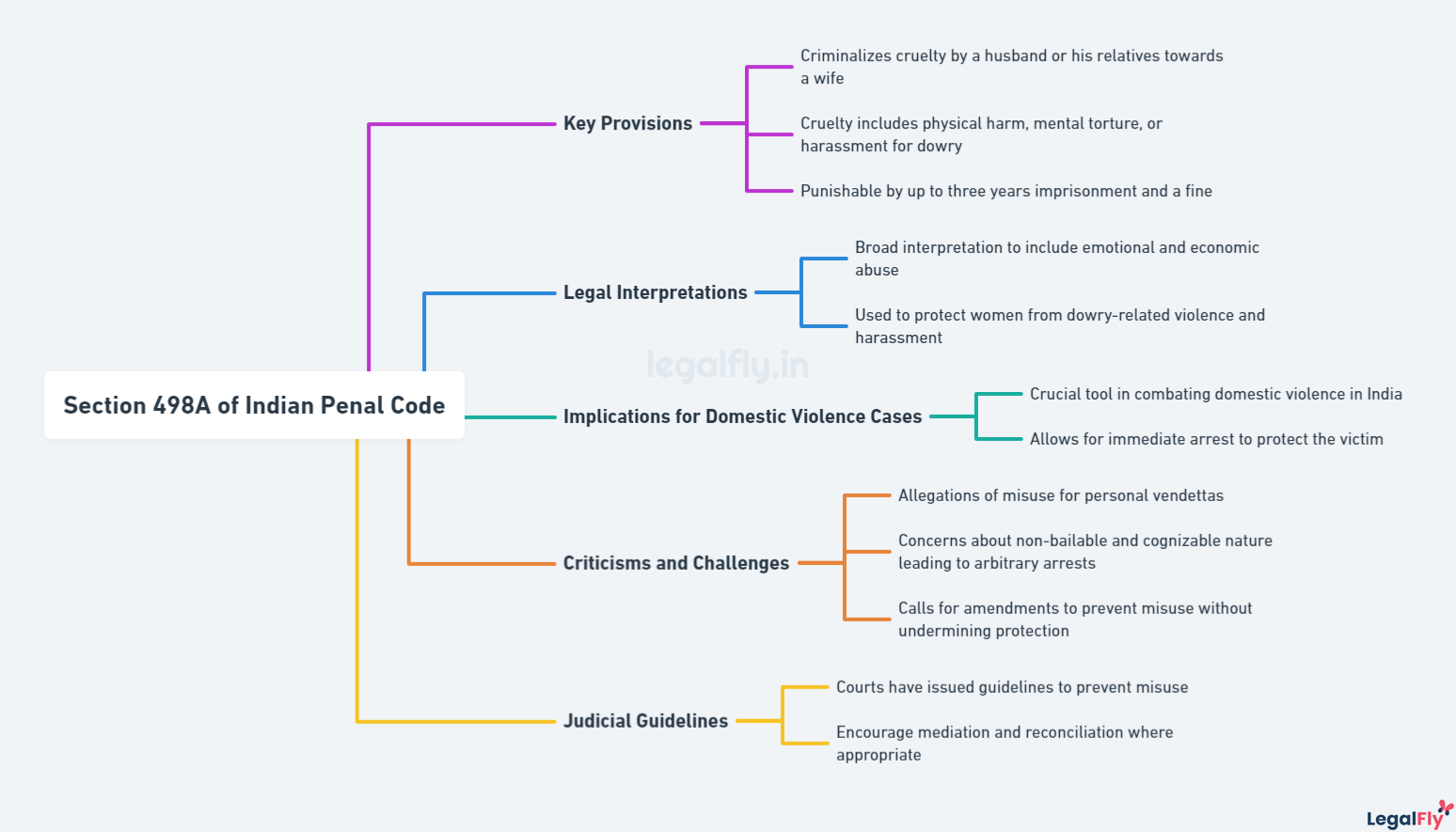
The provision makes it a criminal offence for a husband or his relatives to subject a married woman to cruelty. The offence is cognizable (police may register and investigate without a magistrate's order), non-bailable and, as a rule, non-compoundable (it cannot simply be "settled" out of court, subject to limited judicial exceptions).
Overview of the Law
Section 85 BNS (formerly Section 498A IPC) punishes a husband or a relative of a husband who subjects a married woman to cruelty. The maximum sentence is imprisonment up to three years, and the offender is also liable to a fine.
The meaning of "cruelty" is set out separately in Section 86 BNS (formerly the Explanation to Section 498A IPC) through a two-limb test:
| Limb | What counts as "cruelty" |
|---|---|
| (a) Conduct endangering the woman | Any wilful conduct of such a nature as is likely to drive the woman to suicide, or to cause grave injury or danger to her life, limb or health — whether mental or physical. |
| (b) Harassment for an unlawful demand | Harassment of the woman where it is aimed at coercing her, or any person related to her, to meet an unlawful demand for property or valuable security (i.e. dowry), or because she or her relatives have failed to meet such a demand. |
"Cruelty" is therefore wider than dowry harassment alone — sustained mental cruelty can attract the section even where no dowry demand is made. Courts have held that the conduct must be serious and "wilful"; ordinary wear-and-tear of married life is not enough.
Section 498A IPC to BNS: quick mapping
Most of the related provisions have moved into the new criminal codes. The wording is largely carried forward, so the older case law continues to apply.
| Subject | Old law (repealed) | New law (in force from 1 July 2024) |
|---|---|---|
| Cruelty by husband or his relatives | Section 498A IPC | Section 85 BNS |
| Definition of "cruelty" | Explanation to Section 498A IPC | Section 86 BNS |
| Dowry death | Section 304B IPC | Section 80 BNS |
| Presumption of abetment of suicide | Section 113A, Indian Evidence Act 1872 | Section 117, Bharatiya Sakshya Adhiniyam 2023 |
| Presumption as to dowry death | Section 113B, Indian Evidence Act 1872 | Section 118, Bharatiya Sakshya Adhiniyam 2023 |
| Notice instead of automatic arrest | Section 41A, CrPC 1973 | Section 35, Bharatiya Nagarik Suraksha Sanhita 2023 |
The Dowry Prohibition Act, 1961 continues to operate alongside these provisions and remains the principal statute prohibiting the giving or taking of dowry.
The Role of Section 498A in Protecting Women
Section 498A (now Section 85 BNS) was enacted to give married women a criminal-law remedy against abuse in the matrimonial home. Its main objectives are to:
- Provide legal protection to married women against cruelty, domestic violence and dowry harassment.
- Deter marital cruelty by criminalising both psychological and physical abuse.
- Cover not just physical violence but sustained mental cruelty and coercive dowry demands.
- Give effect to the constitutional guarantee of equality and dignity for women.
Since 1983 the provision has allowed many women to seek legal recourse against abuse, raised awareness of marital rights, and signalled that cruelty against a wife is a punishable crime rather than a private family matter. It works alongside civil remedies such as the Protection of Women from Domestic Violence Act, 2005, which offers protection orders, residence and maintenance — but Section 85 BNS itself is a criminal offence, not a civil remedy.
Controversies and Criticisms
The provision has long been controversial. Critics argue it is sometimes misused to pressure a husband and his extended family, for example to force a favourable divorce or financial settlement. Common concerns include:
- The offence being cognizable and non-bailable, which historically enabled arrests before any meaningful investigation.
- The absence of a strong penalty for demonstrably false complaints.
- The broad definition of cruelty, which can be difficult to apply consistently.
Reported "misuse" rates vary enormously between studies and should be treated with caution. Women's-rights advocates counter that genuine cruelty remains widespread and under-reported, and that diluting the section would weaken protection for real victims. The policy debate is about balancing safeguards for the accused with protection for victims — not about removing the offence, which the Supreme Court has upheld as constitutional.
Key Legal Cases Involving Section 498A
Several Supreme Court judgments have shaped how the section is applied. The most influential are summarised below; their procedural safeguards apply equally to Section 85 BNS.
Sushil Kumar Sharma v. Union of India (2005)
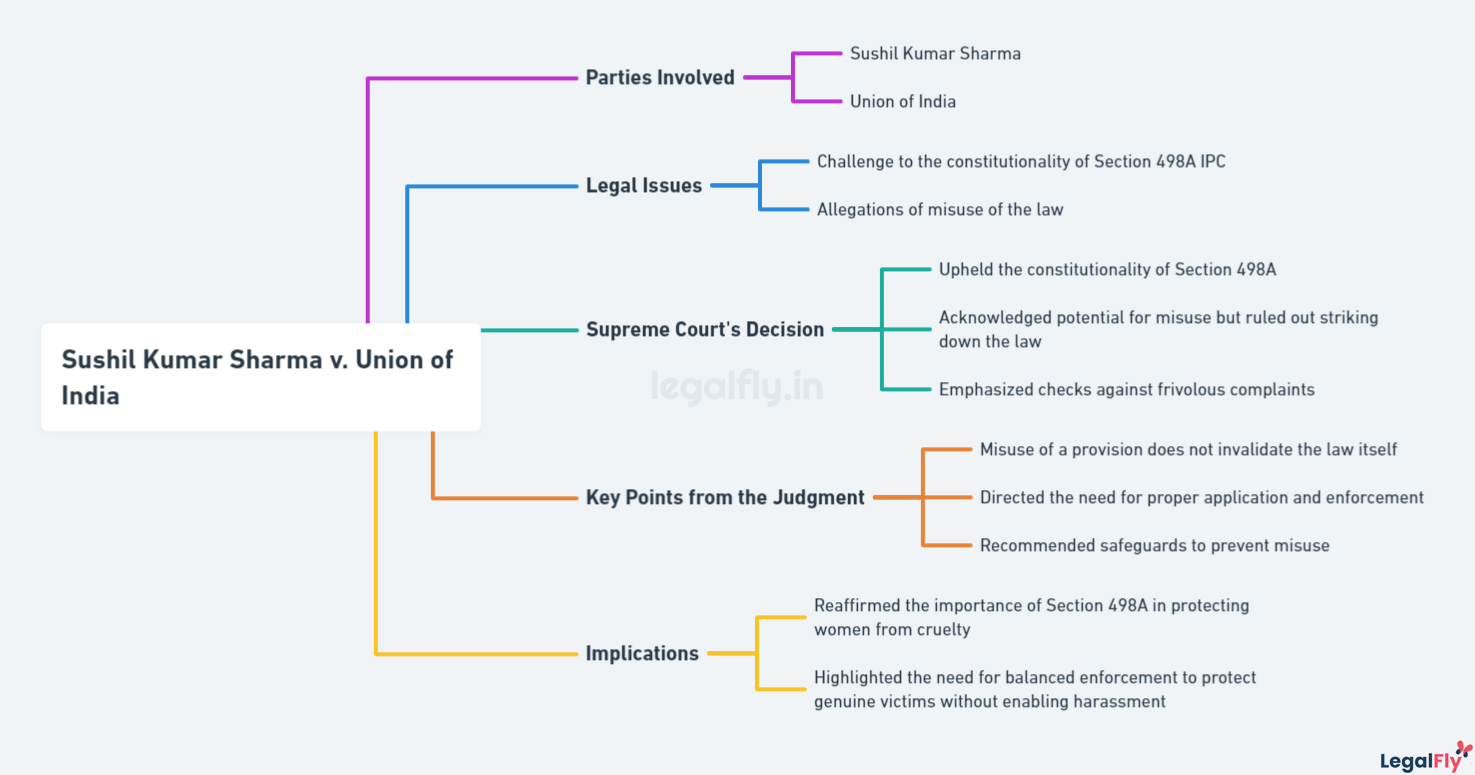
The Supreme Court upheld the constitutional validity of Section 498A, holding that the mere possibility of abuse of a provision does not make it unconstitutional. It is in this judgment that the Court famously cautioned that misuse of the law could amount to "legal terrorism", while making clear that the answer lay in preventing abuse, not striking down the section.
Arnesh Kumar v. State of Bihar (2014)
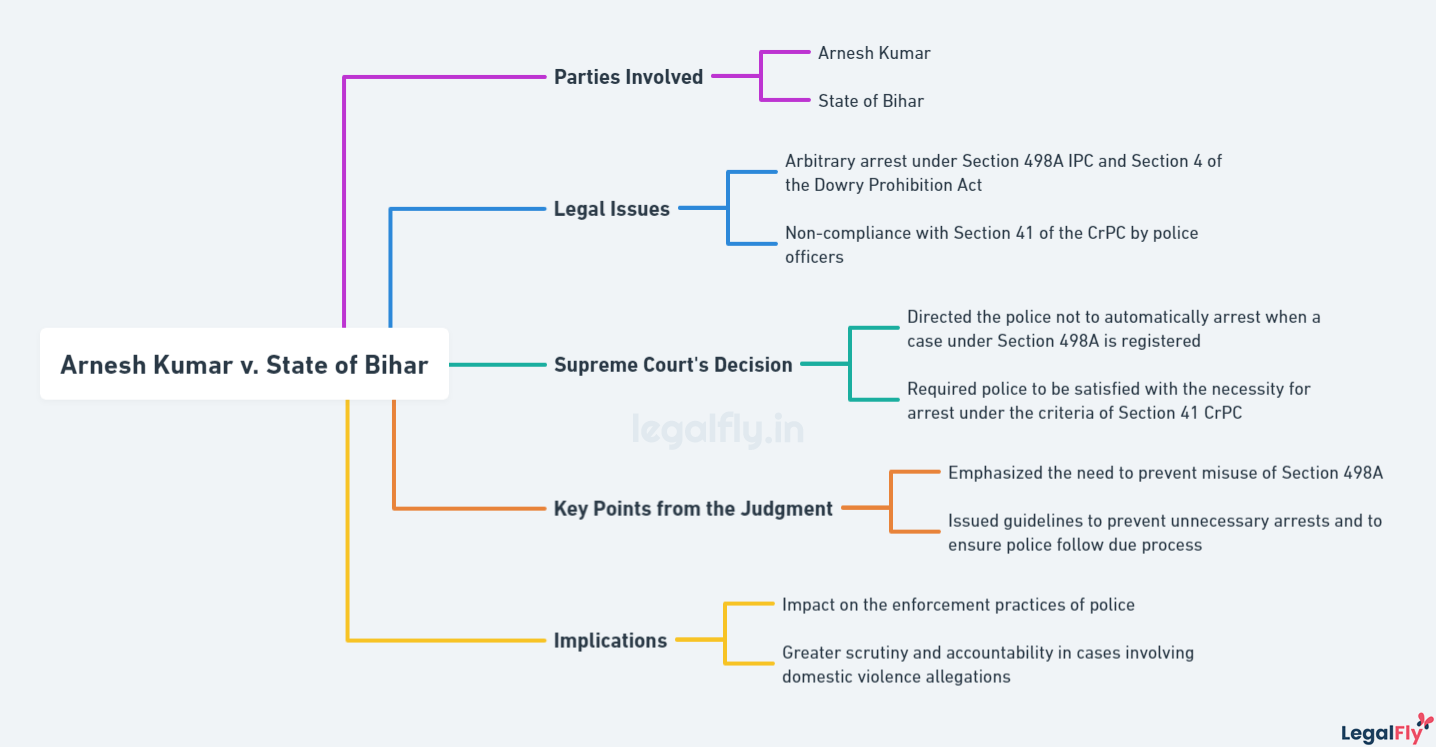
A landmark ruling on arrest. For offences punishable with up to seven years' imprisonment — which includes Section 498A — the Court held that there must be no automatic arrest. Police must first record reasons showing arrest is genuinely necessary under Section 41 CrPC, and otherwise issue a notice of appearance under Section 41A CrPC (now Section 35 BNSS). These "Arnesh Kumar guidelines" remain the leading safeguard against reflexive arrests in 498A/85 BNS cases.
Rajesh Sharma v. State of U.P. (2017)
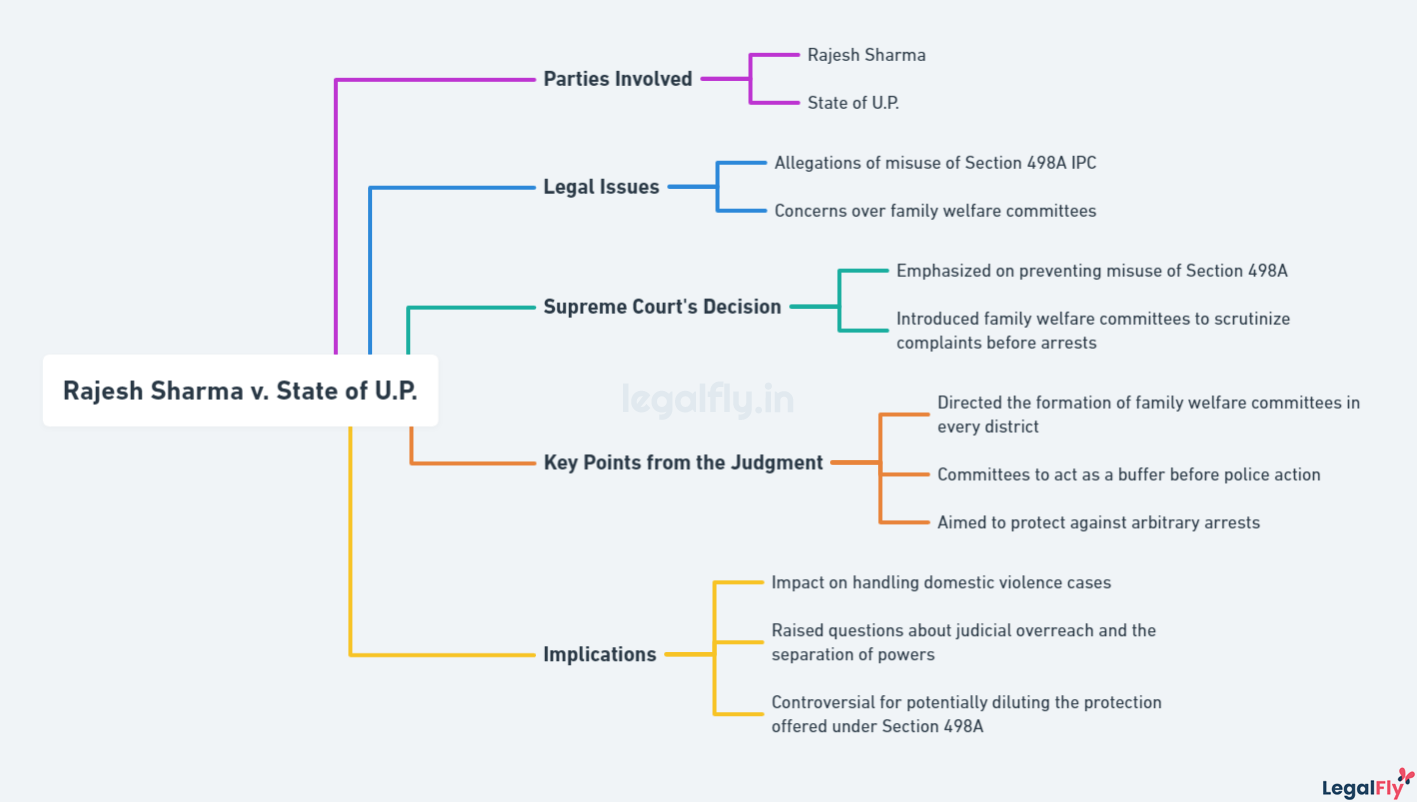
To curb perceived misuse, the Court directed that every district set up a Family Welfare Committee (FWC) to examine 498A complaints before any arrest, with no arrest to be made until the committee reported. These directions are no longer in force — they were substantially overruled the following year (see below).
Social Action Forum for Manav Adhikar v. Union of India (2018)
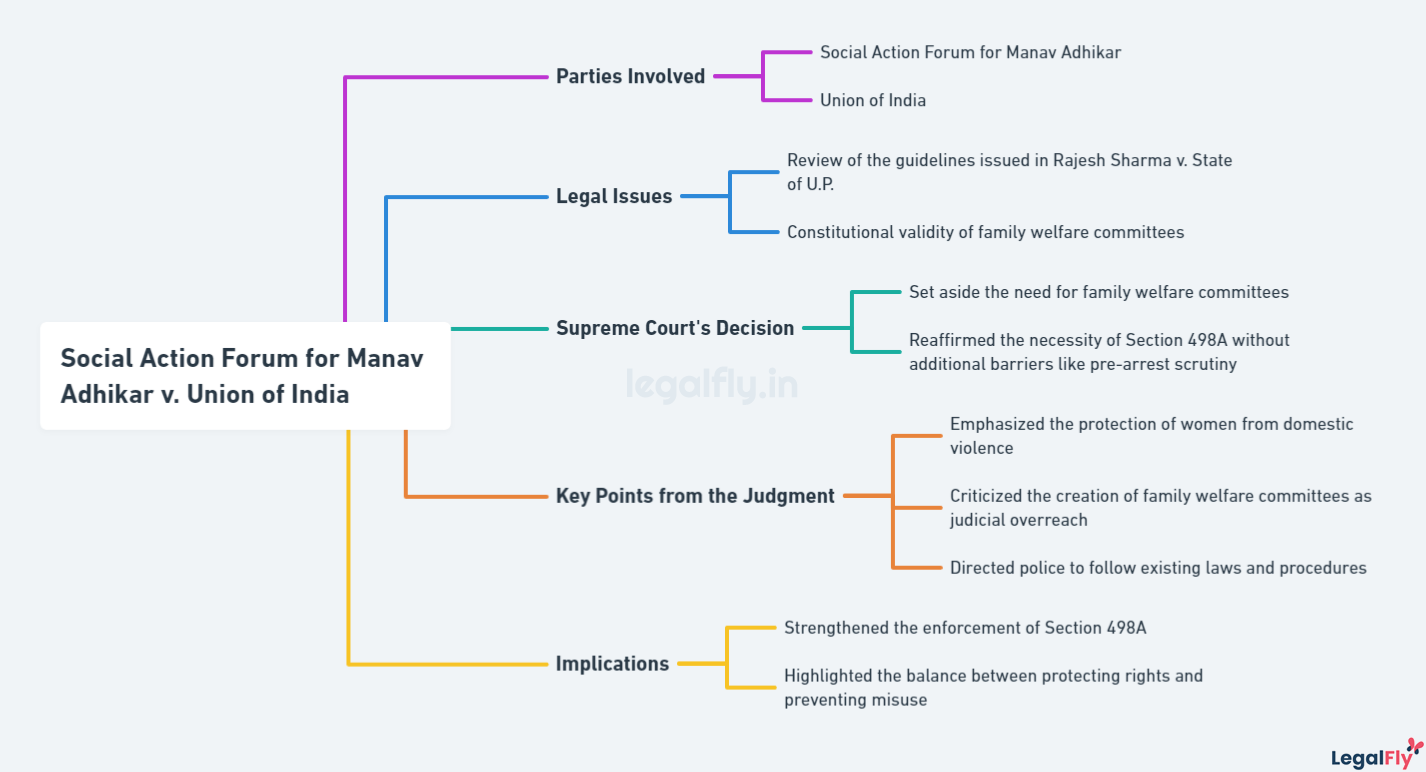
A three-judge bench scrapped the Family Welfare Committee mechanism created in Rajesh Sharma. The Court held that such committees were an extra-judicial body with no legal standing and could not be interposed into the statutory criminal process. The Arnesh Kumar arrest safeguards survived; the FWC filter did not. So, contrary to a common misconception, Family Welfare Committees are not a current requirement in 498A/85 BNS cases.
Safeguards against misuse: timeline
| Year | Case | Effect — still good law? |
|---|---|---|
| 2005 | Sushil Kumar Sharma | Section 498A held constitutionally valid. Still good law. |
| 2014 | Arnesh Kumar | No automatic arrest; notice under §41A CrPC (now §35 BNSS). Still good law. |
| 2017 | Rajesh Sharma | Required Family Welfare Committees to vet complaints. Overruled in 2018. |
| 2018 | Social Action Forum for Manav Adhikar | Struck down the FWC mechanism; retained the Arnesh Kumar safeguards. Current position. |
Current Status of Section 498A
The current position can be summarised as follows:
- The offence continues as Section 85 BNS (with cruelty defined in Section 86 BNS) from 1 July 2024, in substantially the same terms as the old Section 498A IPC.
- Arrest is not automatic. Police must justify arrest under Section 35 BNSS (formerly Section 41A CrPC), following the Arnesh Kumar guidelines.
- Family Welfare Committees are not mandatory. The 2017 FWC directions were set aside in 2018 and do not apply.
- The offence remains non-compoundable as a rule. It cannot simply be "settled" between the parties; in appropriate cases, however, High Courts may quash proceedings on a genuine settlement using their inherent powers.
Related dowry provisions also continue: a dowry death (Section 304B IPC, now Section 80 BNS) carries a minimum of seven years and up to life imprisonment where a woman dies in unnatural circumstances within seven years of marriage after dowry-related cruelty, supported by the statutory presumption now found in Section 118 of the Bharatiya Sakshya Adhiniyam, 2023.
Statistics on Section 498A Enforcement and Outcomes
Enforcement data has long shown a gap between cases filed and convictions secured. Analyses of National Crime Records Bureau (NCRB) figures indicate that the conviction rate under Section 498A fell over the 2000s and 2010s even as overall conviction rates for other offences rose, while large numbers of cases remained pending. Acquittal rates in cases that reached trial were consistently high, and the registration of fresh FIRs declined noticeably after the Supreme Court tightened arrest norms in 2014.
These trends are read in different ways: critics cite high acquittals as evidence of misuse, while others point to weak investigation, hostile witnesses, out-of-court pressure and delay as reasons genuine complaints fail. Up-to-date figures under the new BNS framework are still emerging.
Conclusion
Section 498A IPC — now Section 85 BNS, with "cruelty" defined in Section 86 BNS — remains a central protection for married women against cruelty and dowry harassment in India. Its substance is unchanged by the 2023 criminal-law overhaul; what has changed are the section numbers and the surrounding procedural code.
The provision sits in a careful judicial framework: upheld as constitutional in 2005, fitted with strong anti-arbitrary-arrest safeguards in 2014, and freed of the short-lived Family Welfare Committee filter in 2018. The debate over balancing protection for victims with fairness to the accused will continue, but the offence — and the safeguards around it — are firmly part of India''s criminal law.
This article is general legal information about Indian law, not legal advice. For any specific situation, consult a qualified advocate.