
Chapter 1 of the Bharatiya Nyaya Sanhita 2023: Explained
In this article
Introduction
The Bharatiya Nyaya Sanhita, 2023 (BNS) is India''s new penal code. It replaces the colonial-era Indian Penal Code, 1860, which had governed criminal conduct for over 163 years. The BNS is one of three new criminal laws that came into force on 1 July 2024 — alongside the Bharatiya Nagarik Suraksha Sanhita, 2023 (BNSS), which replaces the Code of Criminal Procedure, and the Bharatiya Sakshya Adhiniyam, 2023 (BSA), which replaces the Indian Evidence Act.
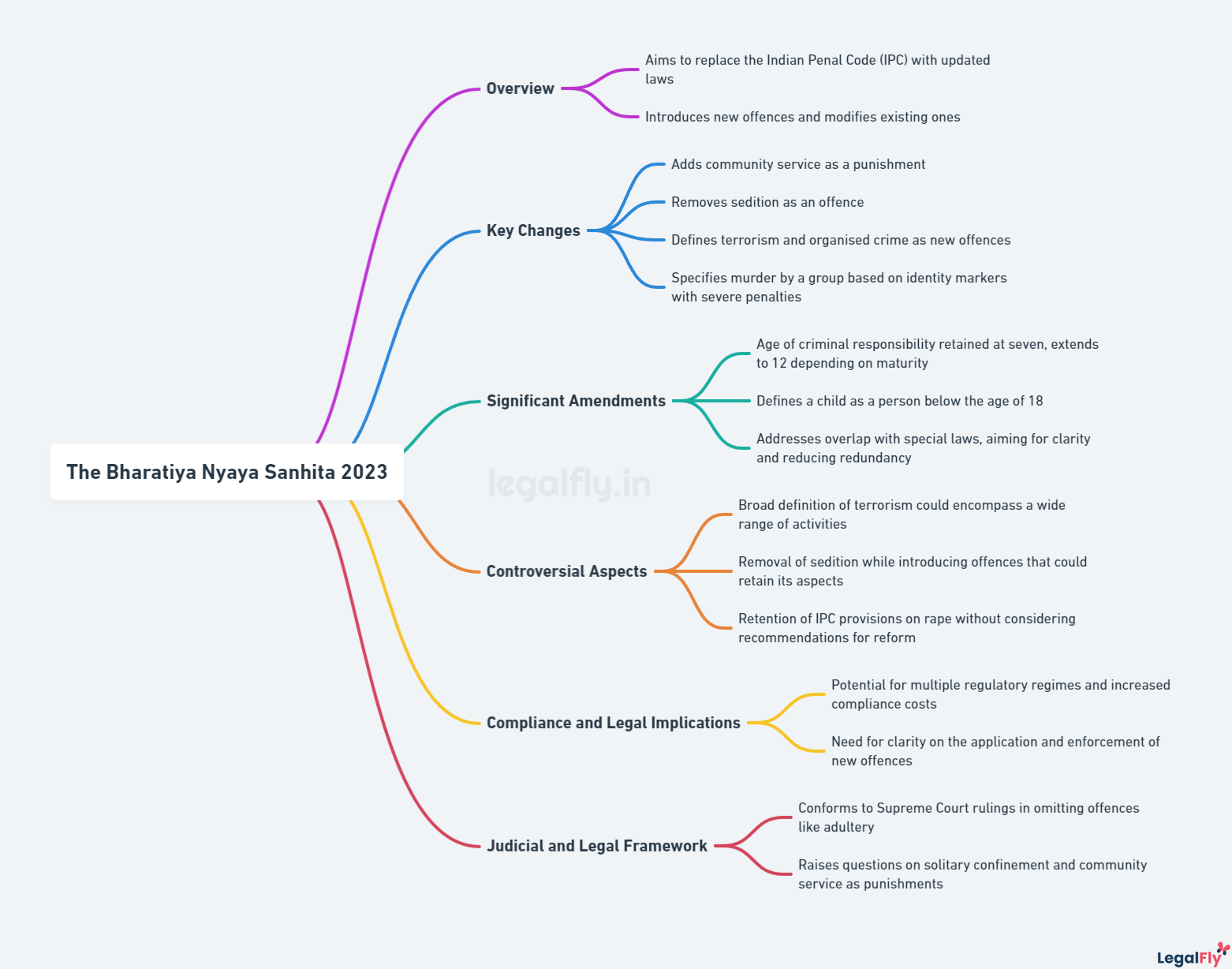
The BNS is shorter and re-organised compared with the IPC: it has 358 sections across 20 chapters (the IPC had 511 sections). It is important to be precise about scope — the BNS is the substantive penal law (what is a crime and its punishment); criminal procedure is dealt with by the BNSS, and evidence by the BSA.
| Old law (colonial-era) | New law (2023, in force 1 July 2024) | Deals with |
|---|---|---|
| Indian Penal Code, 1860 | Bharatiya Nyaya Sanhita, 2023 (BNS) | Offences and punishments |
| Code of Criminal Procedure, 1973 | Bharatiya Nagarik Suraksha Sanhita, 2023 (BNSS) | Criminal procedure |
| Indian Evidence Act, 1872 | Bharatiya Sakshya Adhiniyam, 2023 (BSA) | Evidence |
We have a separate detailed study guide on the Bharatiya Nyaya Sanhita, 2023 covering the Act''s purpose and history; this article focuses on Chapter 1 (the "Preliminary" chapter), Sections 1 to 3.
Overview of Chapter 1 (Preliminary)
Chapter 1 contains Sections 1 to 3 and sets up the framework for the whole code — its name and commencement, where and to whom it applies, the definitions used throughout, and the general explanations that govern how the rest of the Act is read.
- Section 1 — short title, commencement, territorial extent and extra-territorial application.
- Section 2 — definitions of the terms used in the Act.
- Section 3 — general explanations on how those terms and the offences are to be interpreted.
Section 1 — Short title, commencement and application
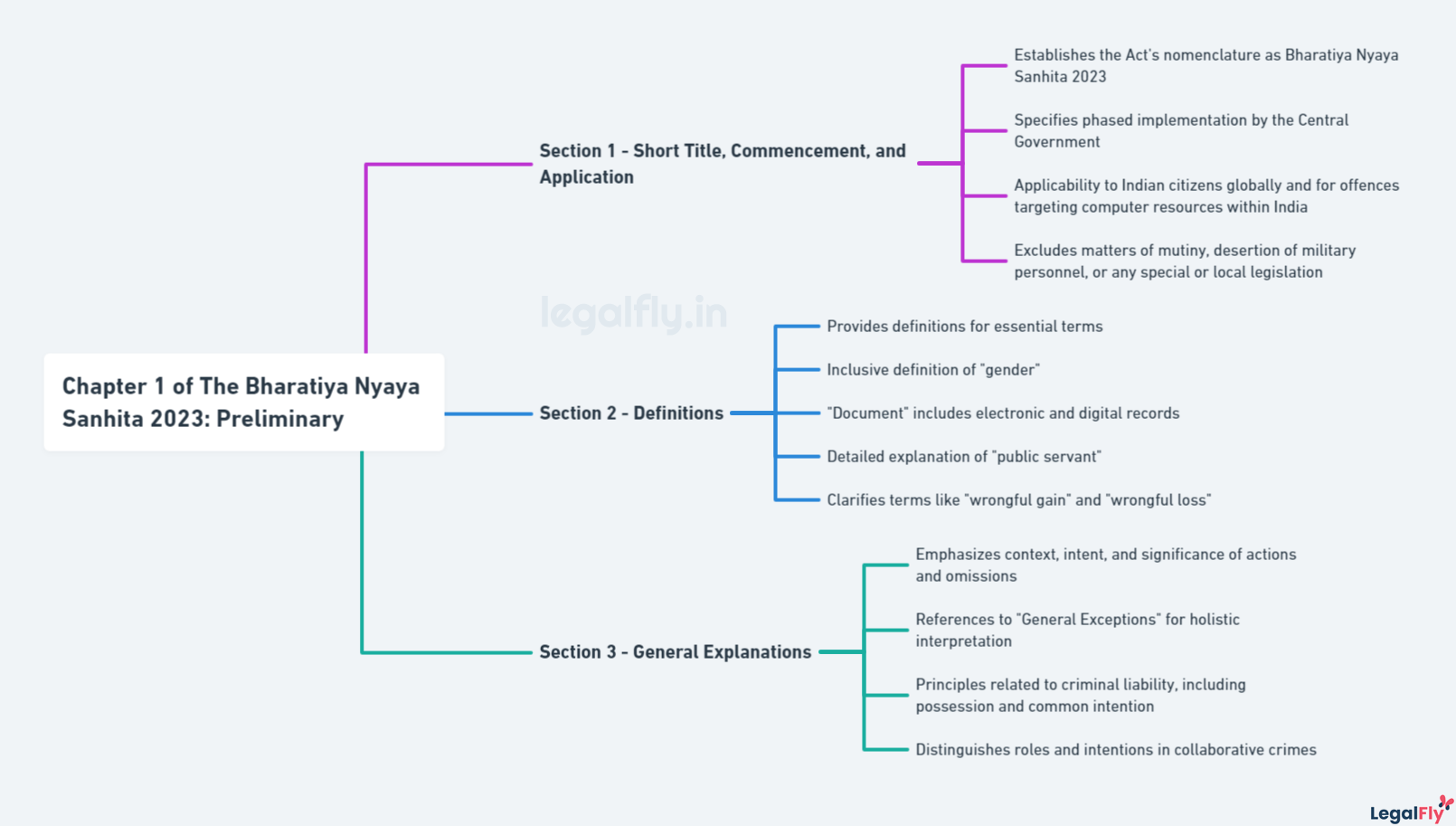
Section 1 gives the Act its name — the Bharatiya Nyaya Sanhita, 2023 — and provides that it came into force on the date notified by the Central Government, namely 1 July 2024. It extends to the whole of India.
Section 1 also sets out the Act''s extra-territorial reach. The BNS applies to:
- any offence committed within India by any person;
- offences committed outside India by an Indian citizen, anywhere;
- offences committed on any ship or aircraft registered in India, wherever it may be; and
- offences committed by any person (even outside India) targeting a computer resource located in India — recognising modern cyber-crime.
Where a person is liable under Indian law for an offence committed abroad, the BNS applies as if the act had been committed within India. Section 1 also preserves special and local laws and the laws dealing with the mutiny and desertion of the armed forces, so those specialised regimes are not disturbed.
Section 2 — Definitions
Section 2 is the Act''s glossary. It defines the terms used throughout — from basic words like "act", "omission" and "animal" to legal concepts such as "counterfeit", "dishonestly", "fraudulently", "wrongful gain" and "wrongful loss" — so that the offences in later chapters are read consistently.
Several definitions reflect deliberate modernisation of the old IPC:
- "Gender": the pronoun "he" and its derivatives apply to any person, whether male, female or transgender (Section 2(10)) — the IPC recognised only male and female.
- "Child": the BNS provides a uniform definition — a child is a person below the age of eighteen years (Section 2(3)), which the IPC lacked.
- "Document": expressly includes electronic and digital records, keeping the law current with the digital age.
- "Public servant": defined broadly to cover a wide range of officials, marking the Act''s extensive reach.
Section 3 — General explanations
Section 3 tells the reader how to interpret the rest of the Act, consolidating several general-explanation provisions of the old IPC into one place. Its key points are:
- Read with the General Exceptions: every definition, penal provision and illustration is subject to the exceptions in the chapter on "General Exceptions". So an act is not an offence if it falls within an exception — for example, an act of a very young child (under seven years is wholly exempt), or an act a public servant is bound by law to do.
- Acts and omissions: a criminal act can be committed by a positive act, by an illegal omission, or by a combination of both — for instance, where neglect together with a physical act causes a victim''s death.
- Common intention: where a criminal act is done by several persons in furtherance of a common intention, each is liable as if he did it alone (the principle formerly in Section 34 IPC, now in Section 3(5) BNS).
- Possession: a person is treated as in possession of things possessed on his behalf by another, such as a spouse, clerk or servant.
- Different offences from one act: different participants in the same act may be guilty of different offences, according to their respective roles and intentions.
Taken together, Chapter 1 lays the groundwork for the entire Bharatiya Nyaya Sanhita — naming the law, fixing its reach in space and time, defining its vocabulary, and setting the interpretive rules that apply to every offence that follows.