
Essential Elements of Tort: Meaning, Elements & Case Laws
In this article
- Meaning of Tort Law
- General Essentials of a Tort
- The Four Essential Elements of Negligence
- Duty of Care
- Breach of Duty
- Causation
- Damages
- Types of Torts and Their Essential Elements
- Intentional Torts: Deliberate Acts of Wrongdoing
- Negligence: Carelessness Causing Harm
- Strict Liability: Liability Without Fault
- Duty of Care Explained
- Establishing a Duty of Care
- The Reasonable Person Standard
- Breach of Duty and Its Implications
- Identifying a Breach of Duty
- Examples of Breach of Duty in Tort Cases
- Causation in Tort Law
- The "But For" Test for Factual Causation
- Proximate Causation and Legal Responsibility
- Damages
- Types of Damages
- Calculating Damages
- Critical Case Studies Illustrating the Essential Elements of Tort in India
- Jacob Mathew v. State of Punjab [(2005) 6 SCC 1]
- M.C. Mehta v. Union of India [(1987) 1 SCC 395]
- Indian Council for Enviro-Legal Action v. Union of India [(1996) 3 SCC 212]
- Bhim Singh v. State of J&K [(1985) 4 SCC 677]
- Conclusion: The Importance of Understanding Tort Law's Essential Elements
Meaning of Tort Law
Tort law is the branch of civil law that deals with civil wrongs that do not arise out of a contract. The word "tort" comes from the Latin tortum, meaning "twisted" or "wrong". Its purpose is to provide a remedy — usually compensation (damages) — to a person who has suffered harm because of someone else's wrongful act or omission.
In India there is no single codified "Tort Act"; tort law is largely judge-made (common) law, developed from English principles and adapted by Indian courts. The main aims of tort law are to:
- Compensate victims for the loss or injury they have suffered;
- Provide a fair, peaceful way to resolve disputes;
- Deter careless, dangerous or harmful conduct.
Unlike criminal law, which punishes the wrongdoer on behalf of the State, tort law focuses on compensating the injured party. It covers areas such as negligence, nuisance, defamation, trespass and product liability.
General Essentials of a Tort
Before looking at the elements of a specific tort like negligence, it helps to know what every tort needs. To constitute a tort, three general essentials must be present:
- A wrongful act or omission by the defendant;
- That causes legal damage (an injury to a legal right, known as injuria) to the plaintiff;
- For which the law provides a legal remedy in the form of an action for damages.
Two Latin maxims explain the crucial idea of "legal damage", and they are favourite exam topics:
- Injuria sine damno — legal injury without actual loss. This is actionable, because a legal right has been violated even if no money was lost. The classic case is Ashby v. White (1703), where a voter wrongly prevented from voting could sue even though his preferred candidate won anyway. The Indian counterpart is Bhim Singh v. State of J&K (1985), discussed below.
- Damnum sine injuria — actual loss without violation of any legal right. This is not actionable. In the Gloucester Grammar School case (1410), a schoolmaster who set up a rival school and drew pupils away (causing the existing school financial loss) was not liable, because no legal right had been infringed — lawful competition causes damage but no injuria.
This rests on the foundational maxim ubi jus ibi remedium — "where there is a right, there is a remedy."
The Four Essential Elements of Negligence
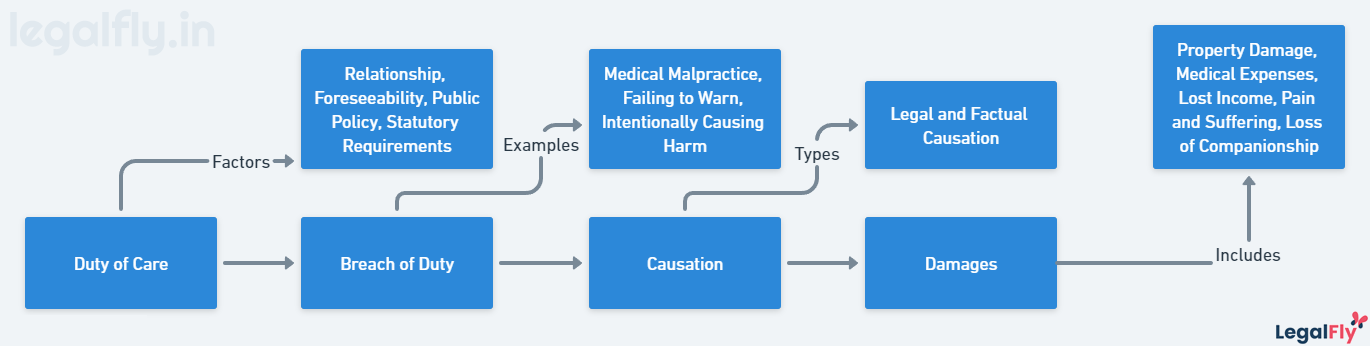
The most litigated tort is negligence, and it has its own four essential elements. To win a negligence claim, the plaintiff must establish all four: duty of care, breach of duty, causation, and damages. (These four are sometimes loosely called the "essential elements of tort", but strictly they are the elements of the tort of negligence.)
Duty of Care
The defendant must have owed the plaintiff a legal duty to take reasonable care. The modern duty of care was born in Donoghue v. Stevenson (1932) and its "neighbour principle". Whether a duty exists depends on factors like the relationship between the parties and the foreseeability of harm.
Breach of Duty
The defendant must have breached that duty by failing to act as a reasonably prudent person would in the circumstances. The plaintiff must show the conduct fell below the standard of care — for example, medical negligence, or failing to warn of a known danger.
Causation
The breach must have actually caused the plaintiff's injury. This involves both factual causation (the "but for" test) and legal/proximate causation (the harm was a foreseeable consequence of the breach).
Damages
The plaintiff must have suffered a real, quantifiable injury or loss — such as physical injury, property damage, medical expenses or lost income — as a direct and foreseeable result of the breach.
Types of Torts and Their Essential Elements
Torts fall into three broad categories, each with different requirements for liability:
- Intentional torts
- Negligence
- Strict (and absolute) liability
Intentional Torts: Deliberate Acts of Wrongdoing
Intentional torts occur when a person deliberately causes harm. Liability requires showing the defendant acted purposefully, knowing harm was likely. Key examples include:
- Battery: intentional physical contact with another person without consent, causing harm or offence.
- Assault: an act that makes someone reasonably fear an imminent battery.
- False imprisonment: unlawfully restricting a person's freedom of movement.
- Trespass: entering another's land or interfering with their goods without lawful right.
- Defamation: a false statement that harms a person's reputation.
Negligence: Carelessness Causing Harm
Negligence is harm caused by failing to act as a reasonably prudent person would. It requires the four elements above: a duty of care, breach of that duty, causation, and actual damage. It is the basis of most personal-injury, medical-negligence and road-accident claims.
Strict Liability: Liability Without Fault
Strict liability holds a party responsible for certain harms regardless of fault or intent. It originates in the rule in Rylands v. Fletcher (1868) and typically covers product liability, the keeping of dangerous animals and abnormally dangerous activities. In India, the Supreme Court went further and developed an even stricter rule of absolute liability for hazardous enterprises (see M.C. Mehta below).
Duty of Care Explained
Duty of care is the first thing a plaintiff must establish in a negligence claim. It is the legal obligation to take reasonable care to avoid acts or omissions that could foreseeably injure others.
Establishing a Duty of Care
The plaintiff must show the defendant owed them a duty to act reasonably. Some relationships — doctor and patient, teacher and student, manufacturer and consumer — automatically create a duty. Beyond these, a duty arises wherever a reasonable person could foresee that their conduct might injure the plaintiff. If no duty exists, the negligence claim fails at the first step.
The Reasonable Person Standard
The law measures conduct against the "reasonable person" — a hypothetical, prudent individual of average care, knowledge and judgment. Falling short of what such a person would do amounts to a breach. Where the defendant holds special skills (a surgeon, an electrician), the standard rises to that of a reasonably competent member of that profession.
Breach of Duty and Its Implications
A breach of duty occurs when a person fails to meet the standard of care owed in the circumstances. To establish a breach, the plaintiff must show that a duty existed and that the defendant fell short of it.
Identifying a Breach of Duty
Courts ask whether the defendant's conduct met the standard expected of a reasonably prudent person in the same situation. If the conduct fell below that standard, there is a breach. Where no duty exists between the parties, there can be no breach.
Examples of Breach of Duty in Tort Cases
Common examples of breach in negligence cases include:
- A doctor failing to diagnose or treat a condition that a competent doctor would have caught.
- A driver causing an accident by driving while drunk or distracted.
- A property owner failing to fix or warn of a known hazard, leading to injury.
- A manufacturer releasing a defective product that injures consumers in normal use.
- An employer failing to provide proper safety equipment or training.
The plaintiff must then link that breach to the injury through causation — a breach alone, without resulting harm, is not enough.
Causation in Tort Law
Causation links the defendant's wrongdoing to the plaintiff's injury. It has two components: factual causation and proximate (legal) causation.
The "But For" Test for Factual Causation
Factual causation is tested by asking: would the injury have occurred but for the defendant's conduct? If the harm would not have happened without the breach, factual causation is established. For example, in a road-accident claim the plaintiff must show that but for the defendant's careless driving, the collision and injuries would not have occurred.
Proximate Causation and Legal Responsibility
Factual causation is not enough on its own. The plaintiff must also prove proximate (legal) cause — that the harm was a reasonably foreseeable consequence of the breach, and not too remote. Proximate cause keeps liability within fair limits, so a defendant is not held responsible for bizarre or wholly unforeseeable chains of events.
Damages
Damages are the monetary compensation awarded to the plaintiff for the loss and harm caused by the defendant's tort. They aim to put the injured party, as far as money can, in the position they would have been in had the tort not occurred.
Types of Damages
- Compensatory damages reimburse actual losses — medical expenses, lost income, property damage and other financial harm.
- Non-pecuniary (general) damages cover non-financial harm such as pain and suffering, loss of companionship and damage to reputation.
- Exemplary (punitive) damages are awarded not to compensate but to punish and deter especially outrageous conduct (as in Bhim Singh below).
- Nominal damages are a token sum awarded where a legal right was violated but little or no actual loss resulted (as in injuria sine damno).
Calculating Damages
To recover compensatory damages, the plaintiff must prove and document their losses with evidence such as medical records, bills and proof of income; expert witnesses (doctors, accountants) are often used to quantify them. Non-pecuniary damages cannot be calculated exactly and are assessed by the court based on the evidence and the circumstances of the case. In India these awards are made by the judge (India does not use juries), and in motor-accident matters by tribunals applying settled formulae.
Critical Case Studies Illustrating the Essential Elements of Tort in India
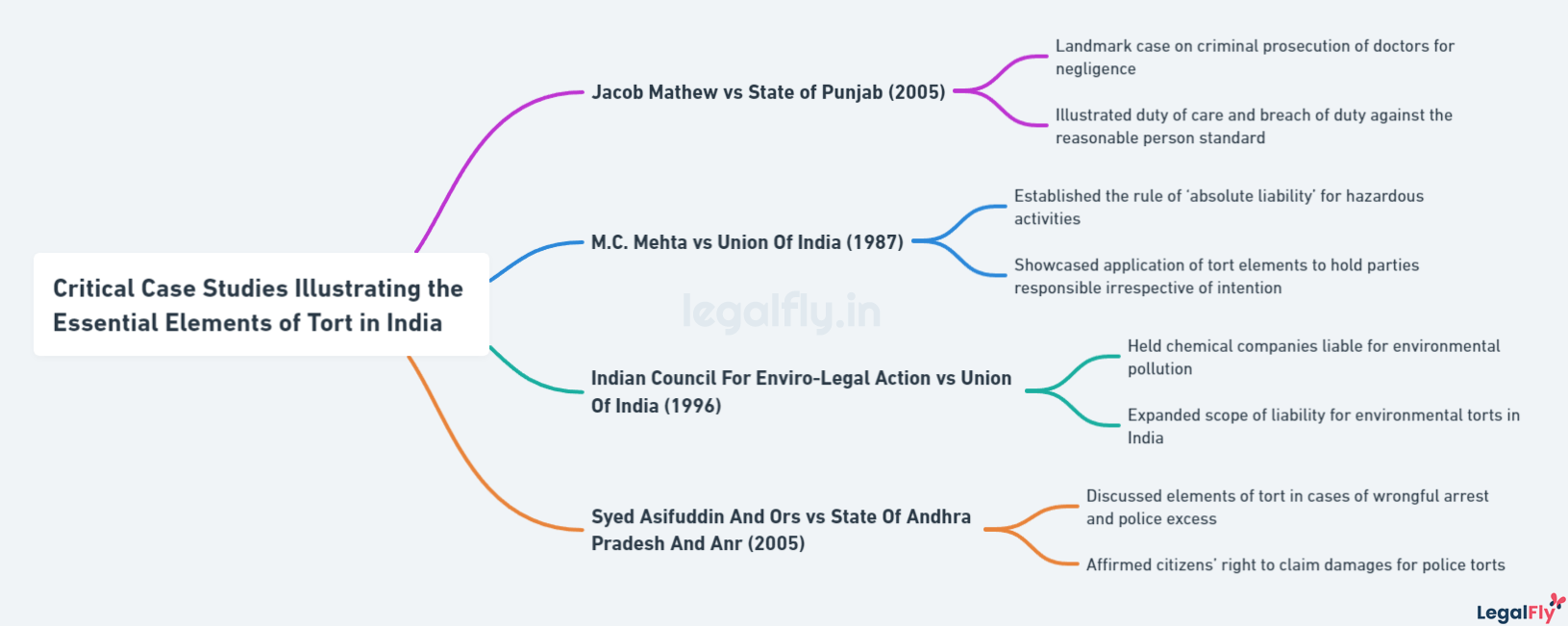
Indian courts have applied these elements — duty, breach, causation and damage — across a wide range of disputes. Four landmark cases show how.
Jacob Mathew v. State of Punjab [(2005) 6 SCC 1]
This Supreme Court decision set out the standard for medical negligence in India, adopting the English Bolam test: a doctor is not negligent if they acted in accordance with a practice accepted as proper by a responsible body of medical professionals. The Court also laid down safeguards before a doctor can be criminally prosecuted for negligence. It illustrates how duty of care and breach are judged against the reasonable (and skilled) person standard.
M.C. Mehta v. Union of India [(1987) 1 SCC 395]
Arising from the oleum gas leak from the Shriram Foods and Fertiliser Industries plant in Delhi (1985), this case established the Indian rule of absolute liability. The Court held that an enterprise carrying on a hazardous activity is absolutely liable for harm caused by an escape of a dangerous substance — with no exceptions (unlike the strict-liability rule in Rylands v. Fletcher). It also held that compensation should be linked to the size and capacity of the enterprise, so that it has a deterrent effect.
Indian Council for Enviro-Legal Action v. Union of India [(1996) 3 SCC 212]
In the "Bichhri village" case, chemical factories had discharged toxic waste that ruined soil and groundwater. The Supreme Court applied the polluter-pays principle and absolute liability, finding a duty of care, a breach through the negligent handling of hazardous waste, and causation of serious environmental damage — expanding liability for environmental torts in India.
Bhim Singh v. State of J&K [(1985) 4 SCC 677]
Bhim Singh, a sitting MLA, was wrongfully arrested and detained by the police and deliberately prevented from attending a session of the Legislative Assembly. The Supreme Court held this to be a clear case of false imprisonment and violation of personal liberty, and awarded exemplary damages of ₹50,000. The case is a textbook illustration of injuria sine damno — a legal wrong actionable even without proof of monetary loss — and of when courts award exemplary damages.
Together these cases show how duty, breach, causation and damage are the framework Indian courts use to decide liability and award fair remedies.
Conclusion: The Importance of Understanding Tort Law's Essential Elements
Tort law compensates those harmed by others' wrongful acts and deters careless or dangerous conduct. Its essentials work on two levels. Every tort needs a wrongful act, legal damage and a remedy — captured by the maxims injuria sine damno, damnum sine injuria and ubi jus ibi remedium. And the most important tort, negligence, has its own four elements: duty of care, breach, causation and damages.
For law students and practitioners alike, mastering this framework is what makes it possible to tell an actionable wrong from a mere loss, to build (or defend) a claim element by element, and to understand how Indian courts decide who must pay for the harm they cause.