
Administrative Law in India: Definition, Sources & Examples

In this article
- Definition of Administrative Law
- Administrative Law vs Constitutional Law
- Sources of Administrative Law in India
- 1. The Constitution of India
- 2. Delegated (Subordinate) Legislation
- 3. Administrative Directions and Circulars
- 4. Judicial Decisions (Precedent)
- 5. Statutory Tribunals
- Natural Justice
- Grounds of Judicial Review
- Landmark Cases in Indian Administrative Law
- Administrative Authorities in India: Examples
- Why Administrative Law Matters

Administrative law is the branch of public law that governs the organisation, powers, and procedures of administrative authorities — and the legal remedies available to individuals when those authorities act unlawfully. In India, it operates at the intersection of constitutional guarantees, delegated legislation, and the supervisory jurisdiction of the courts.
Its core purpose is to ensure that public power is exercised within the boundaries set by law, and that citizens have effective recourse when it is not.
Definition of Administrative Law
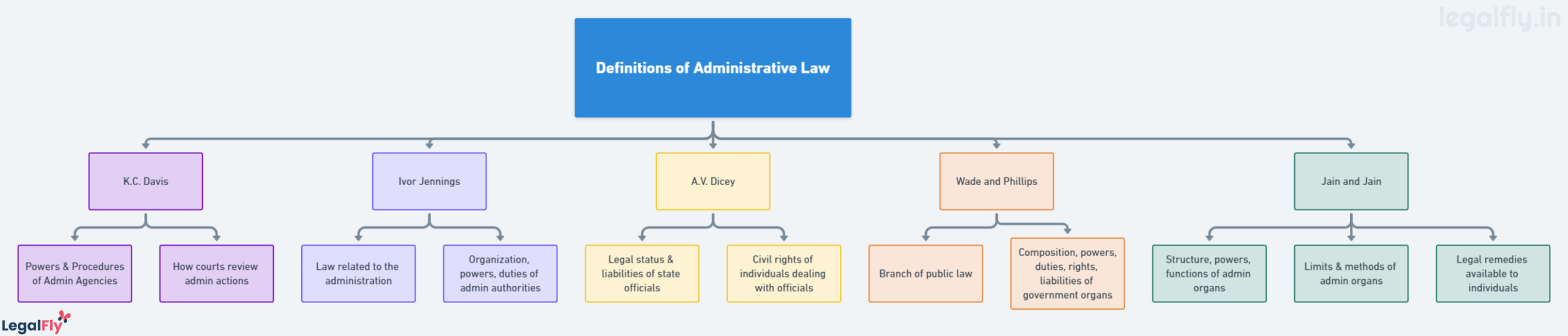
Several leading jurists have defined administrative law from different angles:
- K.C. Davis — administrative law deals with the powers and procedures of administrative agencies, including the law governing judicial review of agency action.
- Ivor Jennings — the law relating to the administration: the organisation, powers, and duties of administrative authorities (criticised for omitting remedies available to aggrieved individuals).
- Wade & Phillips — the branch of public law concerned with the composition, powers, duties, rights, and liabilities of the various organs of government engaged in administration.
- Jain & Jain — the law dealing with the structure, powers, and functions of administrative organs, the limits of their authority, the procedures they must follow, and the remedies available against unlawful action.
For Indian purposes, the Jain & Jain formulation is most useful: it captures both the institutional and the remedial dimensions that courts regularly engage with.
Administrative Law vs Constitutional Law
| Aspect | Constitutional Law | Administrative Law |
|---|---|---|
| Scope | Establishes the framework of government; defines Fundamental Rights | Regulates the day-to-day exercise of power by executive and statutory bodies |
| Primary concern | Structure of the State; relationship between State and citizen at the constitutional level | Procedure, accountability, and control of administrative action |
| Remedies | Arts 32 & 226 (writs); Art 13 (void laws) | Writs, statutory appeals, tribunals, damages for misfeasance |
| Source | The Constitution itself | Constitution + statutes + common law + judicial decisions |
In practice the two overlap substantially — most challenges to administrative action invoke both constitutional provisions (especially Arts 14, 19, and 21) and administrative law principles (natural justice, proportionality).
Sources of Administrative Law in India
Indian administrative law draws on several distinct sources:
1. The Constitution of India
The Constitution is the primary source. Key provisions include:
- Article 12 — defines "the State" broadly (Union, State governments, local authorities, and other instrumentalities), determining which bodies are subject to constitutional constraints.
- Article 13 — renders void any law inconsistent with Part III Fundamental Rights.
- Article 14 — equality before law and equal protection; prohibits arbitrary action by the State.
- Article 19 — freedoms of speech, movement, trade, etc., subject only to reasonable restrictions.
- Article 21 — right to life and personal liberty; after Maneka Gandhi v Union of India (1978), the procedure depriving these rights must itself be fair, just, and reasonable.
- Article 32 — Supreme Court's writ jurisdiction to enforce Fundamental Rights.
- Article 136 — Special Leave Petition to the Supreme Court from any court or tribunal.
- Article 226 — High Courts may issue writs not only for Fundamental Rights violations but for "any other purpose," giving them wider reach than the Supreme Court under Art 32.
- Article 300A — no person shall be deprived of property save by authority of law.
2. Delegated (Subordinate) Legislation
Parliament and State Legislatures routinely delegate rule-making power to the executive. Statutory rules, regulations, bye-laws, and notifications made under such authority are a major source of administrative law. Courts review whether delegated legislation stays within the parent Act (intra vires) and whether it complies with constitutional requirements.
3. Administrative Directions and Circulars
Circulars, policy guidelines, and executive instructions issued by ministries and departments have legal significance — they bind officials and, in appropriate cases, can be enforced by courts, particularly under Art 14 (legitimate expectation and non-arbitrariness).
4. Judicial Decisions (Precedent)
Much of Indian administrative law is judge-made. Landmark Supreme Court decisions have developed the principles of natural justice, the scope of judicial review, and the doctrine of legitimate expectation, filling gaps that no statute covers.
5. Statutory Tribunals
Specialist adjudicatory bodies — the Central Administrative Tribunal (Administrative Tribunals Act 1985), the National Green Tribunal, Securities Appellate Tribunal, and others — create their own body of practice and precedent. Their orders are subject to writ jurisdiction under Art 226, and ultimately to the Supreme Court under Art 136.
Natural Justice
Natural justice is not codified in a single Indian statute; it is a common law and constitutional principle woven into administrative law through judicial decisions. It comprises two rules:
- Audi alteram partem — hear the other side. An authority affecting a person's rights must give that person notice and a fair opportunity to be heard before deciding against them.
- Nemo judex in causa sua — no person should be a judge in their own cause. Decision-makers must be free from bias, both actual and apparent.
The pivotal case is A.K. Kraipak v Union of India, AIR 1970 SC 150. The Supreme Court held that the principles of natural justice apply not only to purely judicial proceedings but also to quasi-judicial and administrative functions whenever those functions affect rights or legitimate interests. This significantly broadened the reach of natural justice in India — prior to Kraipak, natural justice was largely confined to formal adjudicatory bodies.
Grounds of Judicial Review
Judicial review under Arts 32 and 226 is the principal mechanism for controlling administrative action in India. Courts do not substitute their judgment for that of the authority; they review the legality, rationality, and procedural fairness of the decision.
| Ground | What it means | Illustration |
|---|---|---|
| Illegality | The authority acted outside its statutory powers (ultra vires), or failed to exercise a power it was required to exercise | A licensing body imposes a condition its parent Act does not permit |
| Irrationality / Unreasonableness | The decision is so unreasonable that no reasonable authority, properly directing itself, could have made it (Wednesbury standard, still cited in older Indian judgments; increasingly replaced by proportionality) | Dismissing a government servant for a minor technical breach without any rational connection to the penalty |
| Proportionality | The means used must be proportionate to the legitimate aim pursued; courts examine whether a less drastic measure could have achieved the same result | After K.S. Puttaswamy v Union of India (2017), proportionality is applied to restrictions on rights, especially surveillance and data actions |
| Procedural Impropriety | The authority failed to follow the procedure required by statute or by natural justice | Passing an adverse order without giving the affected person an opportunity to be heard |
| Legitimate Expectation | A promise or consistent past practice by a public authority may create a legitimate expectation that a person will be treated in a certain way; defeating it without notice or reason is challengeable | A government contractor with a long-standing renewal practice being denied renewal without notice |
| Malice / Bad Faith | The power was exercised for an improper purpose or with personal bias | Using licensing power to target a political rival's business |
The scope of judicial review of administrative discretion was extensively discussed in Tata Cellular v Union of India, (1994) 6 SCC 651. The Supreme Court held that while courts can review the decision-making process for illegality and unreasonableness, they should not substitute their own judgment on the merits of a policy decision — especially in matters requiring technical or economic expertise.
Landmark Cases in Indian Administrative Law
- A.K. Kraipak v Union of India, AIR 1970 SC 150 — extended natural justice to quasi-judicial and administrative functions; a member of a selection committee who was also a candidate vitiated the entire selection.
- Maneka Gandhi v Union of India, (1978) 1 SCC 248 — the Supreme Court held that Arts 14, 19, and 21 ("the Golden Triangle") are not watertight compartments; a law or executive action must satisfy all three. The procedure depriving liberty must be fair, just, and reasonable — not merely any procedure prescribed by law.
- S.P. Gupta v Union of India, AIR 1982 SC 149 — expanded locus standi in PIL matters; any member of the public can approach the court where injury is suffered by a class of persons who cannot approach the court themselves.
- Olga Tellis v Bombay Municipal Corporation, (1985) 3 SCC 545 — the right to livelihood is part of the right to life under Art 21; pavement dwellers could not be evicted without due process.
- Shrilekha Vidyarthi v State of UP, (1991) 1 SCC 212 — Art 14 applies to government contracts; the State cannot act arbitrarily even in commercial dealings.
- Tata Cellular v Union of India, (1994) 6 SCC 651 — laid down the grounds and limits of judicial review of administrative discretion in economic/policy decisions.
Administrative Authorities in India: Examples
The following statutory bodies illustrate how administrative law structures public power:
- Telecom Regulatory Authority of India (TRAI) — established under the TRAI Act 1997; issues regulations, settles disputes between telecom operators, and makes recommendations on licensing. Its orders are subject to appeal before the Telecom Disputes Settlement & Appellate Tribunal (TDSAT) and judicial review under Art 226.
- Central Board of Direct Taxes (CBDT) — constituted under the Central Board of Revenue Act 1963; functions under the Ministry of Finance; issues circulars interpreting the Income Tax Act that bind tax officers.
- National Commission for Protection of Child Rights (NCPCR) — established under the Commissions for Protection of Child Rights Act 2005; operates under the Ministry of Women and Child Development.
- University Grants Commission (UGC) — established under the University Grants Commission Act 1956; exercises regulatory power over higher education institutions.
- Central Administrative Tribunal (CAT) — established under the Administrative Tribunals Act 1985; adjudicates service disputes of Central Government employees; subject to writ jurisdiction of High Courts under Art 226 (L. Chandra Kumar v Union of India, (1997) 3 SCC 261).
Why Administrative Law Matters
The modern State exercises vast powers — granting licences, allocating contracts, levying taxes, regulating professions, acquiring land, and making policy decisions that touch every aspect of daily life. Without a system of legal control, these powers could be exercised arbitrarily or in bad faith.
Administrative law provides that control through three mechanisms:
- Procedural fairness — natural justice ensures affected persons are heard before adverse decisions are made.
- Judicial review — courts check that authorities act within their powers and in accordance with constitutional requirements.
- Accountability — the threat of judicial review itself disciplines administrative action even when cases are never filed.
Art 226's writ jurisdiction is the primary vehicle through which Indian citizens invoke administrative law. Because it extends to "any other purpose" beyond Fundamental Rights, High Courts can intervene against statutory authorities, tribunals, public sector bodies, and other State instrumentalities — making Art 226 the broadest supervisory power in the Constitution.