
Olga Tellis v. Bombay Municipal Corporation (1985): Case Summary

In short
Olga Tellis v. Bombay Municipal Corporation (1985) is the case that read the "right to livelihood" into the right to life under Article 21. A five-judge bench unanimously held that you cannot deprive a person of their livelihood except by fair and reasonable procedure. Yet, in a famous paradox, the Court still upheld the Municipality's power to evict the Mumbai pavement dwellers — softening it only with directions for humane treatment.
In this brief
- Introduction to Olga Tellis v. Bombay Municipal Corporation
- Background of Olga Tellis v. Bombay Municipal Corporation
- Key Legal Issues Presented in the Case
- The Rights of Pavement Dwellers
- Supreme Court's Judgement and Reasoning
- Impact of the Olga Tellis Case
- Analyzing the Legal Arguments
- The Legacy of Olga Tellis Case
- Conclusion
Introduction to Olga Tellis v. Bombay Municipal Corporation
Olga Tellis v. Bombay Municipal Corporation (1985) is a landmark Supreme Court decision on the rights of Mumbai's pavement and slum dwellers. It is best known for one big idea: the right to life under Article 21 includes the right to livelihood.
The petitioners — journalist Olga Tellis and others, acting for the pavement dwellers — challenged the Bombay Municipal Corporation's drive to evict them and demolish their dwellings.
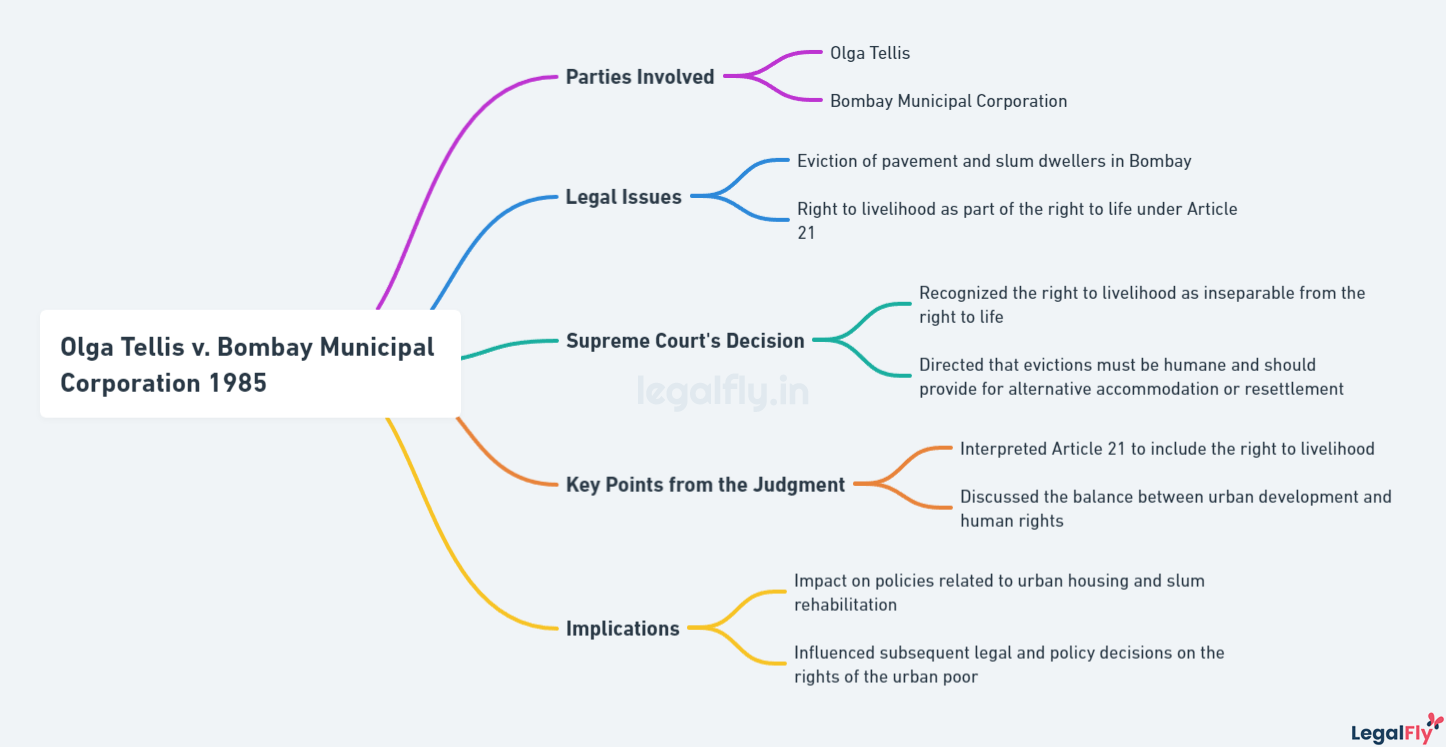
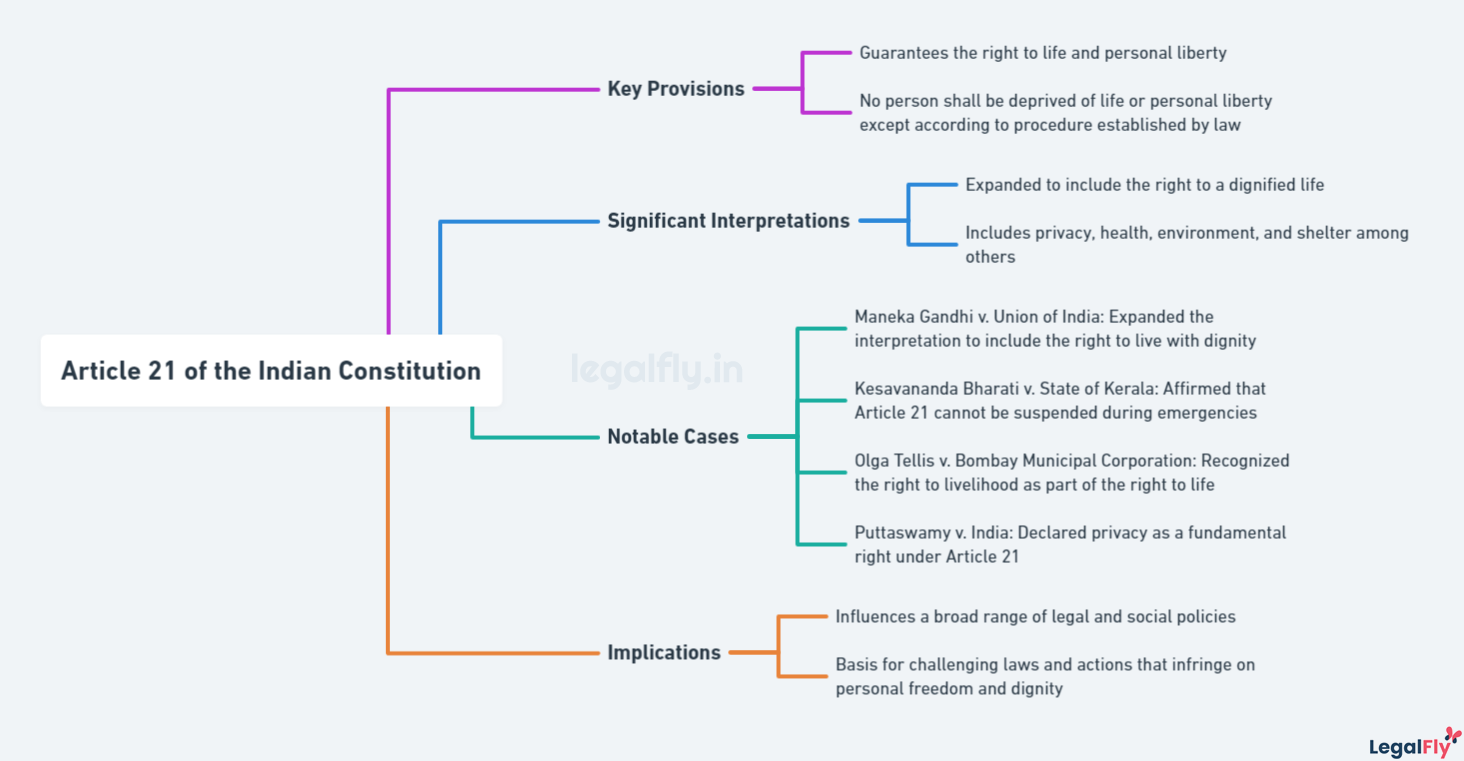
The central question was whether the right to life under Article 21 of the Indian Constitution includes the right to livelihood and shelter. The Court's answer expanded Article 21 for good — but, as we'll see, the dwellers themselves did not win the relief they sought.
Background of Olga Tellis v. Bombay Municipal Corporation
In 1981, the State of Maharashtra and the Bombay Municipal Corporation decided to evict pavement and slum dwellers in Bombay as part of a city "beautification" drive, affecting tens of thousands of people. A public interest litigation was filed by Olga Tellis, a journalist, along with activists, on behalf of the dwellers, challenging the eviction.
Most of the pavement dwellers had migrated from rural areas in search of work and lived in makeshift dwellings close to their sources of informal employment. They argued that eviction would destroy their livelihoods and so violate their fundamental right to life under Article 21.
Key Legal Issues Presented in the Case
The case raised several constitutional questions:
- Does the right to life under Article 21 include the right to livelihood?
- Does it also include a right to shelter or housing?
- Was the power to evict under the Bombay Municipal Corporation Act — in particular Section 314, which allowed removal of encroachments without notice — constitutionally valid and fairly exercised?
- Should Articles 14 (equality), 19 (freedoms) and 21 (life) be read together when judging the dwellers' rights?
- Could the dwellers be evicted without any alternative accommodation?
The Rights of Pavement Dwellers
The petitioners argued that their dwellings and their livelihoods were inseparable. Living on the pavements gave them access to the informal work that kept them alive; forcing them to relocate far away would cut off that work. Their core submission was simple: the right to life is meaningless without the means to live, so destroying their livelihood violated Article 21.
Supreme Court's Judgement and Reasoning
A five-judge Constitution Bench, in a unanimous judgment delivered by Chief Justice Y.V. Chandrachud on 10 July 1985, accepted the central principle but reached a nuanced result.
On the principle, the Court held that the right to life under Article 21 includes the right to livelihood — "no person can live without the means of living". Any procedure that deprives a person of their livelihood must therefore be just, fair and reasonable (applying the post-Maneka Gandhi standard). Articles 19(1)(e) and 19(1)(g) reinforced this reading.
On the outcome, however, the dwellers largely lost. The Court upheld the Municipality's power to remove encroachments from public pavements and footpaths, holding that pavements are meant for passage and that the power to evict was not unconstitutional — provided it was exercised fairly. This is the famous paradox of Olga Tellis: a soaring statement of rights coupled with a decision that allowed the evictions to go ahead.
The Court tempered this with directions for humane treatment: dwellers who had been recorded in the 1976 census were to be offered alternative sites, and evictions were not to be carried out until after the then-current monsoon. So the judgment is remembered far more for the principle it laid down than for the relief it granted.
Impact of the Olga Tellis Case
Despite its mixed result on the facts, the case had a lasting effect on Indian law. By reading livelihood into Article 21, it pushed governments toward more humane resettlement practices and gave the urban poor a constitutional argument against arbitrary, notice-less eviction.
More broadly, the expansive reading of Article 21 laid groundwork for later public interest litigation recognising other facets of the right to life — including the right to shelter, the right to food and the right to health. Socially, the case reframed pavement dwellers from "encroachers" into rights-holders and became a reference point for housing-rights advocacy.
Analyzing the Legal Arguments
The Court took a deliberately purposive view of Article 21, treating socio-economic survival as inseparable from the right to life. Critics have argued the reasoning leaned more on social policy than on tight legal doctrine, and that the gap between the grand principle and the actual outcome (allowing eviction) exposed the limits of judicial protection for the poor. Supporters counter that the case marked a decisive shift toward recognising socio-economic dimensions of fundamental rights and human dignity. Notably, the judgment was unanimous — there was no dissent.
The Legacy of Olga Tellis Case
Olga Tellis remains a cornerstone of Article 21 jurisprudence. Its recognition that livelihood is part of the right to life has been cited and built upon in countless later decisions on the rights of marginalised communities, and its insistence on fair procedure before deprivation of livelihood continues to shape how courts assess evictions and resettlement.
At the same time, the case is a realistic reminder that declaring a right and securing it on the ground are different things: homelessness and inadequate housing in Indian cities persist, and translating the Olga Tellis principle into reality still depends on policy and political will.
Conclusion
Olga Tellis v. Bombay Municipal Corporation (1985) established that the right to life under Article 21 includes the right to livelihood, and that no one may be deprived of it except by a fair and reasonable procedure. Its lasting contribution is this expansion of fundamental rights to embrace socio-economic survival and human dignity.
Yet the case also illustrates the limits of that protection: the Court upheld the power to evict the very pavement dwellers before it, granting only procedural safeguards. The principle endured and reshaped Indian constitutional law — even as the people who brought the case won little immediate relief.