
Case Summary: Braunfeld v. Brown 1961
In short
Six justices upheld Pennsylvania's Sunday closing law in 1961: Warren CJ (plurality, 4) + Frankfurter and Harlan JJ (concurring). The law imposed only an indirect economic burden on Orthodox Jewish Sabbatarians — it did not make religious observance unlawful. Brennan and Stewart JJ dissented. Distinguished by Sherbert (1963); largely restored by Employment Division v. Smith (1990).
In this brief
Overview
Braunfeld v. Brown, 366 U.S. 599 (1961), is the U.S. Supreme Court's principal ruling on whether a secular Sunday closing law — a so-called "blue law" — violates the Free Exercise Clause of the First Amendment when applied to business owners whose religion requires them to close on a different day. The Court upheld the Pennsylvania law, drawing a distinction between laws that directly prohibit religious conduct and laws that merely impose an indirect economic burden on religious observance. Decided alongside McGowan v. Maryland (1961), Braunfeld anchors the early Free Exercise framework, which was later modified by Sherbert v. Verner (1963) and then partly restored by Employment Division v. Smith (1990).
Key Facts at a Glance
| Aspect | Detail |
|---|---|
| Citation | 366 U.S. 599 (1961) |
| Decided | 29 May 1961 |
| Plurality (4) | Warren CJ, Black, Clark, Whittaker JJ |
| Concurred in judgment | Frankfurter J (lengthy separate opinion); Harlan J |
| Dissented | Brennan J, Stewart J (+ Douglas J) |
| Result | Sunday closing law upheld — no First Amendment violation |
| Companion case | McGowan v. Maryland, 366 U.S. 420 (1961) |
Background and Facts
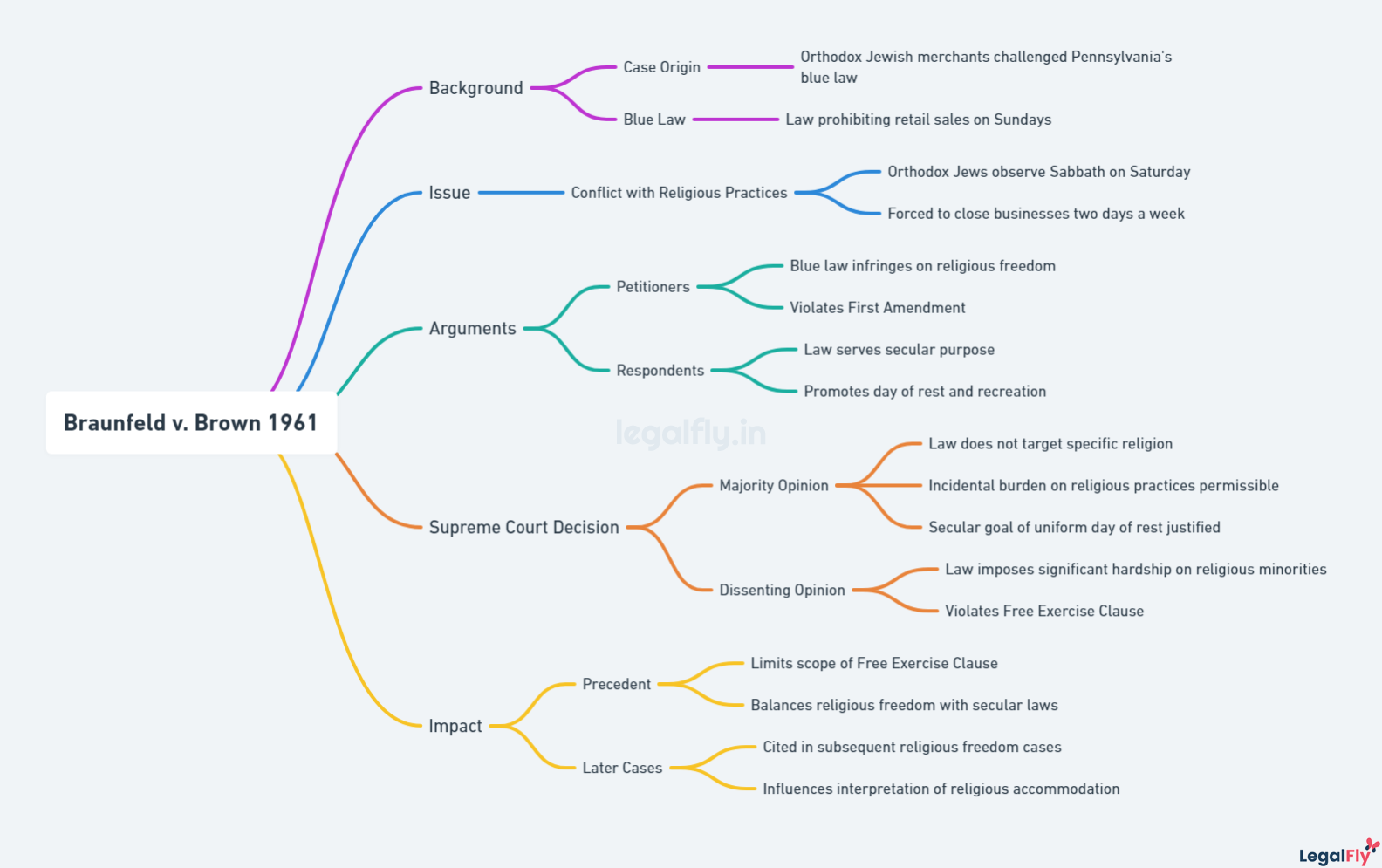
Pennsylvania's Act of 1959 required retail businesses to close on Sundays, with exceptions for certain categories of goods (food, medicine, tobacco, etc.). Abraham Braunfeld and other Orthodox Jewish merchants in Philadelphia challenged the law. As Orthodox Jews, their religion required them to close from Friday nightfall to Saturday sundown (the Sabbath). The Sunday closing law meant they could trade only five days a week, while competitors who did not observe a Saturday Sabbath could open six days. This competitive disadvantage, they argued, effectively penalised them for practising their religion.
Core Legal Issue
Does Pennsylvania's Sunday closing law violate the Free Exercise Clause of the First Amendment as applied to Orthodox Jewish business owners who also observe a Saturday Sabbath?
The Court's Decision
Warren CJ's Plurality Opinion (4 Justices)
Chief Justice Warren's plurality drew a critical distinction:
- Direct prohibition: A law that makes a religious practice itself unlawful clearly violates the Free Exercise Clause.
- Indirect burden: A law that imposes an economic disadvantage on those who observe certain religious practices does not automatically violate the Free Exercise Clause, provided it serves a legitimate secular purpose.
The Sunday law did not prohibit any religious observance — it did not forbid Braunfeld from observing his Saturday Sabbath. It merely regulated a secular activity (commerce) and made religious practice "more expensive" by reducing the number of trading days. Because the law's purpose was secular (a uniform day of rest for the general welfare) and it did not target religion, the plurality held there was no First Amendment violation.
Concurrences (Frankfurter J, Harlan J)
Frankfurter J wrote a lengthy separate opinion elaborating the historical justifications for Sunday closing laws and the state's interest in standardised leisure. Harlan J concurred more briefly in the plurality's result.
Dissenting Opinions
Brennan J dissented, arguing that the economic burden on Sabbatarians was substantial — effectively coercing them to choose between their faith and their livelihood. Even an indirect burden of this magnitude should require the state to show a compelling interest and that no less restrictive alternative was available.
Stewart J dissented separately, stating bluntly that the law made the Braunfelds' religious observance economically costly in a way that was constitutionally impermissible.
The Free Exercise Arc — Braunfeld to Smith to RFRA
Braunfeld is best understood as one point on a three-decade doctrinal arc:
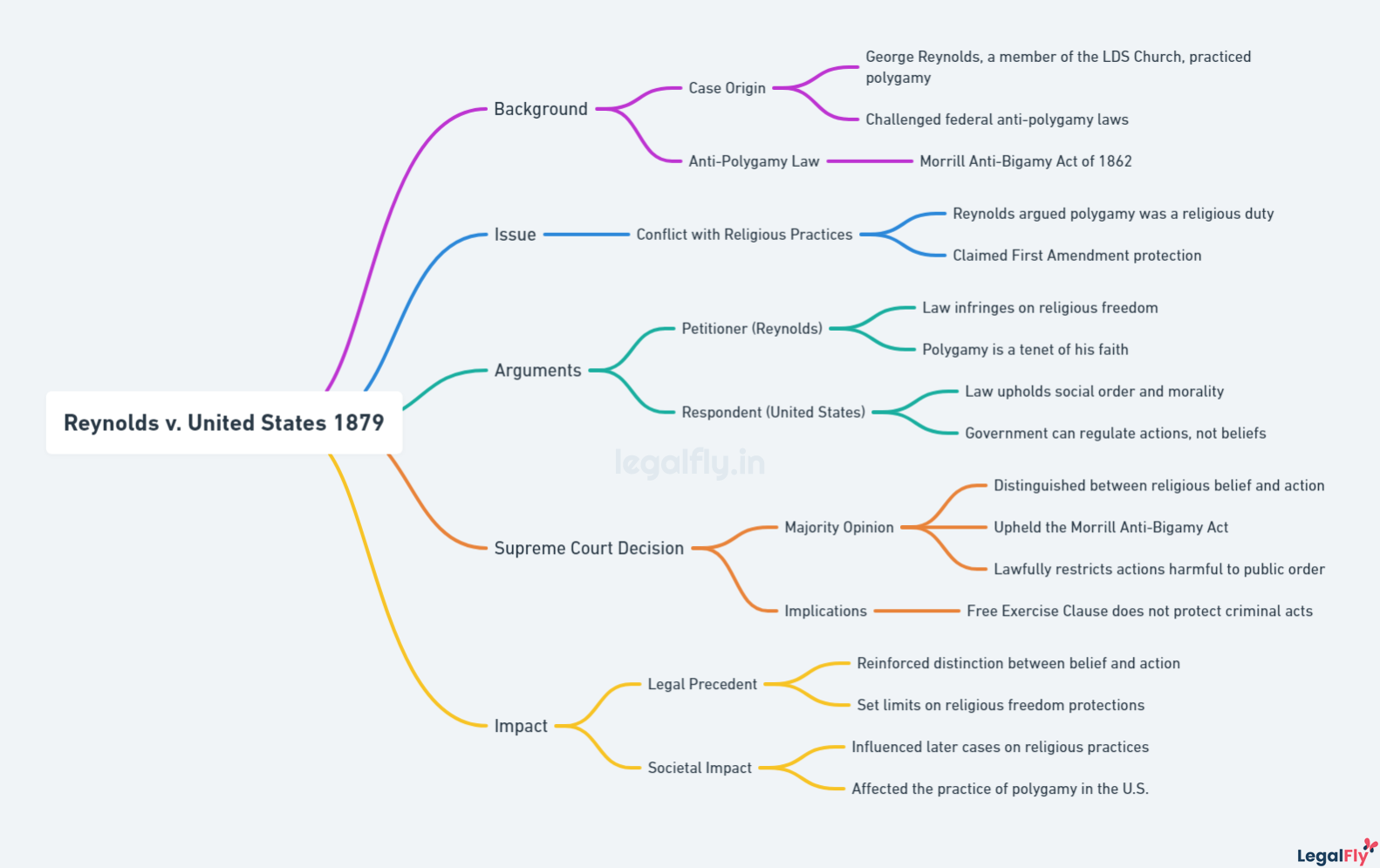
| Case | Rule | Effect on Braunfeld |
|---|---|---|
| Braunfeld v. Brown (1961) | Indirect burden on religion from a neutral law = no Free Exercise violation if a secular purpose exists | — |
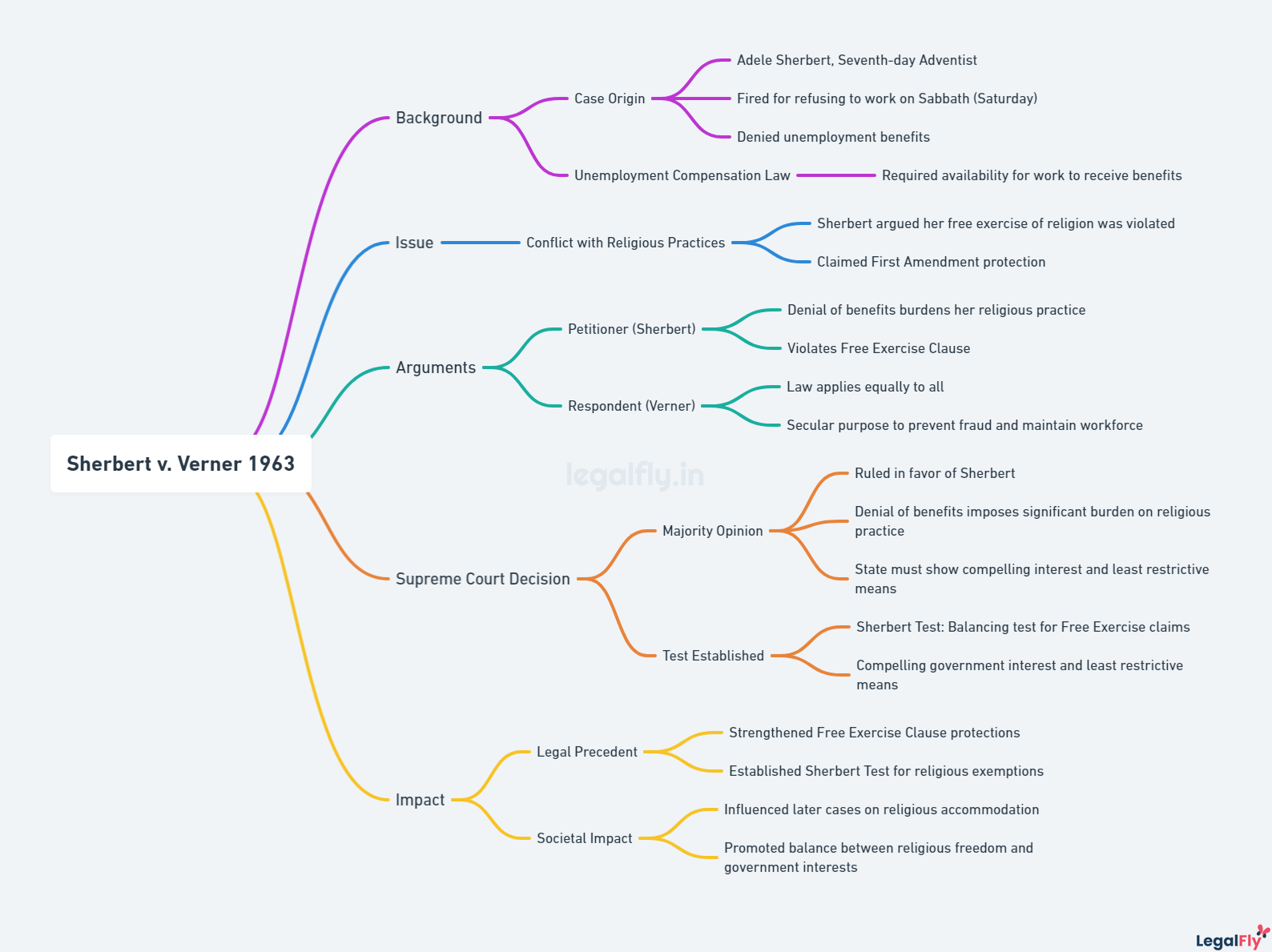
| Sherbert v. Verner (1963) 374 U.S. 398 | Laws that substantially burden religion must survive strict scrutiny — compelling state interest + least restrictive means | Narrowed Braunfeld; Sabbatarian denied unemployment benefits won |
| Wisconsin v. Yoder (1972) 406 U.S. 205 | Amish parents exempted from compulsory schooling — Sherbert applied | Sherbert extended |
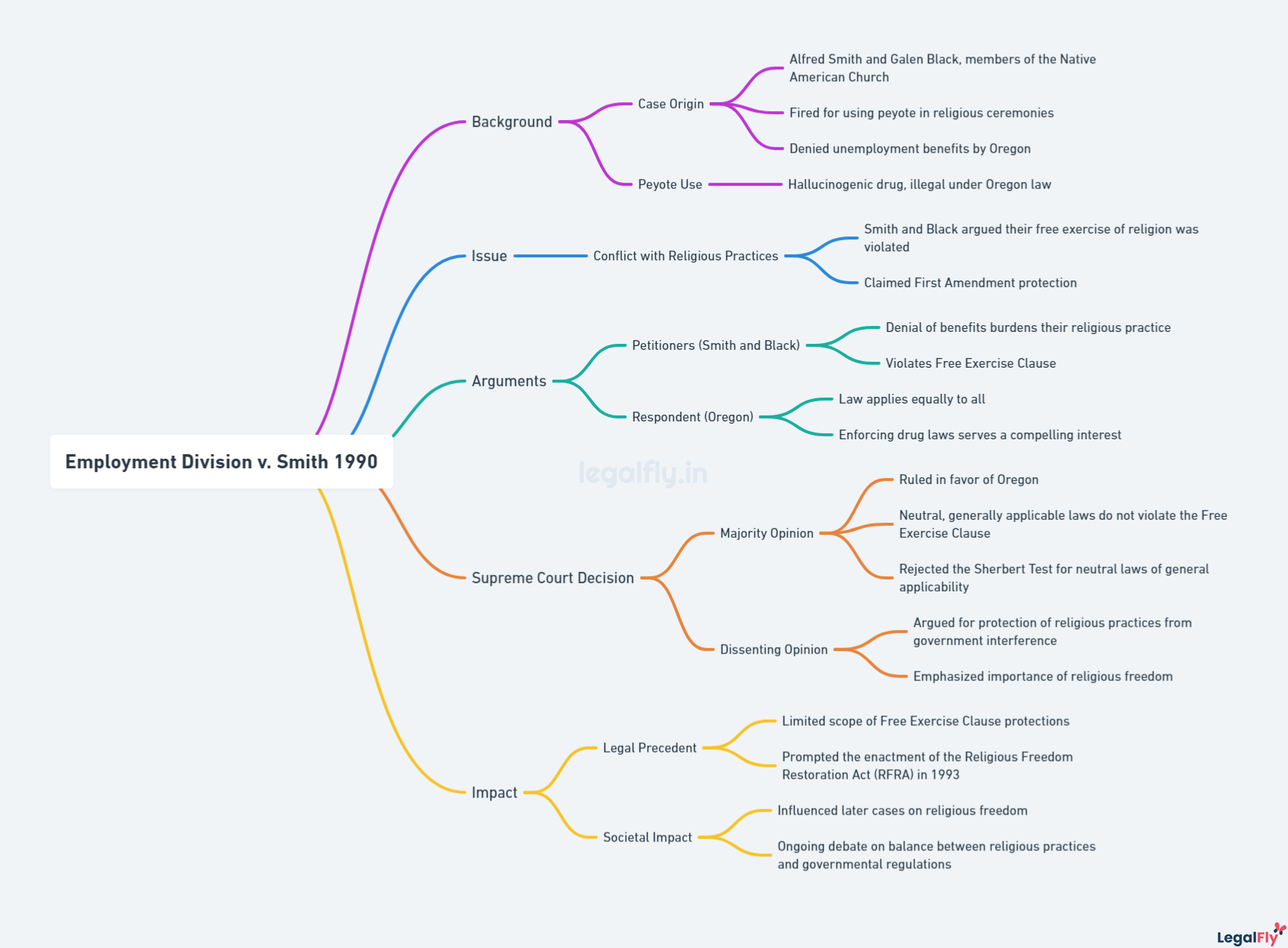
| Employment Division v. Smith (1990) 494 U.S. 872 | Neutral, generally applicable laws do not require religious exemptions — back to Braunfeld-style rule (Scalia J) | Largely restored Braunfeld''s framework |
| Religious Freedom Restoration Act (RFRA) 1993 | Congress restored strict scrutiny for federal government laws burdening religion | Statutory reversal of Smith at federal level |
| Fulton v. City of Philadelphia (2021) 593 U.S. 522 | Government cannot exclude religious organisations from generally available programs where there is discretion to grant exceptions | Narrowed Smith without overruling it |
Significance and Legacy
Braunfeld established the direct/indirect burden distinction as a threshold test for Free Exercise claims. Its lasting significance:
- It was the first case to apply the Free Exercise Clause to a facially neutral law that incidentally burdened a minority religion, setting the terms of debate that followed.
- Brennan J's dissent in Braunfeld effectively became law two years later in Sherbert — demonstrating the case's doctrinal catalytic role.
- After Employment Division v. Smith (1990), Braunfeld's framework governs again for generally applicable laws without individualized exemptions: no strict scrutiny is required for neutral laws that impose only indirect burdens on religion.
- The decline of actual blue laws (most repealed by 2000s) has made Braunfeld less practically significant, but it remains essential reading for understanding the Free Exercise Clause's analytical framework.
Conclusion
Braunfeld v. Brown (366 U.S. 599, 1961) held that a secular Sunday closing law does not violate the Free Exercise Clause merely because it imposes an indirect economic burden on religious minorities who observe a different Sabbath. Warren CJ's plurality drew a constitutional line between laws that directly prohibit religious practice (clearly unconstitutional) and laws that incidentally make religious observance more costly (not automatically unconstitutional). That line — contested in Brennan J's dissent, widened in Sherbert, narrowed again in Smith, and refined further by RFRA and Fulton — continues to define how U.S. courts analyse Free Exercise claims against neutral, generally applicable laws.