Case Summary: Embry v. Hargadine, McKittrick Dry Goods Co.
In short
Embry, employed for one year at $2,000 under a written contract expiring 15 December 1903, pressed his employer's president McKittrick for a renewal and threatened to quit; McKittrick replied, "Go ahead, you're all right; get your men out, and don't let that worry you." About two months later Embry was fired and sued for the year's salary. The trial court told the jury there was a contract only if BOTH men intended one, and the jury found for the company. The Missouri Court of Appeals reversed and remanded: under the objective theory of contracts, if McKittrick's words would lead a reasonable person to believe a contract was made, a contract was formed — his secret intent was irrelevant.
In this brief
Introduction to Embry v. Hargadine, McKittrick Dry Goods Co.
Embry v. Hargadine, McKittrick Dry Goods Co. (1907) is a classic American contract-law decision and a staple of first-year casebooks. The Missouri Court of Appeals used a brief, anxious exchange between an employee and his boss to lay down the objective theory of contracts: what matters is not the secret intention in a party's head, but the meaning a reasonable person would take from his words and conduct.
| Element | Detail |
|---|---|
| Case | Embry v. Hargadine, McKittrick Dry Goods Co. |
| Citation | 127 Mo. App. 383; 105 S.W. 777 (1907) |
| Court | Missouri Court of Appeals |
| Result | Trial verdict for the employer reversed; remanded for a new trial |
| Principle | Objective theory of contracts — outward expression controls over unexpressed intent |
Key Facts of the Case
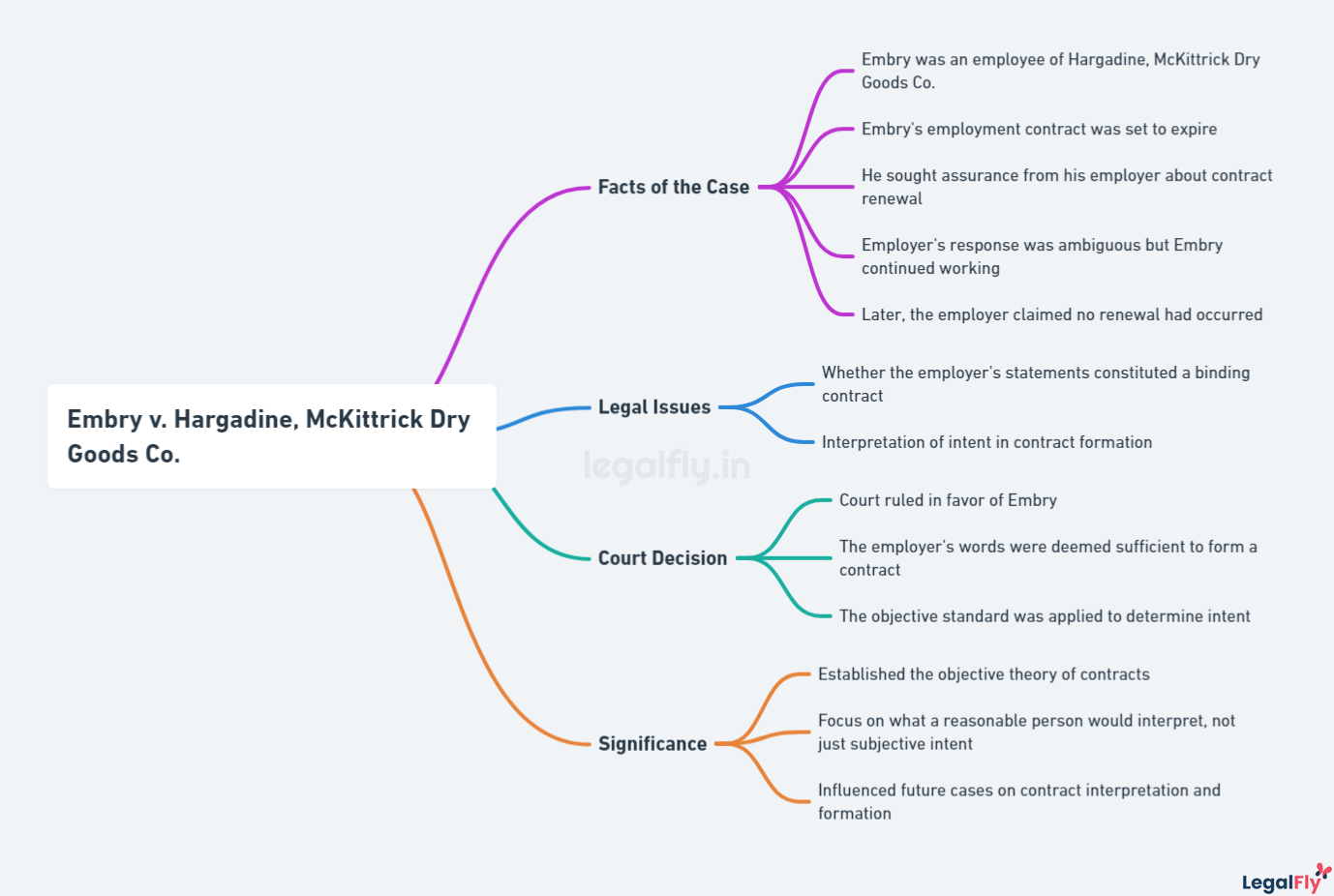
Embry worked for the Hargadine, McKittrick Dry Goods Company under a written one-year contract, at a salary of $2,000 a year, which expired on 15 December 1903. As that date approached he repeatedly pressed the company's president, Thomas McKittrick, to renew his employment for another year.
On Embry's account, he finally told McKittrick that unless he was given a contract for the coming year he would quit at once. McKittrick replied: "Go ahead, you're all right; get your men out, and don't let that worry you." Embry took this as a renewal and kept working. About two months later, the company discharged him. He sued for the balance of a year's salary, claiming the conversation had created a binding one-year contract.
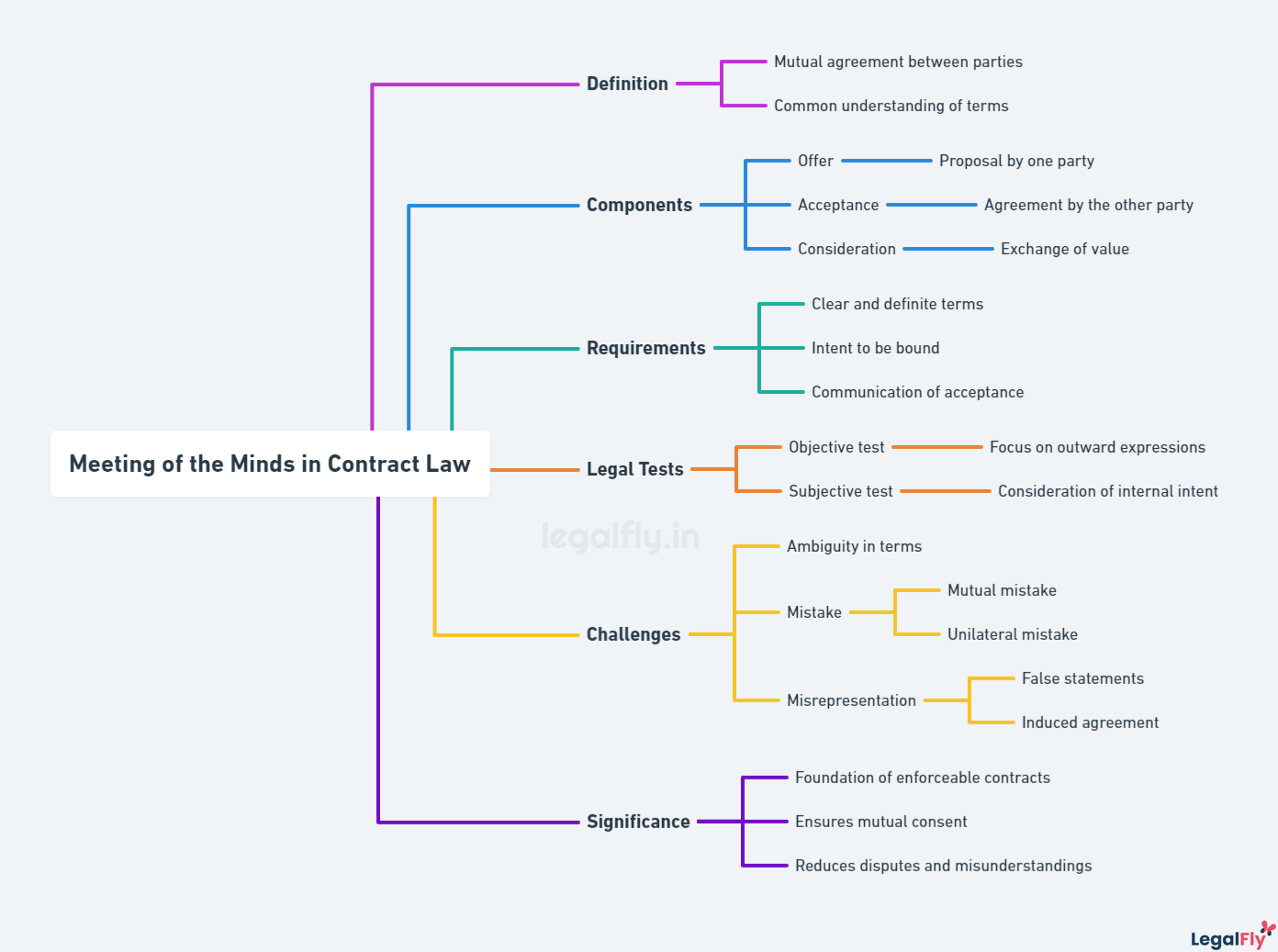
The company denied any new contract: McKittrick said he had been busy, did not recall the precise words, and certainly did not intend to commit the company to another year. The dispute thus turned on whether his words, however he meant them, amounted in law to an offer Embry could accept.
Legal Issue
The single decisive question was whether a contract is judged by the parties' subjective intentions or their objective expressions. If a contract requires that both parties actually, inwardly intend to be bound, McKittrick's denial might defeat the claim. If instead it is enough that his words would reasonably be understood as a commitment, a contract could exist regardless of what he privately intended.
The Court's Decision and Rationale
At trial, the judge had instructed the jury that there was a contract only if both Embry and McKittrick had intended, by their conversation, to make one — a subjective test. On that instruction the jury found for the employer.
The Missouri Court of Appeals (per Goode J.) held that instruction was wrong and reversed, remanding for a new trial. The correct rule, it said, is objective: if McKittrick's words and conduct, taken reasonably, signified a renewal, a contract was formed even if he secretly intended otherwise. In the court's words, "the law imputes to a person an intention corresponding to the reasonable meaning of his words and acts." Because a jury could find that "Go ahead, you're all right" — said to an employee who had just threatened to quit unless re-engaged — reasonably meant "yes, you are employed for another year," the case had to be retried under the proper standard.
It is worth being precise about the outcome: Embry did not walk away with a damages award. He won a new trial under the correct, objective test — the chance to have a jury decide whether a reasonable person would have understood McKittrick's words as an offer.
Implications of the Judgment
Embry is one of the cases that cemented the objective theory as the bedrock of Anglo-American contract formation. Its lessons:
- Outward expression governs. A party cannot escape a deal by later claiming a private, unspoken intention not to be bound.
- Casual words can bind. Even informal, oral assurances can form a contract if a reasonable listener would treat them as a commitment — a particular caution for employers giving verbal reassurances.
- Certainty and fairness. By looking to what was reasonably communicated, the law protects the reasonable expectations the other party acted upon.
The Objective Standard in Indian Law
Indian contract law reaches the same place. Section 13 of the Indian Contract Act, 1872 defines consent as two or more persons agreeing "upon the same thing in the same sense" (consensus ad idem), and Indian courts assess assent objectively — by what the parties outwardly communicated, not by undisclosed reservations. So an Embry-style exchange in India would be tested the same way: did the words, reasonably understood, manifest agreement on the same terms?
Conclusion
Embry v. Hargadine endures because it captures a fundamental move in contract law: courts enforce the bargain people reasonably appear to make, not the one they may privately have had in mind. A boss's offhand "Go ahead, you're all right" was enough to send the case back for a jury to decide whether a year-long contract had been formed — a lasting reminder that, in contract, words mean what a reasonable person would take them to mean.
Related Cases
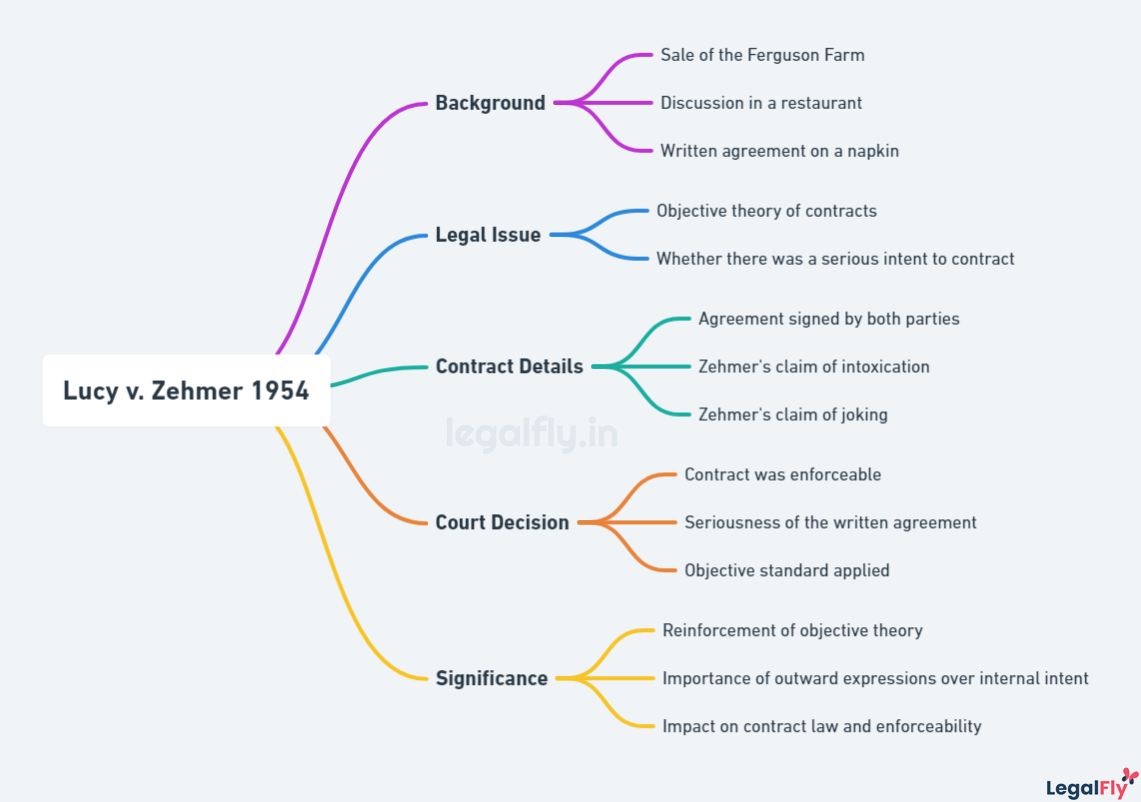
- Lucy v. Zehmer (1954) — the strongest American statement of the same rule: a contract to sell a farm, scrawled on a restaurant check, was binding because the outward acts showed agreement, whatever Zehmer claimed he "secretly" meant.
- Raffles v. Wichelhaus (1864) — the flip side: where a genuine latent ambiguity (two ships "Peerless") meant the parties were objectively at cross-purposes, no contract was formed for want of consensus.
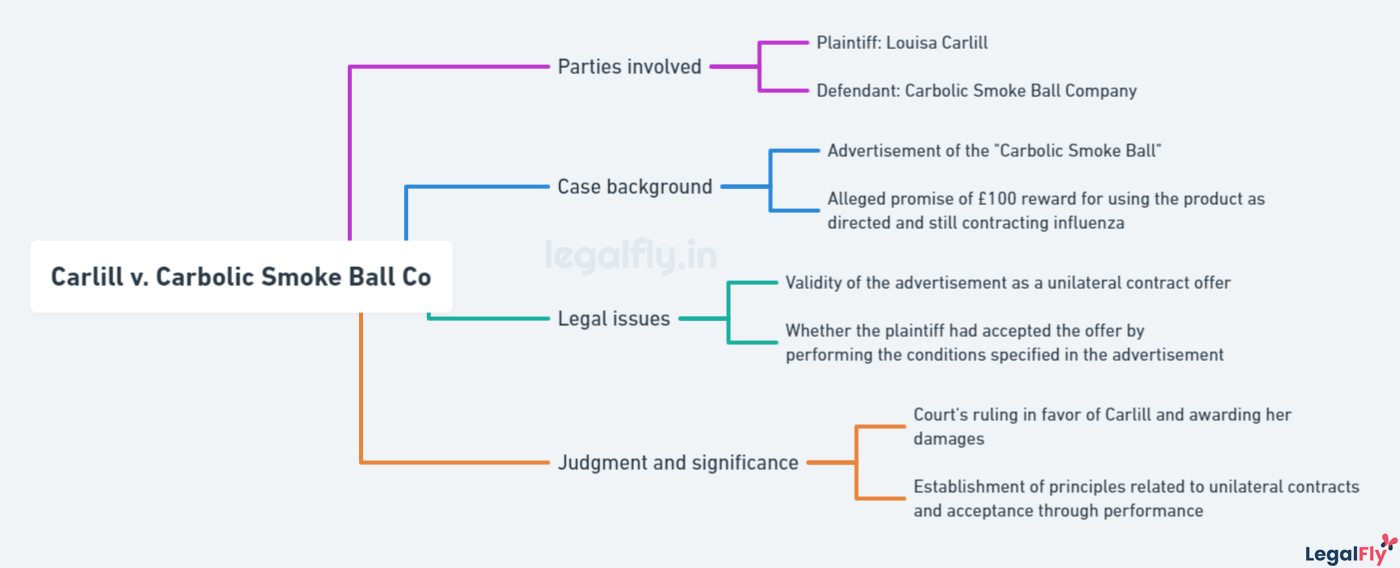
- Carlill v. Carbolic Smoke Ball Co. (1892) — an advertisement, objectively read, can be a binding unilateral offer.
- Leonard v. PepsiCo (1999) — by contrast, a jokey "Harrier jet" advertisement would not be understood by any reasonable person as a serious offer, so no contract arose.